











Best Kidney Stone Treatment: Compare Your Options
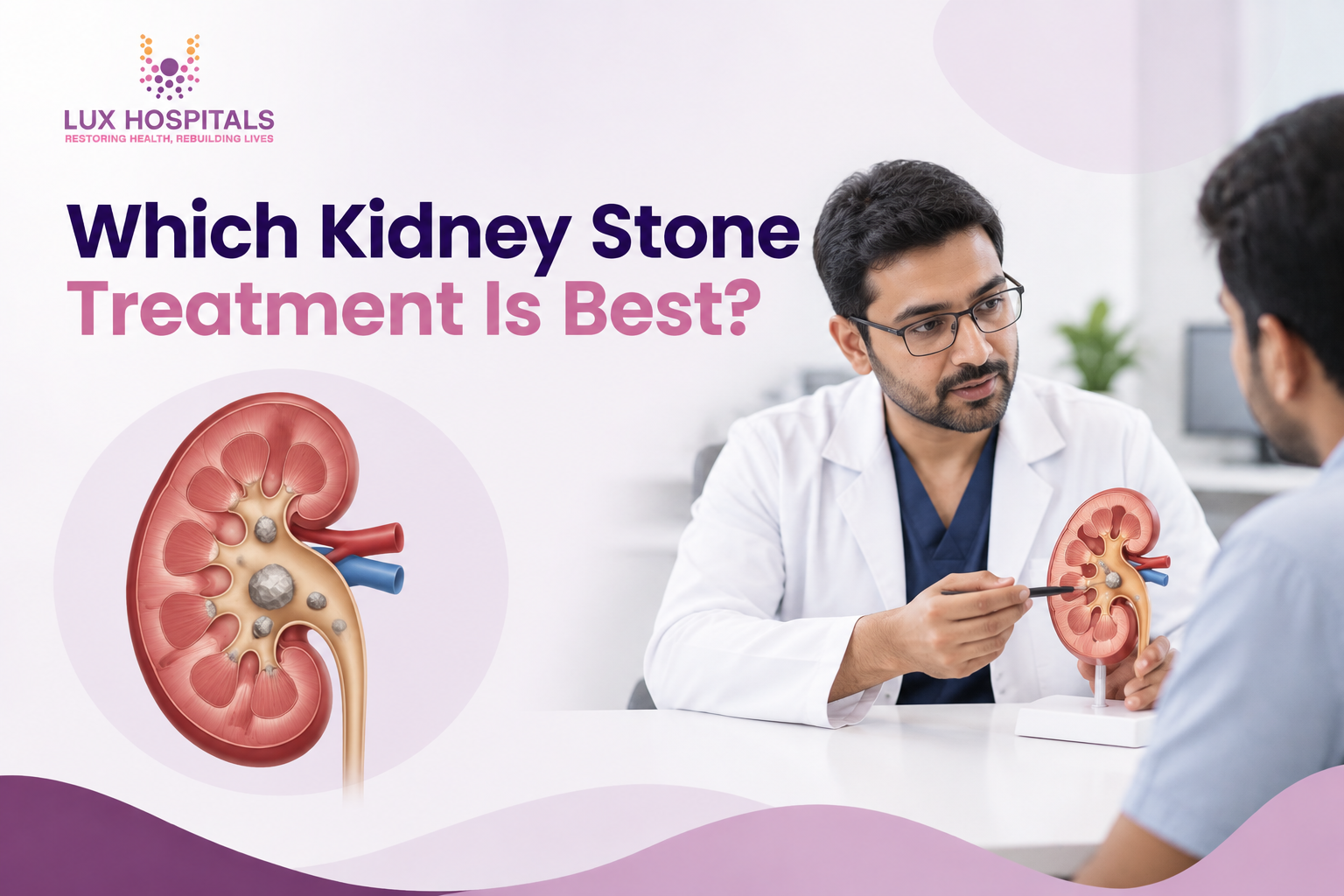
Kidney stones can cause sudden, intense pain, difficulty passing urine, nausea and blood in the urine. If a stone doesn’t pass naturally or causes obstruction, infection, or ongoing symptoms, you may need treatment. But with several options available, many patients ask: What is the Best treatment for kidney stones? The answer depends on several factors, including the stone’s size, location, number, composition, symptoms and your overall health. Doctors may recommend observation, medicines, shock wave lithotripsy (SWL), ureteroscopy, laser treatment, RIRS or percutaneous nephrolithotomy (PCNL). Current European Association of Urology guidance confirms that treatment selection should be individualized according to stone characteristics and patient factors.
Understanding the options can help you have a more informed discussion with your urologist at Lux Hospitals.
What Determines the Best Treatment for Kidney Stones?
No single procedure works best for every kidney stone. Your urologist first evaluates the stone and your symptoms before selecting a treatment.
Important factors include:
- Stone size: Larger stones are less likely to pass on their own.
- Stone location: A stone in the kidney may require a different approach from one in the ureter.
- Number of stones: Multiple stones may influence the choice of procedure.
- Stone composition: Some stones are harder to break with shock waves.
- Pain and symptoms: Persistent or severe symptoms may require active treatment.
- Urinary obstruction: Blockage can affect kidney function and may require prompt treatment.
- Infection: An obstructed kidney with infection can become a medical emergency.
Therefore, the Best treatment for kidney stones is usually the one that safely addresses your particular stone while considering recovery and future stone prevention.

How Are Kidney Stones Diagnosed?
Your doctor may recommend urine tests, blood tests and imaging such as ultrasound or a CT scan. Imaging helps identify the stone’s size and position and can guide treatment planning.
1. Medicines and Observation for Small Stones
Not every kidney stone requires immediate surgery. Some small ureteral stones can pass naturally when there are no complications such as infection, worsening kidney function or uncontrolled pain.
Physicians may advise routine follow-up and observation. Medication may help manage symptoms or help stones pass in certain patients. When active removal is not necessary, the EAU advises monitoring for suitable small ureteral stones.
When Can Observation Be Considered?
It may be considered when:
- The stone is small.
- Symptoms are manageable.
- There is no significant obstruction.
- There is no urinary infection.
- Kidney function remains stable.
- Follow-up is possible.
The Best treatment for kidney stones is not always an immediate procedure. For suitable patients, careful monitoring can avoid unnecessary intervention.
2. Shock Wave Lithotripsy (SWL)
Shock wave lithotripsy, also called ESWL, uses focused shock waves to break a kidney stone into smaller fragments. The fragments can then pass through the urinary tract. SWL is a non-invasive treatment because no instruments need to enter the urinary tract. However, its effectiveness depends on factors such as stone size, location, composition and the patient’s body habitus. Some patients may require more than one session.
When Can SWL Be Useful?
SWL may be considered for selected kidney or ureteral stones when imaging shows that the stone can be effectively targeted. However, certain hard stones, larger stones and stones in less favourable locations may respond less effectively. The EAU notes that stone density and location can influence SWL outcomes. For the right patient, SWL can be an important option when considering the Best treatment for kidney stones.
3. Ureteroscopy and Laser Stone Treatment
Ureteroscopy involves passing a thin scope through the urinary tract to reach the stone. The urologist can then remove the stone or break it into smaller pieces using a laser. Modern ureteroscopy can treat stones in different parts of the urinary tract. Flexible ureteroscopy is also used for kidney stones and is commonly referred to as RIRS when treating stones inside the kidney. Current EAU guidance recommends laser lithotripsy using technologies such as holmium or thulium fibre lasers for flexible ureteroscopy.
What Are the Advantages?
Potential advantages include:
- Direct visualisation of the stone
- Ability to fragment and remove stones during the procedure
- Usefulness for stones that may not respond well to SWL
- Application to both ureteral and selected kidney stones
- Potentially fewer repeat treatments in appropriate cases
Ureteroscopy can involve a stent after treatment in some patients. Your urologist will explain whether you need one. When choosing the Best treatment for kidney stones, ureteroscopy may be particularly useful when direct stone removal is preferred, or SWL is unsuitable.
4. RIRS for Kidney Stones
A less invasive method for treating kidney stones is called retrograde intrarenal surgery, or RIRS. The kidney is accessed by the surgeon using a flexible ureteroscope, and the stone is broken up with a laser. Depending on the situation, the surgeon may remove small fragments or leave them to pass naturally.
When Is RIRS Considered?
RIRS can be considered for selected renal stones, particularly when a flexible endoscopic approach is appropriate. It can also be useful when SWL is less suitable because of stone location or other patient-specific factors. However, larger stones may sometimes require staged procedures. The EAU notes that flexible ureteroscopy can be used when PCNL or SWL are not suitable, although follow-up procedures may sometimes be required.
For many appropriately selected patients, RIRS provides a minimally invasive route to treating kidney stones.
5. PCNL for Large Kidney Stones
Percutaneous nephrolithotomy, or PCNL, is commonly used for larger kidney stones. It involves creating a small access tract through the skin into the kidney so the stone can be broken and removed. The EAU identifies PCNL as the standard procedure for large renal calculi and recommends it as first-line treatment for renal stones larger than 2 cm.
Why Is PCNL Used for Larger Stones?
Large stones may be difficult to clear completely with SWL or a single ureteroscopy procedure. PCNL allows the surgeon to access the kidney directly and remove substantial stone material.
Doctors may consider factors such as:
- Stone size
- Stone burden
- Stone location
- Kidney anatomy
- Previous procedures
- Patient health
- Bleeding risk
PCNL is more invasive than SWL or some ureteroscopic approaches, so your urologist will weigh its potential benefits and risks before recommending it.
Best Treatment for Kidney Stones: Which Option Fits You?
The Best treatment for kidney stones depends on your individual condition.
A simple comparison can help:
Small Stones
Observation and medical management may be appropriate when the stone is likely to pass, and there are no complications.
Suitable Stones for SWL
Consider shock wave lithotripsy when the stone’s size, location, and composition are favourable.
Ureteral Stones
Ureteroscopy can directly access and remove or fragment stones and may provide a higher chance of becoming stone-free with one procedure in selected cases.
Kidney Stones Suitable for RIRS
RIRS offers a flexible endoscopic approach for selected kidney stones.
Large Kidney Stones
PCNL is generally preferred for renal stones larger than 2 cm because it can remove a substantial stone burden more effectively. The Best treatment for kidney stones therefore changes from patient to patient. Your urologist should recommend the best option after reviewing your imaging and medical history.
What Happens If a Kidney Stone Causes Infection?
Urgent care may be necessary for a blocked kidney that exhibits symptoms of a urinary infection or produces no urine. According to the EAU, a blocked kidney with infection or anuria is a urological emergency that frequently necessitates immediate draining prior to definitive stone therapy.
Seek urgent medical attention if kidney stone symptoms occur with:
- Fever or chills
- Severe or worsening pain
- Vomiting
- Difficulty passing urine
- Signs of infection
- Feeling seriously unwell
Don’t delay medical assessment if these symptoms occur.
How Can You Choose the Right Kidney Stone Treatment?
Before deciding on treatment, discuss these questions with your urologist:
- How large is my stone?
- Where exactly is it located?
- Can it pass naturally?
- Is there urinary obstruction?
- Is there an infection?
- Would SWL work for my stone?
- Would RIRS or laser treatment be suitable?
- Do I need PCNL?
- How long will recovery take?
- What can I do to reduce future stone formation?
The best approach should balance effective stone clearance, safety, recovery and your individual needs.
Why Choose Lux Hospitals for Kidney Stone Care?
At Lux Hospitals, kidney stone treatment begins with proper evaluation. A urology specialist can review your symptoms and diagnostic reports before discussing appropriate treatment options. Depending on the clinical situation, patients may be evaluated for treatments such as laser stone procedures, RIRS, ureteroscopy, SWL or PCNL. The goal is to offer a treatment plan that addresses the current issue and supports long-term urinary health, not just removing a stone.
Conclusion
Finding the Best treatment for kidney stones starts with understanding the stone and your health needs. Observation may work for selected small stones, while SWL, ureteroscopy, laser treatment, RIRS and PCNL provide different approaches for stones that require active removal. At Lux Hospitals, a specialist evaluation can help you understand your diagnosis and discuss the most suitable treatment pathway. If kidney stone symptoms are affecting your daily life, timely urological assessment can help prevent complications and guide appropriate care.
Frequently Asked Questions
Instead of a one-size-fits-all approach, the best course of action depends on the stone's size, location, composition, symptoms, and the patient's overall health. When active removal is needed, SWL, ureteroscopy, RIRS, or PCNL may be considered. Small stones may pass naturally.
While SWL uses external shock waves to break a stone into tiny pieces, laser treatment via ureteroscopy can directly fracture or remove a stone. The choice depends on stone characteristics and patient factors, and ureteroscopy can offer a better chance of becoming stone-free in selected cases with one procedure.
PCNL is generally recommended as the primary treatment for renal stones larger than 2 cm because it can effectively address a large stone burden. RIRS or SWL may be considered in selected situations when PCNL is unsuitable, although additional treatment may sometimes be necessary.
Yes, if there is no infection, major obstruction, or uncontrollable pain, some tiny stones may resolve on their own with observation and appropriate medical care. However, active therapy may be necessary for stones that grow, block urine flow, cause persistent symptoms, or are linked to infection.
Lux Hospitals evaluates factors such as stone size, location, symptoms, imaging findings and overall health before discussing suitable treatment options. A urology consultation can help determine whether observation, SWL, ureteroscopy, laser treatment, RIRS or PCNL may be appropriate for your condition.
Lux Hospitals' urology team can evaluate patients with kidney stones and discuss minimally invasive treatment options based on their individual diagnosis. After reviewing your reports, your urologist can explain whether laser-based procedures such as ureteroscopy or RIRS are appropriate.
Consult a urologist when you have persistent stone-related pain, recurrent stones, difficulty passing urine, blood in the urine or a stone identified on imaging. Fever, chills, severe pain with vomiting or reduced urine output can require urgent medical assessment because obstruction with infection can be an emergency.