



Dr. Samhitha Reddy
Consultant Proctologist & Laparoscopic Surgeon
MBBS, MS, FMAS, FISCP, DMAS
- 8 Yrs
- ASCRS Member
Benign prostatic hyperplasia is the medical name for age-related prostate enlargement. The word benign is doing real work in that phrase: this is not cancer, and it never becomes cancer.
What it does do is obstruct urine flow, and over years that strains the bladder and can affect the kidneys. Our urologists at Lux Hospitals, HITEC CITY assess how much obstruction is actually present and treat accordingly, from medication through to laser surgery.
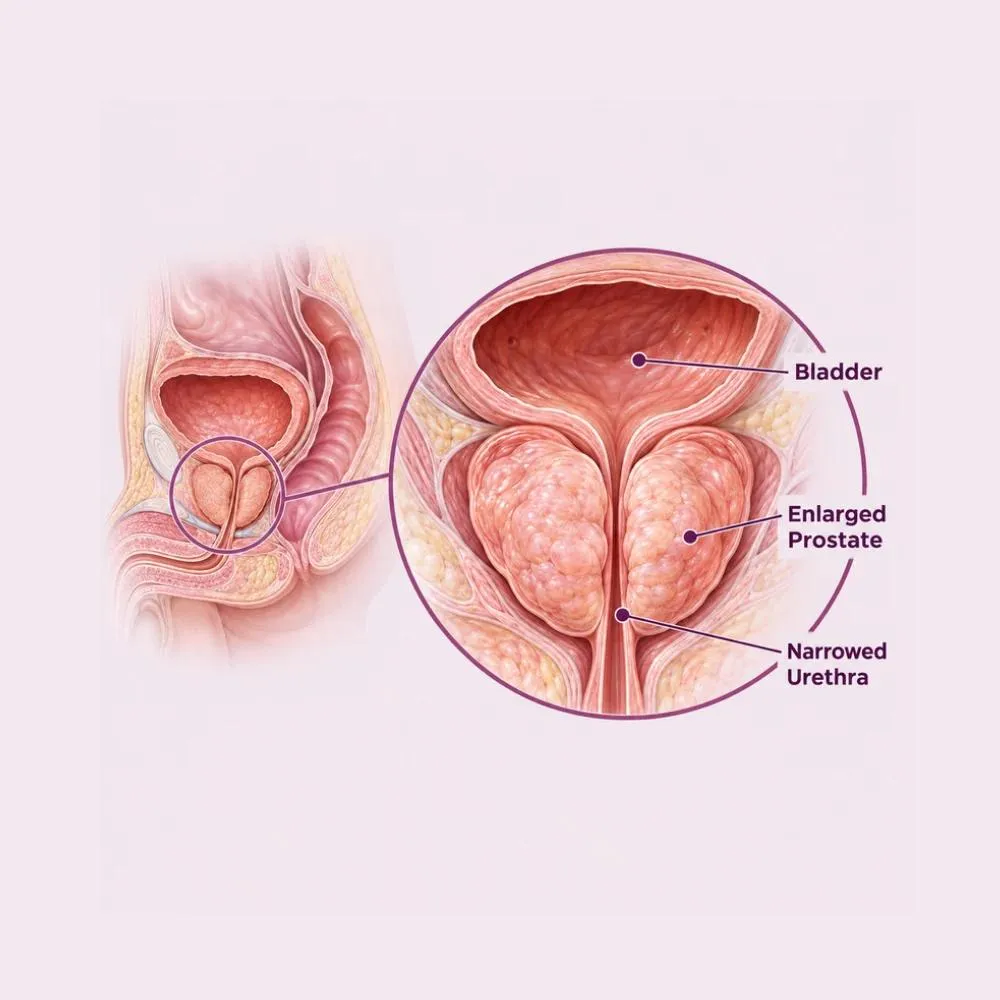
Benign prostatic hyperplasia is an increase in the number of cells in the prostate gland: hyperplasia means more cells, not abnormal ones. It begins in the transition zone, the part of the gland immediately surrounding the urethra, which is precisely why it obstructs.
The consequence is a two-stage problem. First the prostate obstructs flow; then the bladder muscle thickens as it works harder to push urine past that obstruction. Over time that thickened bladder becomes overactive and less compliant, which is why urgency and frequency often persist for a while even after the obstruction is relieved.
Left untreated over many years, BPH can cause recurrent infections, bladder stones, chronic retention and eventually kidney damage from back-pressure. These complications are uncommon and largely avoidable, but they are the reason significant obstruction is treated rather than simply tolerated.
BPH is essentially a consequence of ageing in the presence of male hormones. Several factors influence how severe it becomes.
The dominant factor. Histological BPH is present in most men by their eighties, though not all develop troublesome symptoms.
Testosterone converted to DHT within the prostate drives cell proliferation. Blocking that conversion is how 5-alpha reductase inhibitors work.
The changing ratio of testosterone to oestrogen with age appears to promote prostate growth.
A family history raises the risk and is associated with earlier onset and larger glands.
Obesity, diabetes, hypertension and raised lipids together are strongly associated with larger prostates and worse symptoms.
Sedentary men report more severe symptoms, and regular exercise measurably improves them.
Prostatic inflammation is found alongside BPH in most surgical specimens and appears to drive progression.
High intake of red meat and fat is associated with worse symptoms; vegetables and healthy fats with milder ones.
Metabolic syndrome is the most actionable of these. Weight, blood sugar and activity all influence how troublesome BPH becomes, and improving them helps symptoms directly.
Symptoms are grouped into voiding (problems getting urine out) and storage, from a bladder that has become irritable.
Voiding symptoms
Storage symptoms & complications
Storage symptoms often trouble men more than voiding ones, and they are the ones slowest to settle after treatment, because they come from a bladder that has been working against obstruction for years.
The assessment measures how much obstruction exists, excludes other causes of the same symptoms, and screens for prostate cancer.
A detailed symptom history with the standard International Prostate Symptom Score, quantifying severity and how much it bothers you.
Assesses prostate size, shape and consistency. A hard or irregular gland points toward cancer rather than benign enlargement.
Dipstick and culture to exclude infection, and microscopy for blood: both of which cause similar symptoms.
Screens for prostate cancer. Benign enlargement raises PSA too, so it is interpreted against your age and prostate size rather than a single cut-off.
Measures the strength and pattern of urine flow. A peak flow below ten millilitres per second suggests significant obstruction.
Prostate volume, post-void residual urine, bladder wall thickness and creatinine: assessing both the obstruction and its consequences.
Symptoms alone do not distinguish BPH from an overactive bladder, a urethral stricture or a neurological cause. Flow measurement and residual volume are what confirm the obstruction is genuinely prostatic.
Treatment is stepped according to symptom severity, prostate size and whether complications have developed.
Appropriate for mild symptoms that are not bothersome. BPH does not inevitably progress, and many men remain stable for years.
Limiting evening fluids, caffeine and alcohol, timed voiding, double voiding and treating constipation.
Relax smooth muscle in the prostate and bladder neck, improving flow within days. First-line for most men with moderate symptoms.
Shrink the prostate by around a quarter over six to twelve months. Best for glands above thirty grams, and they reduce the risk of retention and future surgery.
Added where storage symptoms dominate, calming an overactive bladder alongside treatment of the obstruction.
An alpha blocker with a 5-alpha reductase inhibitor, more effective than either alone for larger prostates with significant symptoms.
Laser enucleation removing the entire obstructing adenoma along its natural plane. Size-independent, durable, and with minimal bleeding.
The long-established reference operation, resecting obstructing tissue through the urethra. Highly effective for moderate-sized glands.
The obstructing tissue is vaporised, with very little bleeding. Particularly suitable for men on anticoagulants.
Implants hold the lobes apart without removing tissue, preserving ejaculation. For selected smaller prostates without a middle lobe.
Steam delivered into the prostate causes the tissue to shrink over weeks. Day case, and it preserves sexual function.
Open or robotic removal of the adenoma for very large glands, though laser enucleation has made this rarely necessary.
The newer tissue-preserving options, urethral lift and water vapour therapy, preserve ejaculation, which matters to some men considerably. They are less durable than HoLEP or TURP, and that trade-off is discussed openly.
Whether by laser or electrical resection, the procedure is performed entirely through the urethra with no external incision, over sixty to ninety minutes.
Transurethral prostate surgery
Flow rate, residual volume, prostate size, PSA and a clear urine culture. Operating through infected urine risks urosepsis.
Spinal or general anaesthesia, with spinal often preferred in older men with cardiac or respiratory disease.
The bladder and urethra are inspected first, confirming the anatomy and excluding a stricture, stone or bladder tumour.
The obstructing tissue is enucleated with a laser, resected with an electrical loop, or vaporised: depending on the technique chosen.
Fragments are removed and sent for histology, which detects incidental prostate cancer in a small proportion of cases.
Bleeding points are sealed. Laser techniques achieve this as they work, which is why they suit men on blood thinners.
A catheter with irrigation overnight, removed the next day, and home once passing urine freely: typically one to two nights.
Only the inner obstructing adenoma is removed; the outer prostate capsule stays. That is why PSA screening continues afterwards and why symptoms can, uncommonly, recur many years later.
BPH treatment should be matched to how much obstruction you actually have, not to symptoms alone. Here is why patients trust us:
Flow rate, residual volume and prostate size measured, so treatment is based on measured obstruction rather than impression.
From medication through laser enucleation to tissue-preserving options, so the recommendation fits your prostate and your priorities.
From the first consultation through to post-treatment follow-up, with one team throughout.
Our hospital is in HITEC CITY, near IKEA: easily reachable from across Hyderabad.
Flow improves immediately. Storage symptoms (urgency and frequency) take longer, because the bladder needs time to recover from years of working against obstruction.
Catheter with bladder irrigation overnight, usually removed the next morning. The stream is noticeably stronger straight away.
Home with blood-tinged urine and some burning, both expected. High fluid intake and no straining or heavy lifting.
Bleeding settles, though it may briefly return around day ten as scabs separate. Urgency gradually improves.
Normal activity and work resume. Flow rate rechecked and symptom score compared against baseline.
Storage symptoms continue improving as the bladder recovers. Full benefit is usually apparent by six months.
Keeps urine dilute and flushes the healing prostate bed, reducing clot formation and infection risk.
No heavy lifting, and treat constipation actively. Straining is the commonest trigger for post-operative bleeding.
Blood often reappears around day ten as the scab separates. It is normal, settles with rest and fluids, and is not a complication.
Storage symptoms take months to settle because the bladder has been strained for years. They do improve.
Inability to pass urine, heavy bleeding with clots, fever, or severe burning needing assessment the same day.
The outer prostate remains after surgery, so prostate cancer screening carries on exactly as before.
Retrograde ejaculation follows most BPH operations and is permanent. It does not affect erections or sensation, but it does affect fertility: worth knowing in advance rather than discovering afterwards.
Book a consultation if any of the following apply.
Medication is a modest ongoing cost. Surgery is a one-off expense that usually ends the need for daily tablets.
| Procedure | Estimated Cost |
|---|---|
| Consultation & assessment Per visit | ₹800 – ₹1,500 |
| Uroflowmetry, ultrasound & PSA Full BPH assessment | ₹3,000 – ₹7,000 |
| Alpha blocker therapy Per month, ongoing | ₹300 – ₹800 |
| Combination medical therapy Per month, ongoing | ₹800 – ₹1,800 |
| TURP Two to three nights’ stay | ₹75,000 – ₹1,40,000 |
| HoLEP or laser enucleation One to two nights’ stay | ₹1,10,000 – ₹2,20,000 |
| Water vapour therapy or urethral lift Day care; preserves ejaculation | ₹1,40,000 – ₹2,60,000 |
Very large glands take longer and are better suited to laser enucleation, which uses more expensive equipment than resection.
Resection, laser enucleation, vaporisation and tissue-preserving options differ substantially in consumables and theatre time.
Tablets are inexpensive monthly but continue for years. Over a decade, surgery frequently works out comparable and removes the daily burden.
A shared ward, a twin-sharing room or a private suite: the largest single swing in most estimates.
We are empanelled with most major insurers, and our team files the pre-authorisation for you.
Every figure above is an indicative range, not a quote. After your consultation you are given a written, fixed-cost estimate, and that is the number you pay, with no additions once treatment begins.
The urologists who treat BPH at our HITEC CITY hospital.

Consultant Urologist & Andrologist
MBBS, MS, DrNB (Urology)
10 years experience

Consultant Urologist & Andrologist
MBBS, MS, MCh (Urology)
9 years experience
Reviews from patients treated for prostate and urological conditions at Lux Hospitals, Hyderabad.
Written by Dr. Vipin Reddy B on prostate health, urinary symptoms and urological care.

Dr. Vipin Reddy B
Dr. Vipin Reddy B
Dr. Vipin Reddy B
Dr. Vipin Reddy B

Dr. Vipin Reddy B

Dr. Vipin Reddy B
Common questions about BPH, its treatment, and what surgery costs at Lux Hospitals.
Still have questions? Call us at 079 6908 4422
Still have questions? Message us on WhatsApp at 079 6908 4444
Objective assessment of prostate obstruction with stepped treatment from medication to laser surgery, and costs shared upfront.
Plot No.116, Lumbini Avenue, HITEC CITY, Near IKEA, Hyderabad – 500032













