



Dr. Samhitha Reddy
Consultant Proctologist & Laparoscopic Surgeon
MBBS, MS, FMAS, FISCP, DMAS
- 8 Yrs
- ASCRS Member
A cyst is a closed sac under the skin filled with fluid or soft material. Most are harmless and sit quietly for years, until one becomes infected, and then it becomes painful, red and impossible to ignore.
Draining a cyst relieves the immediate problem but leaves the sac behind, which is why so many come back. Our surgeons at Lux Hospitals, HITEC CITY remove the cyst complete with its wall as a day-care procedure, so it does not recur at that site.
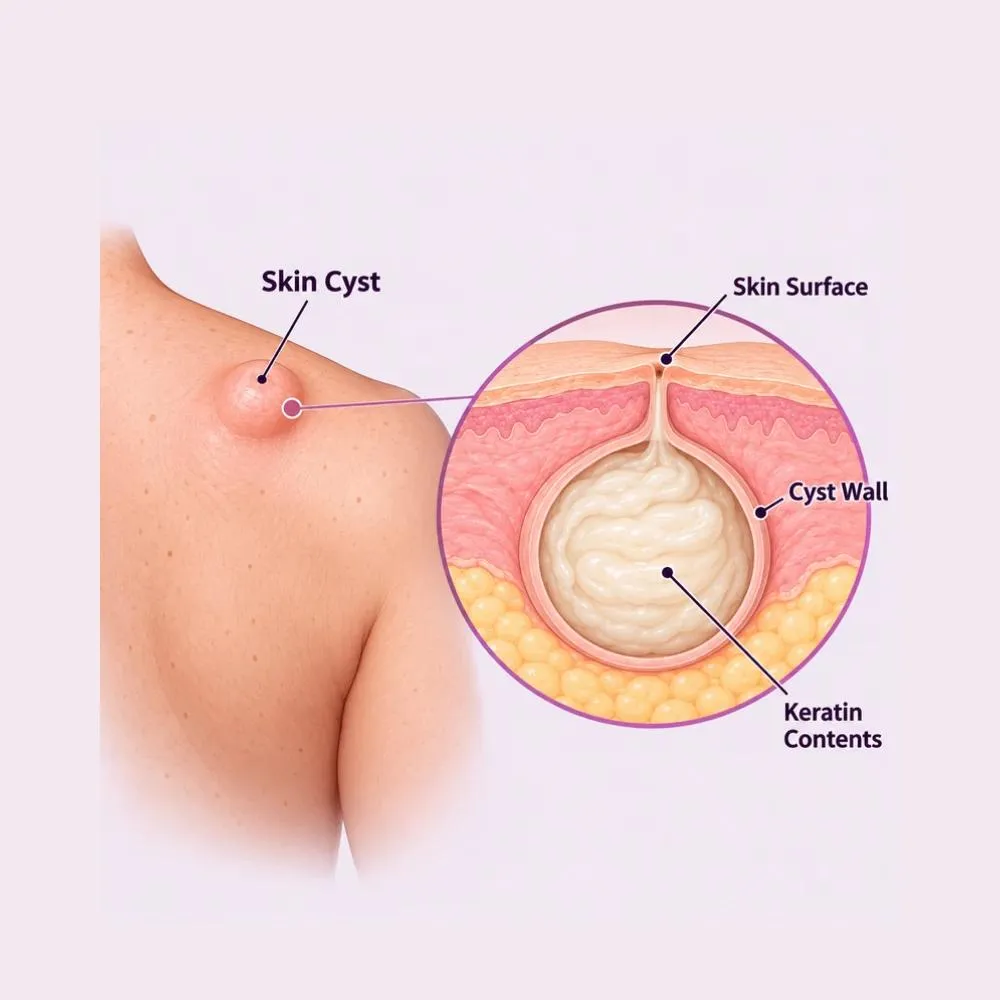
A cyst is a closed sac with a distinct wall, filled with fluid, semi-solid material or pus. Cysts can form almost anywhere (in the skin, in joints, and within internal organs) and most are entirely benign.
The common types differ by site. Sebaceous and epidermoid cysts form under the skin of the face, neck, scalp, back and torso, and are filled with keratin. Ganglion cysts appear on the wrist or hand and contain jelly-like joint fluid. Baker’s cysts sit behind the knee. Pilonidal cysts form near the tailbone. Ovarian, kidney and liver cysts develop internally and are usually found incidentally on a scan.
The important thing about a skin cyst is its wall. That wall is what produces the contents, and as long as it remains in place the cyst refills. This is why simply draining one gives temporary relief and why complete excision is what actually cures it.
Most cysts form when something that should drain is blocked, or when tissue becomes trapped where it does not belong.
The commonest cause of skin cysts. A blocked sebaceous or sweat gland continues producing, and the material accumulates behind the obstruction.
Epidermoid cysts form when surface skin cells become trapped beneath the skin and continue producing keratin inside a closed sac.
A localised infection can form a walled-off collection, and infection also converts a quiet existing cyst into a painful one.
Persistent irritation of tissue (from friction, acne or a skin condition) encourages cyst formation.
A blunt injury or a puncture can drive surface cells into deeper tissue, where they form a cyst months later.
Ganglion cysts arise when joint fluid leaks out through a weak point in the capsule, often after repetitive use.
Ovarian cysts in particular are closely tied to the menstrual cycle, and most resolve on their own within a few cycles.
Polycystic kidney disease and Gardner syndrome cause multiple cysts as part of an inherited pattern.
Nothing you did caused most cysts, and squeezing one is the reliable way to turn a painless lump into an infected, inflamed one. It is best left alone until it can be removed properly.
An uninfected cyst is usually a painless lump that has been there for a while. Infection changes the picture completely and within a day or two.
Typical features
Signs of infection
An infected cyst is usually drained first, and the sac removed later once the inflammation has settled. Trying to excise an actively infected cyst makes a clean, complete removal much harder.
A typical skin cyst is diagnosed by examination alone. Imaging is used for deeper cysts, atypical lumps and anything internal.
A smooth, mobile, well-defined lump, often with a visible central punctum, is characteristic of a sebaceous or epidermoid cyst.
Confirms the lump is fluid-filled rather than solid, shows its size and depth, and distinguishes a cyst from a lipoma or other lesion.
For deep, internal or complex cysts, and to define the anatomy before removing anything within an organ or near a joint.
The contents are sampled where infection is suspected or the nature of the fluid is unclear, and sent for culture or cytology.
Every excised cyst wall is examined under the microscope. It confirms the type and excludes anything unexpected.
Where infection is significant, or as routine pre-operative bloods before an excision under general anaesthesia.
A lump that is hard rather than smooth, fixed rather than mobile, or growing quickly gets imaged before excision. Most do not need any of this.
A small, painless cyst can simply be left alone. Where it is enlarging, recurrently infected or in an awkward place, removal of the whole sac is the only lasting answer.
Small, painless cysts causing no trouble need no treatment. Many stay unchanged for years, and some resolve on their own.
For an infected cyst with surrounding cellulitis. They settle the infection but do not remove the sac, so the cyst remains.
Reduces inflammation in a swollen but uninfected cyst, easing symptoms while definitive removal is planned.
A small cut releases pus from an infected cyst, giving immediate relief. The wall stays behind, so recurrence is likely and excision usually follows later.
Draining a ganglion or simple cyst with a sterile needle. Quick and done in clinic, though recurrence rates are high because the sac remains.
The definitive treatment. The cyst is removed intact with its entire wall, so nothing is left to refill. Usually done under local anaesthetic as day care.
The contents are expressed through a small incision and the wall then extracted, leaving a scar much shorter than the cyst was wide.
For internal cysts of the ovary, kidney or liver, removed through keyhole incisions with less pain and a faster recovery than open surgery.
An open approach for deeply embedded, very large or complex cysts, or where previous infection has left dense scarring.
The ganglion is removed along with its stalk back to the joint capsule, which is what makes excision far more durable than aspiration.
The principle is the same wherever the cyst is: remove the wall and it is gone; drain it and leave the wall, and it comes back. That is the whole difference between the two lists.
A twenty to forty minute day-care procedure for a typical skin cyst. You are awake, the area is numb, and you go home within the hour.
Excision under local anaesthetic
The cyst is examined and the incision marked along a natural skin line. Any active infection is treated and allowed to settle first.
Anaesthetic is injected around the cyst rather than into it, so the sac is not punctured and can be removed intact.
A small elliptical incision is made over the cyst, including the central punctum where one is present, leaving it behind is a route to recurrence.
The cyst is separated from surrounding tissue by careful blunt dissection, staying outside the wall so it comes out whole and unruptured.
The complete sac is delivered through the incision. If it does rupture, every fragment of wall is meticulously removed: retained wall is why cysts recur.
The cavity is closed in layers to avoid a fluid collection, and the skin closed with fine sutures placed for the best cosmetic result.
A dressing is applied and you go home within the hour, with wound care instructions and a date for the histopathology result.
Removing the cyst intact is the whole aim. A cyst that bursts during surgery can still be dealt with, but it takes considerably longer to be certain every piece of wall has been retrieved.
Cyst removal looks simple and often is, but whether it comes back depends entirely on how completely the wall was taken. Here is why patients trust us:
Consultants who remove the cyst intact with its full wall, which is what prevents recurrence at that site.
Minimally invasive techniques including laparoscopic removal for internal cysts, and minimal-excision methods for skin cysts.
From the first consultation through to post-treatment follow-up, with one team throughout.
Our hospital is in HITEC CITY, near IKEA: easily reachable from across Hyderabad.
Recovery from skin cyst removal is quick. Most patients resume normal activities within three to seven days, with the scar fading over the following months.
Home within the hour. Mild soreness as the local anaesthetic wears off, settled with simple painkillers.
Normal daily activity resumes, and most people return to desk work the next day. Keep the surgical site clean and dry.
Most patients are back to their full normal routine. Some bruising and firmness around the site is expected.
Sutures removed and the wound checked. Histopathology is discussed. Avoid strenuous activity until this point.
Full activity including the gym. The scar softens and fades progressively, continuing to improve for up to a year.
Keep the dressing intact for the first forty-eight hours, then change it as instructed. Shower rather than bathe for the first week.
Take painkillers as prescribed and complete any antibiotic course in full, particularly if the cyst had been infected.
No heavy lifting or vigorous exercise for around two weeks, especially where the cyst was over a joint or on the back.
A balanced diet with adequate protein supports tissue repair and helps the wound heal cleanly.
Fever, spreading redness, increasing pain, discharge from the wound, or the wound edges separating.
The wound is assessed and the histopathology result discussed. It is a short visit and it confirms the removal was complete.
A cyst removed with its full wall does not return at that site. New cysts can form elsewhere in people prone to them: that is a new cyst, not a recurrence, and it is treated the same way.
Removal is worth considering if any of the following apply.
Cost depends on the type, size and location of the cyst and on whether local or general anaesthesia is required.
| Procedure | Estimated Cost |
|---|---|
| Consultation & examination Per visit | ₹800 – ₹1,500 |
| Incision & drainage of infected cyst Day care, sac removed later | ₹8,000 – ₹18,000 |
| Sebaceous cyst excision Day care, including histopathology | ₹15,000 – ₹35,000 |
| Large or multiple cyst excision Day care, may need general anaesthesia | ₹35,000 – ₹70,000 |
| Ganglion cyst excision Day care, stalk removed to joint capsule | ₹30,000 – ₹60,000 |
| Laparoscopic internal cyst removal One to two nights’ stay | ₹75,000 – ₹1,60,000 |
A sebaceous cyst on the back and an ovarian cyst needing keyhole surgery are entirely different procedures.
An infected cyst usually needs draining first and excision later, which means two procedures rather than one.
Large or deeply embedded cysts take longer, may need general anaesthesia, and occasionally require layered closure.
A shared ward, a twin-sharing room or a private suite: the largest single swing in most estimates.
We are empanelled with most major insurers, and our team files the pre-authorisation for you.
Every figure above is an indicative range, not a quote. After your consultation you are given a written, fixed-cost estimate, and that is the number you pay, with no additions once treatment begins.
What patients treated here can expect:
The full wall removed, so the cyst cannot refill at that site.
Day-care surgery, with most patients back to routine in a few days.
Incisions planned along natural skin lines and closed in layers.
The general and laparoscopic surgeons who remove cysts at our HITEC CITY hospital.

Consultant General & Advanced Laparoscopic Surgeon
MBBS, MS, FMAS
17 years experience

Senior Consultant: Bariatric & Gastrointestinal Surgery
MBBS, MS, FRCS (UK), DLS (France)
28 years experience

Consultant Proctologist & Laparoscopic Surgeon
MBBS, MS, FMAS, FISCP, DMAS
8 years experience
Reviews from patients treated for cysts, lipoma and general surgery at Lux Hospitals, Hyderabad.
Written by Dr. Abhishek Katha on cysts, lumps and general surgical care.

Dr. Abhishek Katha
Dr. Abhishek Katha

Dr. Abhishek Katha

Dr. Abhishek Katha

Dr. Abhishek Katha
Dr. Abhishek Katha
Common questions about cysts, their removal, and what surgery costs at Lux Hospitals.
Still have questions? Call us at 079 6908 4422
Still have questions? Message us on WhatsApp at 079 6908 4444
Complete cyst removal so it does not come back, with a fixed-cost estimate shared before treatment begins.
Plot No.116, Lumbini Avenue, HITEC CITY, Near IKEA, Hyderabad – 500032













