Dr. Samhitha Reddy
Consultant Proctologist & Laparoscopic Surgeon
MBBS, MS, FMAS, FISCP, DMAS
- 8 Yrs
- ASCRS Member
Liposuction removes localised deposits of fat that have not responded to diet and exercise, reshaping the contour of an area rather than reducing overall body weight.
That distinction matters more than anything else on this page: liposuction is a contouring procedure, not a weight loss one. Our plastic surgeon at Lux Hospitals, HITEC CITY will tell you plainly whether it will achieve what you have in mind before recommending it.
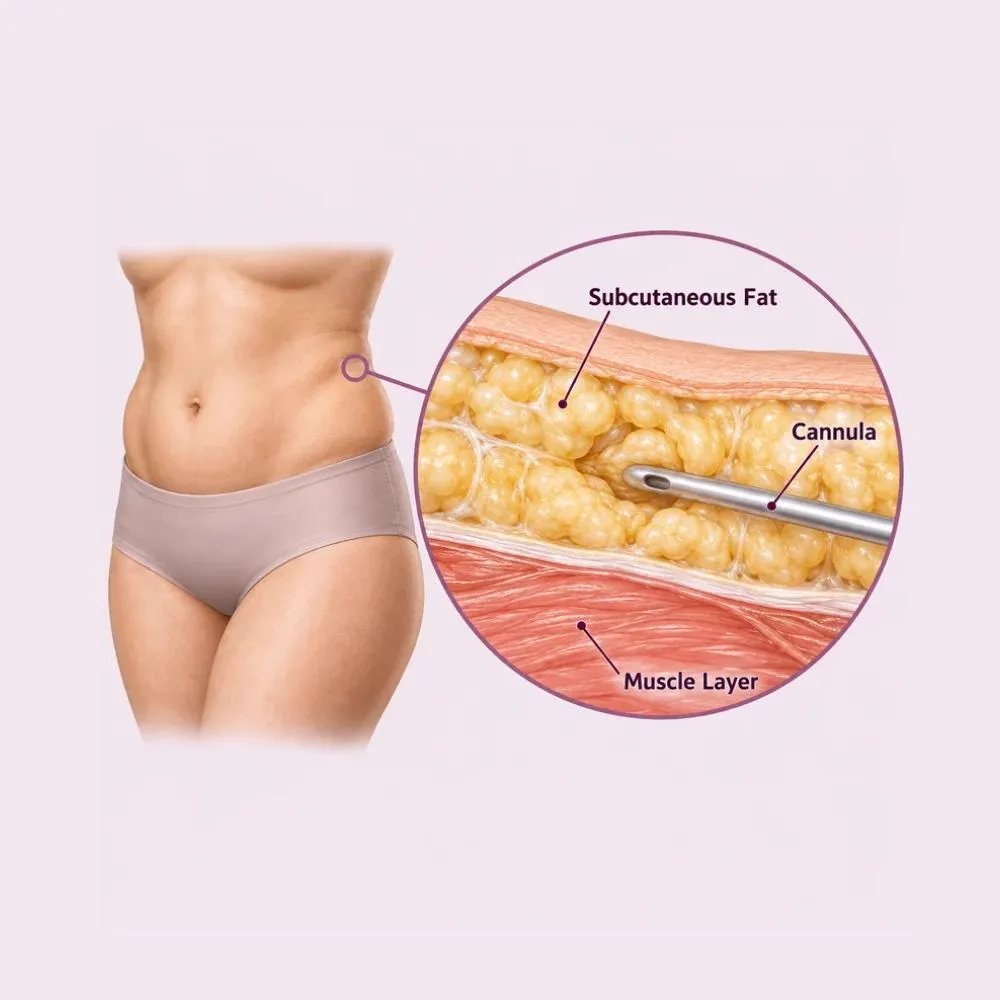
Liposuction removes subcutaneous fat, the layer sitting between skin and muscle, through fine cannulas inserted via small incisions. The fat is loosened and then suctioned away, reducing the volume of that layer and changing the contour of the area treated. Common sites are the abdomen, flanks, thighs, arms, back, chest and under the chin.
It does not remove visceral fat, the deeper fat surrounding the abdominal organs, which is what produces a firm protruding abdomen and carries the metabolic risk. Visceral fat responds to weight loss and exercise, not to surgery. This is the single commonest source of disappointed expectations, and establishing which type of fat you have is the first thing the consultation does.
It also does not tighten skin. Removing fat from beneath loose or poor-quality skin leaves that skin with less to fill it, and it may look worse rather than better. Where skin laxity is significant, after major weight loss or several pregnancies, a tummy tuck or skin excision is the appropriate procedure, sometimes alongside liposuction rather than instead of it.
Localised fat deposits persist for reasons that have little to do with effort.
The number and location of fat cells is largely genetically determined and set by early adulthood. Diet shrinks them; it does not change where they are.
Fat in the hips, thighs and flanks has more receptors that promote storage and fewer that promote release, making it genuinely harder to lose.
Oestrogen favours storage in the hips and thighs, testosterone in the abdomen. This is why the same weight loss produces different results in different people.
Metabolic rate falls and fat redistributes with age, often to the abdomen, independently of any change in diet.
Repeated cycles of gain and loss stretch the skin and alter fat distribution, frequently leaving deposits that do not respond.
Only the subcutaneous layer can be suctioned. Visceral fat around the organs responds to weight loss alone, and no surgery reaches it safely.
Fat cells removed by liposuction do not return, but the remaining cells elsewhere can still enlarge. Weight gain after surgery reappears in a different distribution rather than in the treated area, which is why maintaining your weight matters.
Liposuction works well for the right person and disappoints the wrong one. The difference is largely predictable beforehand.
Good candidates
Where it is not the right procedure
Being told liposuction is not the right procedure for you is a good outcome from a consultation, not a wasted visit. The commonest cause of an unhappy result is an operation that was never going to deliver what the patient wanted.
The consultation establishes whether liposuction will achieve what you want, and whether it is safe for you.
Assessing how much of the bulge is subcutaneous fat that can be removed, and how much is visceral fat or muscle laxity that cannot.
Testing elasticity and recoil. Poor skin quality means removing fat will leave looseness, which changes the recommendation entirely.
Weight stability, existing conditions, medications and smoking status, all of which affect safety and the quality of the result.
Full blood count, clotting profile, blood sugar, kidney and liver function, and ECG, with anaesthetic review.
Standardised photographs from fixed angles, with the areas to be treated marked and the expected change described honestly.
What the result will realistically look like, and what it will not. This conversation determines satisfaction more than the surgery does.
Ask to see unedited photographs of the surgeon’s own patients at the same site, taken at the same angles and lighting. Marketing images tell you very little about what your result will look like.
Several techniques exist. They differ in how fat is loosened before removal, rather than in the end result.
Reaching a stable weight first produces a better and more predictable result, and sometimes removes the need for surgery altogether.
It cannot reduce fat in a specific area, spot reduction is a myth, but it improves the underlying muscle contour that fat sits over.
Cryolipolysis and similar treatments achieve modest reduction in small areas without surgery, with correspondingly modest results.
Thyroid disease, PCOS and some medications affect fat distribution, and are worth addressing before any operation.
Large volumes of dilute local anaesthetic and adrenaline infiltrated first, which numbs the area and markedly reduces bleeding. The foundation of every modern technique.
A laser fibre liquefies fat before suction and produces some skin tightening through heat. Useful for smaller areas and modest skin laxity.
Ultrasound energy selectively breaks down fat while sparing nerves and vessels. Better for fibrous areas such as the male chest and back, and for definition work.
A vibrating cannula that removes fat more efficiently with less physical force, useful for larger volumes.
Harvested fat purified and reinjected to add volume elsewhere, such as the buttocks or face.
Where skin laxity is significant, liposuction alongside a tummy tuck or arm lift rather than on its own.
The technique matters less than most marketing suggests. All modern methods remove fat effectively: the difference between a good and a poor result lies in patient selection, judgement about how much to remove, and evenness of the final contour.
The operation takes one to three hours depending on how many areas are treated.
Day-care or overnight surgery under anaesthesia
Stopping smoking several weeks beforehand, adjusting blood thinners, fasting from midnight, and clot prevention arranged.
Areas marked with you standing, since fat distributes differently lying down. This map is what the surgeon works to in theatre.
Local anaesthesia with sedation for small areas, or general anaesthesia for larger or multiple sites.
Dilute anaesthetic with adrenaline infiltrated into the fat layer, numbing the area, reducing bleeding and making the fat easier to remove.
Fine cannulas passed through incisions of three to four millimetres, working in a criss-cross pattern from several directions so the result is even.
Contour checked by feel and by sitting you up during surgery, comparing sides. Judging the endpoint is where experience shows.
Incisions closed or left open to drain, and a compression garment fitted immediately: it is part of the procedure, not an accessory.
Removing too much fat causes contour irregularity and dents that are far harder to correct than leaving a little extra. A conservative, even result is the goal rather than the maximum volume removed.
Results here depend on honest assessment as much as on surgical skill. Here is why patients trust us:
Performed by a trained plastic surgeon in a full operating theatre with anaesthetic support, not in a clinic setting.
A clear account of whether liposuction will deliver what you want, including being told when a tummy tuck or weight loss is the better answer.
From the first consultation through to post-treatment follow-up, with one team throughout.
Our hospital is in HITEC CITY, near IKEA: easily reachable from across Hyderabad.
Most people return to desk work within a week. The final contour takes three to six months to settle.
Soreness like heavy bruising, with leakage of tumescent fluid from the incisions for the first day or two. Compression worn continuously.
Bruising and swelling peak then begin settling. Most people return to desk work at around one week.
Swelling reduces steadily. Light exercise resumes at two to three weeks and full activity at six. Compression continues throughout.
Most swelling has resolved and the shape becomes apparent. Firmness and lumpiness under the skin gradually soften.
Final contour settles. Skin retraction completes, and any numbness in the treated area resolves.
Continuously for the first two weeks and most of the day for six. It controls swelling and shapes the result: skipping it visibly worsens the outcome.
Swelling masks the contour for months. Assessing the outcome too early is why people worry unnecessarily about a result that is still settling.
Early gentle walking reduces clot risk substantially. Strenuous exercise waits until six weeks.
The treated area feels firm, lumpy and partly numb for weeks to months. This is normal healing and it resolves.
Removed fat cells do not return, but remaining cells elsewhere can enlarge. Significant weight gain redistributes to untreated areas.
Fever, spreading redness, a swollen painful calf or breathlessness need urgent assessment: these suggest infection or a clot.
Lymphatic massage after two weeks helps swelling settle faster and reduces firmness. It is not essential, but most patients who have it find it worthwhile.
A consultation is worthwhile if any of the following apply.
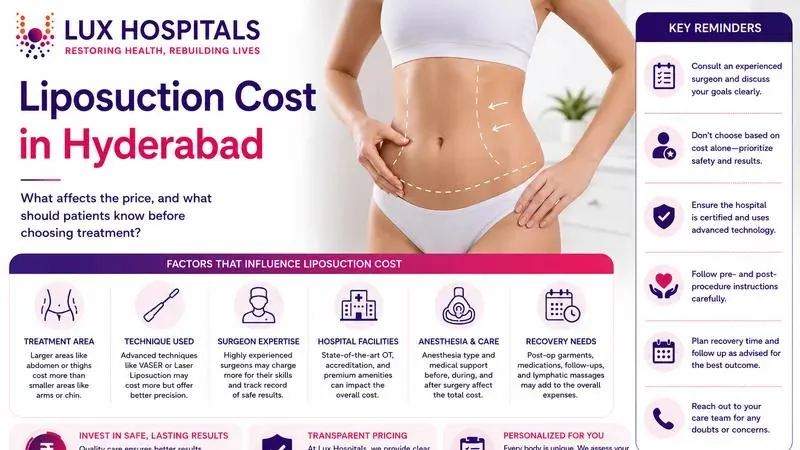
Cost depends on how many areas are treated, the volume removed and the anaesthesia required.
| Procedure | Estimated Cost |
|---|---|
| Consultation Includes assessment and photographs | ₹800 – ₹1,500 |
| Pre-operative workup Bloods, ECG, anaesthetic review | ₹4,000 – ₹9,000 |
| Single small area Chin, arms or a single flank | ₹65,000 – ₹1,20,000 |
| Single large area Abdomen or thighs | ₹1,10,000 – ₹1,90,000 |
| Multiple areas Three or more sites in one sitting | ₹1,80,000 – ₹3,50,000 |
| VASER or laser liposuction Per area; includes technology charges | ₹1,50,000 – ₹3,00,000 |
| Liposuction with fat transfer Includes harvesting and grafting | ₹2,20,000 – ₹4,00,000 |
| Compression garments Usually two, worn for six weeks | ₹3,000 – ₹8,000 |
Each additional area adds theatre time. Treating several together costs less than separate operations but more than one alone.
VASER and laser-assisted liposuction carry technology and consumable charges above standard tumescent technique.
Small areas under local anaesthesia with sedation are day care. Large-volume liposuction needs general anaesthesia and often an overnight stay.
A shared ward, a twin-sharing room or a private suite: the largest single swing in most estimates.
We are empanelled with most major insurers, and our team files the pre-authorisation for you.
Every figure above is an indicative range, not a quote. After your consultation you are given a written, fixed-cost estimate, and that is the number you pay, with no additions once treatment begins.
The plastic surgeon who performs liposuction at our HITEC CITY hospital.

Consultant Plastic & Cosmetic Surgeon
MBBS, MS, MCh (Plastic Surgery)
16 years experience
Reviews from patients treated for cosmetic and plastic surgery at Lux Hospitals, Hyderabad.
Written by Dr. M. Ram Prabhu on plastic and cosmetic surgery.
Dr. M. Ram Prabhu

Dr. M. Ram Prabhu

Dr. M. Ram Prabhu
Dr. M. Ram Prabhu
Dr. M. Ram Prabhu

Dr. M. Ram Prabhu
Common questions about liposuction, what it can achieve and what it costs at Lux Hospitals.
Still have questions? Call us at 079 6908 4422
Still have questions? Message us on WhatsApp at 079 6908 4444
An honest assessment of whether liposuction will achieve what you want, with costs shared upfront.
Plot No.116, Lumbini Avenue, HITEC CITY, Near IKEA, Hyderabad – 500032