



Dr. Samhitha Reddy
Consultant Proctologist & Laparoscopic Surgeon
MBBS, MS, FMAS, FISCP, DMAS
- 8 Yrs
- ASCRS Member
A pilonidal sinus is a small tunnel under the skin at the top of the buttock cleft, formed when loose hair works its way in and the body treats it as a foreign body. It flares, discharges, settles, and flares again.
Traditional excision leaves a large open wound that can take months to heal. Our surgeons at Lux Hospitals, HITEC CITY use laser and minimally invasive techniques instead, so the tract is destroyed through a few millimetres of skin and you are back on your feet in days.
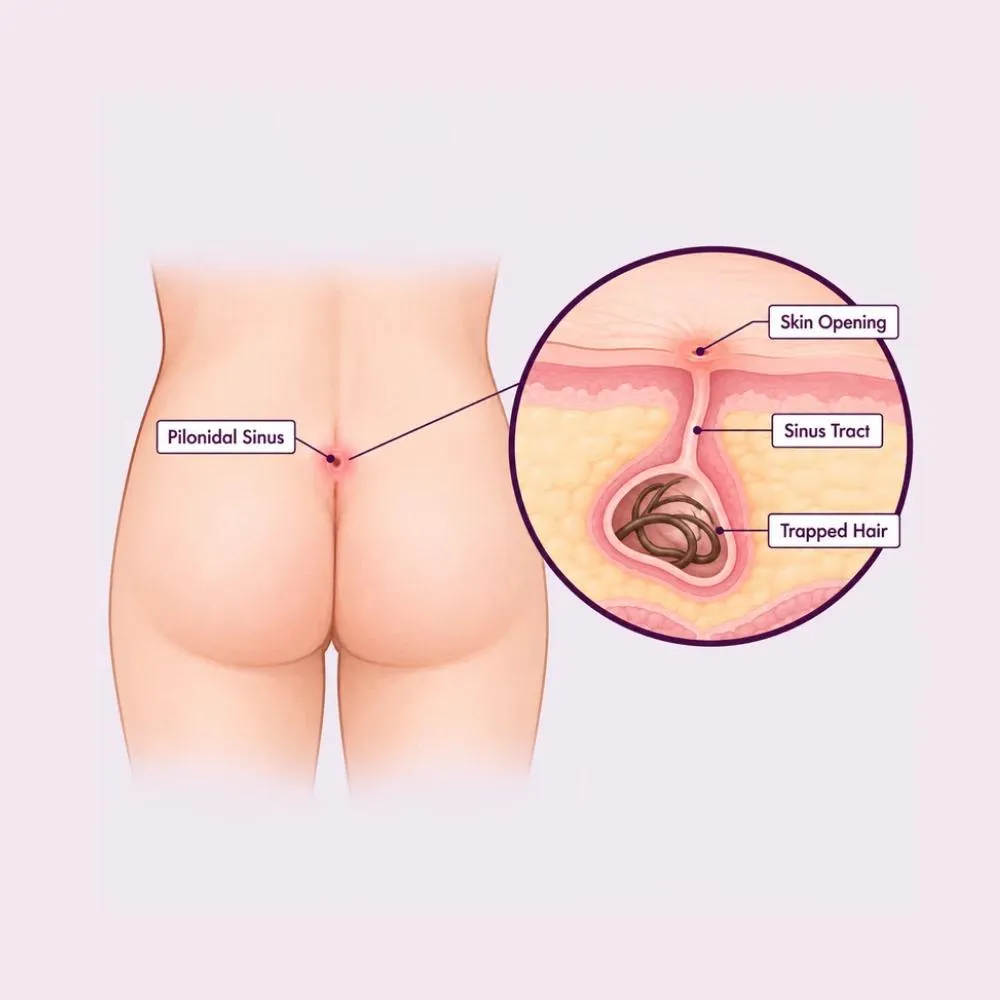
A pilonidal sinus is a small tunnel or cavity in the skin, almost always at the base of the spine in the natal cleft. It forms when loose hair and skin debris get driven into the skin, where the body walls them off as an infected pocket.
On the surface you may see nothing more than one or two tiny pits in the midline of the cleft. Beneath them sits a cavity that fills with hair, debris and pus, and which drains intermittently through those pits.
It is most common in young adults between fifteen and thirty, in men more than women, and in people who sit for long stretches: drivers, desk workers and students. Excess body hair, sweating and friction all make it more likely. It is not caused by poor hygiene, though hygiene helps once you have one.
The exact trigger is not always clear, but the mechanism is: hair gets pushed into the skin, and the skin reacts to it.
Loose hairs are driven point-first into the skin of the cleft, where the body walls them off as a foreign body.
Long hours seated (driving, desk work, study) press the cleft together and work hair inward. Hence its old name, "jeep disease".
More hair in the area means more loose hair available to be driven in, which is why it is commoner in men.
A warm, damp cleft softens the skin and lets hair penetrate more easily, and it suits the bacteria that follow.
Rubbing from tight clothing or repeated movement breaks the skin surface and opens the way in.
A deeper cleft traps more hair and stays damper, which is why some people get this and others never do.
A family history is common. Hair type, cleft depth and skin characteristics are all inherited.
Extra weight deepens the cleft and increases both friction and moisture in it.
None of this is about cleanliness. A pilonidal sinus is a mechanical problem with hair and a skin fold, not a hygiene failure.
A pilonidal sinus swings between two states: quiet and discharging, or acutely infected and extremely painful.
Chronic, low-grade symptoms
Acute infection or abscess
The quiet phase is not the sinus healing: it is the sinus waiting. Nearly every pilonidal sinus that is left alone comes back to the acute phase eventually.
Diagnosis is clinical and quick: the midline pits are close to unmistakable. Imaging is reserved for complicated or recurrent disease.
The characteristic pits in the midline of the natal cleft are usually enough to make the diagnosis on sight.
Feeling the area maps the extent of the underlying cavity and any side tracts running off from it.
A hot, fluctuant swelling means an active abscess, which needs draining first: before any definitive surgery.
Maps the depth and branching of the cavity in complex or recurrent cases, and guides how much tissue must be treated.
Occasionally used for extensive or repeatedly recurrent disease, to show the full extent before planning a flap procedure.
An anal fistula, a sebaceous cyst or hidradenitis can look similar. Position relative to the anus is what separates them.
Most patients are diagnosed at the first consultation and can be given a treatment plan the same day.
An acute abscess is drained first, whatever the eventual plan. Definitive treatment then aims to destroy the tract with as small a wound as possible: a large open excision heals slowly and is what gives this condition its reputation.
For an acute abscess, a small cut releases the pus and relieves the pain immediately. It settles the infection but does not cure the sinus.
Control spreading infection and cellulitis around the sinus. They are supportive treatment, not a cure for the tract.
Laser hair reduction over the cleft removes the raw material the sinus feeds on, and materially lowers recurrence after surgery.
A laser fibre is passed into the tract and withdrawn, destroying its lining so the cavity collapses and seals. Only the tiny pits are opened, so there is no large wound and patients are usually back to daily activity within days.
A fine endoscope goes into the cavity so the surgeon can see and clear every hair, side branch and pocket under direct vision before ablating the lining.
The midline pits are excised as tiny cores and the cavity is drained through a small lateral incision, away from the cleft where wounds heal badly.
For extensive or repeatedly recurrent disease, the sinus is excised and closed with a Limberg or Karydakis flap that flattens the cleft: the most durable option, and the one with the lowest long-term recurrence.
The traditional operation: the tract is excised and the wound left open to heal by itself. Very effective, but the wound takes six to twelve weeks of dressings, so it is now reserved for the most severe disease.
The best treatment depends on how extensive the disease is. For most first presentations seen here, laser or endoscopic treatment is the first offer, because it cures the sinus without the wound that people dread.
A thirty to forty minute day-care procedure, done through openings a few millimetres wide. No large wound, no packing, and no months of dressings.
SiLaC: laser pilonidoplasty
Routine bloods, an ultrasound where the disease is extensive, and a six-hour fasting window. Any active abscess is drained and settled first.
A short spinal or general anaesthetic, with you positioned face down. The procedure itself is painless.
The pits are opened as tiny cores and the cavity is curetted to remove every trapped hair, granulation tissue and pocket of debris. Hair left behind is the commonest reason a sinus recurs.
A radial laser fibre is passed into the cavity and drawn back at a controlled rate, delivering energy in every direction so the lining is destroyed and the walls collapse together.
Each side tract is treated in turn. An untreated branch is a sinus that will discharge again within months.
Two to four hours in day care, then home the same evening with antibiotics, painkillers and simple dressing instructions.
Because the cleft is never opened up, there is no cavity to pack and no wound to dress for weeks, which is the single biggest difference from the traditional operation.
Pilonidal disease is judged on the wound it leaves as much as on the cure. Here is why patients trust us:
Surgeons with extensive experience of complex and recurrent pilonidal disease, not just first presentations.
Laser and endoscopic treatment as the default, so the cure does not cost you months of dressings.
From the first consultation through to post-treatment follow-up, with one team throughout.
Our hospital is in HITEC CITY, near IKEA: easily reachable from across Hyderabad.
This is where minimally invasive surgery earns its keep. Laser recovery is measured in days; a traditional open wound is measured in months.
Home the same evening. Mild soreness over the tailbone, controlled with oral painkillers. Lie on your side rather than your back.
Walking and light activity encouraged. Sitting is comfortable with a cushion. Desk work is realistic from day two or three.
Some serous discharge from the treated pits is normal and settles. First follow-up review at the end of the week.
The pits close and the cavity seals. Driving, gym and normal routine resume. Laser hair reduction usually starts around now.
Final review confirming complete healing. Hair-removal sessions continue as the long-term prevention.
The single most effective thing you can do. Laser hair reduction over the cleft is what stops the sinus re-forming.
Wash daily, pat thoroughly dry, and change dressings as instructed. A damp cleft is what let the hair in originally.
Stand and walk every thirty to forty minutes for the first few weeks, and use a cushion when you must sit.
No heavy lifting or intense exercise for two to three weeks, so the healing cavity is not pulled open.
Fever, increasing pain and swelling, or discharge that restarts after it had stopped: the signs of a recurrence or an abscess.
Pilonidal disease recurs quietly. The reviews are what catch it while it is still a pit rather than an abscess.
Recurrence is the honest weakness of every pilonidal operation, and it is driven almost entirely by hair returning to the cleft. Surgery clears what is there; hair removal is what stops the next one.
Surgery is advised when any of the following apply.
Cost tracks the extent of the disease and the technique used. These are the ranges our patients fall into.
| Procedure | Estimated Cost |
|---|---|
| Incision & drainage of abscess Emergency procedure, usually day care | ₹12,000 – ₹25,000 |
| Pit picking (Bascom) Day care, same-day discharge | ₹30,000 – ₹50,000 |
| Laser pilonidoplasty (SiLaC) Day care, same-day discharge | ₹50,000 – ₹85,000 |
| Endoscopic treatment (EPSiT) Day care or one night’s stay | ₹65,000 – ₹1,00,000 |
| Excision with flap closure One to two nights’ stay | ₹70,000 – ₹1,10,000 |
A single midline pit and a branched cavity with several side tracts are different operations with different theatre times.
Recurrent disease after previous surgery is scarred and harder to clear, and more often needs a flap.
Sessions over the cleft are costed separately and are strongly advised after surgery to prevent recurrence.
A shared ward, a twin-sharing room or a private suite: the largest single swing in most estimates.
We are empanelled with most major insurers, and our team files the pre-authorisation for you.
Every figure above is an indicative range, not a quote. After your consultation you are given a written, fixed-cost estimate, and that is the number you pay, with no additions once treatment begins.
What patients treated here can expect:
Minimally invasive surgery with no large wound to dress.
No packing and no open cavity, so recovery is genuinely comfortable.
Every side branch cleared, with hair removal to prevent the next one.
The proctologists and colorectal surgeons who treat pilonidal disease at our HITEC CITY hospital.

Consultant Proctologist & Laparoscopic Surgeon
MBBS, MS, FMAS, FISCP, DMAS
8 years experience

Consultant General & Advanced Laparoscopic Surgeon
MBBS, MS, FMAS
17 years experience
Reviews from patients treated for pilonidal sinus, piles and fistulas at Lux Hospitals, Hyderabad.
Written by Dr. Samhitha Reddy on pilonidal disease, piles, fistulas and colorectal health.

Dr. Samhitha Reddy


Dr. Samhitha Reddy

Dr. Samhitha Reddy

Dr. Samhitha Reddy

Dr. Samhitha Reddy
Common questions about pilonidal sinus, its treatment, and what surgery costs at Lux Hospitals.
Still have questions? Call us at 079 6908 4422
Still have questions? Message us on WhatsApp at 079 6908 4444
Laser and minimally invasive pilonidal surgery without the months of dressings, and a fixed-cost estimate shared before treatment begins.
Plot No.116, Lumbini Avenue, HITEC CITY, Near IKEA, Hyderabad – 500032













