



Dr. Samhitha Reddy
Consultant Proctologist & Laparoscopic Surgeon
MBBS, MS, FMAS, FISCP, DMAS
- 8 Yrs
- ASCRS Member
A vaginal yeast infection causes intense itching, soreness and a thick white discharge. Around three-quarters of women have at least one in their lifetime, and for many it is straightforward to treat.
The problem is recurrence. Where infections keep returning, the answer is rarely another course of the same cream: it is confirming the diagnosis, identifying the species and finding what is driving it. Our gynaecologists at Lux Hospitals, HITEC CITY investigate rather than simply re-prescribe.
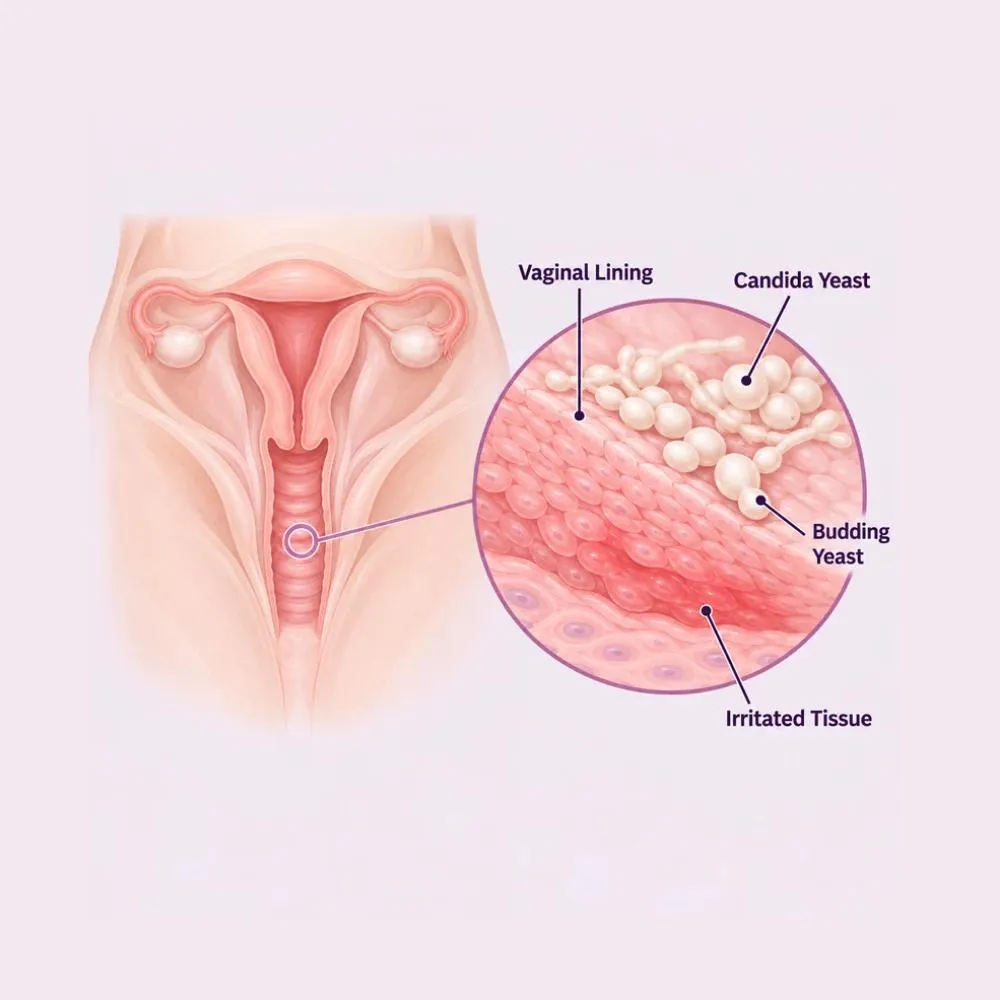
A vaginal yeast infection is an overgrowth of Candida, a fungus that lives harmlessly in the vagina of many women alongside the normal bacterial flora. The healthy vagina is acidic and dominated by lactobacilli, which keep Candida in check. When that balance is disturbed, the yeast multiplies and causes inflammation of the vaginal walls and vulva.
Candida albicans accounts for the great majority of infections and responds reliably to standard antifungal treatment. Other species (Candida glabrata in particular) cause a minority of cases but are considerably more resistant, and are a common reason treatment appears to fail. Identifying which species is involved is what separates effective treatment from repeated disappointment.
Recurrent vulvovaginal candidiasis is defined as four or more confirmed episodes in a year. It affects a meaningful minority of women and is managed quite differently from a single episode, with a longer induction course followed by months of maintenance treatment, rather than a repeated three-day cream.
Yeast infections follow anything that disturbs the vaginal balance or suppresses local immunity.
They kill the protective lactobacilli along with the target bacteria, leaving Candida free to overgrow. One of the commonest triggers.
Raised sugar in vaginal secretions feeds the yeast. Recurrent thrush in an adult should always prompt a blood sugar test: it is sometimes how diabetes is found.
Higher oestrogen increases glycogen in the vaginal lining, which favours Candida. Thrush is considerably commoner in pregnancy.
Oestrogen-containing preparations raise susceptibility through the same mechanism.
Steroids, chemotherapy, HIV and other immunosuppression all allow overgrowth that would normally be controlled.
Washes, sprays, scented soaps and bubble baths disrupt the acidic environment and the protective flora. Douching is actively harmful.
Damp, warm conditions favour yeast growth. Wet swimwear and gym clothes left on are a recognised contributor.
Candida glabrata and others respond poorly to standard treatment, and are a frequent explanation for apparently recurrent infection.
Recurrent thrush is a recognised presenting sign of undiagnosed diabetes. Anyone with four or more episodes in a year should have their blood sugar checked, regardless of whether they feel otherwise well.
Itching is the dominant symptom. The discharge is characteristically thick and, importantly, not offensive in smell.
Typical symptoms
Features suggesting something else
The absence of odour is a genuinely useful clue. Thrush discharge is thick but not smelly; a fishy odour points to bacterial vaginosis, and a frothy grey-green discharge to trichomoniasis: both treated with entirely different drugs.
A first straightforward episode is often treated on symptoms. Recurrent or resistant infection must be confirmed.
Redness, swelling and characteristic thick white discharge adherent to the vaginal walls, with the vulval skin assessed for splits.
Thrush keeps the vagina acidic, below 4.5. A raised pH points instead to bacterial vaginosis or trichomoniasis. A simple and very useful test.
Confirms yeast and, critically, identifies the species. Essential for recurrent infection, since resistant species need different drugs.
Fasting glucose and HbA1c in anyone with recurrent infection, since undiagnosed diabetes is a frequent underlying cause.
Testing for bacterial vaginosis, trichomonas, chlamydia and gonorrhoea where the picture is atypical or symptoms persist.
Where itching persists despite clear antifungal treatment, considering lichen sclerosus, eczema or contact dermatitis instead.
A substantial proportion of women who self-treat repeatedly for thrush do not actually have it. Persistent itching with negative cultures is usually a skin condition of the vulva, and antifungals will never resolve it.
A single episode is quickly treated. Recurrent infection needs a structured induction and maintenance regimen.
Clotrimazole pessary or cream for one to seven days. Effective, safe in pregnancy, and works directly where the problem is.
A single 150 mg dose. Convenient and equally effective, but avoided in pregnancy.
An emollient to soothe soreness and protect broken skin while the antifungal works.
Stopping douching and scented products, changing out of damp clothing, and reviewing recent antibiotics.
An extended induction course followed by weekly fluconazole for six months. The standard approach for four or more episodes a year.
Boric acid pessaries or nystatin for Candida glabrata and other species that resist standard azole antifungals.
Controlling diabetes, reviewing immunosuppressive medication, or changing hormonal contraception where it is contributing.
Only where the partner has symptoms: balanitis or penile irritation. Routine partner treatment does not reduce recurrence.
Emollients, and a short course of topical steroid where inflammation and eczematous change have developed from repeated irritation.
Where treatment consistently fails, reconsidering lichen sclerosus, contact dermatitis or vulvodynia as the actual cause.
Six months of weekly maintenance fluconazole sounds excessive for thrush, but it is what the evidence supports for genuinely recurrent infection, and it works where repeated short courses do not.
A single episode is resolved in a week. Recurrent infection is a six-month programme.
Outpatient assessment and antifungal treatment
History of symptoms, triggers, previous treatment and recurrence pattern, with examination of the vulva and vagina.
pH testing and, for recurrent or atypical cases, a swab for microscopy and culture to identify the species.
Blood sugar testing where infections recur, and screening for other vaginal infections where the picture does not fit.
Topical or oral antifungal, with a barrier emollient for the vulval skin while it settles.
Stopping douching and scented products, advice on clothing and washing, and reviewing contributing medication.
Induction followed by weekly fluconazole for six months, with review at three and six months.
Repeat culture, and reconsideration of the diagnosis: persistent itching with negative cultures is not thrush.
The single most useful thing many women do is stop treating themselves. Repeated over-the-counter courses without a confirmed diagnosis both delays the right treatment and irritates the vulval skin further.
Recurrent thrush is usually a diagnostic problem rather than a treatment one. Here is why patients trust us:
Culture to identify the species and exclude the conditions that mimic thrush, rather than another empirical course of cream.
Blood sugar checked, triggers addressed, and a full six-month maintenance regimen where episodes keep returning.
From the first consultation through to post-treatment follow-up, with one team throughout.
Our hospital is in HITEC CITY, near IKEA: easily reachable from across Hyderabad.
Symptoms improve within one to three days of starting treatment. Preventing recurrence takes longer.
Itching and soreness begin settling within a day or two of starting antifungal treatment.
Symptoms largely resolve. Discharge returns to normal. The full course is completed even once you feel better.
Vulval skin heals fully. Any splits or cracks close. Intercourse comfortable again.
For recurrent infection, weekly maintenance treatment continues with review at three and six months.
Treatment stopped and recurrence monitored. A proportion of women relapse and need a further course.
Douching strips the protective lactobacilli and the acidic environment, making infection considerably more likely rather than less.
Scented soaps, washes, wipes and bubble baths all irritate and disrupt the natural balance. Plain water on the vulva is sufficient.
Wet swimwear and sweaty gym clothes create exactly the warm damp conditions yeast needs. Cotton underwear helps.
Four or more episodes in a year warrants testing for diabetes, regardless of how well you otherwise feel.
Six months of weekly treatment is what actually breaks the cycle of recurrence. Stopping when symptoms settle is why it comes back.
If over-the-counter treatment has not worked, the problem is probably not thrush. Repeating it delays finding what it actually is.
Probiotics and dietary changes are widely promoted for thrush and the evidence for them is weak. What genuinely reduces recurrence is stopping douching and scented products, controlling blood sugar, and completing a proper maintenance course.
Book a consultation if any of the following apply.
A single episode costs very little. Recurrent infection costs more, mainly in testing and the longer course.
| Procedure | Estimated Cost |
|---|---|
| Consultation Includes examination | ₹800 – ₹1,500 |
| Vaginal swab and culture Identifies the species | ₹800 – ₹2,500 |
| Blood sugar testing For recurrent infection | ₹600 – ₹1,800 |
| Full vaginal infection screen Where the picture is atypical | ₹3,000 – ₹8,000 |
| Single-episode treatment Topical or oral antifungal | ₹300 – ₹1,000 |
| Six-month maintenance regimen Induction plus weekly fluconazole | ₹3,000 – ₹8,000 |
| Boric acid pessaries For resistant species | ₹1,500 – ₹4,000 |
One episode is treated for a few hundred rupees. Recurrent infection needs culture, blood sugar testing and a six-month course.
Candida albicans responds to standard treatment. Resistant species need alternative agents and longer courses.
Where diabetes is diagnosed, treating that is a separate but considerably more important cost.
A shared ward, a twin-sharing room or a private suite: the largest single swing in most estimates.
We are empanelled with most major insurers, and our team files the pre-authorisation for you.
Every figure above is an indicative range, not a quote. After your consultation you are given a written, fixed-cost estimate, and that is the number you pay, with no additions once treatment begins.
The gynaecologists who treat vaginal infections at our HITEC CITY hospital.

Consultant Gynaecologist & Advanced Laparoscopic Surgeon
MBBS, MS, FMAS
16 years experience

Consultant Obstetrician, Gynecologist & Laparoscopic Surgeon
MBBS, MS (Obstetrics & Gynaecology)
11 years experience
Reviews from women treated for gynaecological conditions at Lux Hospitals, Hyderabad.
Written by Dr. Harshita Kakarla on women’s health and gynaecological care.

Dr. Harshita Kakarla

Dr. Harshita Kakarla

Dr. Harshita Kakarla

Dr. Harshita Kakarla

Dr. Harshita Kakarla

Dr. Harshita Kakarla
Common questions about vaginal thrush, recurrent infection and what treatment costs at Lux Hospitals.
Still have questions? Call us at 079 6908 4422
Still have questions? Message us on WhatsApp at 079 6908 4444
A confirmed diagnosis and proper treatment for thrush, including a maintenance plan where infections keep returning.
Plot No.116, Lumbini Avenue, HITEC CITY, Near IKEA, Hyderabad – 500032













