



Dr. Samhitha Reddy
Consultant Proctologist & Laparoscopic Surgeon
MBBS, MS, FMAS, FISCP, DMAS
- 8 Yrs
- ASCRS Member
A pancreatic neoplasm is any abnormal growth in the pancreas, and the term covers a very wide range, from entirely harmless cysts through to aggressive cancer. What matters first is establishing which one you have.
Pancreatic cystic lesions in particular are found increasingly often on scans done for other reasons, and many need only monitoring. Our pancreatic team at Lux Hospitals, HITEC CITY characterises them accurately with endoscopic ultrasound and MRI, and operates on the ones that genuinely need it.
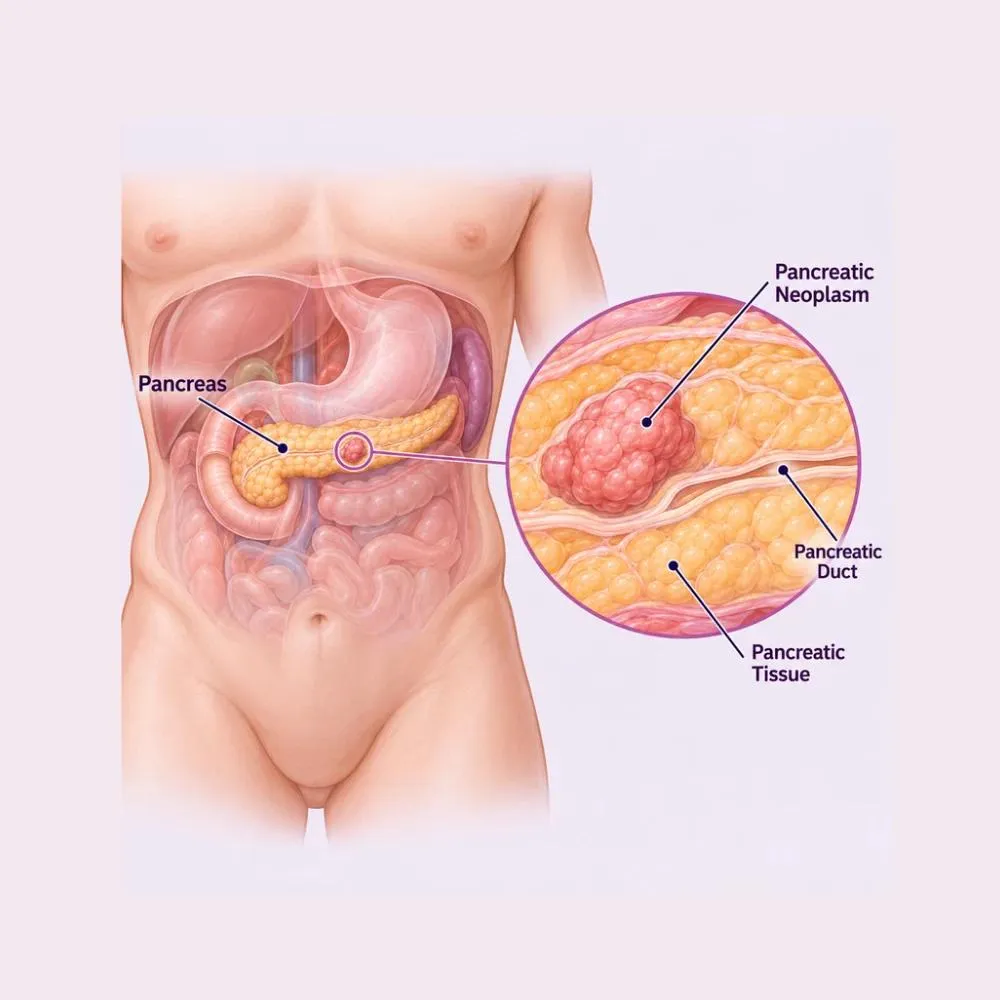
A pancreatic neoplasm is an abnormal growth arising in the pancreas. They divide into solid and cystic tumours, and the distinction carries very different implications.
Among solid tumours, pancreatic ductal adenocarcinoma is the commonest and the most serious. Neuroendocrine tumours are far less common and generally behave much more indolently: insulinoma is the commonest functioning type, producing insulin and causing hypoglycaemia. Solid pseudopapillary tumours occur in young women and are usually curable with surgery.
Cystic neoplasms are increasingly found incidentally on scans. Serous cystadenomas are benign and almost never need surgery. Mucinous cystic neoplasms and intraductal papillary mucinous neoplasms carry a real risk of malignant change, and the decision to operate on them rests on specific features (size, duct involvement, solid components) rather than on their mere presence.
Risk factors for pancreatic cancer are well established. Cystic neoplasms, by contrast, largely arise without an identifiable cause.
The strongest modifiable risk factor, roughly doubling the risk of pancreatic cancer with a clear dose relationship.
Long-standing inflammation substantially raises the risk, particularly in hereditary and tropical calcific forms.
Long-standing diabetes is a modest risk factor. New-onset diabetes after fifty can also be an early consequence of an undiagnosed tumour.
Two or more affected first-degree relatives indicates familial pancreatic cancer and warrants a surveillance programme.
BRCA2, Lynch syndrome, Peutz-Jeghers and familial atypical mole melanoma syndrome all carry increased pancreatic cancer risk.
Obesity raises risk, as do diets high in red and processed meat and low in fruit and vegetables.
Most pancreatic cancers occur after sixty, though neuroendocrine and solid pseudopapillary tumours present considerably younger.
Acts mainly through causing chronic pancreatitis rather than as a direct independent risk.
A cystic lesion found incidentally on a scan is usually not related to any of these. Most are benign, and the task is characterising them accurately rather than assuming the worst.
Many pancreatic lesions cause no symptoms at all and are found incidentally. When symptoms occur, they depend heavily on where in the pancreas the tumour sits.
Common symptoms
Symptoms of specific tumour types
Painless jaundice in an adult is pancreatic cancer until proved otherwise, and needs urgent investigation. So does new diabetes appearing after fifty with no family history or weight gain to explain it.
Accurate characterisation is everything here: it separates a lesion needing lifelong monitoring from one needing major surgery.
A dedicated contrast CT that assesses the tumour, its relationship to major vessels, and whether it is surgically removable.
The best test for cystic lesions. It shows internal structure and whether the cyst communicates with the pancreatic duct: the key feature in classifying IPMNs.
The most accurate test for small lesions, allowing tissue sampling and analysis of cyst fluid for CEA and amylase, which distinguishes cyst types.
CA 19-9 and chromogranin A for neuroendocrine tumours, useful as a baseline and for monitoring response rather than for diagnosis.
Gallium-DOTATATE PET for neuroendocrine tumours, and FDG-PET for staging adenocarcinoma in selected cases.
Insulin, gastrin and other hormone levels where a functioning neuroendocrine tumour is suspected from the symptom pattern.
Cyst fluid analysis at endoscopic ultrasound is often what settles the diagnosis. High CEA indicates a mucinous cyst with malignant potential; low CEA with high amylase suggests a pseudocyst, and those need entirely different management.
Treatment ranges from simple surveillance through to major pancreatic surgery, and the right answer depends entirely on the type of lesion.
For low-risk cystic neoplasms, periodic MRI or endoscopic ultrasound. Many patients need nothing more than this for years.
Chemotherapy before surgery for borderline resectable adenocarcinoma, to shrink the tumour away from major vessels.
For advanced disease, to control the tumour, relieve symptoms and extend life.
For neuroendocrine tumours, controlling hormone-related symptoms and slowing tumour growth.
An endoscopic stent to relieve jaundice, either before surgery or as a palliative measure.
Pancreaticoduodenectomy: removal of the pancreatic head, duodenum, gallbladder and bile duct, with reconstruction. The operation for tumours of the pancreatic head.
Removal of the body and tail of the pancreas, often with the spleen. Frequently done laparoscopically, with a much shorter recovery than a Whipple.
Removal of the whole pancreas, for extensive disease. It results in permanent diabetes and enzyme insufficiency, so it is reserved for cases needing it.
Shelling out a small benign tumour while preserving the rest of the pancreas: suitable for small neuroendocrine tumours.
Where a tumour involves the portal or mesenteric vein, resecting and reconstructing it can still allow a curative operation.
Not every pancreatic lesion needs surgery, and not every one can be safely watched. Getting that judgement right is the single most valuable thing a specialist team does here.
A five to seven hour operation and one of the most complex in abdominal surgery, followed by a ten to fourteen night stay.
Pancreaticoduodenectomy
Staging complete, nutrition optimised, jaundice relieved by stenting where severe, and full cardiac and anaesthetic assessment.
The abdomen is inspected for spread, and the tumour’s relationship to the major vessels confirmed before the resection is committed to.
The pancreatic head, duodenum, gallbladder, bile duct and sometimes part of the stomach are removed as one specimen, with the lymph nodes.
The remaining pancreas is joined to the small intestine. This join is the most technically demanding part and the commonest source of leaks.
The bile duct and stomach are each joined to the small intestine, restoring the flow of bile and food in sequence.
Drains are placed to detect any pancreatic leak early, and their amylase is measured over the following days.
Ten to fourteen nights in hospital with careful monitoring for leaks and delayed gastric emptying, followed by six to eight weeks of recovery.
The Whipple is major surgery, and its outcomes depend strongly on how often the team performs it. Pancreatic leak and delayed gastric emptying are the main complications, and both are managed rather than prevented outright.
Pancreatic surgery is among the most demanding in the abdomen, and knowing when not to operate matters just as much. Here is why patients trust us:
Led by Dr. Tagore Mohan Grandhi, with fellowships in robotic surgery (Korea) and 28 years of complex gastrointestinal surgical experience.
Endoscopic ultrasound with cyst fluid analysis and dedicated pancreatic imaging, so benign lesions are watched rather than operated on.
From the first consultation through to post-treatment follow-up, with one team throughout.
Our hospital is in HITEC CITY, near IKEA: easily reachable from across Hyderabad.
Recovery from a Whipple takes two to three months. Distal pancreatectomy is considerably quicker, and surveillance requires nothing at all.
In hospital with drains monitored for pancreatic leak. Feeding started gradually, often via a tube initially.
Diet advanced as tolerated. Delayed gastric emptying is common after a Whipple and resolves with time and patience.
Home and recovering. Enzyme replacement started where needed. Final pathology discussed and chemotherapy planned.
Adjuvant chemotherapy where indicated. Weight stabilises and strength returns gradually.
Surveillance imaging and tumour markers at intervals, with monitoring of diabetes and pancreatic function.
Most patients need enzyme capsules with every meal after pancreatic resection, to digest fat and maintain weight.
Six small meals daily rather than three large ones, with adequate protein. Weight loss in the early months is expected.
Diabetes is common after pancreatic resection and universal after total pancreatectomy. Regular monitoring is essential.
If the spleen was removed with a distal pancreatectomy, vaccination against encapsulated organisms and prompt treatment of fevers is essential lifelong.
Fever, worsening abdominal pain, persistent vomiting, jaundice, or drain fluid that changes in character.
For cystic neoplasms under observation, the scans are the treatment: they detect change while intervention is still straightforward.
For patients under surveillance rather than surgery, attending the scans is the whole plan. The interval is chosen to catch worrying change early, and skipping them defeats the point of watching.
Book a consultation if any of the following apply.
Many patients need only surveillance. For those requiring surgery, these are the ranges.
| Procedure | Estimated Cost |
|---|---|
| Consultation & assessment Per visit | ₹1,000 – ₹2,000 |
| Pancreatic protocol CT & MRI Characterising the lesion | ₹20,000 – ₹40,000 |
| Endoscopic ultrasound with biopsy Including cyst fluid analysis and cytology | ₹25,000 – ₹50,000 |
| Surveillance imaging Per scan, at six to twelve month intervals | ₹12,000 – ₹22,000 |
| Laparoscopic distal pancreatectomy Five to eight nights’ stay | ₹3,50,000 – ₹6,00,000 |
| Whipple procedure Ten to fourteen nights’ stay | ₹6,00,000 – ₹11,00,000 |
| Chemotherapy Per cycle, where indicated | ₹60,000 – ₹1,80,000 |
A benign serous cystadenoma may need only periodic scans. An adenocarcinoma of the head needs a Whipple and chemotherapy.
A laparoscopic distal pancreatectomy and a Whipple procedure differ enormously in complexity, length of stay and cost.
Pancreatic leak after a Whipple can extend the stay considerably, and is the main source of variation around the quoted range.
A shared ward, a twin-sharing room or a private suite: the largest single swing in most estimates.
We are empanelled with most major insurers, and our team files the pre-authorisation for you.
Every figure above is an indicative range, not a quote. After your consultation you are given a written, fixed-cost estimate, and that is the number you pay, with no additions once treatment begins.
The gastrointestinal and pancreatic surgeon who treats pancreatic tumours at our HITEC CITY hospital.

Senior Consultant: Bariatric & Gastrointestinal Surgery
MBBS, MS, FRCS (UK), DLS (France)
28 years experience
Reviews from patients treated for pancreatic and gastrointestinal conditions at Lux Hospitals, Hyderabad.
Written by Dr. Tagore Mohan Grandhi on pancreatic and digestive health.

Dr. Tagore Mohan Grandhi

Dr. Tagore Mohan Grandhi

Dr. Tagore Mohan Grandhi

Dr. Tagore Mohan Grandhi
Dr. Tagore Mohan Grandhi
Dr. Tagore Mohan Grandhi
Common questions about pancreatic neoplasms, their treatment, and what care costs at Lux Hospitals.
Still have questions? Call us at 079 6908 4422
Still have questions? Message us on WhatsApp at 079 6908 4444
Accurate characterisation of your pancreatic lesion by a specialist team, with surgery only where it is genuinely needed.
Plot No.116, Lumbini Avenue, HITEC CITY, Near IKEA, Hyderabad – 500032













