



Dr. Samhitha Reddy
Consultant Proctologist & Laparoscopic Surgeon
MBBS, MS, FMAS, FISCP, DMAS
- 8 Yrs
- ASCRS Member
Almost every colon cancer begins as a polyp. That single fact is why polyp removal is among the most effective preventive procedures in medicine: remove the polyp, and the cancer it would have become simply never happens.
Most polyps cause no symptoms and are found only when someone looks. Our gastrointestinal team at Lux Hospitals, HITEC CITY removes them during the same colonoscopy that finds them, sends every one for histopathology, and sets your surveillance interval from the result.
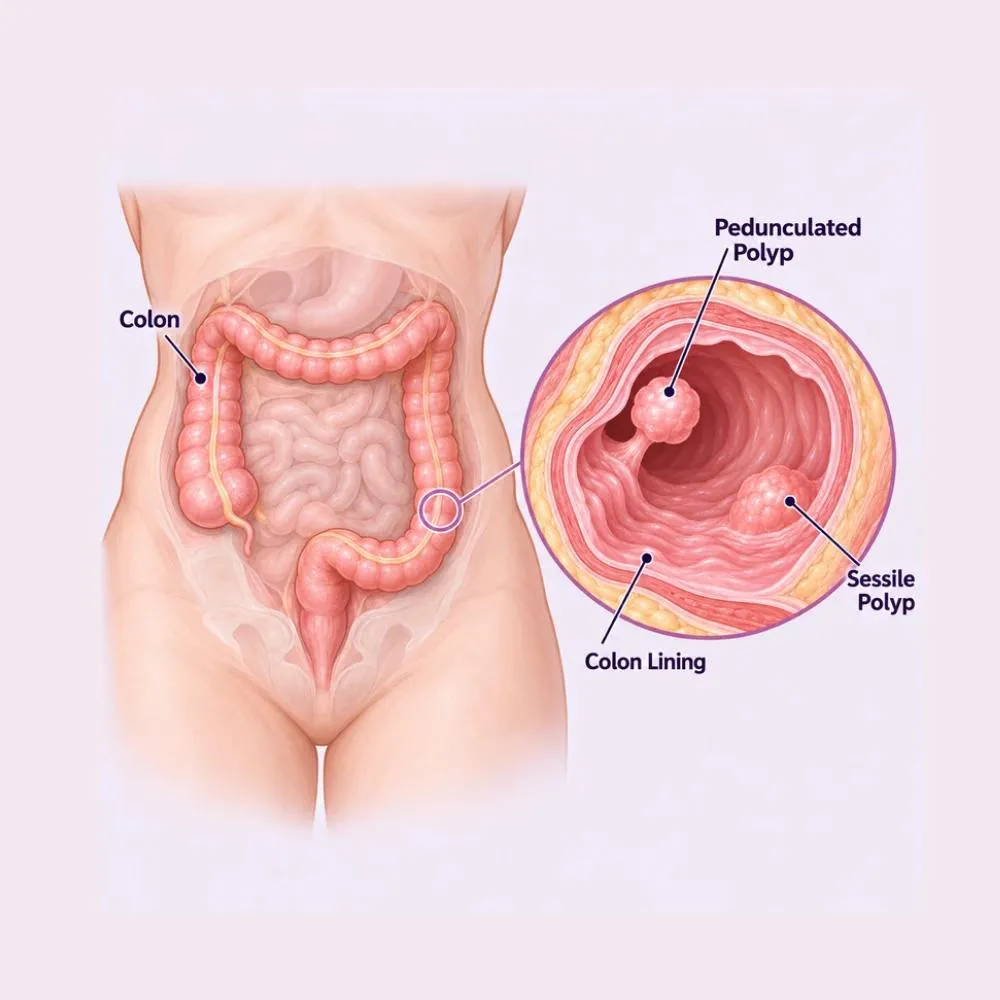
A colon polyp is a growth on the inner lining of the large bowel. Most are benign, and many people have them without ever knowing. Their importance lies entirely in what some of them become if they are left in place.
The types differ enormously in significance. Adenomatous polyps are precancerous: the great majority of colon cancers arise from them, over a period of ten to fifteen years. Sessile serrated lesions are flat, harder to see at colonoscopy, and carry a similar risk. Hyperplastic polyps are generally harmless. Inflammatory polyps occur in inflammatory bowel disease and are not themselves precancerous.
That ten to fifteen year timeline is the whole basis of bowel cancer screening. It is an unusually long window in which a curable lesion can be found and removed before it ever becomes cancer, and it is why colonoscopy prevents cancer rather than merely detecting it.
Polyps form when cells in the bowel lining divide more than they should. Age and genetics dominate; diet and lifestyle contribute meaningfully.
The strongest single risk factor. Prevalence rises steadily with each decade, which is why screening begins at this age.
A first-degree relative with colon cancer or advanced polyps significantly raises your own risk and lowers the age at which screening should start.
Familial adenomatous polyposis and Lynch syndrome cause polyps in large numbers or at young ages, and need dedicated surveillance programmes.
Diets low in fibre and high in red and processed meat are consistently associated with a higher rate of adenomatous polyps.
Both independently increase risk, and abdominal obesity in particular is strongly associated.
Raises the risk of both adenomatous and serrated polyps, and of their progression to cancer.
Regular heavy consumption increases polyp formation and is a modifiable risk in most people.
Long-standing ulcerative colitis or Crohn’s colitis raises the risk of dysplastic change, requiring surveillance from eight years after diagnosis.
Age and genetics cannot be altered, which is exactly why screening matters. Diet, weight, smoking and alcohol can be, and they meaningfully change how many polyps form.
The great majority of polyps cause no symptoms at all. This is precisely why screening exists: waiting for symptoms means waiting too long.
When symptoms do occur
Reasons to be screened without symptoms
Rectal bleeding is easy to attribute to piles, and often that is what it is. But it is also the commonest symptom of a polyp or a cancer, and assuming rather than checking is how those get found late.
Colonoscopy is both the diagnostic test and the treatment. It is the only investigation that finds a polyp and removes it in the same sitting.
The gold standard. It examines the entire colon, detects polyps of all sizes, and allows immediate removal of anything found.
Every polyp removed is examined microscopically. This determines its type, whether it was completely excised, and your surveillance interval.
A stool test detecting hidden blood, used as a first-line screening tool. A positive result mandates a colonoscopy.
Examines the left colon and rectum only. Useful for targeted assessment, but it cannot exclude polyps higher up.
A scan-based alternative for patients unable to undergo colonoscopy. Any polyp it finds still requires a scope to remove.
Full blood count for iron deficiency anaemia, which in an adult over forty warrants colonoscopy regardless of other symptoms.
The quality of the bowel preparation determines what can be seen. An inadequate preparation means small flat polyps are missed, which is why the preparation instructions are worth following exactly.
Nearly all polyps can be removed endoscopically during the colonoscopy that finds them. Surgery is needed only for the small minority that cannot.
A wire loop is placed around the polyp base and closed to cut it free, with electrocautery sealing the vessels. The standard technique for most polyps.
The same loop without diathermy, preferred for polyps under a centimetre because it avoids thermal injury to the bowel wall.
Very small polyps of a few millimetres are simply grasped and removed whole.
Fluid is injected beneath a large flat polyp to lift it away from the muscle layer, so it can be resected safely without perforation.
An advanced technique removing very large or flat lesions in one piece, so the pathologist can assess the margins properly.
Clips applied to the resection base where the defect is large or a visible vessel is present, reducing the risk of delayed bleeding.
Removal of the segment of colon containing the polyp, for large or multiple polyps that cannot be taken endoscopically.
The endoscope and laparoscope are used together to remove a difficult polyp while preserving as much colon as possible.
Removal of a large rectal polyp through the anus, avoiding an abdominal operation entirely.
For familial adenomatous polyposis, where hundreds of polyps make endoscopic clearance impossible and cancer is otherwise inevitable.
Removing a polyp removes the cancer it would have become. This is one of the few interventions in medicine that genuinely prevents a disease rather than treating it.
A thirty to sixty minute day-care procedure under sedation. You are asleep or drowsy throughout, and go home the same day.
Colonoscopy with polypectomy
A laxative preparation the day before to empty the colon completely. Unpleasant, but it determines whether small polyps are seen or missed.
Intravenous sedation with a painkiller. Most patients are asleep and remember nothing of the procedure.
The scope is passed to the caecum and the entire colon inspected carefully on withdrawal, which is when the majority of polyps are actually detected.
Size, shape and surface pattern are assessed, often with narrow-band imaging, to predict the type and choose the right removal technique.
For flat or large polyps, fluid is injected beneath to raise the lesion away from the muscle layer, making resection safe.
The polyp is snared and cut free, the base checked for bleeding and clipped if needed, and every fragment retrieved for the laboratory.
One to two hours of observation, a light meal, then home, though you must not drive. Histopathology follows in about a week.
The follow-up appointment for the histopathology result is part of the treatment, not an optional extra. It is what determines whether your next colonoscopy is in three years or in ten.
Colonoscopy quality is measured by how many polyps are found, not by how quickly it is done. Here is why patients trust us:
Careful inspection on withdrawal with advanced imaging, so flat and small polyps are found rather than missed.
EMR and ESD available, so large flat polyps can be removed endoscopically rather than requiring an operation.
From the first consultation through to post-treatment follow-up, with one team throughout.
Our hospital is in HITEC CITY, near IKEA: easily reachable from across Hyderabad.
Recovery is quick: most patients are back to normal within a day or two. The important part is the surveillance that follows.
Home the same day after the sedation wears off. Mild abdominal discomfort and wind from the air used during the scope, settling within hours. Do not drive.
Normal activities and work resume. A light diet on the first day, then back to normal eating.
A small amount of blood on stool can occur as the resection site heals. Avoid heavy lifting where a large polyp was removed.
Complete healing of the resection site. Histopathology results are available and discussed at follow-up.
Surveillance colonoscopy at an interval set by your pathology: typically three to five years, sooner for multiple or high-risk polyps.
This is the single most important thing. Removed polyps do not regrow, but new ones form, and surveillance is what catches them.
No driving, no machinery and no important decisions for 24 hours after sedation. Have someone accompany you home.
Fruit, vegetables and whole grains, with less red and processed meat. It measurably reduces the formation of new polyps.
No heavy lifting for a few days where a large polyp was removed, to reduce the risk of delayed bleeding.
Stopping smoking, moderating alcohol, losing excess weight and staying active all reduce future polyp formation.
Heavy rectal bleeding, severe abdominal pain, a hard swollen abdomen or fever: the signs of bleeding or perforation.
Tell your first-degree relatives if you have had adenomatous polyps. It changes the age at which they should begin screening, and that information genuinely prevents cancers.
Book a colonoscopy or consultation if any of the following apply.
Cost depends on the number and size of polyps and the technique required. These are the ranges our patients fall into.
| Procedure | Estimated Cost |
|---|---|
| Consultation & assessment Per visit | ₹1,000 – ₹2,000 |
| FIT / faecal occult blood test Screening test, out-patient | ₹1,000 – ₹2,500 |
| Diagnostic colonoscopy Day care, under sedation | ₹12,000 – ₹22,000 |
| Colonoscopy with polypectomy Day care, including histopathology | ₹18,000 – ₹35,000 |
| Endoscopic mucosal resection (EMR) Day care or one night’s stay | ₹35,000 – ₹65,000 |
| Endoscopic submucosal dissection (ESD) One to two nights’ stay | ₹70,000 – ₹1,30,000 |
| Laparoscopic segmental colectomy Four to six nights’ stay | ₹2,50,000 – ₹4,50,000 |
One small polyp snared in seconds and several large flat lesions requiring EMR are very different procedures.
A simple snare, an EMR with injection and clips, and an ESD differ substantially in time and consumables.
Every polyp is examined, so the number of specimens affects the laboratory cost.
A shared ward, a twin-sharing room or a private suite: the largest single swing in most estimates.
We are empanelled with most major insurers, and our team files the pre-authorisation for you.
Every figure above is an indicative range, not a quote. After your consultation you are given a written, fixed-cost estimate, and that is the number you pay, with no additions once treatment begins.
What patients treated here can expect:
Precancerous polyps removed before they can ever progress.
Removed during the same colonoscopy, with normal activity next day.
Histopathology on every polyp, and a surveillance interval built from it.
The gastrointestinal and colorectal surgeon who removes colon polyps at our HITEC CITY hospital.

Senior Consultant: Bariatric & Gastrointestinal Surgery
MBBS, MS, FRCS (UK), DLS (France)
28 years experience
Reviews from patients treated for colorectal and gastrointestinal conditions at Lux Hospitals, Hyderabad.
Written by Dr. Tagore Mohan Grandhi on bowel screening, digestive health and colorectal surgery.

Dr. Tagore Mohan Grandhi
Dr. Tagore Mohan Grandhi
Dr. Tagore Mohan Grandhi
Dr. Tagore Mohan Grandhi
Dr. Tagore Mohan Grandhi
Dr. Tagore Mohan Grandhi
Common questions about colon polyps, their removal, and what treatment costs at Lux Hospitals.
Still have questions? Call us at 079 6908 4422
Still have questions? Message us on WhatsApp at 079 6908 4444
Thorough colonoscopy with same-sitting polyp removal and histopathology on every polyp, with a fixed-cost estimate upfront.
Plot No.116, Lumbini Avenue, HITEC CITY, Near IKEA, Hyderabad – 500032













