



Dr. Samhitha Reddy
Consultant Proctologist & Laparoscopic Surgeon
MBBS, MS, FMAS, FISCP, DMAS
- 8 Yrs
- ASCRS Member
Anal and rectal polyps are growths on the lining of the anal canal or rectum. Most are harmless, but some types become cancerous over time, and because there is no way to tell by looking, removal and examination under a microscope is how the question is settled.
Removing a polyp is quick, done under sedation, and takes the risk away entirely. Our proctologists at Lux Hospitals, HITEC CITY perform endoscopic polypectomy as a day-care procedure, with every polyp sent for histopathology.
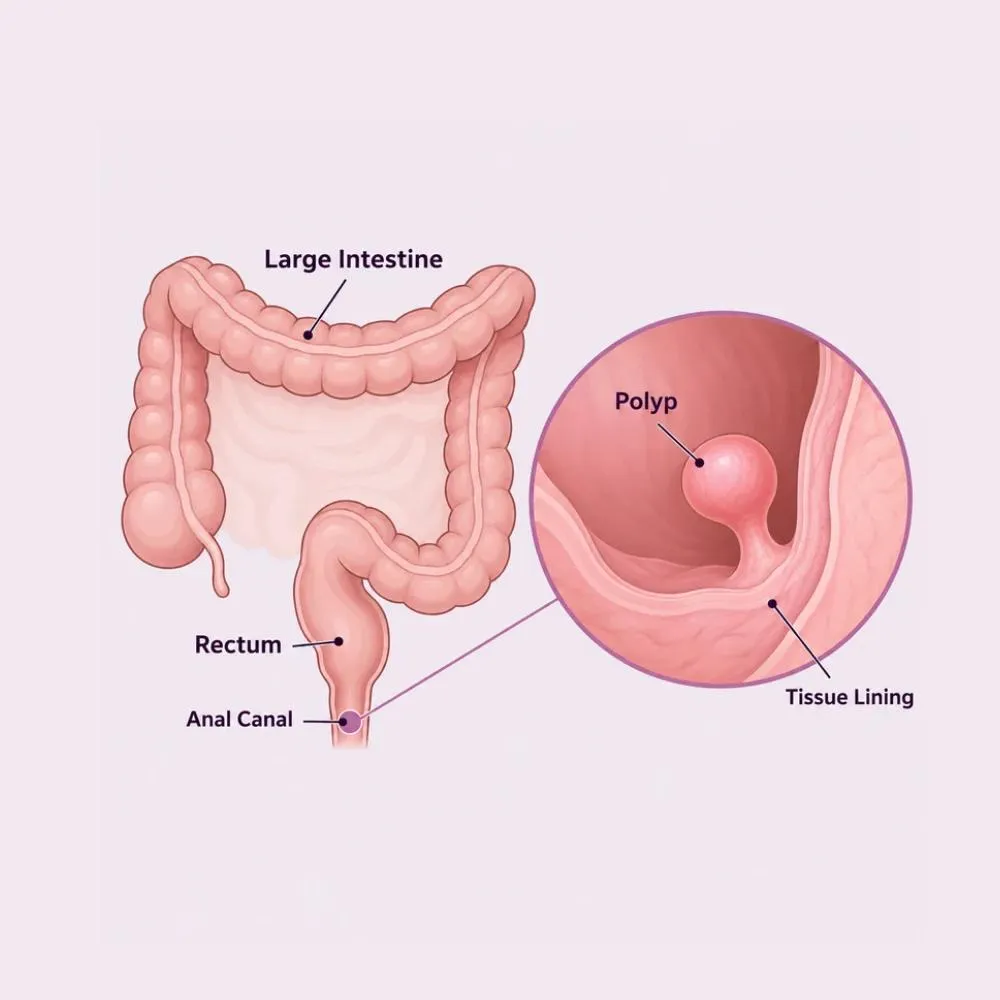
Anal polyp removal, also called polypectomy, is a procedure to remove polyps from the anal canal or rectum. It is performed endoscopically in the great majority of cases, using instruments passed through a scope, and only rarely requires open surgery.
The type of polyp determines how urgently it needs to go. Adenomatous polyps are the important ones: they are precancerous and can become malignant over years, which is why they are always removed. Villous polyps carry a higher risk again. Hyperplastic polyps are generally benign, and inflammatory polyps are common in inflammatory bowel disease and are not themselves precancerous.
Crucially, these types cannot be told apart reliably by eye. That is why the polyp is removed and sent for histopathology: the microscope gives the answer, and that answer sets your surveillance interval afterwards.
Polyps form when cells in the bowel lining grow and divide more than they should. Several things make that more likely.
The risk rises steadily with age, which is why routine bowel screening begins at forty-five to fifty.
A family history of polyps or bowel cancer raises risk substantially, and inherited syndromes such as FAP and Lynch syndrome cause polyps in large numbers.
Persistent irritation of the colon and rectum, particularly in long-standing inflammatory bowel disease, drives polyp formation.
Crohn’s disease and ulcerative colitis increase the risk of both inflammatory polyps and, over many years, dysplastic ones.
Diets low in fibre and high in red or processed meat and saturated fat are consistently associated with polyp growth.
Both raise the risk of adenomatous polyps and of their progression, and both are modifiable.
Excess weight and a sedentary lifestyle are independently associated with a higher rate of polyp formation.
Poorly controlled diabetes is linked with an increased risk of colorectal polyps and cancer.
Age and genetics cannot be changed; diet, weight, smoking and alcohol can. The second group is worth acting on, particularly if polyps have already been found once.
Most polyps cause no symptoms at all and are found incidentally during a colonoscopy. When they do declare themselves, it is usually through bleeding.
Common symptoms
With larger polyps
Rectal bleeding is easy to attribute to piles, and often that is exactly what it is. But bleeding deserves examination rather than assumption: the conditions that need finding early bleed in the same way.
Diagnosis is by direct visualisation. The examination that finds a polyp is usually the same one that removes it.
Inspection and digital rectal examination, which can detect low-lying polyps within reach of a finger.
Direct view of the anal canal and lower rectum, allowing small polyps in that region to be seen and biopsied.
The definitive investigation. It examines the entire colon, because a polyp found low down means others may be present higher up, and it removes what it finds.
Every polyp removed is examined under the microscope. This determines its type, whether it is fully excised, and how soon you need a repeat scope.
Full blood count to detect anaemia from chronic blood loss, and routine pre-procedure bloods.
A scan-based alternative for patients who cannot undergo colonoscopy, though any polyp found still needs a scope to remove it.
A colonoscopy rather than a limited examination matters here. Finding one polyp raises the likelihood of others, and only a full examination rules that out.
Treatment depends on the size, type and number of polyps, and on whether there are any features suggesting malignancy. The aim is complete removal with confirmation under the microscope.
A wire loop is placed around the base of the polyp and closed to cut it free, with electrocautery sealing the vessels as it cuts. The standard technique for most polyps.
The same loop without diathermy, preferred for small polyps under a centimetre because it avoids any thermal injury to the bowel wall.
Tiny polyps of a few millimetres are simply grasped and removed whole with forceps.
Fluid is injected beneath a large flat polyp to lift it away from the muscle layer, so it can be resected safely without perforating the wall.
An advanced technique for very large or flat lesions, removing them in one piece so the pathologist can assess the margins properly.
Removal through the anus for larger rectal polyps that are not suitable for a snare but do not require abdominal surgery.
Rarely needed. Reserved for polyps that are very large, cannot be removed endoscopically, or show signs of malignancy on biopsy.
Small, benign polyps that cause no symptoms may be monitored with periodic colonoscopy rather than removed immediately.
Medication does not remove polyps, but controlling inflammatory bowel disease reduces the inflammation that drives them.
More fibre, less red and processed meat, stopping smoking, limiting alcohol and maintaining a healthy weight all reduce the formation of new polyps.
Endoscopic removal is the standard, and it is usually a day-care procedure with a quick recovery. It removes the bleeding and discomfort, and (more importantly) the risk of that polyp ever becoming cancer.
Usually performed during the same colonoscopy that finds the polyp. You are sedated throughout, and go home the same day.
Endoscopic polypectomy
A laxative preparation the day before to empty the bowel completely. Uncomfortable, but the single thing that most determines whether the examination is adequate.
Intravenous sedation and a painkiller. Most patients are asleep or drowsy throughout and remember nothing of the procedure.
The scope is passed to the caecum and the entire colon inspected carefully on withdrawal, which is when most polyps are actually found.
For flat or large polyps, fluid is injected beneath to raise the lesion away from the muscle layer, making resection safer.
A snare is placed around the base and closed to cut it free, with cautery if needed. Larger polyps may be taken in several pieces.
The base is checked for bleeding and clipped where the defect is large or the vessel prominent. Every polyp removed is retrieved for the laboratory.
One to two hours of observation while the sedation wears off, a light meal, then home the same day, though you must not drive.
Histopathology takes about a week. That result determines your surveillance interval, so the follow-up appointment to receive it is part of the treatment rather than an optional extra.
Polypectomy is a routine procedure whose value lies entirely in it being done thoroughly. Here is why patients trust us:
Colorectal specialists experienced in endoscopic polypectomy, EMR and advanced resection techniques.
Histopathology on everything removed, with a structured surveillance interval set from the result.
From the first consultation through to post-treatment follow-up, with one team throughout.
Our hospital is in HITEC CITY, near IKEA: easily reachable from across Hyderabad.
Recovery after endoscopic polypectomy is quick. Most patients are back to normal within a day or two, with only minor restrictions.
Home the same day after the sedation wears off. Some bloating and wind from the air used during the scope, which passes within hours. Do not drive.
Normal activities and work resume. A light diet on the first day, then back to normal eating.
A small amount of blood on stool can occur as the site heals. Avoid heavy lifting and strenuous exercise where a large polyp was removed.
Complete healing of the resection site. Histopathology results are available and discussed at your follow-up.
A surveillance colonoscopy is scheduled based on the pathology: typically three to five years, or sooner for multiple or high-risk polyps.
No driving, no legal decisions and no machinery for 24 hours after sedation. Have someone accompany you home.
Fluids and light food on the first day, then a normal diet. There is no need for prolonged restriction.
Fruit, vegetables and whole grains support bowel health and reduce the formation of new polyps. Limit processed and fatty foods.
No heavy lifting for a few days where a large polyp was removed, to reduce the risk of delayed bleeding.
Heavy rectal bleeding, severe abdominal pain, a hard swollen abdomen, or fever: the signs of bleeding or perforation.
Removed polyps do not regrow, but new ones can form. The surveillance interval is set by your pathology and is what keeps you ahead of them.
Removing a polyp removes the risk it carried. Attending the surveillance colonoscopy is what deals with the ones that have not formed yet, and it is the appointment people most often let slide.
Book a consultation if any of the following apply.
Cost depends on the number and size of polyps and on the technique required. These are the ranges our patients fall into.
| Procedure | Estimated Cost |
|---|---|
| Specialist consultation Per visit | ₹800 – ₹1,500 |
| Diagnostic colonoscopy Day care, under sedation | ₹12,000 – ₹22,000 |
| Colonoscopy with polypectomy Day care, including histopathology | ₹18,000 – ₹35,000 |
| Endoscopic mucosal resection (EMR) Day care or one night’s stay | ₹35,000 – ₹60,000 |
| Transanal excision One night’s stay | ₹45,000 – ₹80,000 |
| Surgical resection Rarely required; four to six nights’ stay | ₹1,80,000 – ₹3,50,000 |
One small polyp snared in seconds and several large flat lesions needing EMR are very different procedures.
A simple snare, an EMR with injection and clips, and an ESD differ substantially in time and consumables.
Every polyp is sent for examination, and the number of specimens affects the laboratory cost.
A shared ward, a twin-sharing room or a private suite: the largest single swing in most estimates.
We are empanelled with most major insurers, and our team files the pre-authorisation for you.
Every figure above is an indicative range, not a quote. After your consultation you are given a written, fixed-cost estimate, and that is the number you pay, with no additions once treatment begins.
What patients treated here can expect:
Precancerous polyps taken out before they can ever progress.
Home the same day, back to normal activity within a day or two.
Histopathology on every polyp, and a surveillance plan built from it.
The colorectal surgeons and endoscopists who perform polypectomy at our HITEC CITY hospital.

Consultant Proctologist & Laparoscopic Surgeon
MBBS, MS, FMAS, FISCP, DMAS
8 years experience

Consultant General & Advanced Laparoscopic Surgeon
MBBS, MS, FMAS
17 years experience
Reviews from patients treated for polyps, piles and colorectal conditions at Lux Hospitals, Hyderabad.
Written by Dr. Samhitha Reddy on colorectal health, bowel screening and polyps.
Dr. Samhitha Reddy

Dr. Samhitha Reddy

Dr. Samhitha Reddy

Dr. Samhitha Reddy
Dr. Samhitha Reddy
Common questions about anal polyps, polypectomy, and what the procedure costs at Lux Hospitals.
Still have questions? Call us at 079 6908 4422
Still have questions? Message us on WhatsApp at 079 6908 4444
Day-care endoscopic polyp removal with histopathology on every polyp, and a fixed-cost estimate before the procedure.
Plot No.116, Lumbini Avenue, HITEC CITY, Near IKEA, Hyderabad – 500032













