



Dr. Samhitha Reddy
Consultant Proctologist & Laparoscopic Surgeon
MBBS, MS, FMAS, FISCP, DMAS
- 8 Yrs
- ASCRS Member
Chronic constipation is not simply going less often. It is straining, hard stools, and the persistent feeling of never quite finishing: going on for months, and shaping what you eat, where you travel and how you feel all day.
Most people have tried laxatives before they arrive. Our specialists at Lux Hospitals, HITEC CITY look for the cause instead (slow transit, a pelvic floor that will not relax, or a structural problem) because the treatment that works is the one aimed at the right mechanism.
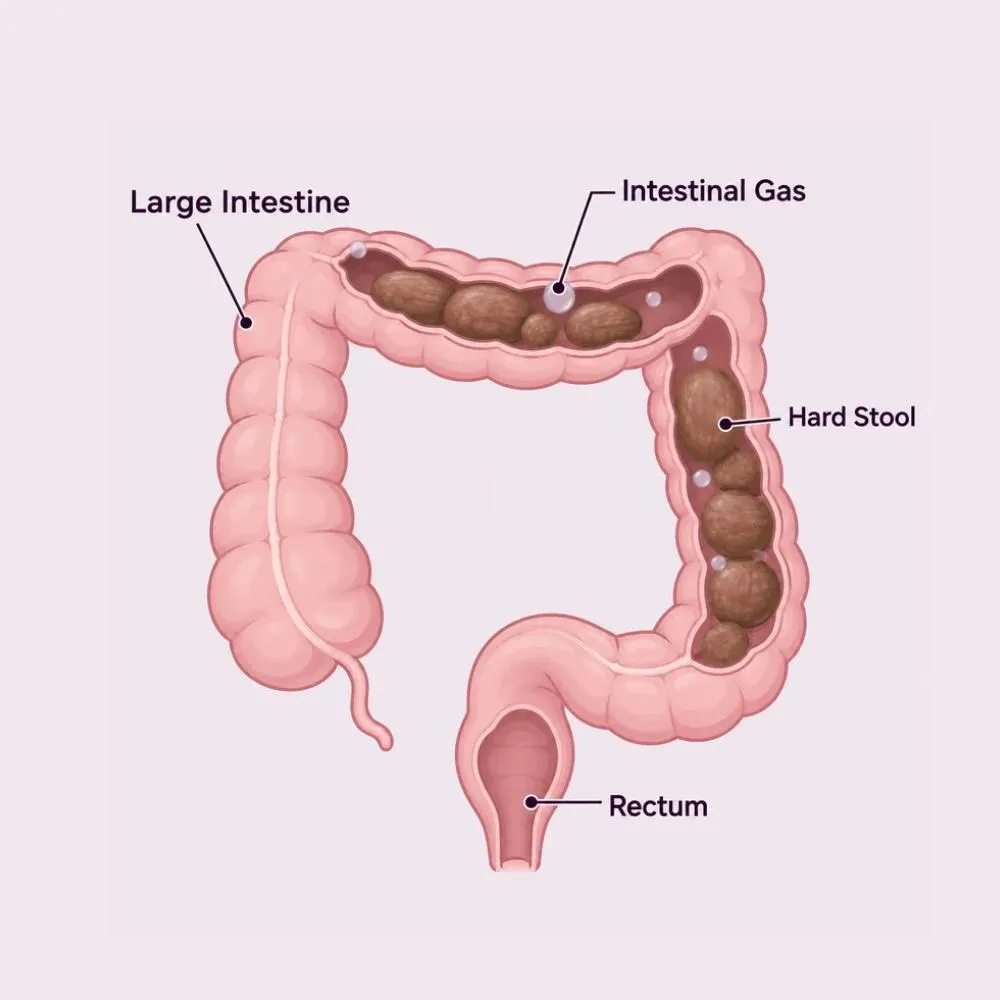
Chronic constipation is infrequent, difficult or incomplete bowel movements lasting three months or longer. Most people affected pass fewer than three stools a week, strain to do so, or finish with the feeling that something is still left behind.
The definition matters less than the mechanism, and there are three. Slow transit constipation means the colon itself moves contents too slowly. Outlet obstruction, or dyssynergic defecation, means the colon works but the pelvic floor will not relax to let stool out. Normal transit constipation covers the rest, where the pattern is uncomfortable but measurably normal.
The distinction is the whole point of investigating rather than simply prescribing. Laxatives help slow transit and do very little for a pelvic floor that clenches instead of relaxing: that one needs retraining, not stimulation.
Diet and habit account for most cases. Some point to a medication, a hormone problem or a structural cause that will keep it going until it is addressed.
Not enough whole grains, fruit and vegetables leaves stool with too little bulk and moisture to move easily.
The colon reabsorbs water from stool. Drink too little and what arrives at the rectum is dry and hard.
Movement stimulates bowel motility. Long periods of sitting or bed rest slow the colon measurably.
Repeatedly deferring (at work, while travelling) dulls the reflex that signals the need to go, and the stool dries out while it waits.
Opioid painkillers, iron and calcium supplements, antidepressants, antacids and some blood pressure tablets all slow the bowel.
An underactive thyroid, diabetes and high calcium all slow gut motility, and are simple to test for.
The pelvic floor contracts instead of relaxing when you push, so stool cannot pass however hard you strain.
A rectocele, an internal prolapse, a stricture or, importantly in new-onset constipation over fifty, a tumour narrowing the bowel.
Finding the cause is what makes relief last. Treating every case with the same laxative is why so many people arrive here having managed the symptom for years without ever improving it.
Constipation is diagnosed on the pattern rather than on a number. Two of the following, present for three months, is the usual threshold.
Bowel symptoms
Associated symptoms
Needing to use a finger to help stool out is worth mentioning even though it is embarrassing. It points strongly to outlet obstruction, which is the type that responds best to biofeedback and least to laxatives.
The first job is to exclude anything serious, particularly in new-onset constipation after fifty. The second is to work out which of the three mechanisms is at play.
Frequency, consistency on the Bristol scale, straining, medications and diet. A two-week diary is more informative than any single test.
Feels for loaded colon and assesses whether the pelvic floor relaxes or paradoxically tightens when you bear down.
Thyroid function, calcium, blood sugar and a full blood count: the metabolic causes are common, cheap to find and easy to correct.
Advised for new constipation over fifty, or with bleeding, weight loss or anaemia, to rule out a tumour or stricture and remove any polyps found.
Radio-opaque markers are swallowed and tracked on X-ray over five days, measuring how fast the colon actually moves. This is what confirms slow transit.
Measures pelvic floor coordination and pushing pressures, and images the rectum while emptying: the tests that identify outlet obstruction.
New constipation in someone over fifty, or constipation with bleeding, weight loss or anaemia, gets a colonoscopy. That is not caution for its own sake: it is the one presentation where the diagnosis might not be constipation at all.
Treatment is staged. Almost everyone starts with the first list, and the great majority never need anything beyond it. What decides the later rungs is which mechanism the tests identified.
Building to 25–30g of fibre a day from whole grains, fruit, vegetables and pulses: increased gradually, because a sudden jump causes bloating and puts people off.
Two to three litres of water a day. Fibre without fluid makes stool bulkier and harder, which is worse than either alone.
Thirty minutes of walking most days measurably speeds colonic transit and is one of the most reliable interventions available.
A consistent time each day, ideally after breakfast when the gastrocolic reflex is strongest, with feet on a low stool and no phone.
Osmotic laxatives such as polyethylene glycol or lactulose are the first choice and are safe long term. Stimulants are for short-term use under supervision.
Support the gut flora and improve stool consistency in some patients, particularly where bloating is prominent.
Pelvic floor retraining using real-time feedback, so you learn to relax rather than clench when pushing. The single most effective treatment for outlet obstruction, with success rates around seventy per cent.
Prokinetic and secretagogue drugs that act directly on colonic motility or fluid secretion, for slow transit that has not responded to standard measures.
Correcting thyroid function, adjusting a constipating medication, or managing diabetes, often the whole answer on its own.
Diagnostic and therapeutic in one: a stricture dilated or a polyp removed at the same sitting.
Repair of a significant rectocele or internal prolapse where imaging shows it is genuinely obstructing evacuation.
Removal of the colon, reserved for severe, proven slow-transit constipation that has failed everything else. Rare, and only after careful selection.
Surgery for constipation is uncommon and is never a first answer. Nearly everyone is treated with diet, retraining, medication or biofeedback, which is why identifying the mechanism matters so much.
The treatment of choice for outlet obstruction. It is a course of outpatient sessions rather than an operation: you are retraining a reflex, not repairing a structure.
Anorectal biofeedback
Anorectal manometry establishes your baseline: resting pressure, squeeze pressure, and what your pelvic floor does when you push.
You are shown your own pressure traces on screen. Most patients see for the first time that they tighten when they intend to relax.
A small sensor gives real-time visual feedback while you practise pushing. The screen shows immediately whether the floor opened or clenched.
Practising the correct sequence, abdominal push with simultaneous pelvic floor relaxation, until it becomes automatic rather than deliberate.
Where rectal sensation has become blunted from years of deferring, a small balloon is used to restore awareness of the urge at a normal volume.
Daily exercises between sessions, with a course typically running four to six sessions over as many weeks, and a review at the end.
There is no anaesthetic, no incision and no recovery period: you drive yourself home afterwards. What it asks for instead is the home practice between sessions, which is what makes the difference.
Constipation is easy to prescribe for and harder to actually fix. Here is why patients trust us:
Specialists including leading female proctologists in Hyderabad, experienced in diagnosing and treating chronic constipation with a patient-first approach.
Colonoscopy, anorectal manometry, transit studies and imaging, so treatment is aimed at the actual mechanism.
From the first consultation through to post-treatment follow-up, with one team throughout.
Our hospital is in HITEC CITY, near IKEA: easily reachable from across Hyderabad.
There is nothing to recover from here: the timeline below is how improvement actually arrives, which is gradually. Constipation treated properly gets better over weeks, not days.
Fibre and fluid increased gradually. Expect some bloating as the gut adjusts; it settles and is not a reason to stop.
Stool consistency softens and frequency improves. Bowel retraining begins to establish a predictable daily pattern.
Biofeedback sessions, where indicated, run through this period. Straining reduces first, the sense of incomplete emptying afterwards.
Laxatives are tapered where the pattern has stabilised. Review to confirm progress and adjust the plan.
The diet, the fluid and the daily routine become the long-term management. This is a condition that is controlled rather than cured once and forgotten.
25–30g a day, increased over two to three weeks. A sudden jump causes bloating and is why most people abandon it.
Non-negotiable alongside the fibre. Fibre without fluid makes constipation worse, not better.
The same time daily, ideally after breakfast. Feet on a low stool, knees above hips, and no phone.
Going when you feel it is what preserves the reflex. Deferring is how the whole cycle started for many patients.
Bring your full list to every appointment. Painkillers, iron and antidepressants are frequent hidden culprits.
Bleeding, unexplained weight loss, or a sudden change in a stable pattern: these need reassessment rather than a stronger laxative.
The people who do best are those who keep the diet and the routine after the symptoms settle. Constipation returns quickly when the habits that caused it come back.
Book a consultation if any of the following apply.
Most patients are treated in the outpatient department, and the cost reflects the investigations rather than any procedure. These are the ranges our patients fall into.
| Procedure | Estimated Cost |
|---|---|
| Specialist consultation Per visit, including a treatment plan | ₹800 – ₹1,500 |
| Blood tests & basic workup Thyroid, calcium, sugar, full blood count | ₹2,000 – ₹5,000 |
| Anorectal manometry Out-patient, no admission | ₹6,000 – ₹12,000 |
| Colonic transit study Over five days, out-patient | ₹5,000 – ₹10,000 |
| Colonoscopy Day care, under sedation | ₹12,000 – ₹25,000 |
| Biofeedback therapy course Four to six out-patient sessions | ₹15,000 – ₹30,000 |
Straightforward dietary constipation needs a consultation and bloods. A complex case may need manometry, a transit study and a proctogram.
Added for new constipation over fifty or with alarm symptoms, and not required for most younger patients.
Most patients need four to six sessions; some need a top-up course later to consolidate the retraining.
A shared ward, a twin-sharing room or a private suite: the largest single swing in most estimates.
We are empanelled with most major insurers, and our team files the pre-authorisation for you.
Every figure above is an indicative range, not a quote. After your consultation you are given a written, fixed-cost estimate, and that is the number you pay, with no additions once treatment begins.
The proctologists and colorectal specialists who treat chronic constipation at our HITEC CITY hospital.

Consultant Proctologist & Laparoscopic Surgeon
MBBS, MS, FMAS, FISCP, DMAS
8 years experience

Consultant General & Advanced Laparoscopic Surgeon
MBBS, MS, FMAS
17 years experience
Reviews from patients treated for constipation, IBS and colorectal conditions at Lux Hospitals, Hyderabad.
Written by Dr. Samhitha Reddy on constipation, IBS and digestive health.

Dr. Samhitha Reddy


Dr. Samhitha Reddy

Dr. Samhitha Reddy

Dr. Samhitha Reddy

Dr. Samhitha Reddy
Common questions about chronic constipation, its treatment, and what care costs at Lux Hospitals.
Still have questions? Call us at 079 6908 4422
Still have questions? Message us on WhatsApp at 079 6908 4444
Cause-led diagnosis and treatment for chronic constipation, with a clear plan and a written estimate before treatment begins.
Plot No.116, Lumbini Avenue, HITEC CITY, Near IKEA, Hyderabad – 500032













