



Dr. Samhitha Reddy
Consultant Proctologist & Laparoscopic Surgeon
MBBS, MS, FMAS, FISCP, DMAS
- 8 Yrs
- ASCRS Member
An ACL tear is the classic sporting knee injury: a twist, a pop, immediate swelling, and a knee that afterwards gives way on turning. It is common in football, cricket, kabaddi and badminton.
Not every ACL tear needs reconstruction, and not every reconstruction should be rushed into. Our orthopaedic surgeons at Lux Hospitals, HITEC CITY perform arthroscopic ACL reconstruction with a structured return-to-sport programme, and will advise honestly on whether you need one.
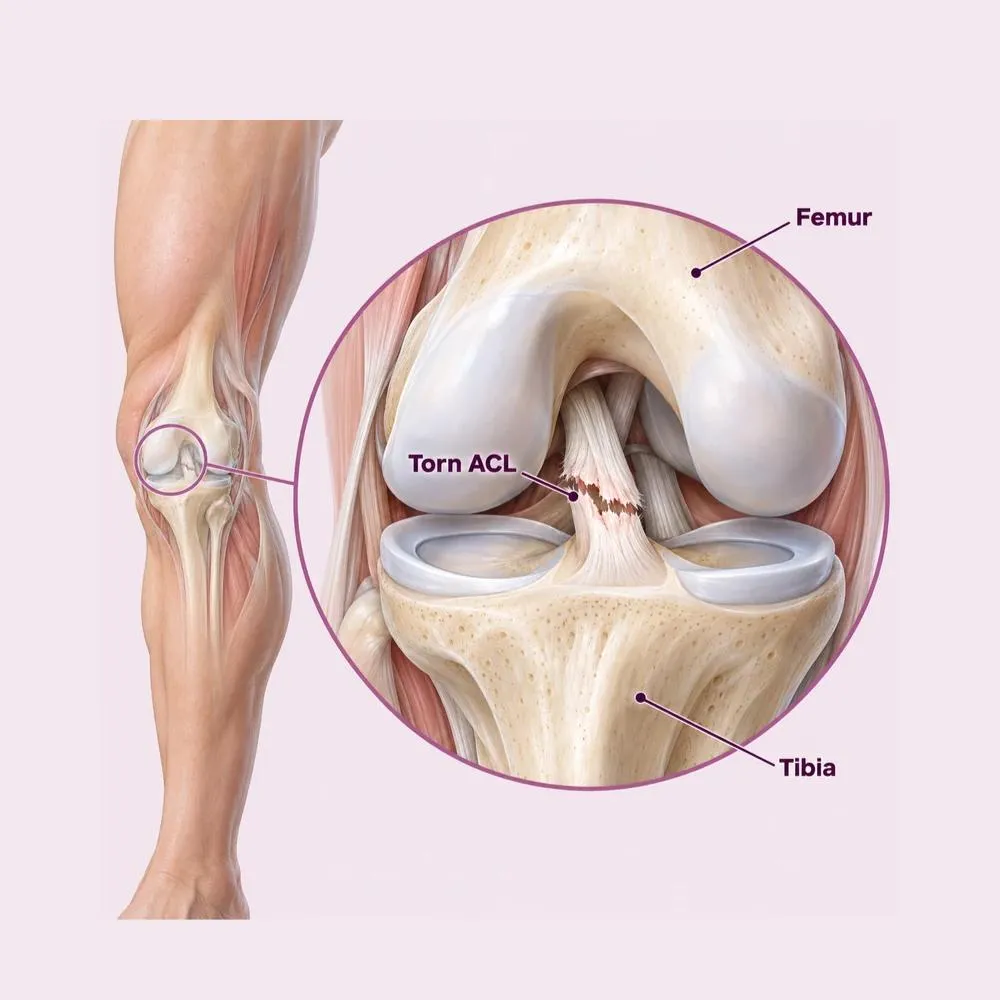
The anterior cruciate ligament runs diagonally through the centre of the knee and stops the shin bone sliding forward on the thigh bone. It is what allows you to turn, pivot and change direction without the knee giving way.
Tears are graded by severity. A grade 1 tear is a stretch with the ligament still functional. A grade 2 is a partial tear with some looseness. A grade 3 is a complete rupture, and the knee becomes unstable on pivoting movements.
The important thing to understand is that a torn ACL does not heal. Unlike most ligaments it has a poor blood supply and sits bathed in joint fluid, and a complete tear will not reattach itself. The decision is therefore not whether it will heal, but whether you need it reconstructed for the life you want to lead.
Most ACL tears happen without contact: a sudden deceleration or change of direction with the foot planted.
Changing direction sharply with the foot planted. The classic non-contact mechanism, accounting for the majority of tears.
Stopping abruptly from running, particularly with the knee close to straight and the body weight behind it.
Landing from a jump with the knee collapsing inward, common in badminton, basketball and volleyball.
A blow to the outside of the knee forcing it inward, seen in football and kabaddi tackles.
Women have a several-fold higher rate of ACL injury, related to differences in anatomy, hormones and landing mechanics.
Weak hip and core muscles allow the knee to collapse inward on landing: the single most trainable risk factor.
Having torn one ACL substantially raises the risk to both the reconstructed knee and the opposite one.
High-friction surfaces and studded footwear increase the rotational force transmitted to the knee.
Neuromuscular training programmes measurably reduce ACL injury rates in athletes, particularly in women. That is genuinely preventive rather than just advice after the event.
The history is usually distinctive: a twisting injury with an audible pop, and swelling that develops within hours rather than days.
At the time of injury
Afterwards
Swelling within hours of a twisting injury means bleeding into the joint, and in a young athlete that means an ACL tear until proved otherwise. Swelling that appears the next day is far less specific.
The diagnosis is often clear from the history and examination. MRI confirms it and, importantly, identifies what else was damaged.
The Lachman test is the most sensitive, assessing forward laxity of the shin. The pivot shift test reproduces the giving-way sensation.
Excludes fracture, particularly an avulsion of the bony attachment which is more common in adolescents.
The definitive investigation. It confirms the ACL tear and identifies associated meniscal tears, cartilage damage and bone bruising.
The meniscus, collateral ligaments and cartilage are commonly damaged at the same time, and that changes the surgical plan.
How the knee behaves in daily life and sport, which determines whether reconstruction is needed at all.
Regaining full extension and reducing swelling before surgery. Operating on a stiff, swollen knee causes lasting stiffness.
Surgery is deliberately delayed until swelling settles and full extension returns, usually two to six weeks. Reconstructing an angry, stiff knee is the main cause of post-operative arthrofibrosis.
A torn ACL does not heal, but not everyone needs it reconstructed. The decision rests on your activities and how unstable the knee actually is.
Intensive strengthening of the quadriceps and hamstrings with neuromuscular training. Many people with a torn ACL manage well without surgery.
Avoiding pivoting sports while continuing straight-line activities such as running, cycling and swimming, which the knee tolerates well.
A hinged brace giving a degree of confidence and support during activity, though it does not replace the ligament.
Ice, elevation and gentle movement in the first weeks, which is necessary whether or not surgery follows.
The commonest technique. Two hamstring tendons are harvested and folded to form a new ligament, fixed in bone tunnels.
A strip of patellar tendon with bone blocks at each end, giving bone-to-bone healing. Often preferred in high-demand pivoting athletes.
An increasingly used option with good strength and less donor-site pain than a patellar tendon graft.
Associated meniscal tears are repaired during the same operation, which preserves tissue and protects against later arthritis.
For a graft that has re-ruptured, usually more complex and sometimes staged with bone grafting of the old tunnels.
Reconstruction is recommended for those who play pivoting sports, whose knee gives way in daily life, or who have a repairable meniscal tear. Those who avoid pivoting sport can often do very well without it.
A sixty to ninety minute arthroscopic procedure with a graft taken from your own knee, usually as a day case or one night.
Arthroscopic ACL reconstruction
Delayed until swelling has settled and full extension returned: typically two to six weeks after injury, to avoid post-operative stiffness.
General or spinal anaesthesia, usually with a nerve block for post-operative pain relief.
Hamstring tendons taken through a small incision below the knee, or a strip of patellar or quadriceps tendon, depending on the chosen graft.
The joint is inspected, the torn ACL remnant cleared, and any meniscal tear repaired at this stage.
Tunnels are drilled in the femur and tibia at the exact anatomical footprints of the original ligament. Tunnel position is the single biggest determinant of success.
The graft is passed through the tunnels and fixed with screws, buttons or similar devices, then tensioned appropriately.
Stability is tested with the Lachman and pivot shift, full range confirmed, and the small incisions closed.
Tunnel placement matters more than graft choice. A graft in the wrong position will not restore normal mechanics however strong it is, which is why the anatomical footprints are identified precisely.
ACL reconstruction succeeds on tunnel placement and on rehabilitation, not on the operation alone. Here is why patients trust us:
Orthopaedic surgeons performing arthroscopic ACL reconstruction regularly, including revision and multi-ligament cases.
Structured rehabilitation with objective strength and hop testing before clearance, rather than clearance by calendar.
From the first consultation through to post-treatment follow-up, with one team throughout.
Our hospital is in HITEC CITY, near IKEA: easily reachable from across Hyderabad.
ACL rehabilitation takes six to nine months, and returning early is the main cause of re-rupture. The programme is the treatment.
Ice, elevation and full extension exercises. Walking with crutches, weight-bearing as comfortable. Swelling control is the priority.
Full range of motion regained, crutches discarded, and quadriceps activation restored. Stationary cycling begins.
Progressive strengthening, closed-chain exercises and balance work. Desk work and driving resume.
Running usually permitted around three months, progressing to agility work, cutting drills and sport-specific training.
Return to pivoting sport, gated on strength testing and hop-test symmetry rather than on time elapsed.
Regaining complete straightening in the first weeks is the top priority. A knee that will not straighten causes lasting problems.
Six to nine months of structured rehabilitation. This is not optional padding: it is what makes the reconstruction work.
Return should be gated on strength symmetry and hop testing. Returning at six months without passing those roughly doubles re-rupture risk.
Hip and core strength control how the knee behaves on landing. Neuromuscular training protects both knees.
Fever, spreading redness, calf pain and swelling, sudden giving way, or a new pop during rehabilitation.
Having torn one ACL raises the risk to the opposite knee substantially. The prevention training applies to both.
Around one in five athletes who return to pivoting sport suffers a further ACL injury, to either knee. Passing objective return-to-sport testing rather than simply waiting six months reduces that risk considerably.
Book a consultation if any of the following apply.
Graft fixation implants are a significant part of the cost. These are the ranges our patients fall into.
| Procedure | Estimated Cost |
|---|---|
| Consultation & assessment Per visit | ₹800 – ₹1,500 |
| MRI knee Confirms the tear and associated injuries | ₹6,000 – ₹12,000 |
| Non-surgical rehabilitation programme Three to six months of structured physiotherapy | ₹15,000 – ₹35,000 |
| Arthroscopic ACL reconstruction One night’s stay, graft fixation included | ₹1,40,000 – ₹2,50,000 |
| ACL with meniscal repair One night’s stay, additional implants | ₹1,80,000 – ₹3,00,000 |
| Revision ACL reconstruction More complex, sometimes staged | ₹2,20,000 – ₹4,00,000 |
| Post-operative rehabilitation Six to nine months of structured programme | ₹25,000 – ₹50,000 |
Fixation devices vary considerably in price, and different graft choices involve different implants.
Meniscal repair, cartilage procedures or additional ligament reconstruction all add to the operation and the cost.
Six to nine months of structured physiotherapy is a real cost, and it is what determines the outcome.
A shared ward, a twin-sharing room or a private suite: the largest single swing in most estimates.
We are empanelled with most major insurers, and our team files the pre-authorisation for you.
Every figure above is an indicative range, not a quote. After your consultation you are given a written, fixed-cost estimate, and that is the number you pay, with no additions once treatment begins.
The orthopaedic and sports injury surgeons who treat ACL tears at our HITEC CITY hospital.

Consultant Orthopaedic Surgeon: Joint Replacement & Arthroscopy
MS (Ortho), FIJR, FIASM (UK), FIKS (Italy), FIRJR
8 years experience
Consultant Orthopaedic Surgeon
MBBS, MS, FIJR
6 years experience
Reviews from patients treated for ACL, meniscus and sports injuries at Lux Hospitals, Hyderabad.
Written by Dr. Sai Kishan Sirasala on sports injuries, knee surgery and orthopaedic care.
Dr. Sai Kishan Sirasala
Dr. Sai Kishan Sirasala
Dr. Sai Kishan Sirasala
Dr. Sai Kishan Sirasala
Dr. Sai Kishan Sirasala
Dr. Sai Kishan Sirasala
Common questions about ACL tears, reconstruction, and what surgery costs at Lux Hospitals.
Still have questions? Call us at 079 6908 4422
Still have questions? Message us on WhatsApp at 079 6908 4444
Arthroscopic ACL reconstruction with a structured return-to-sport programme, and a fixed-cost estimate before treatment begins.
Plot No.116, Lumbini Avenue, HITEC CITY, Near IKEA, Hyderabad – 500032













