



Dr. Samhitha Reddy
Consultant Proctologist & Laparoscopic Surgeon
MBBS, MS, FMAS, FISCP, DMAS
- 8 Yrs
- ASCRS Member
Pelvic inflammatory disease is infection of the uterus, fallopian tubes and surrounding pelvic structures. It causes pelvic pain, abnormal discharge and fever, and if left untreated it scars the tubes.
That scarring is why PID matters so much: each episode meaningfully raises the risk of infertility and ectopic pregnancy, and the damage is permanent. Our gynaecologists at Lux Hospitals, HITEC CITY treat suspected PID promptly rather than waiting for test results, because delay is what causes the harm.
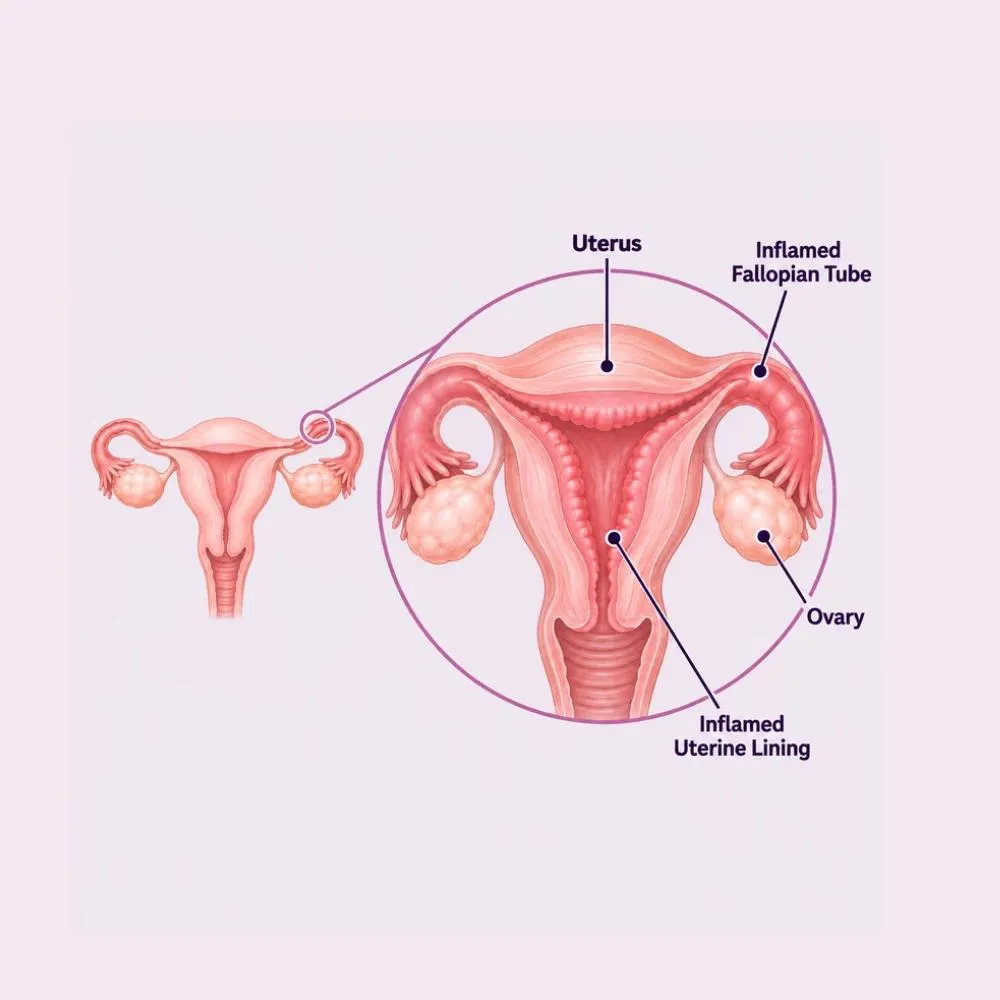
Pelvic inflammatory disease is an infection of the upper female genital tract: the uterus, fallopian tubes, ovaries and surrounding pelvic peritoneum. It occurs when bacteria ascend from the vagina and cervix into structures that are normally sterile. Depending on where the infection settles, it may be described as endometritis, salpingitis, oophoritis or peritonitis, though in practice several are usually involved together.
Most PID is caused by sexually transmitted infection, chiefly chlamydia and gonorrhoea, though a mixed picture including normal vaginal bacteria is common. The cervix normally acts as a barrier; anything that breaches it (a procedure, childbirth, miscarriage or the infection itself) allows bacteria upward.
The consequence that defines PID is tubal damage. Inflammation of the fallopian tubes causes scarring and adhesions, and the delicate lining that transports the egg does not regenerate. A single episode raises the risk of infertility appreciably, and the risk climbs steeply with each subsequent one. It also raises the risk of ectopic pregnancy several-fold and can leave chronic pelvic pain. This is why the threshold for starting treatment is deliberately low.
PID follows bacteria ascending past the cervix, most often sexually transmitted but not always.
The commonest cause. Frequently symptomless in both partners, which is precisely why it causes so much silent tubal damage.
Causes more acute, obvious PID than chlamydia, with more marked pain and discharge, and is increasingly antibiotic-resistant.
Anaerobes and other organisms normally present in the vagina frequently participate alongside the sexually transmitted organism.
An increasingly recognised cause, often resistant to the standard first-line regimens and needing specific testing.
IUD insertion, surgical abortion, D&C or hysteroscopy carry a small risk, mainly in the first few weeks afterwards.
The cervix is open and the uterine lining raw, allowing bacteria to ascend. Infection at this stage needs prompt treatment.
Disruption of the normal vaginal flora raises the risk of ascending infection, and is worth treating in its own right.
The IUD risk is widely overstated. It is confined largely to the first three weeks after insertion, and beyond that an IUD does not meaningfully raise PID risk: a point worth knowing before declining effective contraception over it.
PID ranges from silent to severe, and mild disease causes just as much tubal damage as obvious disease.
Common symptoms
Symptoms needing urgent care
A substantial proportion of PID causes few or no symptoms, particularly when chlamydia is responsible. Silent PID scars the tubes just as effectively, and is often only discovered years later during infertility investigation.
There is no single confirmatory test, and treatment is deliberately started on clinical suspicion rather than waiting for results.
Tenderness of the uterus, adnexa, or on moving the cervix. In a woman at risk, that finding alone is enough to start treatment.
Endocervical and vaginal swabs tested for chlamydia, gonorrhoea and mycoplasma. Results guide adjustment rather than delay treatment.
White cell count and inflammatory markers to assess severity, and a pregnancy test to exclude ectopic pregnancy.
Often normal in mild PID. Its main role is detecting a tubo-ovarian abscess or excluding other causes of pelvic pain.
HIV, syphilis and hepatitis offered where a sexually transmitted cause is confirmed, since co-infection is common.
The most accurate test but rarely needed. Reserved for diagnostic uncertainty or where an abscess requires drainage.
Treating on suspicion means some women receive antibiotics who did not need them. That trade-off is deliberate and correct: the cost of a missed diagnosis is permanent tubal damage.
PID is treated with antibiotics, started immediately. Surgery is only for abscess or failed treatment.
A regimen covering chlamydia, gonorrhoea and anaerobes together, typically for fourteen days. Started on suspicion, before results return.
Refining the regimen once the organism is identified, particularly important with resistant gonorrhoea and mycoplasma.
For severe disease, high fever, pregnancy, an abscess, or where oral treatment has failed, usually with admission.
Sexual partners tested and treated whether or not they have symptoms. Without this, reinfection and further tubal damage follow.
Anti-inflammatories and rest during the acute phase, with abstinence from intercourse until treatment is complete.
An IUD can usually stay if treatment is working. Removal is considered where there is no improvement after seventy-two hours.
A tubo-ovarian abscess drained under ultrasound or CT guidance through a needle, avoiding open surgery in many cases.
Keyhole drainage of an abscess with washout of the pelvis, where percutaneous drainage is unsuitable or has failed.
Division of adhesions causing chronic pain or infertility after previous PID, done laparoscopically.
Removal of a severely damaged, fluid-filled tube (a hydrosalpinx) which improves IVF success rates considerably.
For a ruptured abscess causing peritonitis, which is a life-threatening emergency requiring immediate operation.
Completing the full fourteen days matters more here than in almost any other infection. Symptoms settle within days, but stopping early leaves residual infection that continues quietly scarring the tubes.
Most women are treated as outpatients over fourteen days, with review at three days and at the end of the course.
Prompt antibiotic course with follow-up
History, examination and pregnancy test. Where tenderness is present in a woman at risk, treatment starts at this visit.
Endocervical and vaginal swabs for NAAT testing, plus blood tests where the picture suggests more severe disease.
A broad-spectrum combination begun the same day. Waiting for results before treating is what causes preventable tubal damage.
Arranging testing and treatment for sexual partners, whether or not they have symptoms. This step prevents reinfection.
Checking that symptoms are improving. No improvement by this point prompts reassessment for abscess or an alternative diagnosis.
Fourteen days in full, with abstinence from intercourse throughout and until partners have completed treatment.
Review at the end of the course, repeat testing where indicated, and an honest discussion of the implications for future fertility.
Failure to improve within seventy-two hours is a signal, not something to wait out. It usually means an abscess has formed, a resistant organism is involved, or the diagnosis is something else.
In PID the damage is done by delay, not by the infection being untreatable. Here is why patients trust us:
Antibiotics started at the first visit where the picture fits, because waiting for swab results is what costs women their fertility.
Private consultations, discreet testing, and practical help with partner notification without lecturing.
From the first consultation through to post-treatment follow-up, with one team throughout.
Our hospital is in HITEC CITY, near IKEA: easily reachable from across Hyderabad.
Symptoms improve within days of starting antibiotics, but the full course and partner treatment determine the long-term outcome.
Antibiotics started. Pain and fever begin settling. Rest and abstinence from intercourse throughout.
Review to confirm improvement. Lack of response prompts reassessment for abscess or an alternative diagnosis.
Symptoms largely resolve, but the full fourteen-day course must be completed. Partners treated during this period.
End-of-course review, with repeat testing where indicated. Intercourse resumes once you and your partners have completed treatment.
Where fertility is a concern, tubal patency can be assessed later. Any recurrence is treated urgently.
Symptoms settle within days, but stopping early leaves residual infection quietly scarring the tubes. This is the single most important instruction.
Untreated partners cause reinfection, and each further episode compounds tubal damage. They need treating whether or not they have symptoms.
No intercourse until you and your partners have completed the full course and symptoms have resolved.
This usually means an abscess has formed or a resistant organism is involved. It needs reassessment rather than waiting it out.
Barrier protection is what prevents further episodes, and each episode you avoid meaningfully protects your fertility.
If you are planning a pregnancy after PID, tubal patency can be assessed. Knowing early opens more options than discovering it later.
One episode of PID raises the risk of tubal infertility appreciably; three episodes raise it very substantially. Preventing the next episode is as important as treating this one.
Book a consultation promptly if any of the following apply.
Uncomplicated PID is inexpensive to treat. Costs rise sharply only where an abscess or admission is involved.
| Procedure | Estimated Cost |
|---|---|
| Consultation Urgent appointment | ₹800 – ₹1,500 |
| Swabs and NAAT testing Chlamydia, gonorrhoea, mycoplasma | ₹3,000 – ₹8,000 |
| Blood tests Inflammatory markers, pregnancy test | ₹1,200 – ₹3,500 |
| Pelvic ultrasound To exclude abscess | ₹1,500 – ₹3,500 |
| Oral antibiotic course Fourteen days | ₹1,000 – ₹3,500 |
| Admission with IV antibiotics Three to five days for severe disease | ₹45,000 – ₹1,20,000 |
| Laparoscopic drainage of abscess Includes admission | ₹1,40,000 – ₹2,60,000 |
Early PID treated as an outpatient costs a few thousand rupees. A tubo-ovarian abscess needing admission and surgery is far more.
A full NAAT panel with additional STI screening costs more than basic swabs, but is what makes treatment reliably targeted.
Late presentation means abscess, admission and sometimes surgery. Presenting early is the single largest cost saving.
A shared ward, a twin-sharing room or a private suite: the largest single swing in most estimates.
We are empanelled with most major insurers, and our team files the pre-authorisation for you.
Every figure above is an indicative range, not a quote. After your consultation you are given a written, fixed-cost estimate, and that is the number you pay, with no additions once treatment begins.
The gynaecologists who treat pelvic inflammatory disease at our HITEC CITY hospital.

Consultant Gynaecologist & Advanced Laparoscopic Surgeon
MBBS, MS, FMAS
16 years experience

Consultant Obstetrician, Gynecologist & Laparoscopic Surgeon
MBBS, MS (Obstetrics & Gynaecology)
11 years experience
Reviews from women treated for gynaecological conditions at Lux Hospitals, Hyderabad.
Written by Dr. Harshita Kakarla on women’s health and gynaecological care.
Dr. Harshita Kakarla

Dr. Harshita Kakarla

Dr. Harshita Kakarla

Dr. Harshita Kakarla

Dr. Harshita Kakarla
Dr. Harshita Kakarla
Common questions about pelvic inflammatory disease, fertility and what treatment costs at Lux Hospitals.
Still have questions? Call us at 079 6908 4422
Still have questions? Message us on WhatsApp at 079 6908 4444
Prompt treatment of pelvic infection to protect your fertility, with confidential testing and costs shared upfront.
Plot No.116, Lumbini Avenue, HITEC CITY, Near IKEA, Hyderabad – 500032













