
Dr. Samhitha Reddy
Consultant Proctologist & Laparoscopic Surgeon
MBBS, MS, FMAS, FISCP, DMAS
- 8 Yrs
- ASCRS Member
Kidney cysts are fluid-filled sacs within the kidney, and they are extremely common: found in around a quarter of people over fifty, usually on a scan done for something else entirely.
The overwhelming majority are simple, harmless and need nothing at all. The clinical work is in identifying the small minority that are complex and need following, and treating the few that grow large enough to cause symptoms. Our urologists at Lux Hospitals, HITEC CITY classify the cyst properly and treat only what warrants it.
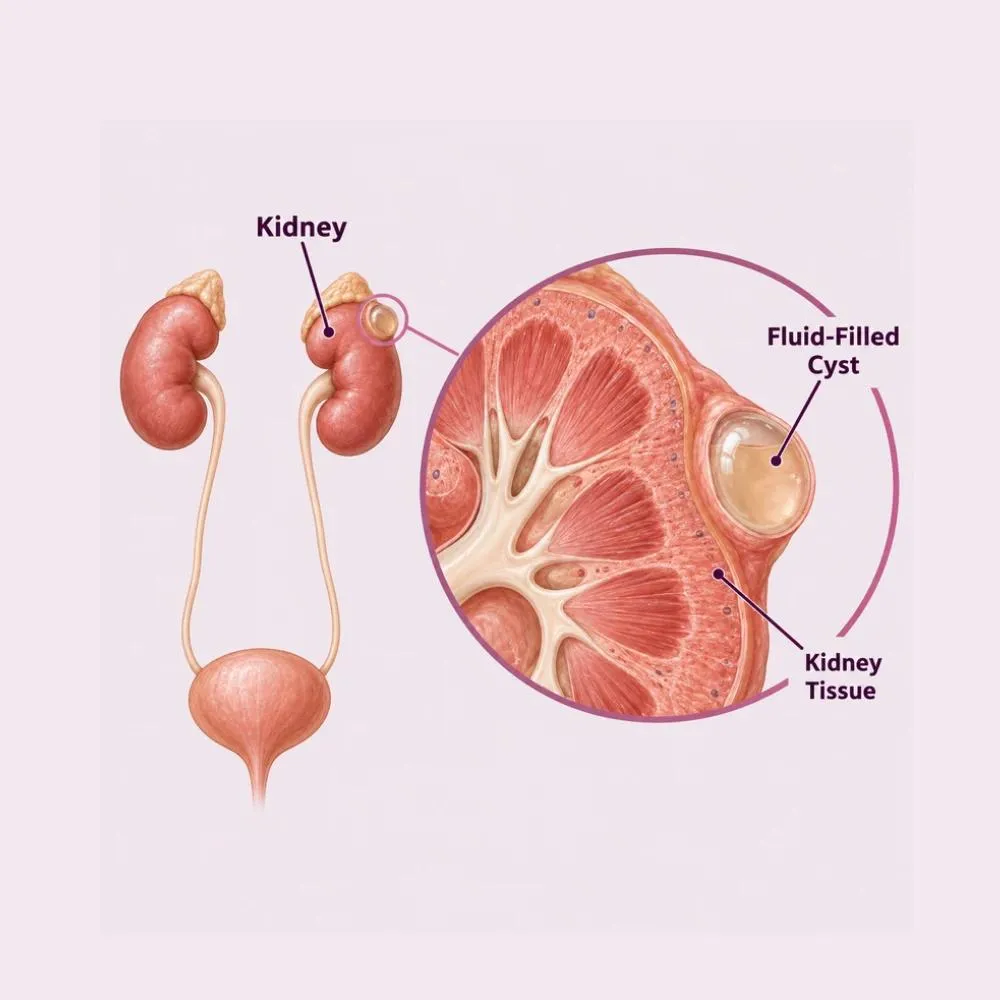
A kidney cyst is a round, fluid-filled sac forming within or on the surface of the kidney. Most arise in the cortex (the outer layer) and are described as cortical cysts. They develop when a small tubule becomes obstructed or a weakness in the tubule wall balloons outward, and they are so common with age that they are considered a normal finding.
The important distinction is between simple and complex. A simple cyst has thin smooth walls, contains clear fluid, has no internal partitions and does not take up contrast on a scan. These are benign, carry essentially no cancer risk, and need no treatment or follow-up. A complex cyst has thickened or irregular walls, internal septations, calcification or areas that enhance with contrast, and some of those harbour cancer.
Complex cysts are graded by the Bosniak classification, from I to IV, which translates directly into how likely malignancy is and what should be done. Bosniak I and II are benign and need nothing; IIF needs surveillance; III carries a substantial cancer risk and IV is treated as cancer until proven otherwise. This grading is what the whole assessment is for.
Simple cysts are largely a consequence of ageing. Complex and multiple cysts have more specific causes.
By far the commonest factor. Simple cysts are found in around a quarter of people over fifty and half of those over seventy.
A small kidney tubule becomes blocked and the fluid behind it accumulates, forming a sac. The likely mechanism for most simple cysts.
A diverticulum-like outpouching from a tubule that gradually fills and enlarges over years.
An inherited condition producing numerous cysts in both kidneys. Quite different from an isolated simple cyst, and diagnosed by the number and pattern.
Multiple cysts developing in people on long-term dialysis. These carry a genuinely raised cancer risk and are monitored.
Trauma or pyelonephritis can leave a complex-looking cyst that is nonetheless benign, though it needs following to prove that.
Both are associated with a higher prevalence, though neither causes cysts directly.
A single simple cyst is a normal finding, not a disease. Multiple cysts in both kidneys is a different matter and raises the question of polycystic kidney disease, which is investigated separately.
Most kidney cysts cause nothing at all. Symptoms appear only when a cyst becomes large, bleeds or becomes infected.
Symptoms of a large cyst
Symptoms needing prompt review
Sudden severe flank pain in someone with a known cyst usually means bleeding into it, which is uncomfortable but generally settles. Pain with fever suggests infection and needs antibiotics that penetrate the cyst wall.
The purpose of the assessment is one question: is this a simple cyst that can be ignored, or a complex one that cannot?
The first test, and often the last. A cyst that is anechoic with thin smooth walls and good through-transmission is simple, and nothing further is needed.
The standard for anything not clearly simple. Enhancement after contrast is the key finding: solid tissue takes up contrast, fluid does not.
Grading I to IV based on wall thickness, septations, calcification and enhancement. This determines whether the cyst is ignored, watched or removed.
Better than CT for characterising septations and for patients in whom contrast or radiation should be avoided.
Creatinine, eGFR and urinalysis, to check that the cyst is not affecting function and to look for blood or infection.
Bosniak IIF cysts are re-imaged at intervals over five years. Stability confirms they are benign; change prompts surgery.
Needle biopsy of a cystic kidney lesion is generally avoided, because sampling error is common and a negative result does not reliably exclude cancer. The imaging classification is more dependable.
Most kidney cysts need no treatment whatsoever. Intervention is for symptoms, or for cysts that may be malignant.
The correct management for a simple Bosniak I or II cyst, however large, provided it causes no symptoms. No follow-up scan is needed.
For Bosniak IIF cysts, repeat scans over about five years. Most remain stable and are then discharged.
Simple analgesia for a symptomatic cyst, avoiding NSAIDs where kidney function is reduced.
An infected cyst needs a prolonged course of an antibiotic that penetrates the cyst wall, sometimes with drainage.
The cyst is drained with a needle under ultrasound or CT guidance and an agent such as alcohol injected to prevent refilling. Minimally invasive, done under local anaesthesia.
Keyhole removal of the outer wall of the cyst so fluid drains into the abdomen and is absorbed. The most durable treatment for a large symptomatic simple cyst.
Removal of the cyst with a margin of kidney tissue where malignancy is suspected (Bosniak III or IV) preserving the rest of the kidney.
Removal of the whole kidney, reserved for a large or centrally placed malignant lesion where partial removal is not feasible.
Occasionally required for very large, complex or previously operated cases where keyhole access is not practical.
Aspiration alone has a high recurrence rate because the cyst lining continues secreting. Adding sclerotherapy improves this considerably, and laparoscopic deroofing is the most durable of the three.
Deroofing takes around sixty to ninety minutes, with one to two nights in hospital.
Keyhole surgery under general anaesthesia
Fasting from midnight, with imaging reviewed to plan port placement and confirm the cyst is benign. Antibiotic given at induction.
General anaesthesia, positioned on your side to bring the kidney forward and let the bowel fall away.
Three or four small ports of five to twelve millimetres. The abdomen is insufflated with carbon dioxide to create working space.
The colon is reflected and the kidney exposed. The cyst is identified and separated from surrounding tissue.
The cyst is drained and the interior inspected directly. Clear fluid and a smooth lining confirm it is benign; anything suspicious is biopsied.
The exposed wall is excised well back to the kidney surface and the edge sealed. Removing enough wall is what prevents refilling.
The wall is sent for histology, ports removed and incisions closed. Most patients go home the following day.
The cyst wall always goes for histology even when everything looks benign. It is a small step that occasionally changes the diagnosis, and skipping it serves no one.
Most kidney cysts need nothing. The value is in classifying them correctly and not over-treating. Here is why patients trust us:
Cysts graded on contrast imaging so the small minority carrying cancer risk are identified and the rest are left alone.
Keyhole deroofing and partial nephrectomy, with smaller incisions and faster recovery than open surgery.
From the first consultation through to post-treatment follow-up, with one team throughout.
Our hospital is in HITEC CITY, near IKEA: easily reachable from across Hyderabad.
Aspiration is a same-day procedure. After laparoscopic deroofing, most people return to work within two weeks.
After aspiration, home the same day with minimal discomfort. After deroofing, mobilising the same evening with light diet.
Discharge after deroofing, usually on day one. Port-site soreness and some shoulder-tip discomfort from the gas, which settles.
Pain settles steadily. Walking encouraged. Wound review and histology result discussed at around a week.
Most people return to desk work within two weeks. Light exercise resumes; heavy lifting still avoided.
Full activity including gym and heavy lifting. A follow-up scan at three to six months confirms the cyst has not refilled.
Early mobilisation after keyhole surgery reduces the risk of clots and chest problems and speeds recovery considerably.
Nothing over five kilograms. Port sites need time to heal fully before abdominal strain.
The excised cyst wall is examined. Make sure you receive that result rather than assuming no news is good news.
A Bosniak IIF cyst is followed for about five years. Skipped scans defeat the entire purpose of surveillance.
A Bosniak I cyst has essentially no cancer risk regardless of size, and needs no repeat scan at all.
Fever, spreading redness at a port site, or increasing rather than settling pain needs review rather than waiting.
The most common outcome of a kidney cyst consultation is reassurance and no treatment. That is a good result, not a wasted visit: knowing a lesion is benign has real value.
Book a consultation if any of the following apply.
Most people need only a consultation and a scan. Costs apply only where the cyst is symptomatic or suspicious.
| Procedure | Estimated Cost |
|---|---|
| Consultation Includes review of existing scans | ₹800 – ₹1,500 |
| Kidney ultrasound Often sufficient on its own | ₹1,500 – ₹3,500 |
| Contrast-enhanced CT For Bosniak classification | ₹6,000 – ₹14,000 |
| MRI kidney Where CT contrast is unsuitable | ₹8,000 – ₹18,000 |
| Aspiration with sclerotherapy Day care, image-guided | ₹35,000 – ₹70,000 |
| Laparoscopic cyst deroofing One to two nights in hospital | ₹1,10,000 – ₹1,90,000 |
| Laparoscopic partial nephrectomy Where malignancy is suspected | ₹2,20,000 – ₹3,80,000 |
A simple cyst needs only a consultation and a scan. The large majority of people go no further than that.
A benign symptomatic cyst is deroofed. A Bosniak III or IV lesion is treated as cancer, with partial nephrectomy and histology.
Multiple cysts, very large ones, or a cyst deep within the kidney take longer and are technically more demanding.
A shared ward, a twin-sharing room or a private suite: the largest single swing in most estimates.
We are empanelled with most major insurers, and our team files the pre-authorisation for you.
Every figure above is an indicative range, not a quote. After your consultation you are given a written, fixed-cost estimate, and that is the number you pay, with no additions once treatment begins.
The urologists who treat kidney cysts at our HITEC CITY hospital.

Consultant Urologist & Andrologist
MBBS, MS, DrNB (Urology)
10 years experience

Consultant Urologist & Andrologist
MBBS, MS, MCh (Urology)
9 years experience
Reviews from patients treated for kidney and urological conditions at Lux Hospitals, Hyderabad.
Written by Dr. Vipin Reddy B on kidney health and urological care.

Dr. Vipin Reddy B

Dr. Vipin Reddy B

Dr. Vipin Reddy B

Dr. Vipin Reddy B

Dr. Vipin Reddy B

Dr. Vipin Reddy B
Common questions about kidney cysts, when they need treatment and what care costs at Lux Hospitals.
Still have questions? Call us at 079 6908 4422
Still have questions? Message us on WhatsApp at 079 6908 4444
Proper classification of your kidney cyst and treatment only where it is warranted, with costs shared upfront.
Plot No.116, Lumbini Avenue, HITEC CITY, Near IKEA, Hyderabad – 500032