



Dr. Samhitha Reddy
Consultant Proctologist & Laparoscopic Surgeon
MBBS, MS, FMAS, FISCP, DMAS
- 8 Yrs
- ASCRS Member
Vulvodynia is chronic pain of the vulva (burning, stinging or rawness lasting more than three months) with no infection, skin disease or other cause to explain it.
Because everything looks normal, women are frequently told there is nothing wrong. There is: this is a recognised nerve-related pain condition, and it responds to treatment aimed at nerves and muscles rather than at infection. Our gynaecologists at Lux Hospitals, HITEC CITY treat it as the pain condition it is.
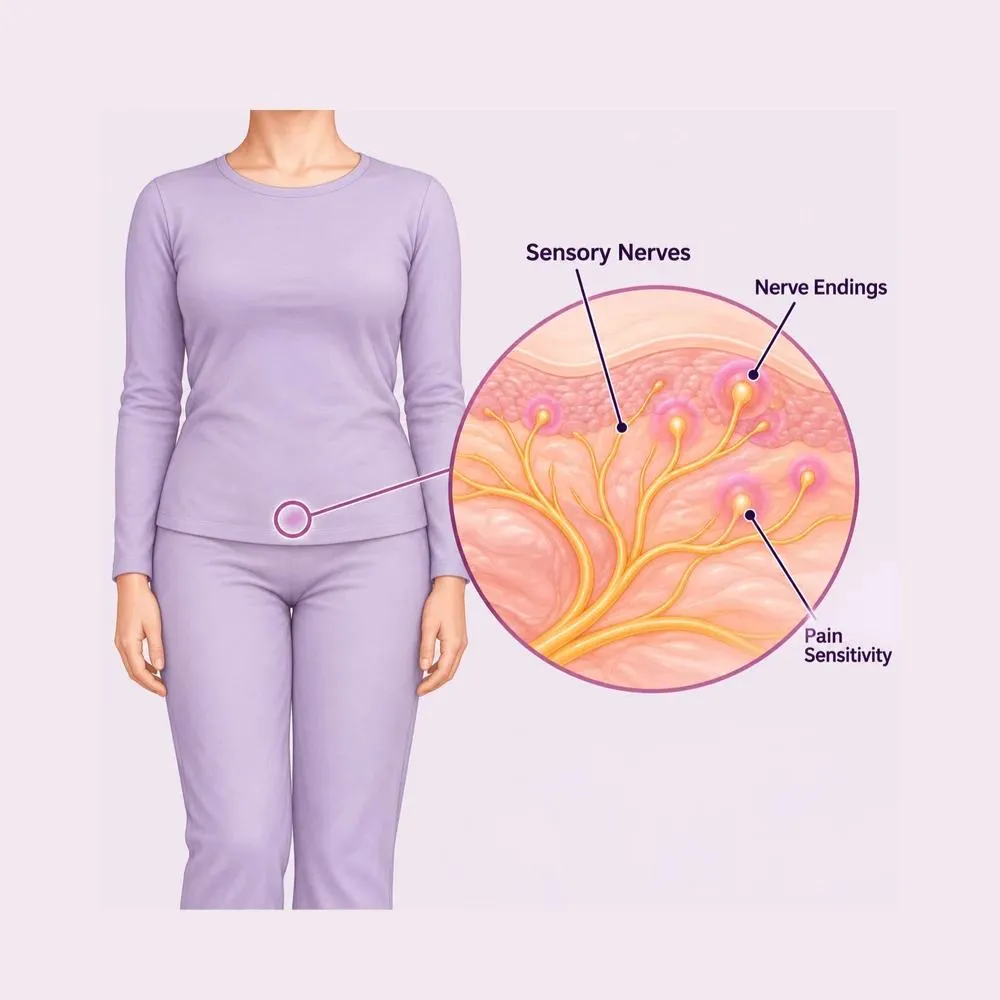
Vulvodynia is chronic vulval pain persisting for three months or more without an identifiable cause. The pain is typically described as burning, stinging, rawness or a feeling of acid on the skin: descriptions characteristic of nerve pain rather than of inflammation or infection. On examination the vulva usually looks entirely normal, which is a large part of why the condition goes unrecognised.
It divides by where the pain is and what provokes it. Localised vulvodynia, most often vestibulodynia, affects the vestibule at the vaginal entrance and is typically provoked: triggered by touch, tampon insertion or intercourse. Generalised vulvodynia affects the whole vulva and is often unprovoked, present regardless of contact. Many women have a mixed picture.
The mechanism appears to involve increased density and sensitisation of nerve fibres in the vulval tissue, alongside central changes in how pain signals are processed. Pelvic floor muscles usually become chronically tight in response, which then contributes its own pain, so treatment addresses nerves and muscles together rather than either alone.
No single cause has been established, and several mechanisms appear to act together.
Increased density and hypersensitivity of nerve fibres in the vulval tissue, so ordinary touch is registered as pain. The core mechanism.
Symptoms often begin after an episode of thrush or a urinary infection, as though the initial inflammation sets off lasting nerve changes.
Chronically tight, spasming muscles both result from and perpetuate the pain, forming a self-sustaining cycle.
Low oestrogen states (after menopause, on some hormonal contraceptives, or while breastfeeding) are associated with vestibular pain.
Long-term use of scented soaps, washes, wipes and repeated antifungal creams damages the skin barrier and sensitises the tissue.
Some women appear predisposed to inflammatory responses and to amplified pain processing, which runs in families.
The overlap with fibromyalgia, irritable bowel syndrome and interstitial cystitis points to a shared tendency toward heightened pain processing.
Vulvodynia is not psychological, not imagined, and not caused by anxiety, though living with unexplained chronic pain understandably produces anxiety, which then makes the pain harder to bear.
The quality of the pain is characteristic, and it occurs against a vulva that looks entirely normal.
Pain characteristics
Associated features
The pattern that most points to vulvodynia is repeated treatment for thrush that never helps, with swabs that keep coming back negative. That is not a stubborn infection: it is a different condition entirely.
It is a diagnosis of exclusion, made by ruling out everything treatable and mapping the pain precisely.
When it began, whether it is provoked or constant, its character, and what has already been tried. Failed antifungal courses are themselves informative.
Light touch with a cotton bud at defined points around the vestibule, mapping exactly where pain is triggered. The key clinical test.
Swabs for candida, bacterial vaginosis, trichomonas and herpes. Negative results in a woman treated repeatedly for thrush are a strong pointer.
Careful examination for lichen sclerosus, lichen planus, eczema and psoriasis, all of which cause vulval pain and are treatable.
Examining for muscle tightness, spasm and trigger points, which are present in most women with vulvodynia and are directly treatable.
Only where the skin looks abnormal. A biopsy of normal-looking skin adds nothing and risks worsening the pain.
The cotton swab test is simple and takes minutes, yet it is rarely performed. Mapping exactly where pain is provoked distinguishes localised vestibulodynia from generalised vulvodynia, and the treatments differ.
Treatment combines nerve pain medication, pelvic floor therapy and psychological support. Most women need more than one.
Stopping all soaps, washes, wipes and antifungal creams, using a plain emollient instead. This alone helps a meaningful proportion.
Manual release of tight pelvic floor muscles, with dilator work where needed. One of the best-evidenced treatments, and not Kegels, which worsen it.
Local anaesthetic ointment applied before intercourse, or overnight to the vestibule as a longer-term desensitising approach.
Where low oestrogen is contributing: after menopause, on hormonal contraception, or while breastfeeding.
Simple measures for symptomatic relief during flares, avoiding anything scented or medicated.
A low-dose tricyclic that calms nerve pain, taken at night. Used for pain modulation rather than depression, and often the mainstay.
Nerve pain medications that reduce the abnormal signalling, useful particularly in generalised vulvodynia.
Local anaesthetic with or without steroid injected around the pudendal nerve, for pain not controlled by oral treatment.
Into the pelvic floor muscles, breaking the spasm cycle where physiotherapy alone has not succeeded.
Effective for the pain itself and for the avoidance and relationship strain that accompany it. Its benefit persists after the course ends.
Surgical excision of the painful vestibular tissue. A last resort for localised provoked vestibulodynia, with good results in carefully selected women.
Kegel exercises make vulvodynia worse. The pelvic floor here is too tight already and needs releasing, not strengthening: a distinction that is frequently got wrong and costs women months of unnecessary pain.
Treatment works in combination and over months. Single interventions rarely resolve chronic vulval pain on their own.
Multidisciplinary programme over months
Pain history, cotton swab mapping, swabs to exclude infection, skin examination and pelvic floor assessment.
Naming the condition and explaining the nerve mechanism. Many women find this the single most valuable part, after years of being told nothing is wrong.
Stopping all soaps, washes, wipes and antifungal creams, and switching to a plain emollient and cotton underwear.
Referral for manual release therapy, typically weekly for eight to twelve sessions with home techniques between.
Topical lidocaine, and an oral nerve pain agent such as amitriptyline or gabapentin, built up slowly to an effective dose.
Cognitive behavioural therapy or sex therapy alongside, addressing avoidance, anxiety and the effect on relationships.
Nerve blocks, botulinum toxin, or vestibulectomy for carefully selected women with localised provoked pain.
Nerve pain medications need building up slowly and given six to eight weeks at an adequate dose. Abandoning them after two weeks because nothing has changed is the commonest reason treatment appears to fail.
Vulvodynia is under-recognised and repeatedly mistreated as thrush. Here is why patients trust us:
Cotton swab mapping, exclusion of skin disease and infection, and a named diagnosis instead of another antifungal prescription.
Nerve pain medication, pelvic floor physiotherapy and psychological support combined, because treating any one alone rarely works.
From the first consultation through to post-treatment follow-up, with one team throughout.
Our hospital is in HITEC CITY, near IKEA: easily reachable from across Hyderabad.
Improvement is gradual and measured in months. Most women improve substantially; complete resolution is less predictable.
Diagnosis established and irritants removed. Some women improve noticeably from stopping soaps and antifungal creams alone.
Pelvic floor physiotherapy underway and medication built up. Nerve pain agents need six to eight weeks at dose before being judged.
Meaningful improvement usually apparent. Intercourse may become possible again, often with topical lidocaine initially.
Further gains consolidate. Where progress has stalled, nerve blocks, botulinum toxin or surgery are considered.
Ongoing management with flare plans. Many women reach a point where the condition no longer dominates daily life.
The pelvic floor in vulvodynia is too tight already. Strengthening it worsens the pain: it needs releasing, which is what physiotherapy does.
Repeated antifungals on a vulva without infection damage the skin barrier and sensitise the tissue further. Use a plain emollient and water only.
Amitriptyline and gabapentin need building up slowly and six to eight weeks at an adequate dose. Stopping early is why they seem not to work.
Tight clothing, synthetic underwear and prolonged sitting all provoke symptoms. Small practical changes make a real difference.
Avoidance of intimacy is nearly universal and strains relationships considerably. Sex therapy addresses what medication cannot.
Applied twenty minutes beforehand, it makes intercourse possible again for many women, and breaking the cycle of anticipated pain matters in itself.
Being believed is a substantial part of the treatment. Many women arrive having been told for years that nothing is wrong, and simply having the condition named and explained changes how manageable it feels.
Book a consultation if any of the following apply.
Medication and skin care cost little. Physiotherapy and psychological therapy are the recurring costs.
| Procedure | Estimated Cost |
|---|---|
| Consultation Per visit | ₹800 – ₹1,500 |
| Swabs and infection screen To exclude treatable causes | ₹1,500 – ₹4,000 |
| Vulval biopsy Only where the skin looks abnormal | ₹8,000 – ₹18,000 |
| Topical treatments Per month; lidocaine, emollients, oestrogen | ₹500 – ₹2,000 |
| Oral nerve pain medication Per month | ₹300 – ₹1,800 |
| Pelvic floor physiotherapy Per session; eight to twelve sessions | ₹800 – ₹2,000 |
| Pudendal nerve block Per procedure | ₹18,000 – ₹40,000 |
| Vestibulectomy Day care or one night | ₹1,10,000 – ₹2,00,000 |
Most women need medication, physiotherapy and psychological support together, and the combination is what accumulates cost.
Pelvic floor physiotherapy runs to eight to twelve sessions, and CBT a similar course. Both are the main recurring expense.
Vestibulectomy is a last resort for a minority. Most women are managed without any operation.
A shared ward, a twin-sharing room or a private suite: the largest single swing in most estimates.
We are empanelled with most major insurers, and our team files the pre-authorisation for you.
Every figure above is an indicative range, not a quote. After your consultation you are given a written, fixed-cost estimate, and that is the number you pay, with no additions once treatment begins.
The gynaecologists who treat chronic vulval pain at our HITEC CITY hospital.

Consultant Gynaecologist & Advanced Laparoscopic Surgeon
MBBS, MS, FMAS
16 years experience

Consultant Obstetrician, Gynecologist & Laparoscopic Surgeon
MBBS, MS (Obstetrics & Gynaecology)
11 years experience
Reviews from women treated for gynaecological conditions at Lux Hospitals, Hyderabad.
Written by Dr. Harshita Kakarla on women’s health and gynaecological care.
Dr. Harshita Kakarla

Dr. Harshita Kakarla

Dr. Harshita Kakarla

Dr. Harshita Kakarla

Dr. Harshita Kakarla

Dr. Harshita Kakarla
Common questions about vulvodynia, chronic vulval pain and what treatment costs at Lux Hospitals.
Still have questions? Call us at 079 6908 4422
Still have questions? Message us on WhatsApp at 079 6908 4444
Chronic vulval pain properly diagnosed and treated as the nerve condition it is, with costs shared upfront.
Plot No.116, Lumbini Avenue, HITEC CITY, Near IKEA, Hyderabad – 500032













