



Dr. Samhitha Reddy
Consultant Proctologist & Laparoscopic Surgeon
MBBS, MS, FMAS, FISCP, DMAS
- 8 Yrs
- ASCRS Member
A hysterectomy removes the uterus. It is one of the most commonly performed operations in gynaecology, and it definitively ends heavy bleeding, fibroid symptoms and prolapse of the uterus.
It is also performed more often than it needs to be. Our gynaecologists at Lux Hospitals, HITEC CITY will tell you honestly what the alternatives are before recommending it, and where hysterectomy genuinely is the right operation, do it laparoscopically so recovery is measured in weeks rather than months.
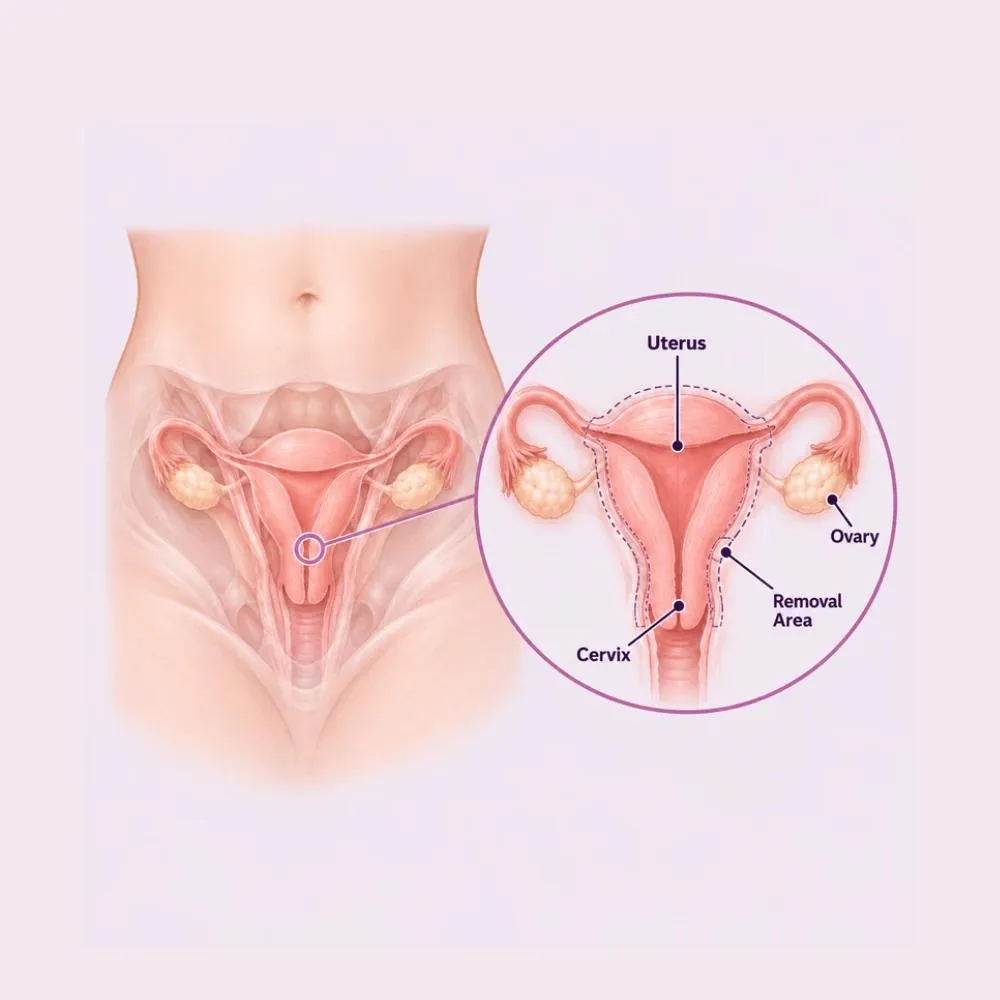
A hysterectomy is the surgical removal of the uterus. What else is removed alongside it varies, and the terminology is worth getting straight. A total hysterectomy removes the uterus and cervix: this is the usual operation, and despite the name it does not include the ovaries. A subtotal or supracervical hysterectomy leaves the cervix in place. A radical hysterectomy removes the uterus, cervix, surrounding tissue and the upper vagina, and is performed for cancer.
The ovaries are a separate decision entirely. Removing them (oophorectomy) causes immediate surgical menopause regardless of your age, with hot flushes, bone loss and cardiovascular effects that are more abrupt than natural menopause. In a premenopausal woman with no specific reason to remove them, the ovaries are generally conserved, and that should be an explicit conversation rather than an assumption.
The route matters as much as the extent. A laparoscopic or vaginal hysterectomy avoids a large abdominal incision, which means less pain, a shorter stay and a return to normal activity in three to four weeks rather than six to eight. Open abdominal hysterectomy remains necessary for very large uteri, extensive adhesions and most cancers, but where a minimally invasive route is feasible, it is clearly preferable.
The decision usually follows a sequence, and each step is worth understanding before consenting.
A hormonal IUD, tranexamic acid, ablation or myomectomy tried and found insufficient. This is the commonest and most defensible route to hysterectomy.
Fibroids and adenomyosis return after conservative treatment. Where family is complete, hysterectomy is the only option that ends it permanently.
Hysterectomy ends fertility absolutely and irreversibly. This is the single most important factor in the decision, and it deserves unhurried thought.
Where malignancy or atypical hyperplasia is confirmed, hysterectomy is the treatment rather than one option among several.
Anaemia requiring transfusion, pain preventing work, or bleeding dominating daily life all shift the balance toward definitive surgery.
Where the uterus has descended and pessary or repair has not helped, hysterectomy is often combined with prolapse repair.
If a hysterectomy is offered at a first consultation for a benign condition, it is entirely reasonable to ask what else could be tried and to seek a second opinion. A good surgeon will not be offended by either.
Hysterectomy is an appropriate operation for specific problems that have not responded to less drastic treatment.
Common indications
Urgent or oncological indications
For most benign indications there is a less drastic alternative worth trying first: a hormonal IUD, endometrial ablation, myomectomy, embolisation. A hysterectomy that follows a fair trial of those is a different decision from one offered straight away.
The assessment establishes the cause of your symptoms, confirms that hysterectomy is warranted, and determines the safest route.
Measures the uterus, maps fibroids, assesses the endometrium and checks the ovaries. It also determines whether the uterus is small enough for a vaginal or laparoscopic route.
Essential before hysterectomy for abnormal bleeding, to exclude hyperplasia or cancer. This can change the operation entirely.
An up-to-date smear, since cervical abnormality changes whether the cervix should be removed and how.
Haemoglobin and ferritin, since anaemia from prolonged bleeding is corrected before surgery rather than after.
For very large fibroids, suspected adenomyosis, or where adhesions from previous surgery are likely.
An explicit discussion of what else could be tried, and a separate decision about whether the ovaries stay: these are not the same conversation.
An endometrial biopsy before hysterectomy for abnormal bleeding is not a formality. Finding cancer beforehand changes the operation from a routine hysterectomy to staging surgery with an oncologist.
Four routes, chosen on uterine size, the reason for surgery, previous operations and prolapse.
The uterus removed entirely through keyhole ports, usually through the vagina. Small incisions, one to two nights, and back to normal in three to four weeks.
Removal entirely through the vagina with no abdominal incision at all. Excellent recovery, and the preferred route where the uterus is not enlarged, particularly with prolapse.
Keyhole surgery to free the uterus, with removal through the vagina. Used where adhesions or endometriosis make a purely vaginal route difficult.
Laparoscopic surgery with robotic instruments, offering greater dexterity in complex cases. Outcomes are similar to standard laparoscopy at higher cost.
Through a horizontal or vertical incision. Necessary for very large uteri, dense adhesions or cancer. Recovery takes six to eight weeks.
The body of the uterus removed and the cervix left. Quicker with fewer urinary complications, but cervical screening must continue.
Ovaries removed alongside, where there is ovarian disease, cancer risk, or after menopause. It causes immediate surgical menopause in a premenopausal woman.
Uterus, cervix, surrounding tissue and upper vagina removed for cervical cancer, with lymph node assessment.
Vaginal wall and vault support procedures done at the same time where prolapse involves more than the uterus.
Vaginal hysterectomy has the best recovery of all the routes and no abdominal incision whatsoever. Where the uterus is a suitable size, it is the first choice: a fact that is often overlooked in favour of laparoscopy.
The operation takes ninety minutes to two and a half hours, with one to two nights in hospital.
Keyhole surgery under general anaesthesia
Anaemia corrected beforehand, fasting from midnight, and antibiotics and clot prevention given at induction.
General anaesthesia, positioned with the head slightly down so the bowel falls away from the pelvis. A catheter is placed.
A camera port at the umbilicus and three small ports across the lower abdomen, with the abdomen insufflated with carbon dioxide.
The round ligaments and the ligaments carrying the blood supply are sealed and divided in sequence, working down each side.
The ureters are traced and kept in view throughout. Ureteric injury is the complication that matters most in this operation, and this step is what prevents it.
The bladder pushed down off the cervix, and the uterine arteries sealed. The vagina is then opened around the cervix.
The uterus delivered through the vagina, the vaginal vault closed with sutures and its support secured, and the ports closed.
The ureters run within a centimetre of the uterine arteries. Keeping them identified throughout is the single most important safety step in a hysterectomy, and it is why the operation takes as long as it does.
Hysterectomy is a good operation for the right indication and the wrong one for many others. Here is why patients trust us:
What else could be tried is set out before hysterectomy is recommended, and a second opinion is welcomed rather than discouraged.
Vaginal and laparoscopic routes preferred, so recovery is three to four weeks instead of six to eight.
From the first consultation through to post-treatment follow-up, with one team throughout.
Our hospital is in HITEC CITY, near IKEA: easily reachable from across Hyderabad.
Recovery after laparoscopic or vaginal surgery is three to four weeks. After open surgery it is six to eight.
Catheter removed and mobilising the day after surgery. Discharge at one to two days after keyhole or vaginal surgery.
Light vaginal bleeding and discharge is expected and can last several weeks. Fatigue is common. Short walks daily.
Most women return to desk work at three to four weeks after minimally invasive surgery. Driving once you can perform an emergency stop.
Follow-up examination confirms the vaginal vault has healed. Intercourse resumes after clearance at six weeks.
Full activity including exercise and lifting. Energy returns fully over this period, sometimes later than expected.
The vaginal vault takes six weeks to heal. Early intercourse risks the suture line opening, which is uncommon but serious.
Nothing over five kilograms. This protects both the vault repair and the abdominal wall while they heal.
Light bleeding and brownish discharge is normal for up to six weeks as the internal sutures dissolve. Heavy bleeding is not.
After subtotal hysterectomy the cervix remains and still needs screening. After total hysterectomy for benign disease, smears usually stop.
Oophorectomy before natural menopause causes abrupt surgical menopause. Hormone replacement protects bone and heart and is usually recommended.
Bleeding heavier than a period, offensive discharge, fever, or a swollen painful calf all need urgent review.
The emotional side deserves acknowledging. Even where a hysterectomy brings enormous relief, many women feel a sense of loss afterwards. That is common, it is not irrational, and it is worth talking about rather than dismissing.
Book a consultation if any of the following apply.
Cost depends mainly on the surgical route and the length of stay it requires.
| Procedure | Estimated Cost |
|---|---|
| Consultation Includes examination | ₹800 – ₹1,500 |
| Pre-operative workup Bloods, ultrasound, biopsy, ECG, anaesthetic review | ₹5,000 – ₹12,000 |
| Vaginal hysterectomy Two nights; no abdominal incision | ₹1,30,000 – ₹2,30,000 |
| Total laparoscopic hysterectomy One to two nights | ₹1,60,000 – ₹2,90,000 |
| Abdominal hysterectomy Four to five nights | ₹1,40,000 – ₹2,50,000 |
| Hysterectomy with prolapse repair Combined procedure | ₹2,00,000 – ₹3,40,000 |
| Robotic-assisted hysterectomy Includes robotic consumables | ₹2,80,000 – ₹4,50,000 |
Laparoscopic surgery costs more in theatre time and consumables but less in hospital stay. Robotic surgery adds a substantial consumable cost.
A large fibroid uterus, or dense adhesions from previous surgery or endometriosis, lengthens the operation considerably.
Prolapse repair, oophorectomy or adhesiolysis performed at the same time each add to the total.
A shared ward, a twin-sharing room or a private suite: the largest single swing in most estimates.
We are empanelled with most major insurers, and our team files the pre-authorisation for you.
Every figure above is an indicative range, not a quote. After your consultation you are given a written, fixed-cost estimate, and that is the number you pay, with no additions once treatment begins.
The gynaecologists who perform hysterectomy at our HITEC CITY hospital.

Consultant Gynaecologist & Advanced Laparoscopic Surgeon
MBBS, MS, FMAS
16 years experience

Consultant Obstetrician, Gynecologist & Laparoscopic Surgeon
MBBS, MS (Obstetrics & Gynaecology)
11 years experience
Reviews from women treated for gynaecological conditions at Lux Hospitals, Hyderabad.
Written by Dr. Harshita Kakarla on women’s health and gynaecological care.
Dr. Harshita Kakarla

Dr. Harshita Kakarla

Dr. Harshita Kakarla

Dr. Harshita Kakarla

Dr. Harshita Kakarla

Dr. Harshita Kakarla
Common questions about hysterectomy, its approaches, recovery and costs at Lux Hospitals.
Still have questions? Call us at 079 6908 4422
Still have questions? Message us on WhatsApp at 079 6908 4444
An honest discussion of the alternatives, and laparoscopic hysterectomy where it is genuinely the right operation.
Plot No.116, Lumbini Avenue, HITEC CITY, Near IKEA, Hyderabad – 500032













