



Dr. Samhitha Reddy
Consultant Proctologist & Laparoscopic Surgeon
MBBS, MS, FMAS, FISCP, DMAS
- 8 Yrs
- ASCRS Member
Premenstrual syndrome is the cluster of physical and emotional symptoms appearing in the week or two before a period and disappearing once bleeding starts. Most women experience some of it; for a substantial minority it genuinely disrupts life.
The defining feature is timing rather than severity: symptoms that arrive with the luteal phase and vanish with the period. Our gynaecologists at Lux Hospitals, HITEC CITY confirm that pattern with proper charting and treat it in steps rather than dismissing it.
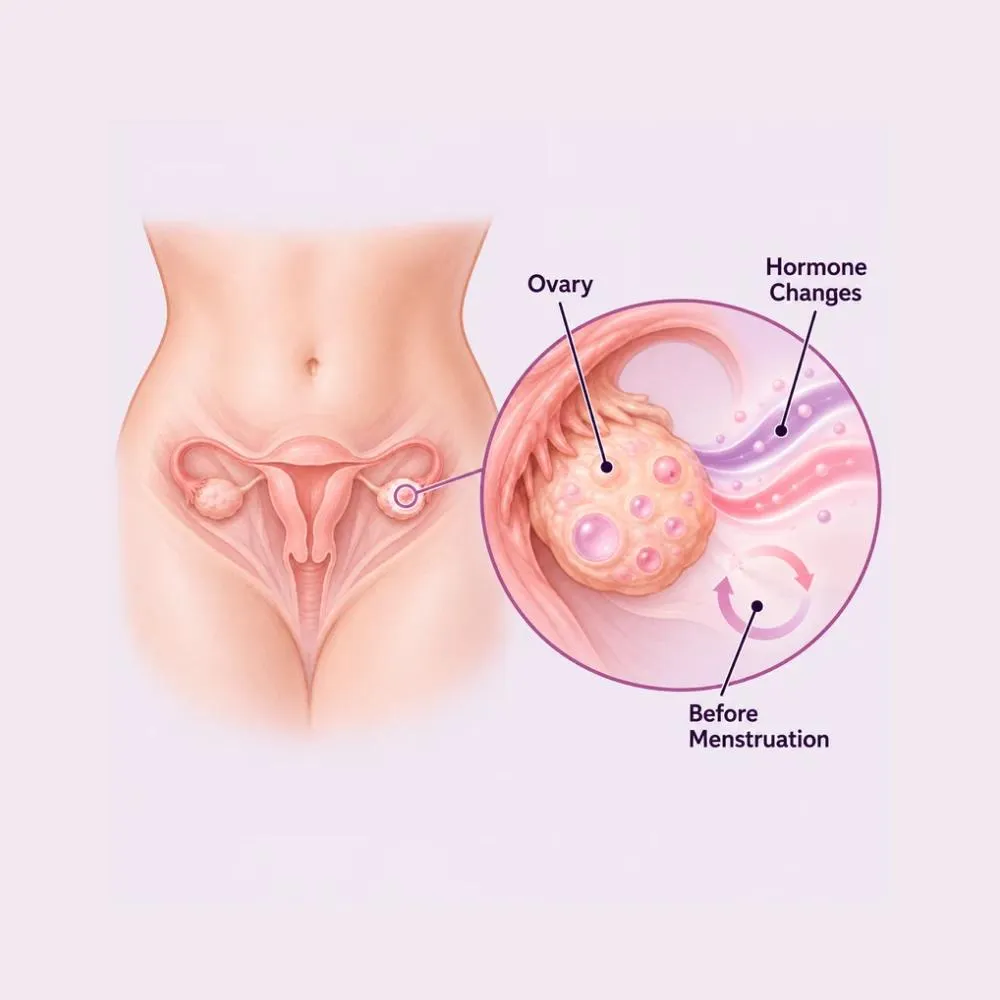
Premenstrual syndrome is a recurrent set of physical, emotional and behavioural symptoms occurring in the luteal phase, the roughly two weeks between ovulation and the start of the period, and resolving within a few days of bleeding beginning. It affects up to three-quarters of women in some form, and around one in twenty severely enough to interfere with work, study or relationships.
The critical feature is the cyclical pattern, not the symptoms themselves. Irritability, bloating and breast tenderness are unremarkable in isolation; what makes them PMS is that they appear reliably after ovulation and disappear reliably with menstruation, with a symptom-free window in the first half of the cycle. Without that clear window, the diagnosis is something else.
The cause is not an abnormal hormone level. Women with PMS have normal oestrogen and progesterone: what differs is sensitivity to the normal fluctuation, particularly the effect of progesterone metabolites on the brain chemical serotonin. That is why treatments raising serotonin work so well, and why simply measuring hormones is unhelpful.
PMS arises from how the brain responds to normal hormonal change rather than from any hormonal abnormality.
Allopregnanolone, a breakdown product of progesterone, acts on brain receptors. Women with PMS appear unusually sensitive to it, which is the leading explanation.
Oestrogen and progesterone influence serotonin, which governs mood, appetite and sleep. This is why SSRIs work so effectively and so quickly here.
PMS occurs only in ovulatory cycles. Suppressing ovulation abolishes it, which is the basis of hormonal treatment.
PMS clusters in families, suggesting an inherited difference in how the brain responds to hormonal shifts.
Low calcium and vitamin D are associated with more severe symptoms, and supplementation has reasonable supporting evidence.
Poor sleep, high caffeine and alcohol intake, low physical activity and chronic stress all worsen symptoms without causing them.
PMS is not a hormonal imbalance, and measuring hormone levels does not diagnose it. Anyone offering to correct your hormones on the basis of a blood test for PMS has misunderstood the condition.
Over a hundred and fifty symptoms have been described. What matters is that yours follow the cycle.
Physical symptoms
Emotional and behavioural
If symptoms are present throughout the cycle and merely worsen before the period, that is not PMS: it is an underlying condition with premenstrual exacerbation, and it is treated quite differently.
There is no blood test. Diagnosis rests entirely on demonstrating the cyclical pattern prospectively.
Recording symptoms daily for two full cycles. This is the diagnostic test: recalling symptoms afterwards is notoriously unreliable.
A clear interval in the first half of the cycle is what distinguishes PMS from an underlying condition that merely worsens premenstrually.
Thyroid function, haemoglobin and ferritin, not to diagnose PMS but to exclude conditions producing similar fatigue and mood symptoms.
Validated questionnaires quantify how much symptoms interfere with work, relationships and daily function, which guides treatment intensity.
Depression and anxiety commonly worsen premenstrually. Distinguishing that from PMS matters, because the treatment differs.
Where emotional symptoms are severe and disabling rather than merely troublesome, premenstrual dysphoric disorder is considered instead.
Two months of daily charting sounds like an imposition, but it is the only reliable way to make this diagnosis, and it frequently reveals a pattern quite different from what the woman expected.
Treatment is stepped, beginning with measures that help most women and escalating only where needed.
Among the best-evidenced non-drug treatments. Regular exercise reduces both physical and emotional symptoms measurably.
Smaller frequent meals with complex carbohydrates, reduced salt, caffeine and alcohol. This steadies blood sugar and reduces bloating and irritability.
The supplements with the best supporting evidence for PMS. Around 1,200 mg of calcium daily has been shown to reduce symptoms.
Consistent sleep timing and structured relaxation. Poor sleep amplifies every other symptom in the luteal phase.
Modest evidence for bloating, breast tenderness and mood. B6 must be kept within safe limits, as excess causes nerve damage.
Effective for the emotional symptoms, with benefits that persist after the course ends: unlike medication, which works only while taken.
The most effective medical treatment. Unusually, they work within a day or two here, so they can be taken only in the luteal phase rather than continuously.
Suppress ovulation and therefore PMS. Continuous or extended regimens work better than a monthly break, since the hormone-free week reproduces symptoms.
NSAIDs for pain and headache, spironolactone for bloating and breast tenderness, addressing specific dominant symptoms.
Transdermal oestrogen suppressing ovulation, with a progestogen or hormonal IUD to protect the uterine lining.
Reserved for severe cases unresponsive to everything else. They abolish the cycle entirely, and require add-back therapy to protect bone.
SSRIs behave differently in PMS than in depression. They work within a day or two rather than weeks, which means many women take them only for the two weeks before their period and stop when it arrives.
Treatment is judged over cycles rather than days, because the condition is inherently cyclical.
Stepped management over several cycles
Daily symptom recording to confirm the cyclical pattern and identify which symptoms actually dominate, often not the ones expected.
Thyroid function, anaemia and mood disorder assessed, since each produces overlapping symptoms and each is treated differently.
Regular exercise, dietary adjustment, sleep routine and calcium supplementation begun together and given two to three cycles.
Comparing charts before and after. This is more reliable than asking whether things feel better, which recall bias distorts.
An SSRI in the luteal phase, or a continuous combined contraceptive, chosen according to whether emotional or physical symptoms dominate.
Specific treatment for whatever remains: spironolactone for bloating, NSAIDs for headache, CBT for persistent emotional symptoms.
Periodic reassessment, since PMS often worsens in the years approaching menopause and treatment may need adjusting.
Judging any PMS treatment needs at least two to three cycles. A single bad month proves nothing, and a single good one proves no more: the chart is what shows whether something is genuinely working.
PMS is frequently dismissed rather than treated, and just as frequently treated without being confirmed. Here is why patients trust us:
Two cycles of prospective recording, which distinguishes genuine PMS from an underlying condition worsening premenstrually.
Lifestyle and nutritional measures given a fair trial before medication, and medication offered readily where symptoms warrant it.
From the first consultation through to post-treatment follow-up, with one team throughout.
Our hospital is in HITEC CITY, near IKEA: easily reachable from across Hyderabad.
Improvement is measured cycle by cycle. Most women see meaningful change within two to three months.
Charting completed and the pattern confirmed. Lifestyle measures and supplementation begun.
Exercise and dietary change begin showing effect, particularly on bloating, fatigue and irritability.
Where medication has been added, its effect is now assessable against the earlier chart. SSRIs act within days of each luteal phase starting.
A workable combination is usually established. CBT benefits consolidate over this period.
Ongoing management with periodic review. PMS often intensifies in the perimenopausal years and resolves completely at menopause.
The chart is both the diagnosis and the measure of treatment. It is the only reliable way to tell genuine improvement from a good month.
Regular aerobic exercise is among the best-evidenced treatments, but only when maintained through the luteal phase, which is when it is hardest.
If taking an SSRI only before your period, start it consistently at the same point each cycle. Irregular timing is the commonest reason it seems not to work.
If using a combined pill for PMS, taking it continuously works considerably better: the hormone-free week reproduces the very fluctuation causing symptoms.
PMS affects relationships as much as it affects you. Partners and family who understand the pattern respond very differently to it.
Severe premenstrual mood symptoms can include suicidal thoughts. That is a reason to be seen immediately, and it points toward PMDD rather than PMS.
PMS resolves completely at menopause, since it depends on ovulation. It commonly worsens in the perimenopausal years first, which surprises many women and is worth knowing in advance.
Book a consultation if any of the following apply.
PMS is inexpensive to treat. Most of what works costs little, and the diagnosis costs nothing beyond your own record-keeping.
| Procedure | Estimated Cost |
|---|---|
| Consultation Per visit | ₹800 – ₹1,500 |
| Blood tests to exclude other causes Thyroid, haemoglobin, ferritin, vitamin D | ₹1,500 – ₹4,000 |
| Pelvic ultrasound Where a structural cause is suspected | ₹1,500 – ₹3,500 |
| Calcium and vitamin D supplements Per month | ₹200 – ₹800 |
| SSRI medication Per month; often luteal phase only | ₹200 – ₹1,200 |
| Combined oral contraceptive Per month | ₹200 – ₹1,000 |
| Cognitive behavioural therapy Per session; six to twelve sessions | ₹1,000 – ₹2,500 |
Mild PMS often responds to lifestyle measures and supplements costing a few hundred rupees monthly. Severe symptoms need medication and sometimes therapy.
CBT is the largest single cost but its benefit persists after the course ends, unlike medication which works only while taken.
Taking an SSRI only for the two weeks before your period roughly halves the medication cost compared with continuous use.
A shared ward, a twin-sharing room or a private suite: the largest single swing in most estimates.
We are empanelled with most major insurers, and our team files the pre-authorisation for you.
Every figure above is an indicative range, not a quote. After your consultation you are given a written, fixed-cost estimate, and that is the number you pay, with no additions once treatment begins.
The gynaecologists who treat premenstrual syndrome at our HITEC CITY hospital.

Consultant Gynaecologist & Advanced Laparoscopic Surgeon
MBBS, MS, FMAS
16 years experience

Consultant Obstetrician, Gynecologist & Laparoscopic Surgeon
MBBS, MS (Obstetrics & Gynaecology)
11 years experience
Reviews from women treated for gynaecological conditions at Lux Hospitals, Hyderabad.
Written by Dr. Harshita Kakarla on women’s health and gynaecological care.
Dr. Harshita Kakarla

Dr. Harshita Kakarla

Dr. Harshita Kakarla

Dr. Harshita Kakarla

Dr. Harshita Kakarla
Dr. Harshita Kakarla
Common questions about PMS, its treatment and what care costs at Lux Hospitals.
Still have questions? Call us at 079 6908 4422
Still have questions? Message us on WhatsApp at 079 6908 4444
Proper diagnosis of premenstrual syndrome through symptom charting, with treatment in steps and costs shared upfront.
Plot No.116, Lumbini Avenue, HITEC CITY, Near IKEA, Hyderabad – 500032













