



Dr. Samhitha Reddy
Consultant Proctologist & Laparoscopic Surgeon
MBBS, MS, FMAS, FISCP, DMAS
- 8 Yrs
- ASCRS Member
Ulcerative colitis is a lifelong inflammatory disease of the colon and rectum. It runs in flares and remissions, and the aim of modern treatment is to make the remissions long and the flares rare.
Treatment has changed considerably: biologics and small-molecule drugs now achieve healing of the bowel lining, not just relief of symptoms. Our specialists at Lux Hospitals, HITEC CITY combine accurate endoscopic assessment with a treatment plan matched to how extensive and how severe your disease actually is.
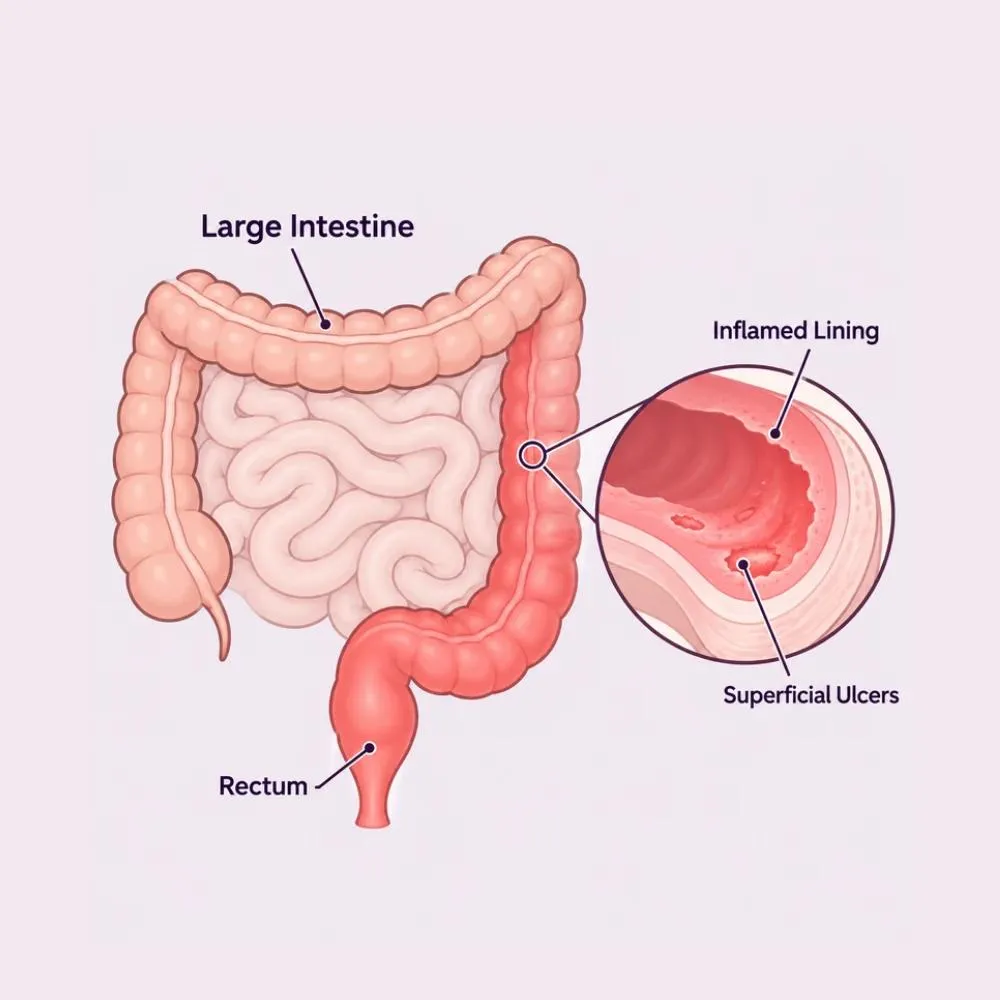
Ulcerative colitis is a form of inflammatory bowel disease that causes continuous inflammation and ulceration of the lining of the colon and rectum. The immune system attacks the bowel lining as though it were a threat, and the resulting inflammation produces the diarrhoea, bleeding and urgency that characterise the disease.
It differs from Crohn’s disease in two ways that matter clinically. Ulcerative colitis affects only the large bowel and always includes the rectum, spreading upward continuously without skipping segments. And it involves only the inner lining rather than the full thickness of the wall, which is why fistulas, common in Crohn’s, are not a feature here.
The disease is classified by how far up the colon it extends: proctitis confined to the rectum, left-sided colitis reaching the splenic flexure, and pancolitis involving the whole colon. That extent determines whether treatment can be delivered locally as suppositories and enemas, or must be taken by mouth or by infusion.
The exact cause is unknown. What is understood is the mechanism: a genetically susceptible person meets an environmental trigger, and the immune response to the gut’s own bacteria fails to switch off.
The immune system mounts a sustained attack on the bowel lining, and the inflammation that should resolve after a threat clears instead persists.
More than two hundred genetic loci are associated with IBD, and a family history raises the risk substantially, though most patients have none.
An altered balance of intestinal bacteria appears both to trigger and to sustain the inflammatory response.
Gastrointestinal infections, certain medications and antibiotic exposure can precipitate a first attack or a subsequent flare.
Incidence is rising fastest in urbanising populations, implicating diet and environment even though no single food causes the disease.
Anti-inflammatory painkillers such as ibuprofen and diclofenac are a well-recognised trigger for flares and are best avoided.
Stress does not cause ulcerative colitis, but it is a consistent trigger for flares in people who already have it.
The commonest avoidable cause of a flare. Maintenance therapy stopped once things feel settled is what precedes a great many relapses.
Nothing you ate or did caused this. What you can influence is the flare rate, and staying on maintenance treatment is by far the most effective lever available.
Symptoms range from mild to severe with the extent of inflammation, and typically develop over weeks rather than appearing suddenly.
Bowel symptoms
Systemic & extra-intestinal
More than six bloody stools a day with fever, a racing pulse or anaemia is a severe flare. That needs hospital assessment the same day: it is the one presentation of this disease that is genuinely urgent.
Diagnosis rests on endoscopy with biopsy. Everything else supports it, measures its severity, or excludes the infections that mimic it.
Full blood count for anaemia, inflammatory markers, albumin, iron studies and liver function: together they gauge how active and how severe the disease is.
A stool marker of bowel inflammation. It distinguishes IBD from IBS reliably, and is the most useful non-invasive way to track disease activity afterwards.
To exclude infective colitis, including Clostridioides difficile, which mimics a flare and needs entirely different treatment.
The definitive test. It shows continuous inflammation extending up from the rectum, establishes the extent, and biopsies confirm the diagnosis histologically.
A limited examination used during a severe flare, when a full colonoscopy would carry a risk of perforation.
CT or MRI where complications are suspected, and to help distinguish ulcerative colitis from Crohn’s disease in unclear cases.
Getting the extent right at diagnosis is not academic. Proctitis is treated with suppositories; pancolitis needs systemic therapy from the outset.
Treatment has two phases: inducing remission during a flare, then maintaining it. The modern target is mucosal healing: a bowel lining that looks normal at endoscopy, not merely a patient who feels better.
Mesalazine, taken orally and as suppositories or enemas. First-line for mild to moderate disease, and the backbone of long-term maintenance.
Prednisolone or budesonide to bring a moderate or severe flare under control quickly. Highly effective for induction, but never for maintenance because of their long-term effects.
Azathioprine or mercaptopurine, used to maintain remission and to allow steroids to be withdrawn. They take two to three months to work.
Anti-TNF agents, vedolizumab and ustekinumab target specific parts of the immune response. They achieve mucosal healing in disease that has not responded to conventional treatment.
Oral small-molecule drugs such as tofacitinib, which work rapidly and are an option for moderate to severe disease.
Iron for anaemia, calcium and vitamin D alongside steroids, and nutritional support during a significant flare.
Removal of the colon, performed as an emergency in severe colitis that does not respond to intensive medical treatment, or where perforation or toxic megacolon develops.
The colon is removed and a pouch fashioned from the small bowel is joined to the anus, so bowel movements continue by the normal route and no permanent stoma is needed.
The same operations done through keyhole incisions, with less pain, a shorter stay and a faster recovery than open surgery.
Often performed in two or three stages with a temporary ileostomy, allowing the pouch to heal before it is brought into use.
Surgery is worth understanding rather than fearing. Removing the colon cures ulcerative colitis outright (the disease cannot return) and for patients with severe refractory disease it is frequently transformative rather than a last resort.
For moderate to severe disease that has not responded to conventional treatment. It is a structured programme of infusions or injections with monitoring, not a single procedure.
Biologic induction & maintenance
Screening for tuberculosis and hepatitis B, a chest X-ray, and a check of your vaccination status: biologics suppress immunity, so latent infection must be excluded first.
The choice between an anti-TNF, vedolizumab, ustekinumab or a JAK inhibitor is made on disease severity, other conditions you have, and how quickly a response is needed.
Loading doses over the first six to eight weeks, given as an intravenous infusion in the day-care unit or as a subcutaneous injection.
Symptoms, blood tests and faecal calprotectin at eight to twelve weeks. Where response is inadequate, the dose is escalated or the agent changed.
Regular dosing every four to eight weeks depending on the drug. Many patients are taught to self-inject at home.
Blood tests before each dose, calprotectin every few months, and a colonoscopy at intervals to confirm the lining has genuinely healed.
Infusions are given in the day-care unit and take one to three hours, after which you go home. Once you are established on treatment, most people find it fits around work with little disruption.
Inflammatory bowel disease is a long relationship with a team rather than a single episode of care. Here is why patients trust us:
Proctologists and colitis experts who manage inflammatory bowel disease as a continuing programme, not a series of flares.
Modern endoscopy and imaging to establish extent and severity accurately, and to confirm mucosal healing later.
From the first consultation through to post-treatment follow-up, with one team throughout.
Our hospital is in HITEC CITY, near IKEA: easily reachable from across Hyderabad.
This is management rather than recovery. The timeline below is how a flare is typically brought under control and remission established.
Flare treatment begins. Steroids or topical therapy start working within days, and bleeding and urgency usually settle first.
Symptoms come under control and steroids are tapered on a planned schedule. Maintenance therapy is established.
Immunomodulators reach full effect. Calprotectin is rechecked to confirm the inflammation is genuinely settling, not just the symptoms.
Colonoscopy to confirm mucosal healing: the target that predicts long-term outcome better than how you feel.
Maintenance therapy continues indefinitely, with regular monitoring and surveillance colonoscopy from eight years after diagnosis.
The commonest cause of a flare is stopping treatment once things feel fine. Maintenance is what is keeping you fine.
Blood tests and calprotectin catch inflammation returning before symptoms do, when it is far easier to treat.
No restriction is needed in remission. During a flare, a low-fibre, low-residue diet with lean protein is easier on an inflamed bowel.
Ibuprofen and diclofenac are recognised triggers for flares. Use paracetamol instead, and tell any doctor treating you.
Long-standing colitis carries a raised risk of bowel cancer. Regular surveillance from eight years after diagnosis is what manages it.
Most treatments are safe in pregnancy and conceiving in remission gives the best outcomes. Discuss it before rather than after.
Most people with ulcerative colitis work full time, travel and have families. The disease is serious and it is also, with modern treatment, very manageable.
Any of the following needs same-day medical assessment.
This is a long-term condition, so the honest figure is an ongoing one rather than a single procedure price. These are the ranges our patients fall into.
| Procedure | Estimated Cost |
|---|---|
| Specialist consultation Per visit | ₹800 – ₹1,500 |
| Colonoscopy with biopsy Day care, including histopathology | ₹15,000 – ₹30,000 |
| 5-ASA maintenance therapy Per month, oral and topical combined | ₹2,000 – ₹6,000 |
| Immunomodulator therapy Per month, including monitoring bloods | ₹1,500 – ₹4,000 |
| Biologic therapy Per dose; frequency varies by agent | ₹25,000 – ₹80,000 |
| Laparoscopic colectomy with pouch Staged procedure, five to seven nights per stage | ₹3,50,000 – ₹6,00,000 |
Proctitis treated with suppositories and pancolitis requiring biologics sit at opposite ends of the cost range.
The step from 5-ASA to a biologic is the largest single change in ongoing cost, and is driven by how the disease responds.
Regular bloods, calprotectin and surveillance colonoscopy are part of long-term care and recur rather than being one-off.
A shared ward, a twin-sharing room or a private suite: the largest single swing in most estimates.
We are empanelled with most major insurers, and our team files the pre-authorisation for you.
Every figure above is an indicative range, not a quote. After your consultation you are given a written, fixed-cost estimate, and that is the number you pay, with no additions once treatment begins.
The proctologists and IBD specialists who manage ulcerative colitis at our HITEC CITY hospital.

Consultant Proctologist & Laparoscopic Surgeon
MBBS, MS, FMAS, FISCP, DMAS
8 years experience

Consultant General & Advanced Laparoscopic Surgeon
MBBS, MS, FMAS
17 years experience
Reviews from patients treated for colitis, IBD and colorectal conditions at Lux Hospitals, Hyderabad.
Written by Dr. Samhitha Reddy on IBD, IBS and colorectal health.

Dr. Samhitha Reddy


Dr. Samhitha Reddy

Dr. Samhitha Reddy

Dr. Samhitha Reddy

Dr. Samhitha Reddy
Common questions about ulcerative colitis, its treatment, and what long-term care costs at Lux Hospitals.
Still have questions? Call us at 079 6908 4422
Still have questions? Message us on WhatsApp at 079 6908 4444
Accurate assessment and a remission-focused treatment plan, with costs discussed openly before treatment begins.
Plot No.116, Lumbini Avenue, HITEC CITY, Near IKEA, Hyderabad – 500032













