



Dr. Samhitha Reddy
Consultant Proctologist & Laparoscopic Surgeon
MBBS, MS, FMAS, FISCP, DMAS
- 8 Yrs
- ASCRS Member
Endometriosis is tissue resembling the uterine lining growing outside the uterus: on the ovaries, the pelvic lining, the bowel or the bladder. It bleeds with every cycle, with nowhere for the blood to go, and the result is inflammation, scarring and pain.
Women wait an average of seven to ten years for this diagnosis, most of them told repeatedly that severe period pain is normal. It is not. Our gynaecologists at Lux Hospitals, HITEC CITY investigate it properly and treat it by excision rather than by burning the surface.
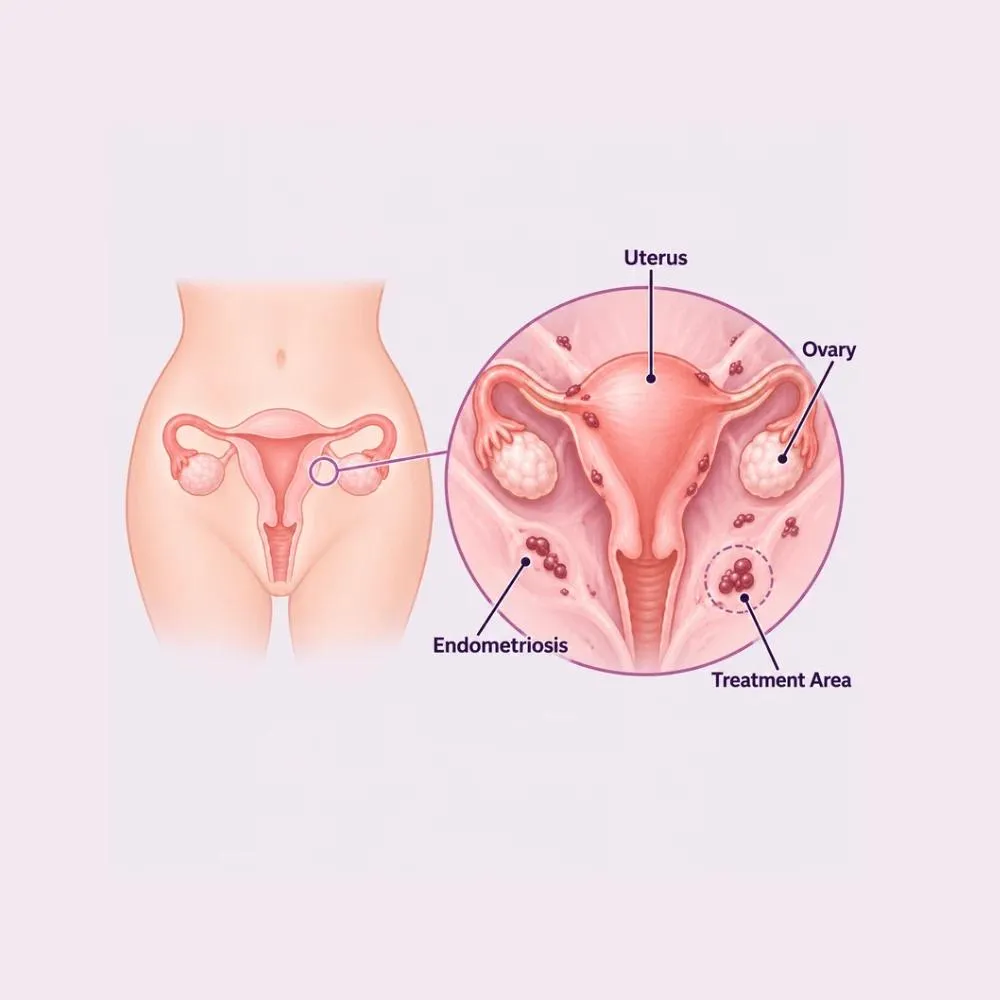
Endometriosis is the presence of tissue similar to the endometrium, the lining of the uterus, in places outside it. The commonest sites are the ovaries, the pelvic peritoneum, the ligaments supporting the uterus, and the space between uterus and rectum. It can also involve the bowel, bladder, ureters and, rarely, the diaphragm.
This tissue responds to the hormonal cycle exactly as the uterine lining does: it thickens and bleeds each month. But unlike menstrual blood, it has no route out. The trapped blood irritates surrounding tissue, provoking chronic inflammation, adhesions that stick organs together, and scar tissue that distorts pelvic anatomy. On the ovary it forms an endometrioma: a cyst of old altered blood, often called a chocolate cyst.
The condition is staged one to four by how extensive it is, but stage correlates poorly with pain. Minimal disease can be agonising and extensive disease can be almost silent. What stage does predict reasonably well is the effect on fertility, and roughly a third to a half of women with unexplained infertility turn out to have endometriosis.
No single theory explains every case, and the condition probably arises through more than one mechanism.
Menstrual blood flowing backwards through the tubes into the pelvis, depositing endometrial cells. The oldest theory, though most women have some retrograde flow and only some develop endometriosis.
A failure to clear displaced endometrial cells that would normally be removed. This helps explain why only some women are affected.
Cells lining the pelvis transforming into endometrial-like tissue. This accounts for endometriosis in women who have never menstruated.
A first-degree relative with endometriosis raises risk several-fold. It clusters strongly in families.
Endometriosis is oestrogen-dependent, and the lesions themselves produce oestrogen locally, which is why hormonal suppression works.
Endometrial cells travelling through blood or lymph, explaining rare deposits in distant sites such as the lung or diaphragm.
Endometriosis is not caused by stress, by using tampons, or by anything within your control. It is not an infection and it is not psychological: a point worth stating plainly given how often women are told otherwise.
Pain that is cyclical and disabling is the hallmark, though the condition reaches well beyond the pelvis.
Pain symptoms
Other symptoms
Period pain that keeps you off work or school, or that painkillers do not touch, is not normal and should not be normalised. That message is the single most useful thing this page can convey.
Imaging finds the larger disease; the smaller superficial disease is often only seen at laparoscopy.
The relationship of pain to the cycle, to intercourse and to bowel and bladder function. A careful history raises the suspicion long before any scan.
Tenderness in the pouch of Douglas, nodules on the uterosacral ligaments, or a fixed retroverted uterus all point strongly toward it.
Detects endometriomas reliably and, in experienced hands, deep infiltrating disease. It cannot see superficial peritoneal disease.
Maps deep infiltrating endometriosis involving bowel, bladder or ureters. Essential for planning surgery in advanced disease.
Direct inspection of the pelvis, historically the definitive test. Where disease is found it is treated in the same operation rather than in a second one.
Tissue excised at surgery is examined to confirm the diagnosis, which matters for long-term management decisions.
A normal ultrasound does not exclude endometriosis. Superficial peritoneal disease is invisible on every scan, and a great many women are wrongly reassured on the strength of one.
Treatment depends on your pain, your fertility plans and the extent of disease, and often combines medical and surgical approaches.
NSAIDs taken before pain begins rather than after, which is considerably more effective than waiting for it to establish.
Taken continuously to suppress periods altogether. Simple, inexpensive and effective first-line treatment for pain.
Dienogest and similar drugs suppress the lesions directly and are well tolerated long term.
A levonorgestrel IUD delivering progestogen locally, reducing pain and bleeding with minimal systemic effect.
Induce a temporary menopausal state to shrink lesions. Used short term, with add-back hormone therapy to protect bone.
Addresses the secondary muscle spasm that develops from chronic pain and often persists after the disease is treated.
Cutting the disease out completely, including what lies beneath the surface. The gold standard, with lower recurrence than ablation.
Removing an endometrioma while preserving healthy ovarian tissue: technique matters here, since careless stripping reduces ovarian reserve.
Dividing adhesions to restore normal pelvic anatomy, which relieves pain and improves the chance of conception.
Excision from bowel, bladder or ureter, requiring a multidisciplinary team and careful planning.
Considered for severe disease where family is complete. It is not a guaranteed cure, since disease outside the uterus remains.
Excision and ablation are not equivalent. Ablation burns the visible surface while excision removes the lesion in full, and recurrence rates after excision are meaningfully lower, which is why the technique is worth asking about.
Surgery takes anywhere from an hour to several, depending on how extensive the disease proves to be.
Keyhole surgery under general anaesthesia
Imaging reviewed to anticipate bowel or ureteric involvement, with bowel preparation and colorectal input arranged where deep disease is expected.
General anaesthesia, with a camera port at the umbilicus and two or three further small ports low on the abdomen.
The entire pelvis examined in sequence: ovaries, tubes, peritoneum, uterosacral ligaments, pouch of Douglas, bowel, bladder and diaphragm.
Disease documented and staged, with photographs taken so you can see afterwards exactly what was found and treated.
Lesions cut out at their base rather than burned, including the portion extending beneath the peritoneal surface.
The cyst wall carefully stripped from the ovary preserving healthy tissue, since aggressive technique here costs ovarian reserve permanently.
Adhesions divided, organs separated, and an anti-adhesion barrier placed where appropriate before closing.
Where an endometrioma is removed, the surgeon is trading disease clearance against ovarian reserve with every movement. If you hope to conceive, say so before surgery: it genuinely changes how the operation is done.
Endometriosis takes years to diagnose and is frequently under-treated when it is. Here is why patients trust us:
Disease cut out in full rather than burned at the surface, which is what keeps recurrence rates lower.
Ovarian reserve protected during cystectomy, and the post-surgical fertility window planned for rather than missed.
From the first consultation through to post-treatment follow-up, with one team throughout.
Our hospital is in HITEC CITY, near IKEA: easily reachable from across Hyderabad.
Recovery from keyhole surgery is quick. Managing the condition afterwards is what determines whether the pain stays away.
Home the same day or after one night. Shoulder-tip pain from the gas is common and settles. Walking encouraged from the first evening.
Port-site soreness settles. Most women return to desk work at one to two weeks depending on how extensive the surgery was.
Light exercise resumes. Intercourse after clearance at four to six weeks. Findings and histology discussed at follow-up.
Hormonal suppression usually started to prevent recurrence, unless you are trying to conceive: in which case this window is the most fertile.
Ongoing management of pain and cycles, with review if symptoms return. Recurrence is possible and is not a treatment failure.
If you are trying to conceive, the months immediately after excision are the most fertile. Discuss timing before surgery rather than after.
Without hormonal suppression after surgery, recurrence is considerably commoner. Where pregnancy is not the immediate goal, it is worth taking.
Years of pain create secondary muscle spasm that persists after the disease is removed. Physiotherapy addresses the pain that surgery cannot.
NSAIDs started a day before the period is due work far better than the same drug taken once pain has established.
Ask for the stage, the sites involved and the photographs. This record matters enormously for any future treatment decision.
Endometriosis affects mood, work and relationships. Psychological support is a legitimate part of treatment, not an admission the pain is imagined.
Endometriosis cannot be cured permanently, and recurrence after surgery is common. What can be achieved (reliably) is long stretches of good pain control and successful pregnancy, and that is a realistic goal rather than a consolation.
Book a consultation if any of the following apply.
Medical management is inexpensive. Surgical cost varies widely, because the extent of disease is often only known once inside.
| Procedure | Estimated Cost |
|---|---|
| Consultation Per visit | ₹800 – ₹1,500 |
| Transvaginal ultrasound Detects endometriomas | ₹1,500 – ₹3,500 |
| MRI pelvis For deep infiltrating disease | ₹8,000 – ₹18,000 |
| Monthly hormonal treatment Pill, progestogen or GnRH analogue | ₹400 – ₹3,500 |
| Hormonal IUD insertion Includes the device; lasts five years | ₹12,000 – ₹25,000 |
| Diagnostic laparoscopy Day care or one night | ₹65,000 – ₹1,10,000 |
| Laparoscopic excision surgery One to two nights; varies with extent | ₹1,30,000 – ₹2,60,000 |
| Deep infiltrating disease surgery Multidisciplinary; longer stay | ₹2,60,000 – ₹4,50,000 |
Superficial disease is quickly excised. Disease involving bowel, bladder or ureter needs a longer operation and a wider team.
Ovarian cystectomy adds time and requires meticulous technique to preserve ovarian reserve.
Hormonal suppression at a few hundred rupees monthly controls pain for many women without any operation.
A shared ward, a twin-sharing room or a private suite: the largest single swing in most estimates.
We are empanelled with most major insurers, and our team files the pre-authorisation for you.
Every figure above is an indicative range, not a quote. After your consultation you are given a written, fixed-cost estimate, and that is the number you pay, with no additions once treatment begins.
The gynaecologists who treat endometriosis at our HITEC CITY hospital.

Consultant Gynaecologist & Advanced Laparoscopic Surgeon
MBBS, MS, FMAS
16 years experience

Consultant Obstetrician, Gynecologist & Laparoscopic Surgeon
MBBS, MS (Obstetrics & Gynaecology)
11 years experience
Reviews from women treated for gynaecological conditions at Lux Hospitals, Hyderabad.
Written by Dr. Harshita Kakarla on women’s health and gynaecological care.
Dr. Harshita Kakarla
Dr. Harshita Kakarla
Dr. Harshita Kakarla
Dr. Harshita Kakarla
Dr. Harshita Kakarla
Dr. Harshita Kakarla
Common questions about endometriosis, excision surgery, fertility and costs at Lux Hospitals.
Still have questions? Call us at 079 6908 4422
Still have questions? Message us on WhatsApp at 079 6908 4444
Proper investigation of pelvic pain and laparoscopic excision surgery, with costs shared upfront.
Plot No.116, Lumbini Avenue, HITEC CITY, Near IKEA, Hyderabad – 500032













