



Dr. Samhitha Reddy
Consultant Proctologist & Laparoscopic Surgeon
MBBS, MS, FMAS, FISCP, DMAS
- 8 Yrs
- ASCRS Member
The meniscus is the shock absorber of the knee, and tearing it is one of the commonest knee injuries there is. In younger people it usually follows a twist; in older people it often tears gradually with no injury at all.
That distinction changes the treatment completely. Our orthopaedic surgeons at Lux Hospitals, HITEC CITY repair meniscal tears wherever the tear pattern allows, because preserving the meniscus protects the knee from arthritis decades later.
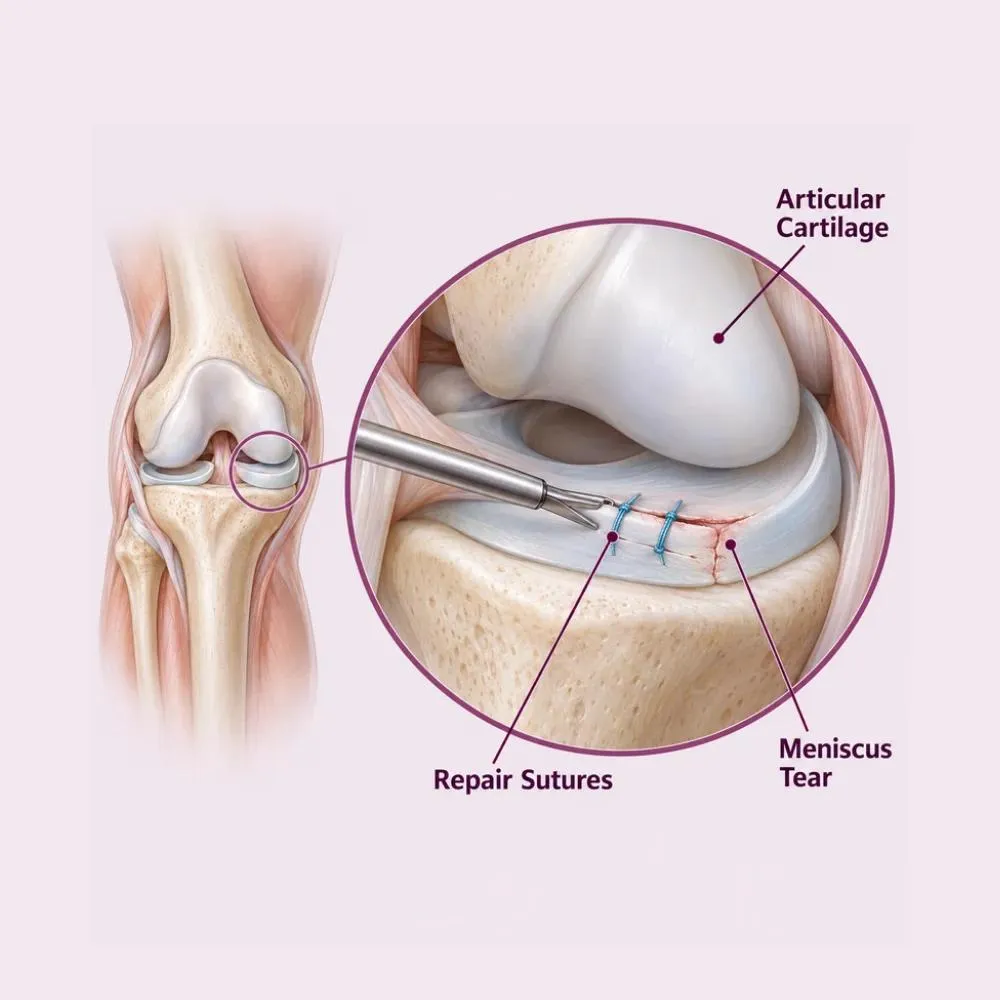
Each knee has two menisci: C-shaped wedges of tough cartilage sitting between the thigh bone and shin bone. They distribute load across the joint, absorb shock, and help stabilise the knee. Losing meniscal tissue concentrates pressure on the articular cartilage, which is why it matters so much.
Tears are described by pattern and location: longitudinal, radial, horizontal, flap and bucket-handle. The pattern matters because it determines whether the tear can be stitched back together or must be trimmed away.
Blood supply is the decisive factor. Only the outer third of the meniscus has a blood supply (the so-called red zone) and tears there can heal if repaired. Tears in the inner white zone have no blood supply and will not heal however well they are stitched, so they are trimmed instead. Where a tear sits determines the operation more than anything else.
There are two quite different mechanisms, and they occur in different age groups with different treatment implications.
The classic mechanism in younger people: turning with the foot planted, or squatting deeply and twisting.
Football, cricket, kabaddi and badminton all involve the cutting and pivoting movements that tear menisci.
In people over forty the meniscus weakens with age and can tear during ordinary activity: sometimes just standing up from a squat.
Meniscal tears frequently accompany ACL ruptures, and repairing both together gives the best long-term result.
Occupations and activities involving repeated deep squatting load the posterior meniscus heavily.
A congenital variant where the meniscus is disc-shaped rather than C-shaped. It tears more readily, often in children.
Increases load through the meniscus and accelerates degenerative tearing.
Altered mechanics after ligament injury or previous surgery increase stress on the remaining meniscal tissue.
Degenerate tears in people over forty are extremely common and frequently cause no symptoms. Finding one on a scan does not by itself mean it needs treating.
Meniscal symptoms are mechanical: pain on twisting, catching, and sometimes the knee locking outright.
Common symptoms
Symptoms needing prompt assessment
A knee that is genuinely locked (physically unable to straighten) is the one presentation needing prompt surgery. That is usually a bucket-handle tear flipped into the joint, and it is repairable if dealt with early.
Examination and MRI together, interpreted alongside each other. An MRI finding without matching symptoms is not a diagnosis.
Joint line tenderness is the most useful sign, with McMurray and Thessaly tests provoking the symptoms by loading the meniscus.
Does not show the meniscus but assesses the degree of arthritis, which is often what determines whether surgery would help.
Shows the tear, its pattern and its location relative to the blood supply, plus any associated ligament or cartilage damage.
Tear pattern, position in the red or white zone, tissue quality and time since injury together determine whether repair is feasible.
How the knee behaves day to day. Mechanical symptoms suggest surgery; diffuse aching in an arthritic knee does not.
Swelling control and regaining full extension before surgery, plus routine bloods and anaesthetic review.
The commonest error in this area is treating the MRI rather than the patient. A degenerate tear on a scan in a fifty-year-old with diffuse arthritic pain is usually an incidental finding.
Many tears settle without surgery, particularly degenerate ones. Where surgery is needed, repairing beats trimming wherever the tear allows.
The first-line treatment for degenerate tears, and as effective as surgery for them in large trials. Quadriceps strengthening is the core of it.
Avoiding deep squatting and twisting for six to twelve weeks allows many acute tears to become asymptomatic.
Controls pain and swelling during the settling phase, alongside rehabilitation.
Useful where swelling and inflammation dominate, particularly in a knee with coexisting arthritis.
Support during the recovery phase, and offloading braces where the tear sits in an arthritic compartment.
Stitching the torn meniscus back together with sutures or devices. Always preferred where the tear pattern and blood supply allow, because it preserves the tissue.
Trimming the torn portion back to a stable rim. Effective for locking and catching, but it removes tissue that cannot be replaced.
Reattaching a torn meniscal root, which is functionally equivalent to losing the whole meniscus if left. Repair here is particularly worthwhile.
Replacing a meniscus that was largely removed previously, in selected young patients with pain in that compartment.
Repairing both at one operation, which gives better healing rates for the meniscus than repair alone.
Removing meniscal tissue relieves the mechanical symptoms but increases contact pressure on the cartilage, and that raises the risk of arthritis over the following decades. This is why repair is pursued whenever it is possible.
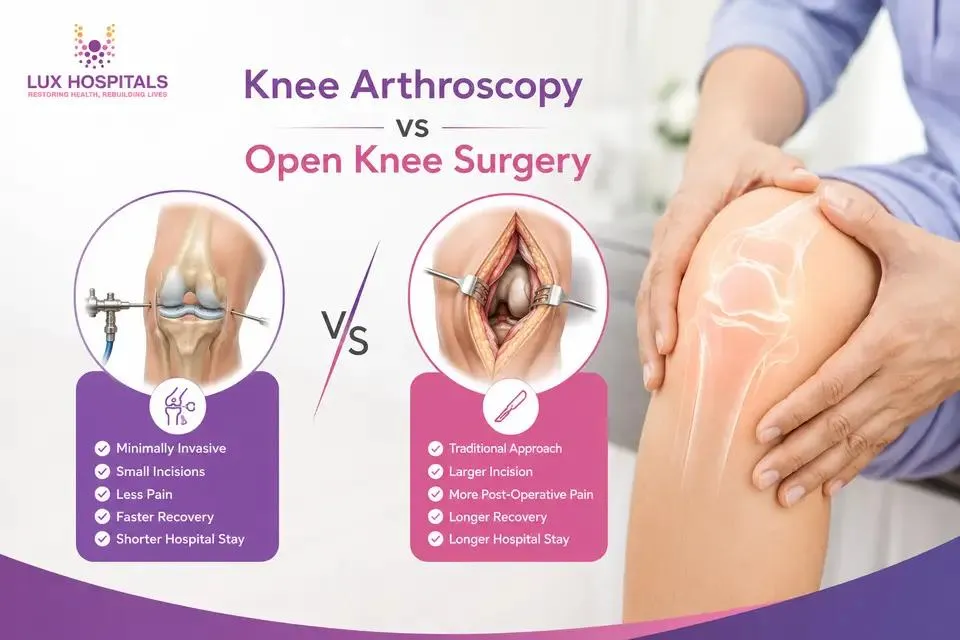
A thirty to sixty minute day-case arthroscopic procedure through two or three small portals.
Arthroscopic meniscal repair or trimming
General or spinal anaesthesia, with local anaesthetic infiltrated into the portals for comfort afterwards.
The joint is entered and inspected systematically: both menisci, the cruciate ligaments and all cartilage surfaces.
The tear is probed to establish its pattern, stability and position relative to the blood supply. This is what decides repair versus trimming.
The tear is stitched using inside-out, all-inside or outside-in techniques depending on its position, and the edges freshened to promote healing.
The unstable torn fragment is trimmed back to a stable, balanced rim, preserving as much meniscus as possible.
The knee is taken through its range to confirm no further catching, and the joint irrigated.
Portals closed with a stitch each, and home the same day with a rehabilitation plan specific to what was done.
Whether the meniscus is repaired or trimmed is often decided during the operation, since the arthroscopic view is more informative than the MRI. Both possibilities are discussed with you beforehand, because the recovery differs substantially.
The most valuable decision here is whether to repair, trim or leave alone entirely. Here is why patients trust us:
We repair meniscal tears wherever the pattern and blood supply allow, because preserving the tissue protects the knee long term.
Surgeons performing meniscal repair and reconstruction regularly, including combined ACL and meniscal procedures.
From the first consultation through to post-treatment follow-up, with one team throughout.
Our hospital is in HITEC CITY, near IKEA: easily reachable from across Hyderabad.
Recovery differs sharply between the two operations. Trimming allows a return within weeks; repair requires three months of protection.
Home the same day walking with crutches. Ice and elevation to control swelling, with simple painkillers.
After trimming, crutches are discarded within days and normal walking resumes. After repair, weight-bearing and bending are restricted as instructed.
After trimming, return to desk work and light activity. After repair, protected range of motion continues with progressive loading.
After trimming, return to most sport. After repair, full weight-bearing and strengthening, with running from around three months.
Return to pivoting sport after a repair, guided by strength and function. The meniscus has healed to bone by this point.
After a repair, the restrictions on weight-bearing and deep bending protect the healing tissue. Ignoring them is the main cause of repair failure.
Regular icing in the first week controls swelling, which is the main limit on regaining movement.
Quadriceps strength protects the knee and is the single most useful thing rehabilitation achieves.
Deep flexion under load stresses the posterior meniscus most, and is restricted for three months after a repair.
Fever, spreading redness, increasing swelling, calf pain and swelling, or the knee locking again.
Maintain a healthy weight and keep the quadriceps strong. Both reduce load on the remaining meniscal tissue.
The longer recovery after a repair is a genuine trade-off, and it is worth making. Preserving meniscal tissue meaningfully reduces the risk of arthritis in that knee over the following twenty years.
Book a consultation if any of the following apply.
Repair costs more than trimming because of the implants used, and needs a longer recovery. These are the ranges.
| Procedure | Estimated Cost |
|---|---|
| Consultation & assessment Per visit | ₹800 – ₹1,500 |
| MRI knee Confirms the tear pattern and location | ₹6,000 – ₹12,000 |
| Physiotherapy programme Six to twelve weeks, often sufficient alone | ₹8,000 – ₹20,000 |
| Arthroscopic partial meniscectomy Day care, same-day discharge | ₹70,000 – ₹1,20,000 |
| Arthroscopic meniscal repair Day care or one night; repair devices included | ₹90,000 – ₹1,60,000 |
| Meniscal repair with ACL reconstruction One night’s stay | ₹1,80,000 – ₹3,00,000 |
| Post-operative physiotherapy Longer after repair than after trimming | ₹8,000 – ₹30,000 |
Repair uses sutures and devices and takes longer in theatre, but preserves tissue that protects the knee for decades.
A meniscal tear alongside an ACL rupture means one larger operation rather than two, and the costs combine.
A meniscectomy needs a few weeks of physiotherapy; a repair needs three months of protected rehabilitation.
A shared ward, a twin-sharing room or a private suite: the largest single swing in most estimates.
We are empanelled with most major insurers, and our team files the pre-authorisation for you.
Every figure above is an indicative range, not a quote. After your consultation you are given a written, fixed-cost estimate, and that is the number you pay, with no additions once treatment begins.
The orthopaedic and sports injury surgeons who treat meniscus tears at our HITEC CITY hospital.

Consultant Orthopaedic Surgeon: Joint Replacement & Arthroscopy
MS (Ortho), FIJR, FIASM (UK), FIKS (Italy), FIRJR
8 years experience

Consultant Orthopaedic Surgeon
MBBS, MS, FIJR
6 years experience
Reviews from patients treated for meniscus, ACL and sports injuries at Lux Hospitals, Hyderabad.
Written by Dr. Sai Kishan Sirasala on knee injuries, arthroscopy and orthopaedic care.

Dr. Sai Kishan Sirasala
Dr. Sai Kishan Sirasala
Dr. Sai Kishan Sirasala
Dr. Sai Kishan Sirasala
Dr. Sai Kishan Sirasala
Dr. Sai Kishan Sirasala
Common questions about meniscus tears, their treatment, and what surgery costs at Lux Hospitals.
Still have questions? Call us at 079 6908 4422
Still have questions? Message us on WhatsApp at 079 6908 4444
Accurate assessment of your meniscal tear and repair wherever possible, with a fixed-cost estimate before treatment begins.
Plot No.116, Lumbini Avenue, HITEC CITY, Near IKEA, Hyderabad – 500032













