Dr. Samhitha Reddy
Consultant Proctologist & Laparoscopic Surgeon
MBBS, MS, FMAS, FISCP, DMAS
- 8 Yrs
- ASCRS Member
Cushing syndrome is what happens when the body is exposed to too much cortisol for too long. It produces a characteristic pattern: weight gain around the trunk and face, thin bruising skin, purple stretch marks, muscle weakness and high blood pressure.
The commonest cause by a wide margin is not a tumour at all but long-term steroid medication. Where it is not, the source has to be located precisely before anything is treated. Our urologists at Lux Hospitals, HITEC CITY work through that sequence properly and perform laparoscopic adrenal surgery where it is indicated.
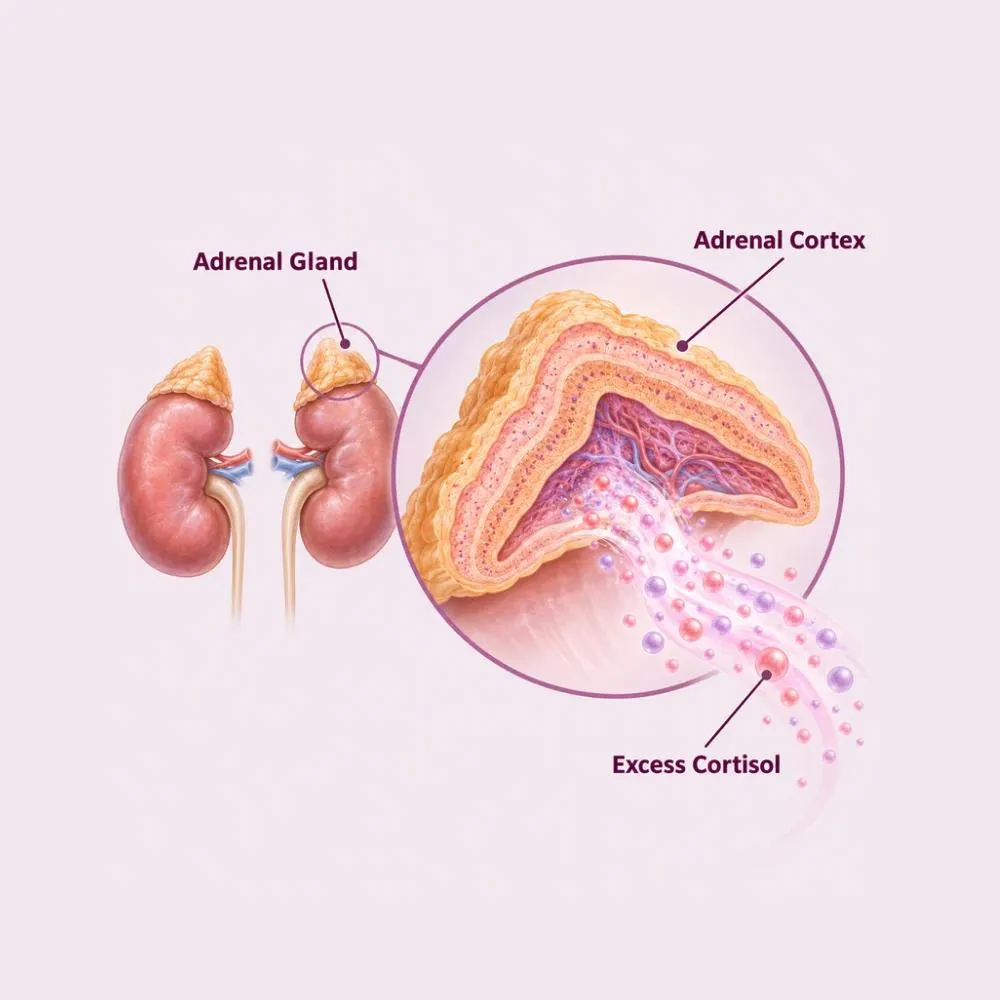
Cushing syndrome is the clinical state produced by prolonged exposure to excess cortisol. Cortisol is made by the adrenal glands, two small glands sitting on top of the kidneys, and it governs metabolism, blood sugar, blood pressure, immune function and the response to stress. In the right amount it is essential. In excess and over months, it damages almost every system in the body.
The distinction that drives all treatment is where the excess comes from. Exogenous Cushing syndrome, by far the commonest form, results from corticosteroid medication taken for asthma, arthritis, skin conditions or autoimmune disease. Endogenous Cushing syndrome means the body itself is overproducing, and that has three main sources: a pituitary tumour driving the adrenals through excess ACTH, an adrenal tumour producing cortisol autonomously, or an ectopic tumour elsewhere secreting ACTH.
The term Cushing’s disease refers specifically to the pituitary-driven form, which accounts for most endogenous cases. It is a subset of Cushing syndrome rather than a synonym for it, and the difference matters because pituitary disease is operated on through the nose by a neurosurgeon while adrenal disease is operated on laparoscopically by a urologist.
Establishing the cause is the whole diagnostic exercise, because the treatment for each is entirely different.
The commonest cause overall. Prednisolone and similar drugs for asthma, arthritis, skin disease or after transplantation. Also seen with high-dose inhaled steroids and unregulated topical creams.
A benign pituitary tumour secreting excess ACTH, which drives both adrenal glands to overproduce cortisol. This is Cushing’s disease, and it accounts for most endogenous cases.
A benign tumour in one adrenal gland producing cortisol autonomously. This is the form urologists treat surgically, and laparoscopic removal is usually curative.
A malignant adrenal tumour. Uncommon, but suspected where the tumour is large, growth is rapid, or symptoms have developed unusually quickly.
A tumour outside the pituitary, most often in the lung, secreting ACTH. It tends to cause severe, rapidly progressive disease with marked potassium loss.
Both adrenal glands enlarged and overproducing, either driven by ACTH or occasionally independently.
Rare inherited conditions such as multiple endocrine neoplasia and Carney complex, usually with other endocrine features alongside.
Because steroid medication is such a common cause, the first question is always what you are taking, including creams, inhalers, joint injections and any traditional remedy, some of which contain undeclared steroids.
The pattern is distinctive: weight gain that is central rather than general, alongside skin and muscle changes that point specifically to cortisol.
Characteristic features
Systemic effects
The combination that distinguishes Cushing syndrome from ordinary weight gain is central obesity with thin limbs, wide purple stretch marks, and proximal muscle weakness: difficulty rising from a chair or climbing stairs.
Diagnosis proceeds in two distinct stages: confirming that cortisol is genuinely excessive, then finding where it is coming from.
Measures total cortisol excreted over a full day, smoothing out the natural hourly variation. Usually repeated, since a single collection can mislead.
Cortisol should be at its lowest around midnight. A raised late-night level is one of the earliest and most reliable abnormalities.
A dose of dexamethasone overnight should suppress cortisol in a healthy person. Failure to suppress confirms autonomous overproduction.
The key test for localisation. Suppressed ACTH points to an adrenal source; normal or raised ACTH points to a pituitary or ectopic one.
CT of the adrenal glands where ACTH is suppressed, and pituitary MRI where it is not. Chest imaging is added if an ectopic source is suspected.
Blood sampled directly from the veins draining the pituitary, to distinguish pituitary from ectopic ACTH where imaging is inconclusive.
Several conditions produce mildly raised cortisol without Cushing syndrome: obesity, poorly controlled diabetes, depression, heavy alcohol use and pregnancy among them. This is why confirmation requires more than one abnormal test.
Treatment is directed at the source. Surgery is curative in most cases where a single tumour is responsible.
Where the cause is prescribed steroids, the dose is tapered slowly in conjunction with the prescribing doctor. Stopping abruptly is dangerous and can precipitate adrenal crisis.
Ketoconazole, metyrapone and osilodrostat block cortisol production. Used to control severe disease before surgery, or long term where surgery is not possible.
Suppresses and destroys adrenal cortical tissue. Used mainly in adrenal carcinoma, and requires careful monitoring.
Blocks cortisol receptors rather than production. Particularly useful where diabetes is a dominant problem.
Blood pressure, diabetes, potassium, bone protection and clot prevention all treated alongside, since these cause much of the harm.
Keyhole removal of the affected adrenal gland for an adrenal adenoma. Curative in the great majority, with small incisions and a short stay.
Removal of a pituitary adenoma through the nose, performed by a neurosurgeon. The first-line treatment for Cushing’s disease.
Reserved for large tumours or suspected adrenal carcinoma, where complete removal without rupturing the tumour is the priority.
Removal of both glands where the source cannot be found or controlled. It cures the cortisol excess but creates lifelong steroid dependence.
Directed at the pituitary where surgery has not achieved remission or the tumour cannot be fully removed. Effect develops over months.
Bilateral adrenalectomy trades one problem for another: it reliably ends the cortisol excess but leaves you dependent on replacement steroids for life. It is a considered last resort rather than a straightforward cure.
Removing one adrenal gland takes around ninety minutes to two hours, with two to three days in hospital.
Keyhole adrenal surgery under general anaesthesia
Blood pressure, blood sugar and potassium brought under control first, sometimes with cortisol-blocking medication for several weeks. Operating on uncontrolled disease is considerably riskier.
General anaesthesia, positioned on your side so the kidney and adrenal gland come forward and the bowel and spleen or liver fall away.
Three or four small ports along the flank. The abdomen is insufflated with carbon dioxide to create working space.
The colon and, on the left, the spleen and pancreas are mobilised away. On the right, the liver is retracted to expose the gland beside the vena cava.
The adrenal vein is identified, clipped and divided early. This is the critical step of the operation, and on the right it drains directly into the vena cava.
The gland is freed from surrounding fat and placed in a retrieval bag so it comes out intact: important where malignancy is a possibility.
Hydrocortisone is given around surgery, because the remaining gland has been suppressed for months and cannot immediately respond.
Steroid cover after surgery is not optional. The opposite adrenal gland has been shut down by months of excess cortisol and takes six to eighteen months to recover: during which replacement is essential.
Cushing syndrome is uncommon, complex, and easily mishandled if the source is not properly located. Here is why patients trust us:
Sequential confirmation and localisation testing, so the adrenal, pituitary and ectopic forms are distinguished rather than assumed.
Keyhole adrenalectomy with small incisions and a short stay, and appropriate steroid cover managed carefully afterwards.
From the first consultation through to post-treatment follow-up, with one team throughout.
Our hospital is in HITEC CITY, near IKEA: easily reachable from across Hyderabad.
Physical recovery from keyhole surgery is quick. Hormonal recovery is slow, and the difference between the two surprises most patients.
Mobilising the day of surgery, discharged at two to three days on replacement hydrocortisone with clear instructions on how to take it.
Port sites heal. Many patients feel worse rather than better as cortisol falls: fatigue, aching and low mood are expected and are a sign the surgery worked.
Blood pressure, blood sugar and weight begin improving. Skin and stretch marks fade slowly. Steroid replacement is gradually reduced.
The suppressed adrenal gland recovers and steroid replacement is withdrawn under testing. Muscle strength and bone density improve.
Annual review of cortisol levels to detect recurrence, with continued management of bone health and cardiovascular risk.
The remaining adrenal gland is suppressed and cannot respond. Stopping abruptly can cause adrenal crisis, which is life-threatening.
It tells any doctor treating you in an emergency that you need stress-dose steroids. Wear an alert bracelet as well if you can.
Illness, fever, vomiting or injury all require increased steroid doses. You will be given clear sick-day rules: follow them rather than waiting to see.
Withdrawal from long-standing high cortisol causes fatigue, aches and low mood for weeks to months. It is expected, temporary, and not a sign of failure.
Proximal muscle weakness takes months to reverse. Progressive resistance exercise, once cleared, restores it considerably faster.
Cortisol excess thins bone. Bone density is assessed and calcium, vitamin D and specific treatment given where needed.
Feeling markedly worse in the weeks after successful surgery is one of the most disorienting parts of this condition. It reflects the body adjusting to normal cortisol after months of excess, and it does resolve.
Book a consultation if any of the following apply.
The diagnostic workup is a substantial part of the cost, because localising the source requires several sequential tests.
| Procedure | Estimated Cost |
|---|---|
| Consultation Per visit | ₹800 – ₹1,500 |
| Cortisol confirmation tests Urinary, salivary and suppression testing | ₹6,000 – ₹15,000 |
| ACTH and localisation bloods Determines adrenal versus pituitary source | ₹3,000 – ₹8,000 |
| CT adrenals Where ACTH is suppressed | ₹6,000 – ₹14,000 |
| MRI pituitary Where ACTH is normal or raised | ₹8,000 – ₹18,000 |
| Inferior petrosal sinus sampling Where imaging is inconclusive | ₹1,20,000 – ₹2,20,000 |
| Laparoscopic adrenalectomy Two to three days in hospital | ₹2,40,000 – ₹4,20,000 |
| Monthly medical therapy Cortisol-blocking drugs | ₹4,000 – ₹18,000 |
Steroid-induced disease needs only a supervised taper. An adrenal adenoma needs surgery. Pituitary disease needs neurosurgery, which is costed separately.
A clear adrenal tumour on CT settles it quickly. An unclear picture may require petrosal sinus sampling, which is a significant additional cost.
Severe disease often needs weeks of cortisol-blocking medication and control of diabetes and blood pressure before surgery is safe.
A shared ward, a twin-sharing room or a private suite: the largest single swing in most estimates.
We are empanelled with most major insurers, and our team files the pre-authorisation for you.
Every figure above is an indicative range, not a quote. After your consultation you are given a written, fixed-cost estimate, and that is the number you pay, with no additions once treatment begins.
The urologists who treat adrenal and hormonal disorders at our HITEC CITY hospital.

Consultant Urologist & Andrologist
MBBS, MS, DrNB (Urology)
10 years experience

Consultant Urologist & Andrologist
MBBS, MS, MCh (Urology)
9 years experience
Reviews from patients treated for urological and adrenal conditions at Lux Hospitals, Hyderabad.
Written by Dr. Vipin Reddy B on urological and hormonal care.
Dr. Vipin Reddy B

Dr. Vipin Reddy B

Dr. Vipin Reddy B
Dr. Vipin Reddy B

Dr. Vipin Reddy B

Dr. Vipin Reddy B
Common questions about Cushing syndrome, adrenal surgery and what treatment costs at Lux Hospitals.
Still have questions? Call us at 079 6908 4422
Still have questions? Message us on WhatsApp at 079 6908 4444
Proper localisation of excess cortisol and laparoscopic adrenal surgery where indicated, with costs shared upfront.
Plot No.116, Lumbini Avenue, HITEC CITY, Near IKEA, Hyderabad – 500032