



Dr. Samhitha Reddy
Consultant Proctologist & Laparoscopic Surgeon
MBBS, MS, FMAS, FISCP, DMAS
- 8 Yrs
- ASCRS Member
The gastric band is the only bariatric procedure that is both adjustable and fully reversible. A silicone band around the top of the stomach creates a small pouch, and its tightness can be altered at any time without another operation.
That reversibility is its real appeal, and it comes with an honest trade-off: weight loss is slower and less than with other procedures, and reoperation rates are higher. Our bariatric team at Lux Hospitals, HITEC CITY will tell you plainly whether it is the right choice for you.
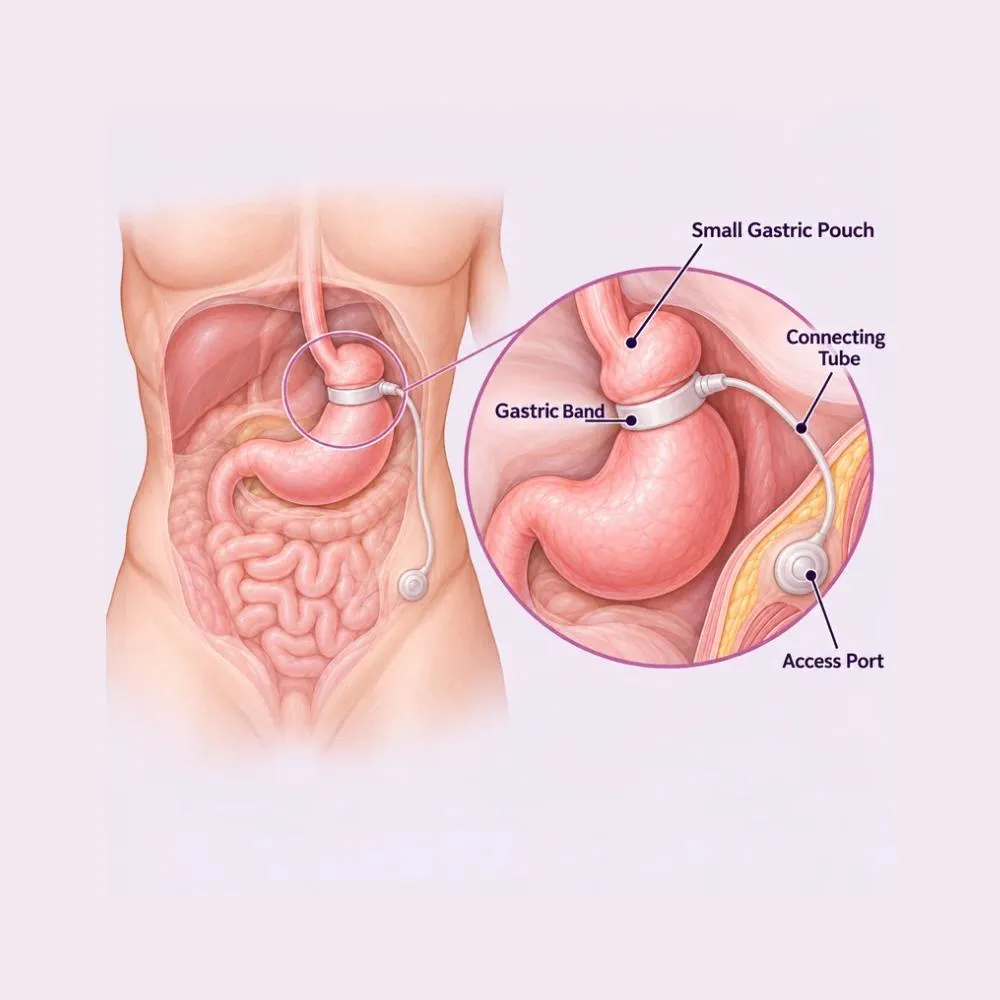
Gastric band surgery involves placing an adjustable silicone band around the upper portion of the stomach, creating a small pouch above it. Food fills that pouch quickly, producing a sense of fullness after a small amount, and then passes slowly through the narrowed opening into the rest of the stomach.
The band is connected by fine tubing to a small port placed just under the skin of the abdomen. Injecting saline into that port tightens the band; withdrawing saline loosens it. Adjustments are made in the clinic with a needle, take a few minutes, and require no anaesthetic or operation.
Nothing is cut, stapled or removed. The stomach and intestines are left entirely intact, and if the band is removed the anatomy returns to normal. It is the only bariatric procedure of which that is true, and it is the reason some patients choose it despite its lower effectiveness.
The band works purely by restriction. It has none of the hormonal effect that makes sleeves and bypasses more powerful, which is precisely why its results are more modest.
Food fills the pouch above the band quickly, triggering fullness signals after a very small volume.
Food passes slowly through the banded opening, so the sense of fullness lasts well beyond the meal.
Tightness is tuned to your progress. Too loose gives inadequate restriction; too tight causes vomiting and reflux.
Unlike a sleeve or bypass, the band does not alter ghrelin or GLP-1. Hunger is not reduced, only capacity, which makes it harder work.
Nothing is bypassed, so nutrient absorption is unchanged and the risk of deficiency is far lower than after a bypass.
The band restricts solid food but not liquid calories. Someone who drinks their calories can defeat it entirely.
That last point is the key to understanding this procedure. Because appetite is not reduced, success depends more heavily on your own behaviour than with any other bariatric operation.
The band is offered against the same criteria as other bariatric surgery, but is now chosen far less often, usually by patients for whom reversibility is the deciding factor.
You may be a candidate if
It particularly suits people who
Being honest about this: the band is performed much less often than it once was, because long-term weight loss is lower and around one in three patients eventually needs it removed or revised. We will discuss that openly rather than after the fact.
The workup is the standard bariatric assessment, with particular attention to whether you are likely to sustain the frequent follow-up a band requires.
Weight history, previous weight-loss attempts, comorbidities and a full medication review.
HbA1c, lipids, liver and kidney function, thyroid and a nutritional panel to establish a baseline.
Checks for ulcers, H. pylori, hiatal hernia and reflux. Significant reflux or a large hernia makes a band a poor choice.
Assesses for gallstones and fatty liver, both common in this group.
ECG, echocardiogram where indicated, and a sleep study for suspected sleep apnoea.
A frank discussion about adjustment visits, eating behaviour, and whether the band is realistically the right procedure for you.
The most important part of this assessment is not a test. It is an honest conversation about whether you will attend the adjustments, because a band without them does not work.
The band is one of several options, and it is no longer the most commonly chosen. Setting it beside the alternatives is the fairest way to decide.
Endoscopic, temporary and needing no operation. Similar in spirit to a band, with less weight loss but no surgery at all.
GLP-1 receptor agonists now produce weight loss comparable to a band, without any procedure.
Dietitian-led planning and behavioural work, which is essential alongside any procedure.
Reversible and adjustable, with no cutting or stapling. Typically 40–50% excess weight loss, and a high long-term reoperation rate.
Permanent, 50–70% excess weight loss, with a strong hormonal effect on hunger. Now the most commonly performed procedure worldwide.
The most effective for weight and diabetes, with 60–80% excess weight loss and lifelong supplements.
Removing a band that has slipped, eroded or produced inadequate weight loss, often converting to a sleeve or bypass at the same time.
If reversibility is genuinely your priority, the band is the only procedure that offers it. If weight loss is the priority, a sleeve or bypass will serve you better, and we would say so.
A forty-five minute to one hour keyhole operation through four or five small incisions, with a one-night stay. The shortest of the bariatric operations.
Laparoscopic adjustable gastric banding
BMI and overall health reviewed, with endoscopy and the necessary tests completed beforehand.
General anaesthetic. The abdomen is inflated with carbon dioxide and four to five small ports are placed.
A narrow passage is created behind the upper stomach, in the correct plane so the band sits where it should and cannot slip.
The silicone band is passed around the upper stomach and locked, creating a pouch of around fifteen to twenty millilitres above it.
Stomach tissue is stitched over the front of the band to hold it in position. This step is what prevents slippage, the commonest band complication.
The connecting tube is brought out and attached to a small port secured to the abdominal wall muscle, just under the skin.
Home after one night. The band is left empty initially, with the first adjustment at around six weeks once healing is complete.
The band does nothing at all for the first six weeks: it is deliberately left empty while tissue heals around it. Weight loss begins with the first adjustment, not with the operation.
The band suits some patients well and many patients poorly. What matters is a team that will tell you which you are. Here is why patients trust us:
Led by Dr. Tagore Mohan Grandhi, with fellowships in bariatric surgery (USA) and robotic surgery (Korea) and 28 years of experience.
We perform bands, sleeves and bypasses, so the recommendation reflects your case rather than what we happen to offer.
From the first consultation through to post-treatment follow-up, with one team throughout.
Our hospital is in HITEC CITY, near IKEA: easily reachable from across Hyderabad.
Physical recovery is the quickest of the bariatric operations. The commitment afterwards, however, is the longest: the adjustments continue for years.
One night in hospital. Sips of fluid the same evening, walking within hours. Home the next day.
Sugar-free liquids and non-carbonated drinks. Port site soreness is normal and settles quickly.
Pureed and soft foods. Desk work resumes from around week one to two: sooner than after other bariatric operations.
Gradual return to normal foods in small portions. The band is still empty, so restriction is minimal at this stage.
First band adjustment. Further adjustments every four to six weeks until the right restriction is found, then periodically for life.
This is the whole procedure. A band that is never adjusted does nothing, and this is the commonest reason bands fail.
Food must pass through a narrow opening. Large or poorly chewed mouthfuls cause obstruction and vomiting.
Sugary drinks, milkshakes and alcohol pass straight through the band. They are the easiest way to defeat it entirely.
Because the band produces less weight loss than other procedures, exercise contributes proportionally more to the result.
Sudden inability to eat, persistent vomiting, severe reflux or night-time regurgitation. These need urgent assessment.
Pain, swelling, redness at the port site, or an inability to adjust the band: all suggest a port or tubing problem.
Band slippage, erosion and port problems are all recognised long-term complications, and around one in three patients eventually needs the band removed or converted. Knowing that from the outset is part of choosing it well.
Book a consultation with a bariatric specialist if any of the following apply.
The operation costs less than a sleeve or bypass, but the ongoing adjustments and the possibility of later removal should be factored into the comparison.
| Procedure | Estimated Cost |
|---|---|
| Consultation & bariatric assessment Per visit | ₹1,000 – ₹2,000 |
| Complete pre-operative workup Bloods, endoscopy, ultrasound and cardiac review | ₹15,000 – ₹30,000 |
| Laparoscopic gastric band placement One night’s stay, band and port included | ₹2,20,000 – ₹3,50,000 |
| Band adjustment Per visit; several needed in the first year | ₹2,000 – ₹5,000 |
| Band removal One to two nights’ stay | ₹1,50,000 – ₹2,50,000 |
| Band removal with conversion to sleeve Two to three nights’ stay | ₹3,50,000 – ₹5,50,000 |
Several adjustments are needed in the first year and periodically thereafter. Individually inexpensive, but they add up over years.
Around one in three patients eventually needs the band removed or converted. That is worth weighing in the total cost, not just the first operation.
The device itself is a substantial part of the theatre cost, and differs between manufacturers.
A shared ward, a twin-sharing room or a private suite: the largest single swing in most estimates.
We are empanelled with most major insurers, and our team files the pre-authorisation for you.
Every figure above is an indicative range, not a quote. After your consultation you are given a written, fixed-cost estimate, and that is the number you pay, with no additions once treatment begins.
What patients treated here can expect:
Nothing cut or stapled: removing the band restores normal anatomy.
Tightness tuned in clinic without another operation.
The shortest bariatric operation, with a one-night stay.
The bariatric and gastrointestinal surgeon who performs gastric band surgery at our HITEC CITY hospital.

Senior Consultant: Bariatric & Gastrointestinal Surgery
MBBS, MS, FRCS (UK), DLS (France)
28 years experience
Reviews from patients treated for bariatric and gastrointestinal conditions at Lux Hospitals, Hyderabad.
Written by Dr. Tagore Mohan Grandhi on bariatric surgery and metabolic health.

Dr. Tagore Mohan Grandhi

Dr. Tagore Mohan Grandhi
Dr. Tagore Mohan Grandhi

Dr. Tagore Mohan Grandhi
Dr. Tagore Mohan Grandhi

Dr. Tagore Mohan Grandhi
Common questions about gastric band surgery, its results, and what it costs at Lux Hospitals.
Still have questions? Call us at 079 6908 4422
Still have questions? Message us on WhatsApp at 079 6908 4444
An honest comparison of band, sleeve and bypass for your case, with a fixed-cost estimate and insurance check before treatment begins.
Plot No.116, Lumbini Avenue, HITEC CITY, Near IKEA, Hyderabad – 500032













