



Dr. Samhitha Reddy
Consultant Proctologist & Laparoscopic Surgeon
MBBS, MS, FMAS, FISCP, DMAS
- 8 Yrs
- ASCRS Member
Shoulder arthroscopy allows the whole joint to be inspected and repaired through incisions a few millimetres across. It has largely replaced open surgery for rotator cuff tears, impingement and instability.
The shoulder is a demanding joint to work in, and the rehabilitation afterwards is longer than most people expect. Our orthopaedic surgeons at Lux Hospitals, HITEC CITY perform arthroscopic cuff repair, stabilisation and decompression, with a structured programme afterwards.
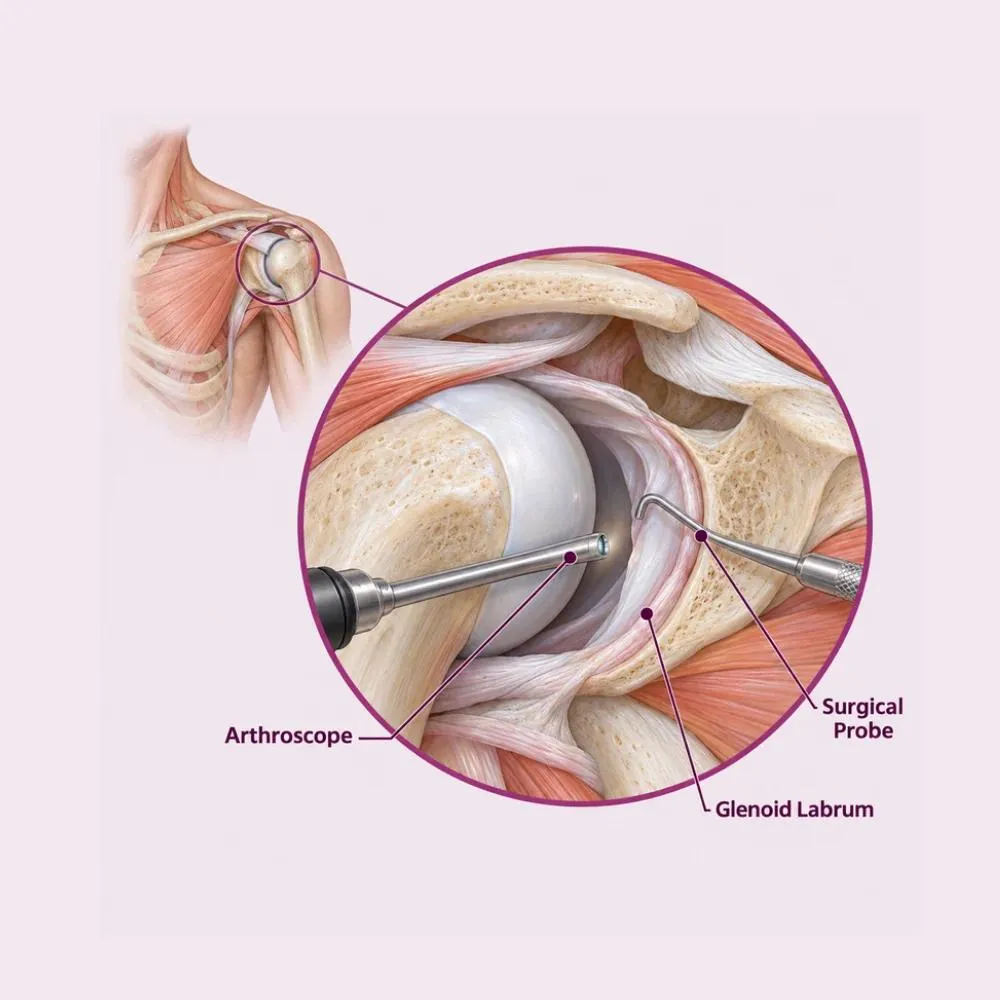
Shoulder arthroscopy is keyhole surgery of the shoulder joint. A camera is introduced through a portal a few millimetres wide, and instruments through two or three further portals, allowing the surgeon to inspect and repair structures inside and around the joint on a magnified screen view.
It is used to repair torn rotator cuff tendons, to reattach a torn labrum after dislocation, to remove bone spurs causing impingement, and to release a stiff capsule in frozen shoulder. Almost everything that was once done through a large open incision can now be done this way.
The advantages are real but worth stating precisely. The keyhole approach means less soft tissue damage, less post-operative pain and better cosmesis. It does not, however, make the repaired tendon heal any faster: a rotator cuff repaired arthroscopically still takes three months to heal to bone, and the rehabilitation is correspondingly long.
These are the shoulder problems keyhole surgery addresses, and the mechanisms behind them.
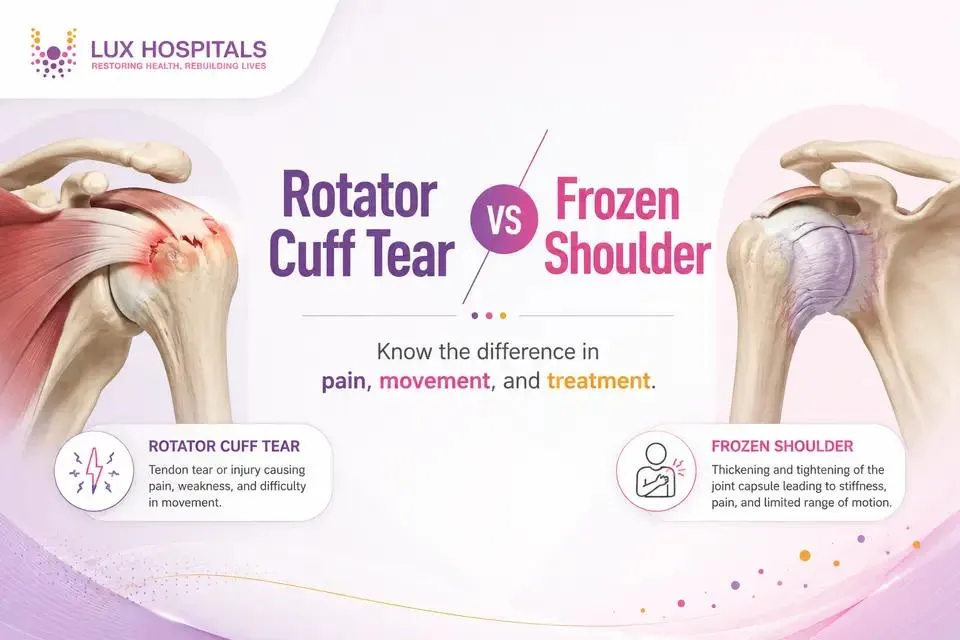
Degenerate or traumatic tears of the tendons that lift and rotate the arm. The commonest indication for shoulder arthroscopy.
A bone spur narrowing the space above the cuff, causing the tendon to catch painfully on overhead movement.
Damage to the cartilage rim of the socket, typically after a dislocation, which leaves the shoulder unstable.
Repeated dislocations stretching or detaching the stabilising structures, common in young athletes.
Contracture of the joint capsule causing profound stiffness, which can be released arthroscopically when it does not resolve.
Inflammation or partial tearing of the long head of biceps, which can be released or reattached.
Calcium deposits within the cuff tendon causing severe pain, which can be excised arthroscopically.
Wear at the joint on top of the shoulder, treated by excising a small portion of the clavicle.
Rotator cuff tears are worth a note: many are degenerate and asymptomatic, found incidentally on scans. A tear on MRI only warrants repair when it explains your symptoms.
Arthroscopy is considered for structural problems that have not settled with physiotherapy and injection.
Symptoms that may need arthroscopy
Findings that support surgery
Most shoulder pain improves without surgery. Arthroscopy is for structural damage confirmed on imaging that matches the symptoms, after conservative treatment has been genuinely tried.
The assessment identifies which structure is damaged and confirms it matches the symptoms before any surgery is planned.
The pattern of pain, any injury, previous dislocations, and which movements provoke the symptoms.
Range of motion, cuff strength testing, impingement signs and instability tests: each localising a specific structure.
Show bone spurs, arthritis, calcific deposits and any bony damage to the socket rim after dislocation.
The key investigation. It shows the rotator cuff, labrum and capsule in detail, including tear size and tendon quality.
Blood tests, medication review, particularly blood thinners and anti-inflammatories, and an anaesthetic consultation.
Usually general anaesthesia with an interscalene nerve block, which gives excellent pain relief for the first day.
Arrange for someone to take you home. You will be groggy from the anaesthetic and your arm will be in a sling and numb from the block.
Most shoulder conditions respond to conservative treatment. Arthroscopy is for structural problems that persist.
The first-line treatment for almost every shoulder problem. Cuff strengthening and scapular control resolve a great many cases without surgery.
Steroid injected into the space above the cuff, giving relief for weeks to months and helping confirm where the pain is coming from.
Reduces tendon inflammation during the settling phase, used alongside physiotherapy.
Avoiding repetitive overhead loading while the tendon settles, and adapting how tasks are performed.
Distending the capsule with fluid under imaging guidance, particularly effective in frozen shoulder.
Torn tendon reattached to bone with anchors. The commonest arthroscopic shoulder procedure, with a three to six month rehabilitation.
Removing the bone spur and inflamed bursa to create space for the cuff to glide freely.
Reattaching the torn labrum to the socket rim, restoring stability after recurrent dislocation.
Dividing the contracted capsule in frozen shoulder, restoring range of motion in a single procedure.
Releasing or reattaching a damaged biceps tendon, often performed alongside a cuff repair.
Clearing loose fragments, calcific deposits and inflamed tissue from the joint.
Rotator cuff repair is the procedure with the most demanding rehabilitation. The tendon takes three months to heal to bone, and pushing too early is the main cause of a repair failing.
A forty-five minute to two hour procedure depending on what is repaired, through three or four small portals. Usually a day case.
Arthroscopic shoulder surgery
General anaesthesia with an interscalene nerve block, which numbs the shoulder for the first twelve to eighteen hours.
Positioned either in a beach-chair position or on the side, whichever gives the best access for the planned procedure.
Three or four incisions of five to ten millimetres are made around the shoulder for the camera and instruments.
The joint and the subacromial space are inspected systematically: cuff, labrum, biceps, cartilage and capsule.
Cuff tendon reattached with suture anchors, labrum repaired, bone spur removed or capsule released, depending on the findings.
The shoulder is moved through its range to confirm the repair is secure and there is no residual impingement.
Portals closed with a single stitch each, a dressing applied, and the arm placed in a sling before you go home.
The nerve block wears off after twelve to eighteen hours, and the pain that follows can be sharp if you have not started oral painkillers before it does. Take them proactively that first evening.
Arthroscopic shoulder surgery is technically demanding and the rehabilitation determines the result. Here is why patients trust us:
Orthopaedic surgeons performing arthroscopic cuff repair, stabilisation and decompression regularly.
A staged protocol matched to exactly what was repaired, run over three to six months rather than left to chance.
From the first consultation through to post-treatment follow-up, with one team throughout.
Our hospital is in HITEC CITY, near IKEA: easily reachable from across Hyderabad.
Recovery depends entirely on what was repaired. A decompression takes weeks; a rotator cuff repair takes months.
Home the same day with the arm in a sling. The nerve block provides good pain relief initially: start oral painkillers before it wears off.
Sling worn continuously after a cuff or labral repair. Gentle passive movements only, protecting the repair while it heals to bone.
Sling discarded and active movement begins. After a decompression alone, most patients are already back to normal by this point.
Strengthening work. Return to driving, desk work and most daily activities. Overhead work resumes gradually.
Return to sport and heavy overhead work after a cuff repair, subject to strength and control rather than to time alone.
After a cuff or labral repair it protects the repair while the tendon heals to bone. Discarding it early is the main cause of failure.
Passive first, then active-assisted, then active, then strengthening. Skipping stages causes either stiffness or re-tearing.
Take painkillers before the nerve block wears off on the first evening. Catching up afterwards is considerably harder.
Most patients are more comfortable semi-upright in a recliner or on pillows for the first few weeks than lying flat.
Fever, spreading redness or portal discharge, sudden loss of movement, or pain that worsens rather than settles after the first week.
Shoulder recovery is slower than knee or hip. Range improves for six to twelve months, and expecting that makes the middle months easier.
Stiffness is the commonest problem after shoulder surgery, and re-tearing is the most serious. The staged protocol exists to balance those two risks, which is why following it precisely matters.
Book a consultation if any of the following apply.
Cost is driven by what is repaired and how many anchors are used. These are the ranges our patients fall into.
| Procedure | Estimated Cost |
|---|---|
| Consultation & assessment Per visit | ₹800 – ₹1,500 |
| MRI shoulder The key diagnostic investigation | ₹7,000 – ₹14,000 |
| Diagnostic arthroscopy with debridement Day care, same-day discharge | ₹60,000 – ₹1,00,000 |
| Subacromial decompression Day care, same-day discharge | ₹75,000 – ₹1,25,000 |
| Arthroscopic rotator cuff repair Day care or one night; anchors included | ₹1,40,000 – ₹2,60,000 |
| Arthroscopic Bankart repair Day care or one night; anchors included | ₹1,30,000 – ₹2,40,000 |
| Post-operative physiotherapy Three to six months after a cuff repair | ₹15,000 – ₹40,000 |
Anchors are a major part of the cost, and a large cuff tear needs several more than a small one.
A small single-tendon tear and a massive retracted multi-tendon tear are very different operations.
Cuff repair needs three to six months of physiotherapy, which is a real and often underestimated cost.
A shared ward, a twin-sharing room or a private suite: the largest single swing in most estimates.
We are empanelled with most major insurers, and our team files the pre-authorisation for you.
Every figure above is an indicative range, not a quote. After your consultation you are given a written, fixed-cost estimate, and that is the number you pay, with no additions once treatment begins.
The orthopaedic and shoulder surgeons who perform shoulder arthroscopy at our HITEC CITY hospital.

Consultant Orthopaedic Surgeon: Joint Replacement & Arthroscopy
MS (Ortho), FIJR, FIASM (UK), FIKS (Italy), FIRJR
8 years experience

Consultant Orthopaedic Surgeon
MBBS, MS, FIJR
6 years experience
Reviews from patients treated for shoulder, knee and sports injuries at Lux Hospitals, Hyderabad.
Written by Dr. Sai Kishan Sirasala on shoulder surgery, sports injuries and orthopaedic care.
Dr. Sai Kishan Sirasala
Dr. Sai Kishan Sirasala
Dr. Sai Kishan Sirasala
Dr. Sai Kishan Sirasala
Dr. Sai Kishan Sirasala
Dr. Sai Kishan Sirasala
Common questions about shoulder arthroscopy, its recovery, and what surgery costs at Lux Hospitals.
Still have questions? Call us at 079 6908 4422
Still have questions? Message us on WhatsApp at 079 6908 4444
Keyhole shoulder surgery with a structured rehabilitation programme, and a fixed-cost estimate before treatment begins.
Plot No.116, Lumbini Avenue, HITEC CITY, Near IKEA, Hyderabad – 500032













