



Dr. Samhitha Reddy
Consultant Proctologist & Laparoscopic Surgeon
MBBS, MS, FMAS, FISCP, DMAS
- 8 Yrs
- ASCRS Member
Total knee replacement resurfaces all three compartments of the knee. It is the operation for arthritis that has spread across the whole joint, and it is among the most predictable procedures in orthopaedics: pain relief is achieved in the large majority of patients.
The result depends as much on how the implant is balanced as on the implant itself. Our orthopaedic surgeons at Lux Hospitals, HITEC CITY offer conventional and robotic-assisted total knee replacement, with rehabilitation beginning the day of surgery.
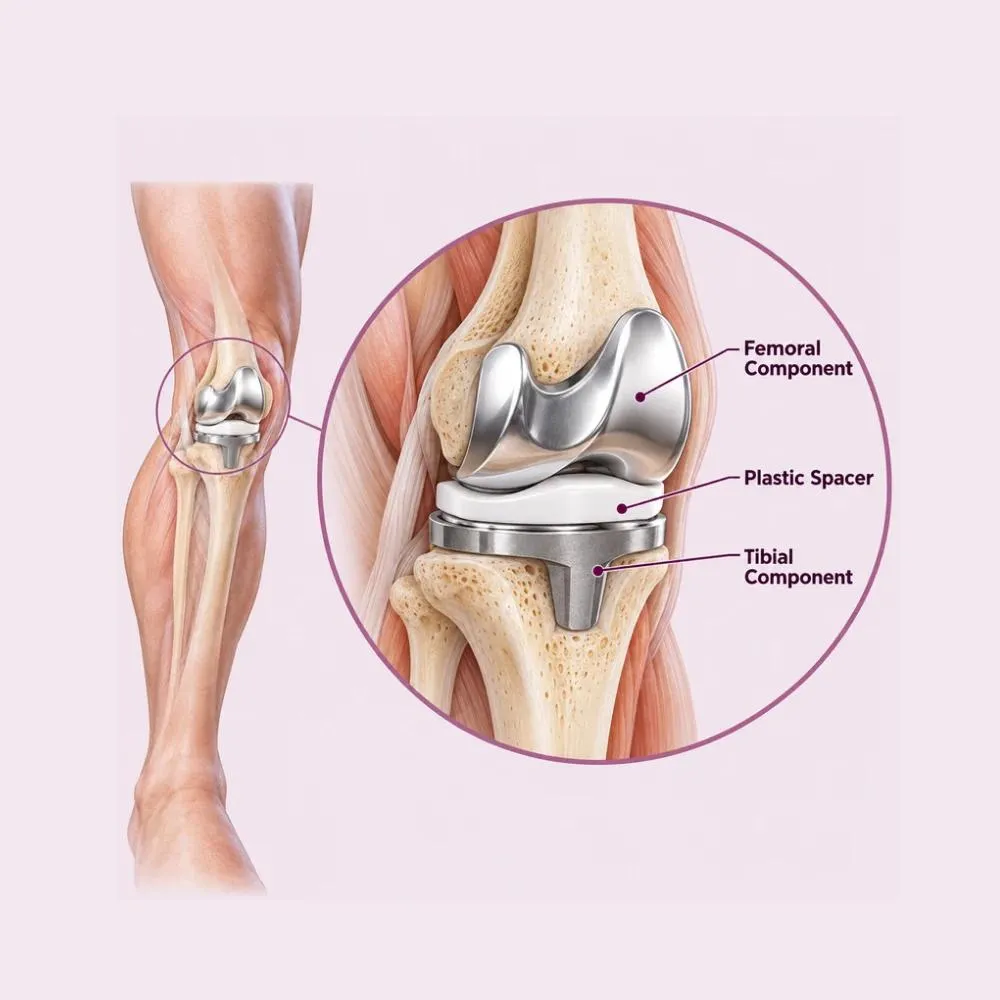
Total knee replacement, or total knee arthroplasty, resurfaces all three compartments of the knee joint: the inner, the outer and the kneecap. Worn cartilage and a few millimetres of underlying bone are removed from the femur and tibia and replaced with metal components, with a durable plastic bearing between them.
It differs from a partial replacement in scope. A partial resurfaces only one damaged compartment and preserves the cruciate ligaments; a total replacement addresses the whole joint and is appropriate when arthritis has spread beyond one compartment, when there is significant deformity, or when the ligaments are no longer competent.
The variants that matter are how it is performed rather than what is implanted. Conventional replacement uses mechanical cutting jigs. Robotic-assisted replacement uses a pre-operative plan and navigation to place components to within a degree. Both use similar implants; the difference lies in the precision of alignment, which matters most in deformed or unusual knees.
The end point is the same (a worn-out joint) but several conditions get there by different routes.
Progressive wear of the cartilage over years, eventually leaving bone articulating on bone across the whole joint.
Inflammatory disease that destroys cartilage and bone across all compartments simultaneously, often at a younger age.
Arthritis following a fracture into the joint surface, which alters loading permanently and wears the cartilage prematurely.
Long-standing bow legs or knock knees overload one compartment first, then progressively damage the rest.
Substantially accelerates cartilage wear and is the most modifiable factor in both causing and outliving a replacement.
Extensive meniscectomy or repeated procedures alter load distribution and accelerate arthritis over the following decades.
Loss of blood supply causing bone collapse and destruction of the overlying joint surface.
Repeated crystal-induced inflammation damages cartilage cumulatively over many years.
Whatever the route, the assessment is the same: how much of the joint is affected, how well aligned the leg is, and whether the ligaments still work.
Total replacement is considered when arthritis affects more than one compartment and non-surgical treatment has stopped working.
Symptoms indicating surgery
Findings favouring total over partial
Where arthritis is genuinely confined to one compartment and the ligaments are intact, a partial replacement gives a more natural-feeling knee. That option is assessed for before defaulting to a total.
The workup confirms that a total replacement is the right operation and that you are in the best possible condition for it.
Range of motion, strength, stability and alignment assessed, along with the hip and spine, which commonly refer pain to the knee.
Standing films show the true joint space narrowing, and long-leg views measure overall limb alignment for surgical planning.
Assesses soft tissue and bone quality where needed, and provides the dataset for planning in robotic-assisted surgery.
Screening for anaemia, infection and diabetes control. Correcting anaemia beforehand reduces the need for transfusion.
Diabetes, heart disease and obesity are assessed and optimised, since each meaningfully affects complication rates.
Strengthening the quadriceps before surgery measurably improves the speed and quality of recovery afterwards.
Any source of infection (dental, urinary or skin) is treated before surgery. An implant seeded with bacteria is the one complication that turns a good operation into a very difficult problem.
Total replacement is the endpoint. Everything before it should have been genuinely tried, and several surgical alternatives exist for the right patient.
Quadriceps strengthening reduces arthritic knee pain measurably, and is the most effective non-surgical treatment available.
Reduces load through the knee severalfold, often producing worthwhile pain relief and improving surgical outcomes if surgery follows.
Paracetamol, topical and oral anti-inflammatories, used with awareness of their long-term risks.
Steroid injections for flares, and hyaluronic acid for lubrication in selected patients.
A stick in the opposite hand offloads the knee substantially and delays the need for surgery.
The standard operation using mechanical alignment guides. Highly predictable, with over ninety per cent of implants lasting fifteen to twenty years.
A pre-operative plan and intraoperative navigation place components within a degree of target. Most valuable in significant deformity.
For single-compartment disease with intact ligaments. Smaller operation, quicker recovery, and a more natural-feeling knee.
Realigning the tibia to offload the worn compartment, preserving the joint in younger active patients.
Replacing a loose, worn or infected implant. Considerably more complex than the primary operation.
The genuine question at consultation is not which implant, but whether a total replacement is the right operation for your knee, or whether a partial or an osteotomy would serve you better.
A sixty to ninety minute operation through a single incision at the front of the knee, with a two to three night stay.
Total knee arthroplasty
Usually spinal anaesthesia with sedation and a nerve block, which is associated with less blood loss and fewer complications than a general anaesthetic.
A single incision of around fifteen to twenty centimetres at the front of the knee, giving access to the joint.
The worn cartilage and a few millimetres of underlying bone are removed from the femur and tibia with precise cutting guides.
Metal components are fitted to the femur and tibia with a plastic bearing between them, and the kneecap resurfaced where indicated.
Components are aligned to restore the limb’s mechanical axis, and the soft tissues balanced so the knee is stable through its full range.
The knee is put through full flexion and extension and tested for stability before anything is cemented in place.
Closed in layers, and you are stood up and walking with a physiotherapist the same day or the next morning.
Balance and alignment matter more to how the knee ultimately feels than the choice of implant. A well-balanced knee feels like your own; a poorly balanced one aches whatever was put in.
Joint replacement rewards volume, precision and structured rehabilitation. Here is why patients trust us:
A dedicated orthopaedic team performing knee replacement regularly, with conventional and robotic-assisted techniques available.
Physiotherapy from the day of surgery through to twelve weeks, because the operation alone does not deliver the outcome.
From the first consultation through to post-treatment follow-up, with one team throughout.
Our hospital is in HITEC CITY, near IKEA: easily reachable from across Hyderabad.
Recovery is demanding and the physiotherapy is the treatment, not an add-on. Most patients are walking without aids by six weeks.
Monitored in recovery until the anaesthesia wears off, then standing and walking with a frame within hours. Pain controlled with a nerve block and medication.
Physiotherapy twice daily, walking progressively further and managing stairs. Home once safe and independent, usually after two to three nights.
Intensive physiotherapy at home and in clinic. The targets are full extension and at least ninety degrees of flexion by six weeks.
Walking without aids, driving from around six weeks, and returning to desk work. Swelling reduces steadily.
Continued gains in strength and comfort. Most patients describe the knee as feeling genuinely their own by six to twelve months.
Begin within a day or two of surgery and continue consistently. A knee not moved in the first six weeks stiffens, and that is hard to reverse.
Getting the knee completely straight matters more than how far it bends. A knee that will not straighten causes a permanent limp.
Regular icing and elevation in the first weeks reduces swelling and makes the exercises considerably more comfortable.
Take blood thinners as prescribed and do ankle exercises regularly. Clots are the main early risk after joint replacement.
Fever, spreading redness or wound discharge, calf pain and swelling, breathlessness, or sudden severe knee pain.
Keep weight down, choose low-impact exercise, and tell any dentist or doctor that you have a joint replacement.
Some patients are disappointed that a replaced knee does not feel entirely like a natural one. It usually feels different, but it should not hurt, and pain relief is the reliable result of this operation.
Book a consultation if any of the following apply.
The implant is the largest single component of the cost. These are the ranges our patients fall into.
| Procedure | Estimated Cost |
|---|---|
| Consultation & assessment Per visit | ₹800 – ₹1,500 |
| Pre-operative workup X-rays, bloods and anaesthetic review | ₹8,000 – ₹18,000 |
| Total knee replacement: one knee Three nights’ stay, standard implant | ₹1,80,000 – ₹3,20,000 |
| With high-flexion or premium implant Three nights’ stay | ₹2,40,000 – ₹3,80,000 |
| Robotic-assisted total knee replacement Three nights’ stay | ₹2,80,000 – ₹4,50,000 |
| Bilateral total knee replacement Both knees in one sitting, four to five nights | ₹3,20,000 – ₹5,50,000 |
| Post-operative physiotherapy Six to twelve weeks of rehabilitation | ₹15,000 – ₹35,000 |
Standard, high-flexion and oxidised zirconium implants differ substantially in price, and the right choice depends on your age and activity.
Robotic assistance adds meaningfully to the cost, and its value is greatest in significant deformity or unusual anatomy.
Bilateral surgery in one sitting costs less than two admissions but is a bigger physiological insult, and suits only fitter patients.
A shared ward, a twin-sharing room or a private suite: the largest single swing in most estimates.
We are empanelled with most major insurers, and our team files the pre-authorisation for you.
Every figure above is an indicative range, not a quote. After your consultation you are given a written, fixed-cost estimate, and that is the number you pay, with no additions once treatment begins.
The orthopaedic and joint replacement surgeons who perform total knee replacement at our HITEC CITY hospital.

Consultant Orthopaedic Surgeon: Joint Replacement & Arthroscopy
MS (Ortho), FIJR, FIASM (UK), FIKS (Italy), FIRJR
8 years experience

Consultant Orthopaedic Surgeon
MBBS, MS, FIJR
6 years experience
Reviews from patients treated for knee, shoulder and orthopaedic conditions at Lux Hospitals, Hyderabad.
Written by Dr. Sai Kishan Sirasala on knee replacement, arthroscopy and orthopaedic care.

Dr. Sai Kishan Sirasala
Dr. Sai Kishan Sirasala

Dr. Sai Kishan Sirasala
Dr. Sai Kishan Sirasala

Dr. Sai Kishan Sirasala
Dr. Sai Kishan Sirasala
Common questions about total knee replacement, its recovery, and what surgery costs at Lux Hospitals.
Still have questions? Call us at 079 6908 4422
Still have questions? Message us on WhatsApp at 079 6908 4444
Conventional and robotic-assisted total knee replacement with rehabilitation built in, and a fixed-cost estimate before treatment begins.
Plot No.116, Lumbini Avenue, HITEC CITY, Near IKEA, Hyderabad – 500032













