



Dr. Samhitha Reddy
Consultant Proctologist & Laparoscopic Surgeon
MBBS, MS, FMAS, FISCP, DMAS
- 8 Yrs
- ASCRS Member
Urethritis is inflammation of the urethra, the tube carrying urine out of the body. It causes burning on urination and often a discharge, and it is one of the commonest reasons men attend a urologist.
Most cases are infective and respond quickly to the right antibiotic, but the right antibiotic depends on which organism is responsible, and that requires testing rather than guessing. Our urologists at Lux Hospitals, HITEC CITY test properly, treat accordingly, and keep the whole consultation confidential.
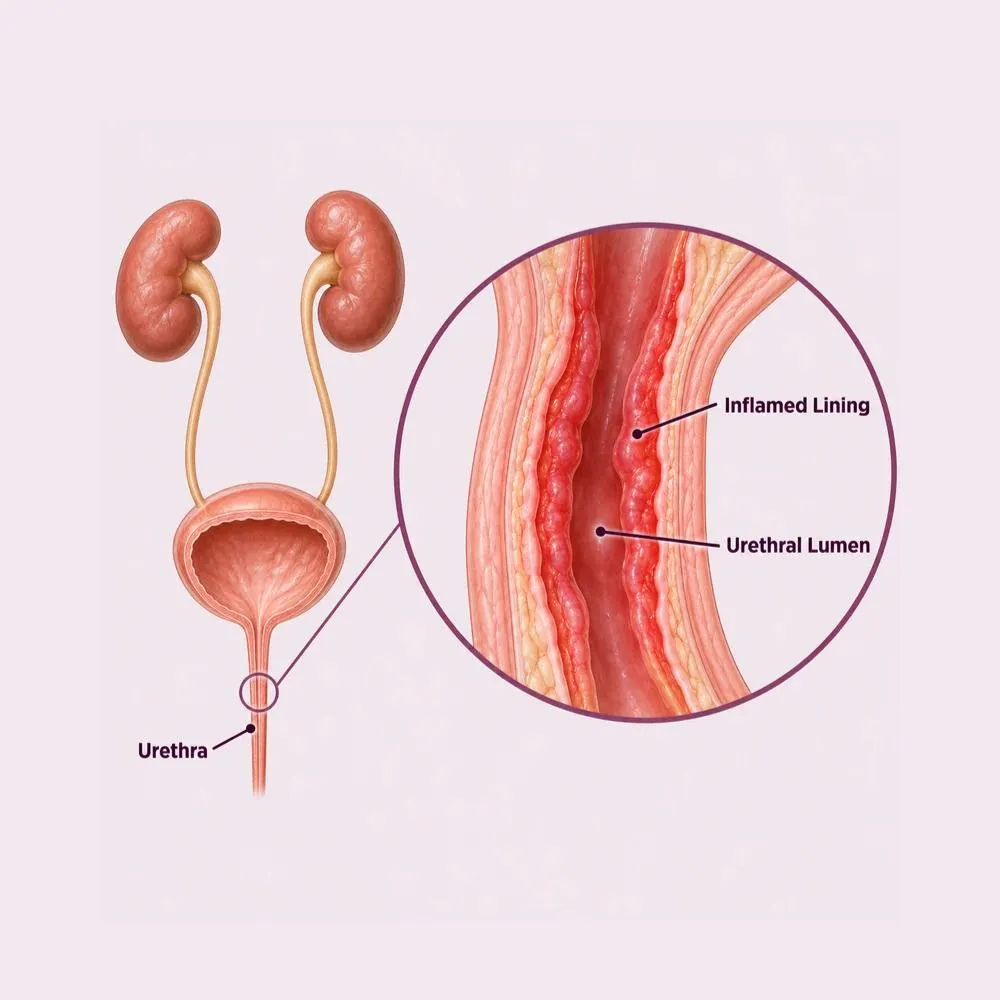
Urethritis is inflammation of the urethra. It presents with burning or stinging on passing urine, often with a discharge from the tip of the penis, and sometimes with itching or irritation at the opening. In women the symptoms overlap so closely with cystitis that the two are frequently confused.
It is classified by cause. Gonococcal urethritis is caused by Neisseria gonorrhoeae and typically produces a thick yellow-green discharge with abrupt onset. Non-gonococcal urethritis (the larger group) is most often caused by Chlamydia trachomatis or Mycoplasma genitalium, and produces a thinner, clearer discharge with a more gradual onset. Non-infective urethritis follows irritation from catheters, soaps, spermicides or instrumentation.
The reason it matters beyond the discomfort is what happens when it is not treated. Untreated infection can ascend to cause epididymitis in men and pelvic inflammatory disease in women, with consequences for fertility. Repeated episodes also scar the urethra, producing a stricture that is far harder to treat than the original infection.
Most urethritis is infective and sexually transmitted, but a meaningful minority is not.
The commonest cause of non-gonococcal urethritis. Frequently symptomless, particularly in women, and a leading preventable cause of infertility.
Causes gonococcal urethritis with abrupt onset and thick yellow-green discharge. Increasingly antibiotic-resistant, so treatment must be guided by testing.
An increasingly recognised cause of persistent urethritis, often resistant to standard first-line treatment and needing specific testing.
A parasitic infection causing urethritis in men and vaginitis in women. Requires a different class of drug entirely.
E. coli and similar organisms, particularly in older men with prostate enlargement or after catheterisation.
Mechanical irritation from a catheter, cystoscopy or any urethral procedure causes non-infective inflammation.
Soaps, bubble baths, spermicides and antiseptics applied to the area. A genuine cause that is often overlooked in favour of assuming infection.
Not every case is sexually transmitted, and assuming so causes needless distress. Chemical irritation, catheter trauma and ordinary urinary bacteria all cause identical symptoms, which is another reason to test rather than assume.
Burning on urination with a discharge is the classic combination, though some people have very few symptoms at all.
Common symptoms
Symptoms needing prompt care
Chlamydial urethritis is often silent, particularly in women. A substantial proportion of people have no symptoms at all while remaining infectious, which is why partner testing matters as much as your own treatment.
Identifying the organism is what makes treatment work, and modern tests give an answer within days.
A first-void urine sample, which is more sensitive for urethritis than a mid-stream one. Detects inflammatory cells and ordinary urinary bacteria.
Nucleic acid amplification for chlamydia, gonorrhoea, mycoplasma and trichomonas. Highly sensitive, done on urine, and the test that guides treatment.
A swab from the urethra examined immediately, which can identify gonorrhoea within minutes and confirm inflammation.
HIV, syphilis and hepatitis testing offered where a sexually transmitted cause is confirmed, since co-infection is common.
Where symptoms are recurrent, to assess the prostate, check bladder emptying and look for an underlying cause.
Reserved for persistent or recurrent cases, to look for a stricture: the commonest reason urethritis keeps coming back.
Recurrent urethritis after adequate treatment usually means one of three things: an untreated partner, a resistant organism such as Mycoplasma genitalium, or an underlying stricture. Each needs a different answer.
Treatment is antibiotic and usually rapid. Surgery is only for the strictures that repeated inflammation leaves behind.
Chosen by the organism identified: azithromycin or doxycycline for chlamydia, ceftriaxone for gonorrhoea, and specific regimens for mycoplasma.
Sexual partners treated simultaneously, whether or not they have symptoms. Without this, reinfection is close to inevitable.
No sexual contact until seven days after both you and your partner have completed treatment and symptoms have resolved.
Longer or second-line courses where symptoms persist, guided by repeat testing rather than by trial and error.
Where the cause is chemical or mechanical (soaps, spermicides, a catheter) stopping the irritant resolves it without antibiotics.
High fluid intake, simple analgesia and urinary alkalinisers to ease burning while the antibiotic works.
Stretching a short stricture. Simple and quick, but recurrence is common, so it is a holding measure rather than a cure.
Endoscopic incision of a short stricture under vision. Reasonable success for a first, short, single stricture.
Surgical reconstruction of the urethra, often using a graft of buccal mucosa from the inside of the cheek. The definitive treatment, with success rates well above ninety per cent.
Extended antibiotics, scrotal support and anti-inflammatories where the infection has ascended to the testicle.
Repeated dilatation of a stricture is one of the commonest patterns in urology and one of the least useful. Where a stricture keeps recurring, urethroplasty is the operation that actually solves it.
Most cases are resolved within a fortnight from first consultation to confirmed clearance.
Confidential testing and targeted antibiotic treatment
A private discussion of symptoms, sexual history where relevant, catheter use and any products applied to the area.
A first-void urine sample and, where appropriate, a urethral swab. Holding urine for an hour beforehand improves the yield.
Where symptoms are typical, treatment covering the likely organisms is started immediately rather than waiting for results.
Treatment refined once the organism is identified, particularly important with increasingly resistant gonorrhoea.
Partners tested and treated at the same time. This step is what prevents the cycle of reinfection.
Repeat testing after treatment where indicated, particularly for gonorrhoea and mycoplasma, to confirm the infection has cleared.
Where symptoms continue, assessment for resistant organisms, untreated partners or an underlying stricture.
Holding urine for at least an hour before giving the sample makes a real difference to test sensitivity. Passing urine on the way to the appointment is the commonest reason a test comes back falsely negative.
Urethritis is easy to treat badly: guessed at rather than tested. Here is why patients trust us:
NAAT testing for chlamydia, gonorrhoea, mycoplasma and trichomonas, so treatment is targeted rather than empirical guesswork.
Private consultations, discreet testing, and clear guidance on partner notification without lecturing.
From the first consultation through to post-treatment follow-up, with one team throughout.
Our hospital is in HITEC CITY, near IKEA: easily reachable from across Hyderabad.
Symptoms usually improve within days of starting the right antibiotic and resolve within a week or two.
Treatment started. Burning and discharge typically begin improving within forty-eight to seventy-two hours.
Symptoms largely resolve. The full antibiotic course must still be completed even once you feel well.
Sexual activity may resume seven days after both you and your partner have completed treatment and are symptom-free.
Test of cure where indicated, particularly after gonorrhoea or mycoplasma. Persistent symptoms are reassessed rather than re-treated blindly.
Assessed with urethrogram or cystoscopy, and treated endoscopically or by urethroplasty depending on length and position.
Stopping when symptoms improve leaves the infection partly treated and contributes directly to antibiotic resistance.
Untreated partners are the commonest cause of recurrence. They need treating whether or not they have symptoms.
Counted from when both of you have finished the course and are symptom-free. Earlier contact restarts the cycle.
High fluid intake flushes the urethra and eases burning considerably while the antibiotic takes effect.
Scented soaps, bubble baths, antiseptics and spermicides all irritate the urethra. Plain water is sufficient for washing.
A stream that becomes weak or takes longer, months after an episode, suggests a stricture forming and should be assessed early.
The complication worth watching for is not the infection itself but the scarring it can leave. A stream that gradually weakens in the months after urethritis is a stricture until proven otherwise.
Book a consultation if any of the following apply.
Most cases cost little: a consultation, a test and a short course of antibiotics. Surgery applies only where a stricture has developed.
| Procedure | Estimated Cost |
|---|---|
| Consultation Private and confidential | ₹800 – ₹1,500 |
| Urine analysis and culture First-void sample | ₹600 – ₹1,800 |
| NAAT panel Chlamydia, gonorrhoea, mycoplasma, trichomonas | ₹3,000 – ₹8,000 |
| Additional STI screening HIV, syphilis, hepatitis | ₹2,000 – ₹5,000 |
| Antibiotic course Depends on the organism and regimen | ₹400 – ₹2,500 |
| Optical internal urethrotomy Day care or one night, for a short stricture | ₹55,000 – ₹95,000 |
| Urethroplasty Three to five days in hospital | ₹1,80,000 – ₹3,20,000 |
A basic urine culture costs little. A full NAAT panel with STI screening is more, and is what makes treatment reliable.
Simple urethritis is treated for a few thousand rupees. A stricture requiring urethroplasty is an entirely different order of cost.
Resistant gonorrhoea or Mycoplasma genitalium needs repeat testing and second-line drugs, adding to the total.
A shared ward, a twin-sharing room or a private suite: the largest single swing in most estimates.
We are empanelled with most major insurers, and our team files the pre-authorisation for you.
Every figure above is an indicative range, not a quote. After your consultation you are given a written, fixed-cost estimate, and that is the number you pay, with no additions once treatment begins.
The urologists who treat urethritis at our HITEC CITY hospital.

Consultant Urologist & Andrologist
MBBS, MS, DrNB (Urology)
10 years experience

Consultant Urologist & Andrologist
MBBS, MS, MCh (Urology)
9 years experience
Reviews from patients treated for urological conditions at Lux Hospitals, Hyderabad.
Written by Dr. Vipin Reddy B on urinary and urological care.

Dr. Vipin Reddy B

Dr. Vipin Reddy B

Dr. Vipin Reddy B

Dr. Vipin Reddy B

Dr. Vipin Reddy B

Dr. Vipin Reddy B
Common questions about urethritis, its treatment and what care costs at Lux Hospitals.
Still have questions? Call us at 079 6908 4422
Still have questions? Message us on WhatsApp at 079 6908 4444
Discreet testing and targeted antibiotic treatment for urethritis, with costs shared upfront.
Plot No.116, Lumbini Avenue, HITEC CITY, Near IKEA, Hyderabad – 500032













