Dr. Samhitha Reddy
Consultant Proctologist & Laparoscopic Surgeon
MBBS, MS, FMAS, FISCP, DMAS
- 8 Yrs
- ASCRS Member
A brow lift raises a heavy, descended brow to a natural position, opening the eyes and softening the frown lines between them.
It is frequently confused with eyelid surgery, and the two solve different problems: operating on the wrong one worsens the appearance. Our plastic surgeon at Lux Hospitals, HITEC CITY works out which applies to you, and will tell you where botulinum toxin would do the job instead.
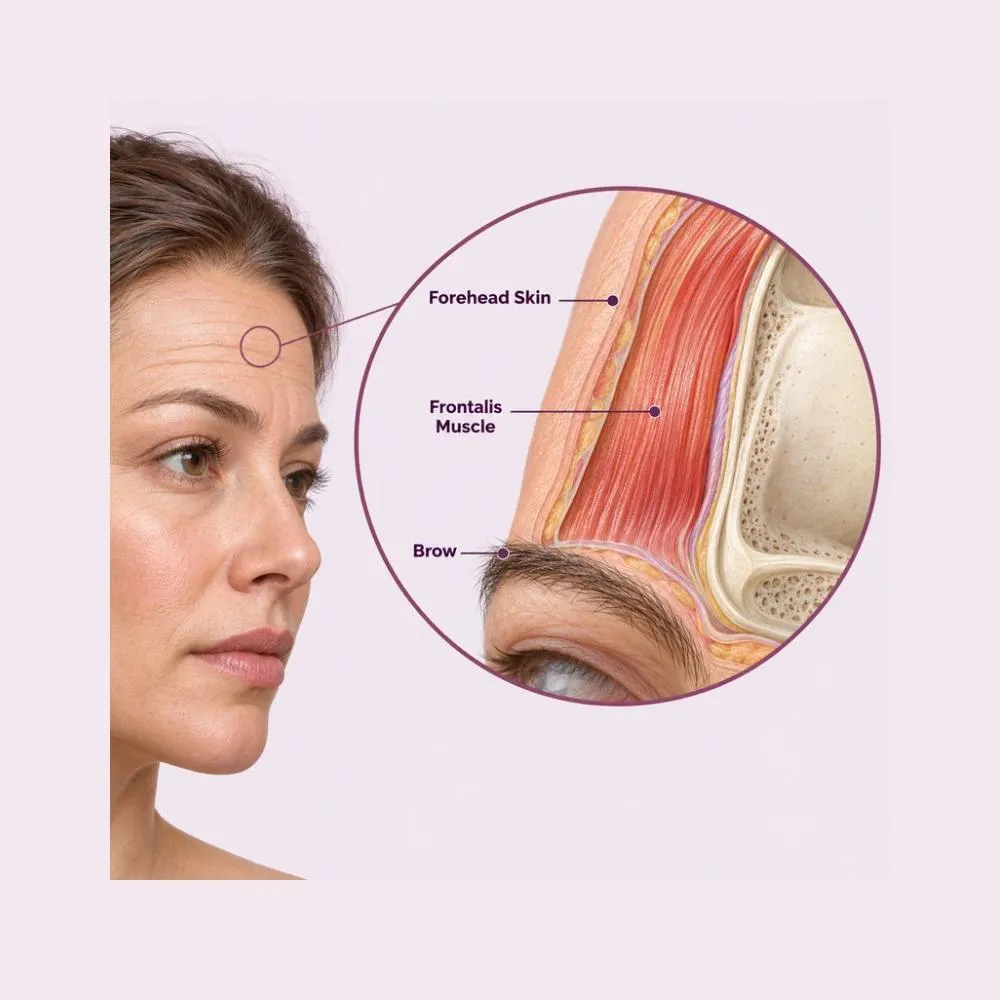
A brow lift repositions the eyebrows and forehead tissue upward, correcting the descent that occurs with age. As the brow falls it presses down on the upper eyelid, producing hooding, a heavy look and a permanently tired or stern expression. Raising the brow relieves that pressure and opens the eye.
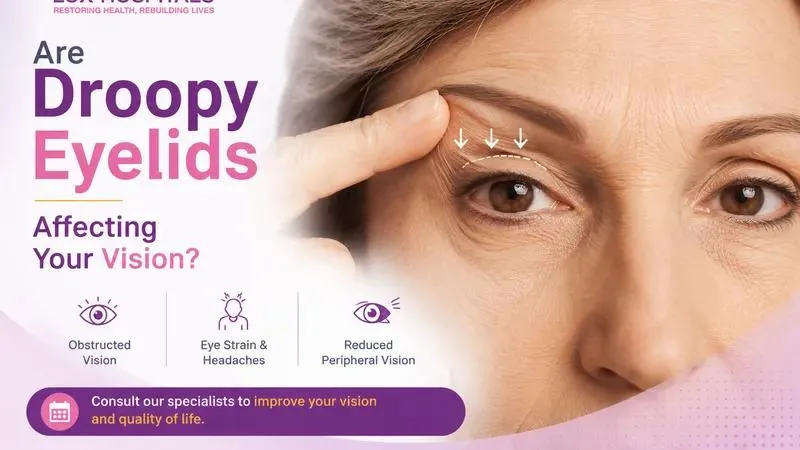
The distinction from blepharoplasty is fundamental. Eyelid surgery removes excess eyelid skin; a brow lift raises the structure above it. When the true problem is brow descent and eyelid skin is removed instead, the brow is pulled further down and the result looks worse: a heavy, closed-off eye with a scar to show for it. Where both problems exist, both operations are needed.
It is also worth being clear about what it does not fix. A brow lift raises the brow and softens the vertical frown lines between the eyebrows by weakening the muscles that produce them. It does not remove horizontal forehead lines caused by muscle activity: those respond to botulinum toxin, and in many patients toxin alone achieves a modest brow lift without any surgery at all.
Brow descent is a combination of gravity, tissue change and the constant pull of the muscles around the eye.
Collagen and elastin decline with age, so forehead skin stretches and no longer holds the brow at its original height.
The ligaments anchoring the brow to the underlying bone loosen, allowing the whole structure to slide downward.
The muscles around the eye and between the brows pull downward continuously, while only the frontalis muscle pulls up. Over decades, down wins.
Fat beneath the brow diminishes with age, so the brow loses the support it was resting on and settles lower.
The orbital rim gradually resorbs with age, enlarging the eye socket and reducing the bony support beneath the brow.
Both accelerate collagen breakdown considerably, bringing brow descent on earlier than it would otherwise appear.
Because only one muscle lifts the brow while several pull it down, weakening the depressors with botulinum toxin produces a genuine if modest lift, which is why toxin is worth trying before surgery in milder cases.
The procedure suits genuine brow descent. Where the brow sits normally, it is the wrong operation.
Signs of brow descent
Where it is not the answer
The simplest test is in front of a mirror: lift your brows gently with your fingers to where they would naturally sit. If that opens your eyes and lightens your expression, a brow lift addresses your problem. If it does little, the issue is eyelid skin instead.
The assessment measures brow position objectively and establishes whether eyelid surgery is needed alongside or instead.
Assessing brow height relative to the orbital rim, and the shape of the arch. This is what distinguishes descent from a normally positioned brow.
Lifting the brow to its intended position to preview the effect, and to reveal how much eyelid hooding remains once the brow is corrected.
Judging whether blepharoplasty is also needed. Both are frequently required, and doing only one gives an incomplete result.
Hairline height and hair density determine which technique is suitable: some approaches raise the hairline, which suits only a low one.
Discussing the risk to the nerve supplying forehead movement, which varies with the approach chosen.
Standardised photographs with the intended brow position marked, so expectations are agreed before rather than after.
A brow lifted too high produces a permanently surprised expression that is very difficult to reverse. Conservative elevation to a natural position is the goal, not maximum lift.
From injections to endoscopic surgery, with the choice depending on how much lift is needed.
Weakening the muscles that pull the brow down produces a modest lift of two to three millimetres. Reversible, and worth trying first in mild cases.
Restoring volume beneath the brow and at the temples, supporting the brow without lifting it surgically.
Barbed sutures placed to elevate the brow. Less invasive than surgery, but results are modest and last only twelve to eighteen months.
Energy-based tightening producing subtle elevation over months. Suits very mild descent rather than established brow ptosis.
The most commonly used technique. Three to five small incisions behind the hairline, with a camera used to release and elevate the forehead.
Small incisions at the temples lifting the outer brow only. Suits patients whose descent is mainly at the outer third.
Skin excised immediately above the eyebrow. Very effective and precise, but leaves a visible scar, usually reserved for older patients or facial palsy.
The traditional approach through an incision across the top of the scalp. Powerful and durable, but raises the hairline and involves more numbness.
An incision at the hairline itself, which lifts the brow without raising the hairline. Suits patients with a high forehead.
Brow lift and upper eyelid surgery together, addressing both structures: very common, and the sequence matters.
A botulinum toxin brow lift is genuinely worth trying first if your descent is mild. It costs a fraction of surgery, it is reversible, and it shows you how a lifted brow suits your face before committing.
The operation takes sixty to ninety minutes, and you go home the same day.
Day-care surgery under sedation or general anaesthesia
Stopping blood thinners and supplements that increase bruising, fasting from midnight, and hair washed with antiseptic shampoo.
Incision sites behind the hairline and the intended brow position marked with you sitting upright.
Local anaesthesia with sedation, or general anaesthesia. Local anaesthetic with adrenaline is infiltrated to reduce bleeding.
Three to five incisions of one to two centimetres, placed behind the hairline where hair conceals them completely.
A camera passed beneath the scalp, and the forehead tissue released from the bone across the brow and temples so it can move upward.
The muscles producing vertical frown lines partially divided under direct vision, which softens those lines lastingly.
The forehead elevated to the planned position and secured with absorbable fixation devices or sutures, then the incisions closed.
Endoscopic technique gives a comparable lift to the traditional coronal approach with far smaller incisions, less numbness and no raising of the hairline, which is why it has largely replaced it.
Brow lift and eyelid surgery are frequently confused, and the wrong choice worsens the result. Here is why patients trust us:
Brow position measured objectively and eyelid skin assessed separately, so you get the operation your anatomy needs rather than the one you asked for.
Botulinum toxin suggested where it would achieve enough, rather than surgery recommended by default.
From the first consultation through to post-treatment follow-up, with one team throughout.
Our hospital is in HITEC CITY, near IKEA: easily reachable from across Hyderabad.
Most people are presentable within two weeks. Scalp numbness is the symptom that lasts longest.
Forehead and eyelid swelling, with bruising often settling downward around the eyes. Head elevated and cold compresses used constantly.
Swelling peaks then settles. Sutures or staples removed at seven to ten days. Hair can be washed gently from day three.
Most bruising resolves and makeup can be used. Most people return to work at two weeks. Exercise resumes at three.
The brow settles slightly from its initial over-corrected position into its final place. Residual swelling resolves.
Scalp numbness and itching gradually resolve, though full sensation can take up to a year to return.
It is deliberately over-corrected, and settles a few millimetres over six to twelve weeks. Judging the result in the first fortnight is premature.
Sleep on two or three pillows for the first week. It substantially reduces forehead and periorbital swelling.
Numbness behind the incisions is universal and normal, and the itching as nerves recover can be intense. Both resolve over months.
Incisions behind the hairline are protected by hair, but exposed scalp should be covered while healing to avoid pigmentation.
For two to three weeks. Straining raises pressure and risks bleeding beneath the released forehead tissue.
Inability to raise one brow suggests nerve injury and needs assessment. Rapidly expanding swelling suggests a haematoma.
A surgical brow lift typically lasts eight to twelve years, though ageing continues underneath it. Botulinum toxin and threads last months rather than years, which is the main trade-off against their lower cost.
A consultation is worthwhile if any of the following apply.
Cost depends on the technique and on whether eyelid surgery is done at the same time.
| Procedure | Estimated Cost |
|---|---|
| Consultation Includes assessment and photographs | ₹800 – ₹1,500 |
| Botulinum toxin brow lift Per session; lasts four to six months | ₹18,000 – ₹40,000 |
| Thread lift Lasts twelve to eighteen months | ₹60,000 – ₹1,20,000 |
| Temporal or lateral brow lift Outer brow only, day care | ₹1,20,000 – ₹2,10,000 |
| Endoscopic brow lift Day care; includes fixation devices | ₹1,80,000 – ₹3,20,000 |
| Coronal or pretrichial brow lift Open technique | ₹2,00,000 – ₹3,50,000 |
| Combined with upper blepharoplasty Both procedures in one sitting | ₹2,50,000 – ₹4,20,000 |
A temporal lift addressing the outer brow only is shorter and less expensive than a full endoscopic lift with fixation devices.
Botulinum toxin costs a fraction per session but recurs every four to six months. Surgery is a one-off cost lasting years.
Combining brow lift and blepharoplasty costs more in one sitting but considerably less than two separate operations.
A shared ward, a twin-sharing room or a private suite: the largest single swing in most estimates.
We are empanelled with most major insurers, and our team files the pre-authorisation for you.
Every figure above is an indicative range, not a quote. After your consultation you are given a written, fixed-cost estimate, and that is the number you pay, with no additions once treatment begins.
The plastic surgeon who performs brow lift surgery at our HITEC CITY hospital.

Consultant Plastic & Cosmetic Surgeon
MBBS, MS, MCh (Plastic Surgery)
16 years experience
Reviews from patients treated for cosmetic and plastic surgery at Lux Hospitals, Hyderabad.
Written by Dr. M. Ram Prabhu on plastic and cosmetic surgery.

Dr. M. Ram Prabhu

Dr. M. Ram Prabhu

Dr. M. Ram Prabhu
Dr. M. Ram Prabhu
Dr. M. Ram Prabhu

Dr. M. Ram Prabhu
Common questions about brow lift surgery, the alternatives and what it costs at Lux Hospitals.
Still have questions? Call us at 079 6908 4422
Still have questions? Message us on WhatsApp at 079 6908 4444
Brow position and eyelid skin assessed separately, with non-surgical options offered where they would do the job.
Plot No.116, Lumbini Avenue, HITEC CITY, Near IKEA, Hyderabad – 500032