



Dr. Samhitha Reddy
Consultant Proctologist & Laparoscopic Surgeon
MBBS, MS, FMAS, FISCP, DMAS
- 8 Yrs
- ASCRS Member
A urinary tract infection is one of the commonest reasons anyone sees a doctor, and a simple bladder infection usually clears within days of the right antibiotic. The problem is not treating one UTI: it is treating the fourth.
Recurrent infections need a cause found rather than another prescription. Our urologists at Lux Hospitals, HITEC CITY treat acute infections with culture-guided antibiotics and investigate recurrent ones properly, because something is usually driving them.
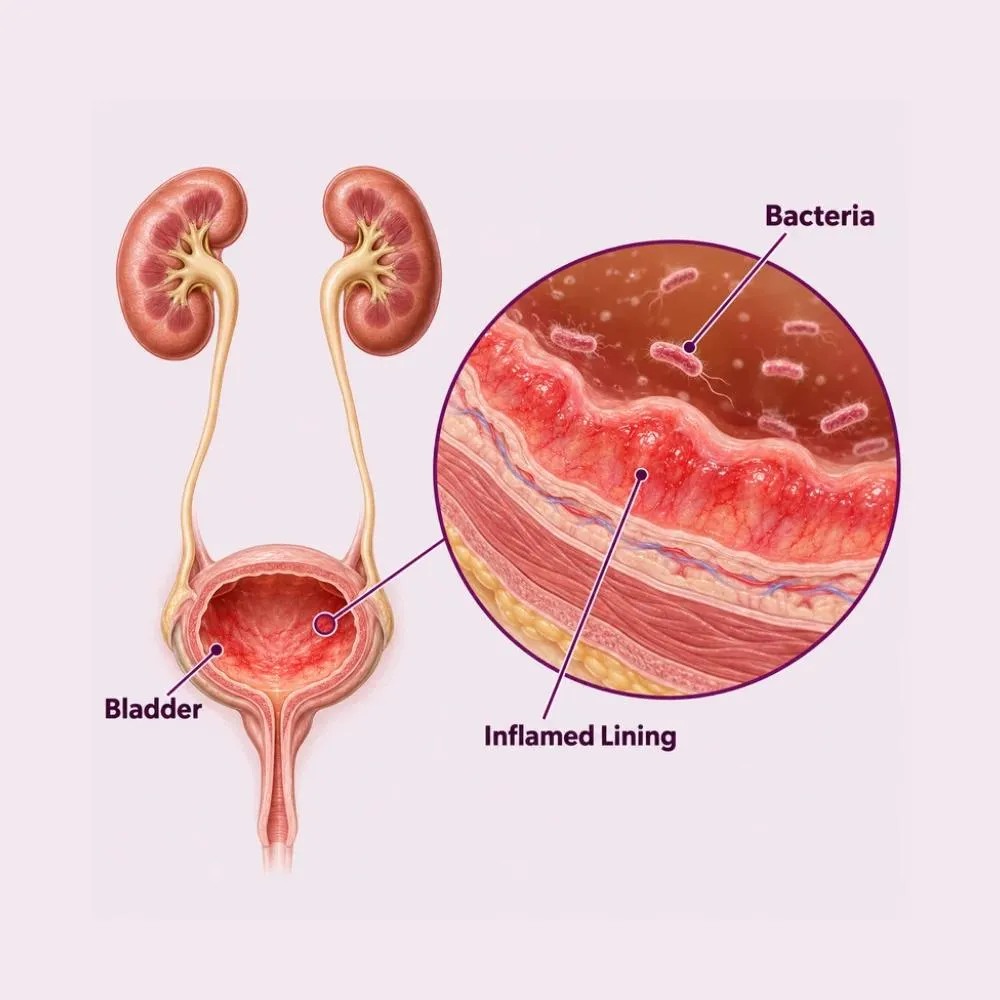
A urinary tract infection is bacterial infection anywhere in the urinary system: the kidneys, ureters, bladder or urethra. Most are caused by E. coli travelling from the bowel to the urethra and up into the bladder.
Where the infection sits determines how serious it is. Cystitis, confined to the bladder, causes burning and frequency and is uncomfortable but not dangerous. Pyelonephritis, where infection reaches the kidney, causes fever, loin pain and vomiting, and can lead to sepsis: it is a different illness requiring a different response.
Women get UTIs far more often than men because the female urethra is much shorter, giving bacteria a shorter route to the bladder. Conversely, a UTI in a man is less common and more likely to indicate an underlying problem, which is why it is investigated more thoroughly.
Most UTIs arise when bowel bacteria reach the bladder. Several factors make that more likely or make clearing them harder.
A shorter urethra sited close to the anus gives bacteria a much shorter route to the bladder. This is the single biggest reason UTIs are commoner in women.
Mechanically introduces bacteria toward the urethra. Passing urine soon afterwards measurably reduces the risk.
Concentrated urine passed infrequently allows bacteria to multiply rather than being flushed out.
Infrequent voiding gives bacteria time to establish. Regular emptying is one of the simplest preventive measures.
Residual urine from prostate enlargement, a prolapse or nerve problems provides a reservoir for bacteria to grow in.
Glucose in the urine feeds bacteria, and impaired immunity makes infections more frequent and more severe.
Falling oestrogen thins the vaginal and urethral lining and alters the protective bacterial flora, causing a marked rise in UTIs.
Both provide surfaces on which bacteria form biofilm, which antibiotics penetrate poorly: a common cause of relapsing infection.
A UTI in a man, or a recurrent UTI in anyone, warrants looking for a cause. Stones, incomplete emptying and structural abnormalities are the usual findings, and each is treatable.
Bladder infections cause local symptoms. Kidney infections add fever and systemic illness, and that distinction matters.
Bladder infection (cystitis)
Kidney infection: seek care today
In elderly patients a UTI can present as confusion or a fall with none of the classic urinary symptoms at all. That presentation is easily missed and worth knowing about.
A urine culture confirms the infection and identifies which antibiotic will work. That matters increasingly as resistance rises.
A bedside test detecting nitrites and white cells. Quick and useful, though not conclusive on its own.
The definitive test. It identifies the organism and which antibiotics it responds to, which is essential given rising resistance in India.
Inflammatory markers, kidney function and blood sugar where the infection is severe or recurrent.
For recurrent infections, infections in men, or suspected kidney involvement: looking for stones, obstruction or incomplete emptying.
Where a kidney infection is not responding, to detect an abscess, an obstructing stone or a structural abnormality.
Direct inspection of the bladder in recurrent infections, looking for stones, a diverticulum or, occasionally, a tumour.
Antibiotic resistance in India is high enough that treating on a dipstick alone frequently fails. Sending a culture before starting treatment is what allows the antibiotic to be corrected if the first choice was wrong.
A simple bladder infection needs a short antibiotic course. Recurrent infections need the cause found and a prevention strategy.
Three to five days for uncomplicated cystitis, chosen by local resistance patterns and adjusted once the culture is back.
Seven to fourteen days for kidney infection, infections in men, or where there is an underlying abnormality.
For pyelonephritis with vomiting, high fever or sepsis, given in hospital until the fever settles.
Analgesia and generous fluid intake, which relieves symptoms and helps flush bacteria from the bladder.
Reduce the burning of cystitis symptomatically while the antibiotic takes effect.
Adequate fluids, regular voiding, passing urine after intercourse, and wiping front to back. Simple, and genuinely effective.
For post-menopausal women, restoring the protective vaginal flora. One of the most effective preventive measures available.
A small nightly dose, or a single dose after intercourse, for frequent recurrences. Effective, though used with awareness of resistance.
Non-antibiotic supplements that reduce bacterial adherence to the bladder wall. Evidence is modest but they are harmless.
Removing stones, relieving prostate obstruction, or correcting incomplete emptying, which is what actually stops recurrence.
Hyaluronic acid instilled into the bladder to restore its protective lining, for selected patients with recurrent infection.
Recurrent UTIs are not simply bad luck. There is usually a reason (incomplete emptying, a stone, or hormonal change after menopause) and finding it is the difference between managing infections and stopping them.
Three or more infections in a year warrants a proper assessment rather than another prescription. This is what that involves.
Recurrent UTI workup
Reviewing past cultures to confirm the infections were genuine and to identify whether it is the same organism recurring or different ones.
The same organism returning suggests a persistent focus such as a stone. Different organisms suggest reinfection, and that points elsewhere.
Flow rate and post-void residual ultrasound. Residual urine is one of the commonest and most treatable causes of recurrence.
Ultrasound or CT looking for stones, obstruction, a diverticulum or anatomical abnormality feeding the infections.
Direct inspection of the bladder and urethra, particularly in men, in anyone with blood in the urine, or where imaging is inconclusive.
Blood sugar, menopausal status, bowel habit, fluid intake and sexual history: each a modifiable contributor.
A specific plan combining behavioural measures, hormonal treatment where relevant, and antibiotic prophylaxis only if needed.
The aim is to stop writing antibiotic prescriptions. Where a stone or residual urine is found and dealt with, recurrent infections often cease entirely, which no course of antibiotics would have achieved.
Treating one UTI is straightforward. Stopping recurrent ones needs proper investigation. Here is why patients trust us:
Antibiotics chosen on culture and sensitivity rather than guesswork, which matters given rising resistance.
Imaging, flow assessment and cystoscopy where indicated, so recurrent infections have their cause found and treated.
From the first consultation through to post-treatment follow-up, with one team throughout.
Our hospital is in HITEC CITY, near IKEA: easily reachable from across Hyderabad.
A simple UTI settles within days. Preventing the next one is where most of the value lies.
Burning and urgency improve substantially within 24 to 48 hours of starting the right antibiotic.
Course completed. Symptoms should have resolved fully: if not, the culture is reviewed and the antibiotic changed.
After a kidney infection, fatigue can persist for a week or two. A repeat culture confirms clearance.
Where infections have been recurrent, this is when the workup is completed and a prevention plan agreed.
Prevention measures continue. Most patients see infections become far less frequent or stop entirely.
The simplest and most effective preventive measure. Dilute urine passed frequently flushes bacteria out before they establish.
Empty regularly rather than deferring, and always pass urine after intercourse. Both measurably reduce recurrence.
Complete it even once symptoms have gone. Stopping early is a leading cause of relapse and of resistance.
For post-menopausal women this is among the most effective preventive treatments, and it is frequently overlooked.
Fever, loin pain, vomiting, confusion, or symptoms not improving after 48 hours of antibiotics.
Three or more infections in a year should be investigated, not simply treated again. There is usually a findable cause.
Repeated courses of antibiotics without ever looking for a cause is the pattern most worth breaking. It drives resistance, and it leaves the actual problem in place.
Book a consultation for the first three, and seek urgent care for the rest.
Treating a simple UTI is inexpensive. Investigating recurrent infections costs more and is what prevents the next ones.
| Procedure | Estimated Cost |
|---|---|
| Consultation Per visit | ₹800 – ₹1,500 |
| Urine culture and sensitivity Identifies the organism and the right antibiotic | ₹500 – ₹1,200 |
| Antibiotic course for simple UTI Three to five days | ₹300 – ₹1,200 |
| Ultrasound KUB with residual volume For recurrent infections | ₹1,500 – ₹3,500 |
| Recurrent UTI workup Imaging, bloods and flow assessment | ₹8,000 – ₹20,000 |
| Cystoscopy Day care, under sedation | ₹12,000 – ₹25,000 |
| Admission for kidney infection Three to five nights with IV antibiotics | ₹40,000 – ₹1,00,000 |
Uncomplicated cystitis costs a few hundred rupees. Pyelonephritis needing admission and intravenous antibiotics costs considerably more.
A single infection needs a culture and antibiotics. Recurrent infections warrant imaging and cystoscopy to find the cause.
Where a stone or prostate obstruction is driving the infections, treating that is a separate and larger cost, and the one that works.
A shared ward, a twin-sharing room or a private suite: the largest single swing in most estimates.
We are empanelled with most major insurers, and our team files the pre-authorisation for you.
Every figure above is an indicative range, not a quote. After your consultation you are given a written, fixed-cost estimate, and that is the number you pay, with no additions once treatment begins.
The urologists who treat urinary tract infections at our HITEC CITY hospital.

Consultant Urologist & Andrologist
MBBS, MS, DrNB (Urology)
10 years experience

Consultant Urologist & Andrologist
MBBS, MS, MCh (Urology)
9 years experience
Reviews from patients treated for urinary infections and urological conditions at Lux Hospitals, Hyderabad.
Written by Dr. Vipin Reddy B on urinary infections, bladder health and urological care.

Dr. Vipin Reddy B

Dr. Vipin Reddy B

Dr. Vipin Reddy B

Dr. Vipin Reddy B

Dr. Vipin Reddy B

Dr. Vipin Reddy B
Common questions about urinary tract infections, their treatment, and what care costs at Lux Hospitals.
Still have questions? Call us at 079 6908 4422
Still have questions? Message us on WhatsApp at 079 6908 4444
Culture-guided treatment for acute infections and proper investigation of recurrent ones, with costs shared upfront.
Plot No.116, Lumbini Avenue, HITEC CITY, Near IKEA, Hyderabad – 500032













