



Dr. Samhitha Reddy
Consultant Proctologist & Laparoscopic Surgeon
MBBS, MS, FMAS, FISCP, DMAS
- 8 Yrs
- ASCRS Member
Are you still experiencing back pain, leg pain or numbness after spine surgery? Has your pain returned after an initial period of improvement? Persistent or recurring symptoms following spinal surgery may be associated with Failed Back Surgery Syndrome (FBSS), also called Persistent Spinal Pain Syndrome Type 2.
Pain after spine surgery does not always mean the procedure was unsuccessful. Symptoms may result from ongoing nerve irritation, recurrent disc problems, new spinal changes or other musculoskeletal conditions. At Lux Hospitals, Hyderabad, patients can enquire about specialist spine consultations for persistent pain after spinal surgery and assessment of suitable treatment options.
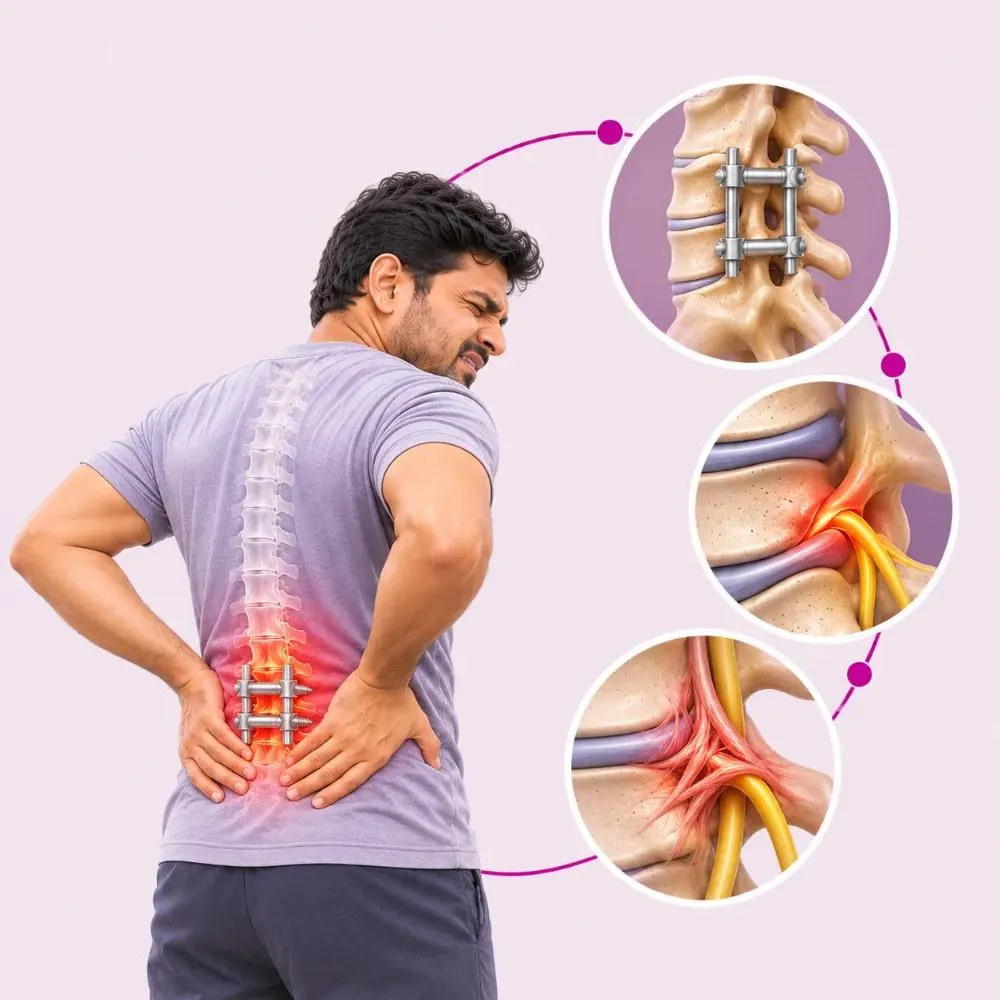
Failed Back Surgery Syndrome (FBSS) refers to persistent, recurring or new back or leg pain following spinal surgery, such as discectomy, laminectomy, spinal decompression or spinal fusion. It is also known as Persistent Spinal Pain Syndrome Type 2 (PSPS-T2), a term that describes ongoing pain after surgery without necessarily indicating a surgical mistake.
Patients may experience persistent lower back pain, recurring leg pain, burning or shooting sensations, tingling, numbness, muscle weakness and difficulty walking or sitting for extended periods. These symptoms may result from nerve irritation, scar tissue formation, recurrent disc herniation, spinal instability or other underlying causes.
Treatment begins with identifying the source of persistent pain through clinical evaluation and appropriate investigations. The goal is to relieve symptoms, improve mobility and restore daily functioning rather than automatically recommending another surgery.
Persistent pain after spinal surgery can develop for different reasons.
A disc may herniate again at a previously treated spinal level, causing recurring nerve compression.
Some people continue to experience symptoms because of ongoing nerve compression, at the operated level or at another affected level.
Scar tissue may develop around spinal nerve structures after surgery. Although postoperative scar tissue is common, it does not necessarily cause pain.
Following certain spinal procedures, especially fusion, changes may develop at nearby spinal levels over time. These changes may occasionally contribute to new symptoms.
Abnormal movement between vertebrae may contribute to mechanical back pain in selected patients.
Pseudarthrosis occurs when a planned spinal fusion does not heal into a solid bony union. It can sometimes contribute to persistent pain.
The sacroiliac joint may cause lower back or buttock pain, particularly in some patients after lumbar fusion.
Nerves may remain sensitive or damaged even after the original compression has been relieved.
Hip disorders, muscular pain, facet joint pain and other conditions can produce symptoms that resemble pain from the operated spine.
Identifying the actual cause helps determine whether rehabilitation, medication, pain interventions or revision surgery may be appropriate.
Symptoms vary according to the underlying condition and previous operation.
Common symptoms
Emergency warning signs
Pain may remain similar to the symptoms experienced before surgery or may develop in a different location. Pain travelling below the knee, persistent foot or leg numbness, burning sensations, changes in sensation, weakness in specific muscles and difficulty walking normally suggest nerve involvement. The emergency signs may indicate serious nerve compression, infection or another postoperative complication and need immediate medical attention.
Evaluation focuses on understanding the previous operation, identifying the pain source and determining whether further treatment is necessary.
The clinician reviews the original spinal condition, type of surgery, date of operation and recovery history. The timing of pain recurrence can provide useful information.
The doctor may review previous MRI or CT scans, operation reports, discharge summaries, implant details, physiotherapy records, previous injections and current medicines.
The clinician assesses spinal movement, walking ability, muscle strength, sensation and reflexes, and may also examine the hips and sacroiliac joints.
MRI may help identify recurrent disc herniation, spinal stenosis, infection or other soft-tissue abnormalities. Contrast-enhanced MRI may be useful in selected postoperative patients, particularly when distinguishing recurrent disc material from scar tissue.
X-rays may help assess spinal alignment and implants. CT may be recommended when evaluating fusion healing, bone structures or hardware-related concerns.
For some patients, targeted diagnostic injections, electrodiagnostic tests or blood tests may be required.
The findings are reviewed together to determine whether a structural condition, nerve-related pain or another pain source is responsible.
Treatment depends on the cause of pain, neurological findings, previous surgery and overall health. Many patients benefit from a multidisciplinary approach involving appropriate rehabilitation, medication review and selected interventions, with interventional procedures considered when conservative treatment has not provided sufficient improvement.
May focus on restoring movement, improving strength and gradually increasing activity tolerance. Treatment should account for the previous procedure, any implants and the patient’s current neurological condition.
Progressive strengthening, walking programmes and functional exercises may help improve physical conditioning. The plan should avoid movements that are unsafe for the patient’s surgical condition.
A clinician may review medicines used for nociceptive or neuropathic pain. Medication choice depends on the suspected pain mechanism, medical history, side effects and previous treatment response. Long-term opioid treatment should be approached cautiously because of dependence and other risks.
Persistent pain can affect sleep, mood, work and daily activities. Cognitive behavioural approaches or other structured pain-management strategies may help patients manage pain-related disability alongside physical treatment.
Regular sleep, graded exercise, stopping smoking and treatment of associated medical conditions may all contribute to overall rehabilitation.
An epidural injection may be considered for certain nerve-related pain patterns, but benefits vary, and the procedure is not appropriate for every patient.
When facet joint or sacroiliac joint pain is suspected, targeted diagnostic procedures may help identify the source of pain.
May be considered for selected patients with appropriately assessed facet or sacroiliac-mediated pain. It does not treat every cause of persistent postoperative pain.
In carefully selected patients, specialised procedures may be considered to address suspected painful epidural adhesions. The evidence is mixed, and these are not routine or guaranteed treatments.
Spinal cord stimulation (SCS) is a specialised treatment for selected patients with persistent neuropathic pain despite appropriate standard care. A device delivers controlled electrical impulses through electrodes implanted close to the spinal cord. Before permanent implantation is considered, patients typically undergo a multidisciplinary evaluation and a short stimulation trial. SCS does not correct spinal instability or remove a surgically treatable compressive lesion.
Repeat surgery is considered only when evaluation identifies a suitable structural problem likely to benefit from another operation. Examples may include recurrent nerve compression, significant spinal instability, symptomatic pseudarthrosis, certain implant complications and progressive neurological deterioration.
Revision surgery may be more complex and carry greater risks than the original operation. It should not be recommended solely because persistent pain remains.
Revision surgery is not necessary for every patient with persistent pain after spinal surgery. When it is indicated, the procedure depends on the underlying structural problem.
Revision Spine Surgery
The surgeon reviews the original operation, current symptoms, imaging and overall medical condition.
The team determines whether decompression, implant revision, fusion assessment or another intervention is required.
Revision spine operations are commonly performed under general anaesthesia.
The surgeon takes existing scar tissue and other surgical changes into account when approaching the affected spinal level.
The procedure may involve relieving nerve compression, removing recurrent disc material or addressing instability or implant-related problems.
When clinically indicated, the surgeon may use implants or fusion techniques.
The patient is monitored after surgery and receives individualised instructions on mobility, wound care and rehabilitation.
Potential risks include infection, bleeding, nerve injury, dural tear, persistent pain, implant complications and the possibility of further surgery.
Persistent pain after spinal surgery requires careful reassessment rather than automatically repeating the previous treatment.
Surgical reports and imaging may help clarify the original diagnosis, treatment and subsequent recovery.
The clinician assesses whether symptoms arise from nerve compression, mechanical spinal problems or other pain sources.
Rehabilitation and appropriate pain management may help patients who do not have a clear indication for repeat surgery.
Selected patients may require diagnostic procedures, specialist pain management or revision surgical evaluation.
Patients can enquire about available spine consultations at Lux Hospitals, Hyderabad.
Recovery depends on the underlying cause of persistent pain, previous surgery and selected treatment.
Following reassessment, a patient may begin or modify an appropriate rehabilitation and pain-management plan.
Rehabilitation may focus on gradual strengthening, movement tolerance and manageable daily activities.
The treatment response is reviewed, and further investigation or intervention is considered when appropriate.
Some patients gradually improve physical function, while others require longer-term multidisciplinary support.
Activity and strengthening programmes should account for the previous operation and current spinal condition.
Long-term pain medicines require monitoring for effectiveness, side effects and interactions.
Treatment may aim to improve walking, sleep and daily function even when complete pain relief is not possible.
Follow-up helps assess neurological function, pain control and rehabilitation progress.
New weakness, bladder or bowel changes, fever or significant new pain require appropriate medical assessment.
After revision surgery, recovery depends on the operation performed: revision decompression and spinal fusion may involve different restrictions and rehabilitation requirements. Some patients experience pain improvement, but pre-existing nerve damage or chronic pain may persist.
Consider medical evaluation if:

Consultant Endoscopic Spine Surgeon
MBBS, MS (Orthopaedics), Fellowship in Spine Surgery (RGUHS)
7 years experience
Common questions about pain after spine surgery, its causes and when revision surgery is considered.
Still have questions? Call us at 079 6908 4422
Still have questions? Message us on WhatsApp at 079 6908 4444
Spine assessment at Lux Hospitals, HITEC CITY: a review of your previous surgery, a search for the source of pain, and revision surgery only when a structural problem calls for it.
Plot No.116, Lumbini Avenue, HITEC CITY, Near IKEA, Hyderabad – 500032













