



Dr. Samhitha Reddy
Consultant Proctologist & Laparoscopic Surgeon
MBBS, MS, FMAS, FISCP, DMAS
- 8 Yrs
- ASCRS Member
Achalasia is a rare swallowing disorder in which the valve at the bottom of the oesophagus fails to relax, so food and liquid cannot pass into the stomach. It is frequently mistaken for reflux for years before it is correctly identified.
The distinction matters, because acid-suppressing medication does nothing for it. Our gastrointestinal surgeons at Lux Hospitals, HITEC CITY diagnose achalasia with manometry and treat it with POEM or laparoscopic Heller’s myotomy: procedures that divide the tight muscle and restore normal swallowing.
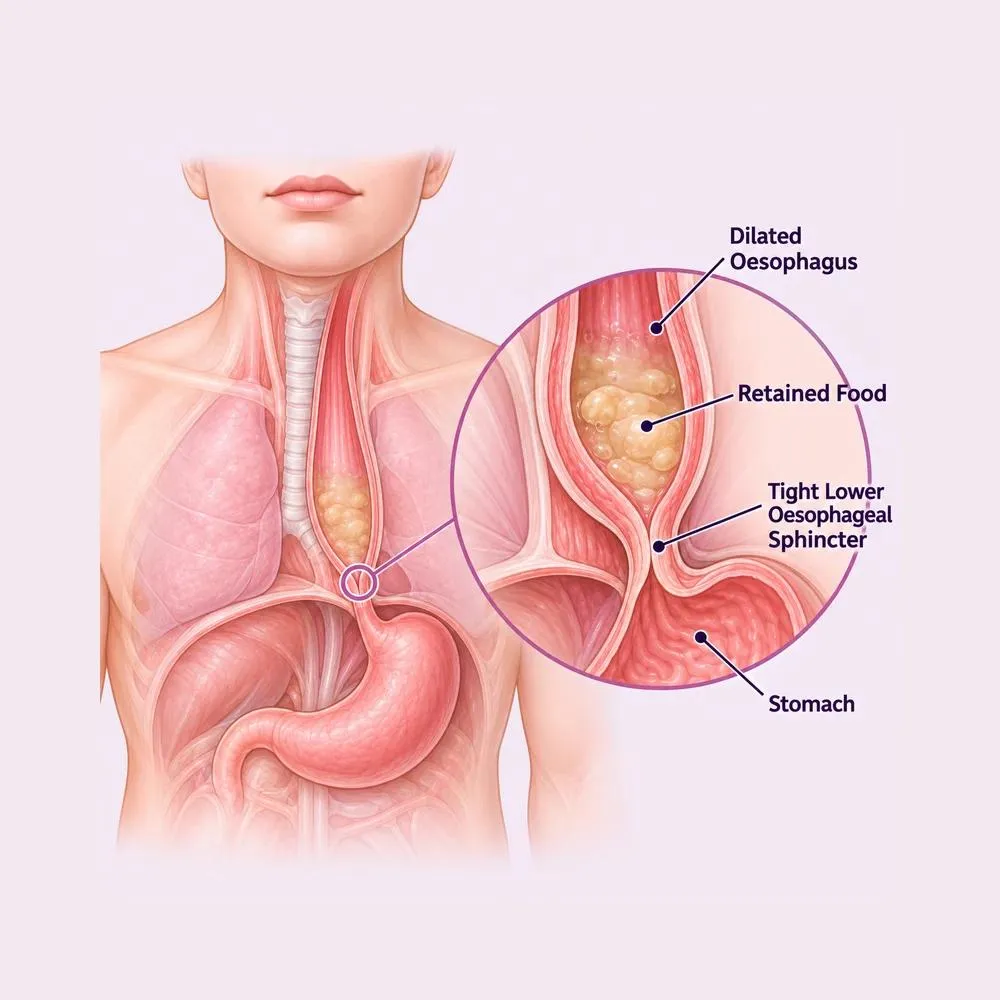
Achalasia cardia is a disorder in which the lower oesophageal sphincter, the muscular valve where the oesophagus joins the stomach, fails to relax when you swallow. At the same time the oesophagus above it loses its normal coordinated squeezing. Food and liquid therefore collect above the closed valve instead of passing through.
The underlying problem is nerve loss. The specialised nerve cells in the oesophageal wall that would normally signal the sphincter to open degenerate, and once lost they do not regenerate. This is why every treatment for achalasia is mechanical: the muscle is stretched, weakened or divided, because the nerve control cannot be restored.
Manometry divides it into three types, and the distinction guides treatment. Type II, with pressurisation along the oesophagus, responds best to any treatment. Type I with an already-dilated oesophagus responds less well, and Type III, the spastic form, responds particularly well to POEM because a longer myotomy can be made.
The nerve degeneration that causes achalasia is not fully explained. Several contributing mechanisms are recognised.
Loss of the ganglion cells in the myenteric plexus that coordinate swallowing and signal the sphincter to relax. This is the core lesion.
Evidence points to an immune-mediated attack on those nerve cells, and achalasia is commoner in people with other autoimmune conditions.
Herpes, measles and other viral infections have been implicated as triggers for the immune response in genetically susceptible people.
Rare familial forms exist, and achalasia occurs as part of inherited syndromes such as Allgrove syndrome.
Infection with Trypanosoma cruzi destroys the same nerve cells and produces an identical picture, though it is confined to South America.
A tumour at the gastro-oesophageal junction can mimic achalasia exactly. It is the crucial diagnosis to exclude, particularly in older patients.
For most patients no specific cause is ever identified. What matters clinically is excluding pseudoachalasia, because a tumour causing the same symptoms needs entirely different treatment.
The hallmark that distinguishes achalasia from almost everything else is difficulty swallowing liquids as well as solids, from early on.
Core symptoms
As it progresses
Difficulty with liquids from the outset is the giveaway. A mechanical obstruction such as a stricture or tumour causes trouble with solids first, and liquids only much later: achalasia does not follow that pattern.
Achalasia is diagnosed on manometry. Endoscopy and a barium swallow support it, and endoscopy has the separate job of excluding a tumour.
The definitive test. It measures pressures along the oesophagus, confirms the sphincter fails to relax, and classifies the type, which guides treatment.
Shows the classic tapering "bird’s beak" at the lower oesophagus, with dilatation above it and delayed emptying of contrast.
Excludes a tumour at the junction mimicking achalasia, and assesses retained food, candida and the state of the mucosa.
Measures how much contrast remains after one and five minutes, giving an objective figure to compare against after treatment.
Where pseudoachalasia is suspected, to look for a tumour outside the oesophagus compressing the junction.
A simple score combining dysphagia, regurgitation, chest pain and weight loss. It quantifies severity and tracks response objectively.
Achalasia is commonly misdiagnosed as reflux for years, and treated with acid suppression that cannot help. Manometry is what settles it, and it is worth asking for if the picture fits.
No treatment restores the lost nerves. Every option works by reducing the resistance at the sphincter so gravity and residual contractions can move food through.
Calcium channel blockers and nitrates relax the sphincter modestly. Effects are limited and short-lived, so this is reserved for patients unfit for anything else.
Botulinum toxin injected into the sphincter endoscopically relaxes it for around six to twelve months. Useful for frail or elderly patients, but repeated injections scar the tissue and make later surgery harder.
A balloon is inflated across the sphincter to tear the muscle fibres. Effective, and often needs repeating. There is a small risk of perforation, which is why it is done where surgical backup exists.
Per-Oral Endoscopic Myotomy. The muscle is divided from inside the oesophagus through an endoscope, with no external incision at all. Excellent results, and the treatment of choice for Type III achalasia because the myotomy can be extended as far as needed.
The muscle is divided from outside through keyhole incisions. The long-established gold standard, with durable results over decades of follow-up.
A partial wrap added at the same operation. Dividing the sphincter removes the barrier to reflux, and the wrap restores it, which is why this combination is standard.
The same operation with robotic instrumentation, giving finer control when dividing muscle fibres against a thin mucosa.
Removal of the oesophagus, reserved for end-stage disease with a massively dilated, sigmoid-shaped oesophagus that no myotomy will help.
POEM and Heller’s myotomy give comparable relief of swallowing. The trade-off is reflux: POEM has no anti-reflux component and causes more of it, while Heller’s with a partial wrap causes less. That choice is made with you.
A one to two hour endoscopic procedure done entirely through the mouth. No external incisions, no scars, and a one to two night stay.
Per-Oral Endoscopic Myotomy
A liquid diet for two days beforehand so the oesophagus is empty: retained food would make the procedure unsafe. Antibiotics are given at induction.
General anaesthetic with the airway protected, since retained oesophageal contents carry a real risk of aspiration.
A small incision is made in the inner lining of the oesophagus, around ten centimetres above the sphincter, to enter the wall.
A submucosal tunnel is created between the inner lining and the muscle layer, extending down past the sphincter into the upper stomach.
The circular muscle fibres are divided along the length of the tunnel, including across the sphincter. Myotomy length is tailored to the achalasia type.
The mucosal entry point is closed with clips or sutures. The intact mucosa over the myotomy is what keeps the chest sealed from the oesophagus.
A contrast swallow the next day to confirm no leak, then fluids, and home after one to two nights on a graded diet.
Because the sphincter no longer closes, reflux is common after POEM and most patients need long-term acid-suppressing medication. That is a straightforward trade for being able to swallow normally.
Achalasia is uncommon, frequently misdiagnosed, and needs specialist testing to identify. Here is why patients trust us:
High-resolution manometry, endoscopy and timed barium studies, so the diagnosis is confirmed and typed rather than assumed.
Led by Dr. Tagore Mohan Grandhi, with extensive experience in POEM, laparoscopic myotomy and complex oesophageal surgery.
From the first consultation through to post-treatment follow-up, with one team throughout.
Our hospital is in HITEC CITY, near IKEA: easily reachable from across Hyderabad.
Recovery after minimally invasive treatment takes one to two weeks. The diet is graded deliberately while the myotomy heals.
Nil by mouth overnight. A contrast swallow the next morning confirms there is no leak before anything is given by mouth.
Home on a liquid diet, progressing to soft foods. Most patients notice swallowing is dramatically easier straight away.
Soft then normal textures, small mouthfuls, chewed well. Desk work resumes from around week two. Acid-suppressing medication starts.
Normal diet restored. Weight lost before treatment begins to return. Full activity including the gym resumes.
Review with a repeat Eckardt score, and manometry or a timed barium study where symptoms warrant, to confirm objective improvement.
A proton pump inhibitor long term, particularly after POEM. The sphincter no longer closes, so reflux is expected rather than a complication.
Small mouthfuls, chewed thoroughly, and stay upright for two to three hours after eating to let gravity help.
Nothing within three hours of lying down. This reduces both reflux and the risk of aspirating retained food at night.
By fifteen to twenty centimetres. It genuinely reduces night-time reflux and regurgitation.
Fever, severe chest pain, breathlessness, or difficulty swallowing that returns after initially improving.
Achalasia carries a small increased risk of oesophageal cancer over decades, so periodic endoscopic surveillance is recommended.
Treatment relieves the obstruction but does not restore the lost nerves: the oesophagus never regains normal coordinated squeezing. Symptoms can gradually return over years, and repeat treatment is sometimes needed.
Book a consultation if any of the following apply.
Cost depends on which treatment is chosen. These are the ranges our patients fall into.
| Procedure | Estimated Cost |
|---|---|
| Consultation & assessment Per visit | ₹1,000 – ₹2,000 |
| High-resolution manometry The diagnostic test, out-patient | ₹10,000 – ₹18,000 |
| Endoscopy & barium swallow Combined diagnostic workup | ₹10,000 – ₹20,000 |
| Botox injection Day care, effect lasts 6–12 months | ₹35,000 – ₹60,000 |
| Pneumatic balloon dilation Day care or one night; may need repeating | ₹55,000 – ₹95,000 |
| POEM One to two nights’ stay, no external incision | ₹2,20,000 – ₹3,80,000 |
| Laparoscopic Heller’s myotomy with fundoplication Two to three nights’ stay | ₹2,00,000 – ₹3,50,000 |
Botox and dilation cost far less but need repeating. A myotomy costs more once and lasts for years.
Type III needs a longer myotomy and a longer procedure. An end-stage sigmoid oesophagus is a different operation altogether.
Repeated Botox injections scar the plane surgeons need to work in, making a later myotomy longer and more difficult.
A shared ward, a twin-sharing room or a private suite: the largest single swing in most estimates.
We are empanelled with most major insurers, and our team files the pre-authorisation for you.
Every figure above is an indicative range, not a quote. After your consultation you are given a written, fixed-cost estimate, and that is the number you pay, with no additions once treatment begins.
The gastrointestinal surgeon who treats achalasia and oesophageal disorders at our HITEC CITY hospital.

Senior Consultant: Bariatric & Gastrointestinal Surgery
MBBS, MS, FRCS (UK), DLS (France)
28 years experience
Reviews from patients treated for gastrointestinal conditions at Lux Hospitals, Hyderabad.
Written by Dr. Tagore Mohan Grandhi on digestive health and gastrointestinal surgery.

Dr. Tagore Mohan Grandhi
Dr. Tagore Mohan Grandhi
Dr. Tagore Mohan Grandhi
Dr. Tagore Mohan Grandhi
Dr. Tagore Mohan Grandhi
Dr. Tagore Mohan Grandhi
Common questions about achalasia cardia, its treatment, and what care costs at Lux Hospitals.
Still have questions? Call us at 079 6908 4422
Still have questions? Message us on WhatsApp at 079 6908 4444
Manometry-confirmed diagnosis and definitive treatment for achalasia, with a fixed-cost estimate before treatment begins.
Plot No.116, Lumbini Avenue, HITEC CITY, Near IKEA, Hyderabad – 500032













