



Dr. Samhitha Reddy
Consultant Proctologist & Laparoscopic Surgeon
MBBS, MS, FMAS, FISCP, DMAS
- 8 Yrs
- ASCRS Member
Conn’s syndrome is the overproduction of aldosterone by the adrenal glands. Aldosterone tells the kidney to hold on to sodium and shed potassium, so the result is high blood pressure and low potassium.
It is the most common curable cause of hypertension, and it is substantially under-diagnosed: many people are treated with three or four blood pressure tablets for years without anyone testing for it. Our urologists at Lux Hospitals, HITEC CITY test for it properly, and where one gland is responsible, remove it laparoscopically.
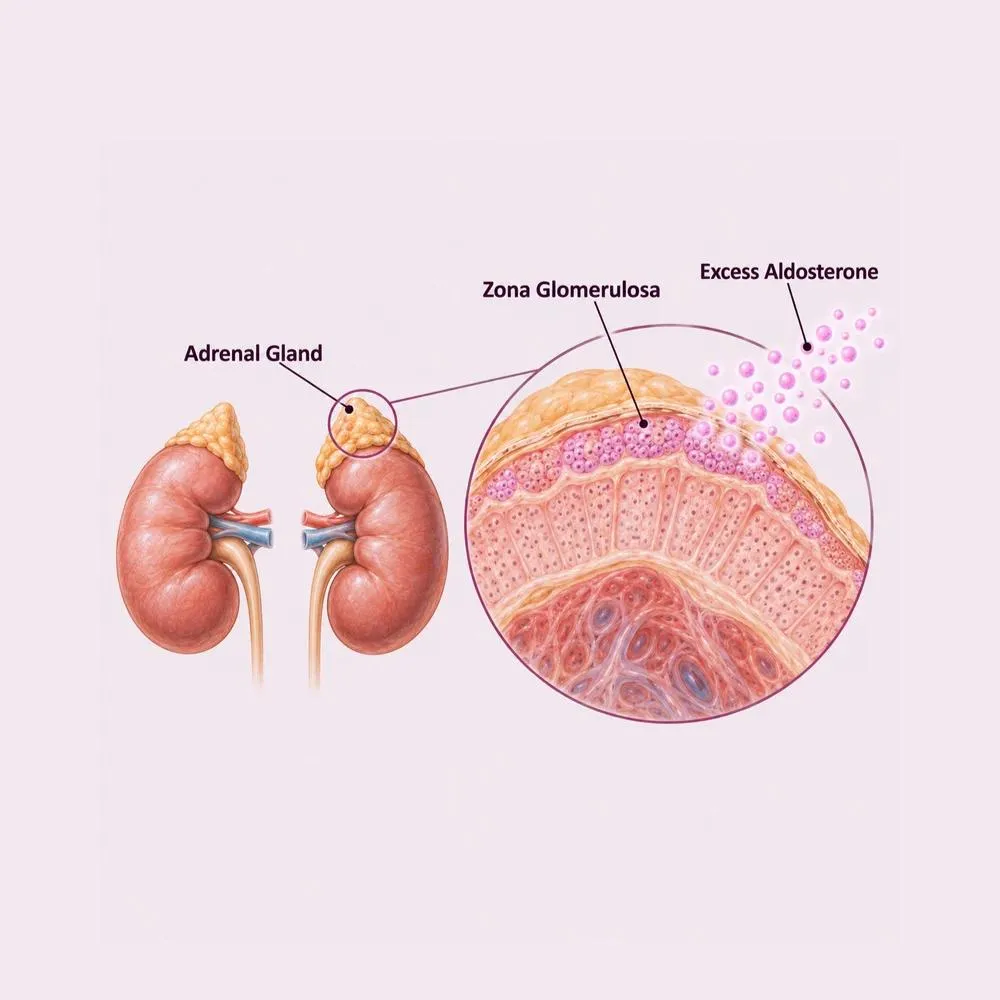
Conn’s syndrome, also called primary hyperaldosteronism, is the autonomous overproduction of aldosterone by the adrenal glands. Aldosterone is the hormone that regulates the balance of sodium and potassium. It instructs the kidney to retain sodium (and water with it) while excreting potassium. In excess, that produces exactly what you would predict: raised blood volume and blood pressure, and depleted potassium.
What makes it clinically important is that it is common and curable. It is now recognised in something like five to ten per cent of people with hypertension, and considerably more among those whose blood pressure resists treatment. Where the cause is a single adenoma in one gland, removing that gland cures or substantially improves the hypertension.
It is also more harmful than equivalent blood pressure from other causes. Excess aldosterone damages the heart, kidneys and blood vessels directly, independent of the pressure it produces, causing fibrosis of the heart muscle and accelerated kidney decline. This is why identifying and treating it specifically matters rather than simply controlling the numbers.
Two causes account for almost all cases, and the distinction between them determines whether surgery is appropriate.
A benign tumour in one adrenal gland producing aldosterone autonomously. Around a third of cases, and the form that surgery cures.
Both glands enlarged and overproducing. The commonest cause, accounting for roughly two-thirds, and treated with medication rather than surgery.
Several inherited forms, uncommon but worth considering in young patients or where there is a strong family history of early hypertension or stroke.
Enlargement of one gland only, without a discrete adenoma. Behaves like an adenoma and responds to removal of that gland.
A malignant aldosterone-producing tumour. Rare, and suspected where the tumour is large or accompanied by other hormone excess.
The whole diagnostic effort after confirming the hormone excess is aimed at one question: is this one gland or both? Removing a gland in bilateral disease achieves nothing and leaves the patient worse off.
Many people have no symptoms beyond stubborn high blood pressure. Where symptoms occur, they follow from low potassium.
Common features
Features from low potassium
Not everyone with Conn’s syndrome has low potassium: a substantial proportion have entirely normal levels. Waiting for low potassium before testing is the commonest reason the diagnosis is missed.
Diagnosis has three stages: screening, confirmation, then determining whether one gland or both is responsible.
The screening test. In Conn’s syndrome aldosterone is high while renin is suppressed, producing a characteristically raised ratio.
Several blood pressure drugs (particularly spironolactone, beta blockers and diuretics) distort the result and must be adjusted beforehand.
A saline infusion or salt loading test. In health this suppresses aldosterone; in Conn’s syndrome the autonomous production continues regardless.
Images the glands and detects an adenoma. It is not sufficient on its own, since incidental non-functioning nodules are common and can mislead.
Blood sampled directly from each adrenal vein to establish which gland is overproducing. The definitive test for lateralisation, and the one that decides on surgery.
Kidney function, ECG and echocardiography, since excess aldosterone damages heart and kidney independently of blood pressure.
Adrenal vein sampling matters because CT alone is wrong often enough to be dangerous. A visible nodule may be non-functioning while the opposite, normal-looking gland is the true source, and operating on the wrong side is irreversible.
Surgery for one-sided disease, medication for both-sided. Getting that distinction right is the entire point of the workup.
An aldosterone receptor blocker and the mainstay for bilateral disease. Highly effective, though it can cause breast tenderness and enlargement in men.
A more selective aldosterone blocker with fewer hormonal side effects. Preferred where spironolactone is not tolerated.
Supplements to restore potassium, usually needed only until the aldosterone blocker takes effect, since it conserves potassium itself.
Added where an aldosterone blocker alone does not achieve target, though many patients need considerably less once the right drug is used.
Genuinely effective here, because the underlying problem is sodium retention. Reducing salt directly reduces the blood pressure effect.
Supports blood pressure control alongside medication and reduces overall cardiovascular risk.
Keyhole removal of the affected gland where vein sampling confirms one-sided overproduction. Small incisions, two to three days in hospital.
A posterior keyhole approach avoiding the abdominal cavity entirely. Useful in patients with previous abdominal surgery.
Removing the adenoma while preserving normal adrenal tissue, considered in selected cases and in bilateral disease.
Reserved for large tumours or where adrenal carcinoma is suspected and complete intact removal is essential.
After removal of a unilateral adenoma, blood pressure is cured outright in roughly a third to a half of patients and substantially improved in most of the rest. Low potassium corrects in nearly everyone.
Removing one adrenal gland takes around ninety minutes to two hours, with two to three days in hospital.
Keyhole adrenal surgery under general anaesthesia
Potassium corrected and blood pressure controlled beforehand, usually with an aldosterone blocker for several weeks. Operating with low potassium is unsafe.
General anaesthesia, positioned on your side so the adrenal gland comes forward and surrounding organs fall away under gravity.
Three or four small ports along the flank, with the abdomen insufflated with carbon dioxide to create working space.
The colon is mobilised, and on the left the spleen and pancreas are moved aside; on the right the liver is retracted to reach the gland beside the vena cava.
The adrenal vein is clipped and divided early. Blood pressure often changes noticeably at this moment as the hormone supply is interrupted.
The gland is freed from surrounding fat and removed in a retrieval bag so it comes out intact for histology.
Potassium and blood pressure watched closely. Aldosterone blockers are stopped and other antihypertensives often reduced within days.
Potassium can rise sharply in the first days after surgery, particularly if supplements or spironolactone continue out of habit. Medications are reviewed and stopped deliberately rather than left running.
This is a curable cause of hypertension that is routinely missed. Here is why patients trust us:
Adrenal vein sampling before surgery, because CT alone is wrong often enough that operating on it risks removing the wrong gland.
Keyhole adrenalectomy with small incisions, a two to three day stay, and careful management of potassium and blood pressure afterwards.
From the first consultation through to post-treatment follow-up, with one team throughout.
Our hospital is in HITEC CITY, near IKEA: easily reachable from across Hyderabad.
Recovery from keyhole surgery is quick, and the blood pressure benefit continues developing over months.
Mobilising the day of surgery. Potassium and blood pressure monitored closely, and aldosterone blockers stopped. Discharge at two to three days.
Port sites heal. Blood pressure medications reviewed and frequently reduced: many patients need considerably fewer than before.
Most people return to desk work. Muscle weakness and cramps from low potassium resolve, often noticeably.
Blood pressure continues improving. Repeat aldosterone and renin testing confirms biochemical cure.
Full effect on blood pressure becomes apparent. Blood vessel changes from years of hypertension take this long to remodel.
Potassium can rise sharply once the aldosterone excess is removed. Supplements and spironolactone are stopped deliberately, not left running.
Medications frequently need reducing within days of surgery. Continuing the old regimen unchanged can cause blood pressure to fall too far.
Reducing sodium remains worthwhile after treatment, both for blood pressure and for the cardiovascular risk that years of hypertension have built.
Blood pressure continues improving for up to a year as the blood vessels remodel. Judging the result at six weeks understates it.
Aldosterone, renin and potassium are rechecked to confirm cure. Persisting abnormality suggests the other gland is also involved.
Aldosterone excess damages heart and kidneys directly. Even after cure, existing damage needs ongoing attention.
Blood pressure is cured outright in roughly a third to a half after removal of a unilateral adenoma, and improved in most of the remainder. The longer hypertension has been present beforehand, the less likely a complete cure, which is an argument for testing early.
Book a consultation if any of the following apply.
The diagnostic pathway is a real part of the cost, particularly adrenal vein sampling, but it is what makes surgery worth doing.
| Procedure | Estimated Cost |
|---|---|
| Consultation Per visit | ₹800 – ₹1,500 |
| Aldosterone-renin ratio Screening test | ₹3,000 – ₹7,000 |
| Confirmatory saline suppression test Day-care procedure | ₹6,000 – ₹14,000 |
| CT adrenals Images both glands | ₹6,000 – ₹14,000 |
| Adrenal vein sampling Determines which gland to remove | ₹1,10,000 – ₹2,00,000 |
| Laparoscopic adrenalectomy Two to three days in hospital | ₹2,40,000 – ₹4,20,000 |
| Monthly medical therapy Spironolactone or eplerenone | ₹600 – ₹3,000 |
Bilateral disease is treated with medication at a few hundred rupees monthly. Unilateral disease warrants surgery, which is a one-off cost that often ends lifelong tablets.
It is a significant cost, but operating on the wrong gland is irreversible, which is why it is done before surgery in most adult patients.
Cardiac and kidney assessment adds to the workup where hypertension has been long-standing and poorly controlled.
A shared ward, a twin-sharing room or a private suite: the largest single swing in most estimates.
We are empanelled with most major insurers, and our team files the pre-authorisation for you.
Every figure above is an indicative range, not a quote. After your consultation you are given a written, fixed-cost estimate, and that is the number you pay, with no additions once treatment begins.
The urologists who treat adrenal and hormonal disorders at our HITEC CITY hospital.

Consultant Urologist & Andrologist
MBBS, MS, DrNB (Urology)
10 years experience

Consultant Urologist & Andrologist
MBBS, MS, MCh (Urology)
9 years experience
Reviews from patients treated for urological and adrenal conditions at Lux Hospitals, Hyderabad.
Written by Dr. Vipin Reddy B on urological and hormonal care.
Dr. Vipin Reddy B

Dr. Vipin Reddy B
Dr. Vipin Reddy B
Dr. Vipin Reddy B

Dr. Vipin Reddy B

Dr. Vipin Reddy B
Common questions about Conn’s syndrome, adrenal surgery and what treatment costs at Lux Hospitals.
Still have questions? Call us at 079 6908 4422
Still have questions? Message us on WhatsApp at 079 6908 4444
Testing for a curable cause of high blood pressure, with laparoscopic adrenal surgery where it is indicated.
Plot No.116, Lumbini Avenue, HITEC CITY, Near IKEA, Hyderabad – 500032













