



Dr. Samhitha Reddy
Consultant Proctologist & Laparoscopic Surgeon
MBBS, MS, FMAS, FISCP, DMAS
- 8 Yrs
- ASCRS Member
Vaginal atrophy is thinning, drying and inflammation of the vaginal walls when oestrogen falls. It causes dryness, burning, painful intercourse and recurrent urinary symptoms.
It affects around half of postmenopausal women and, unlike hot flushes, it does not improve with time: it progresses. Very few women raise it, and very few doctors ask. Our gynaecologists at Lux Hospitals, HITEC CITY treat it directly and effectively.
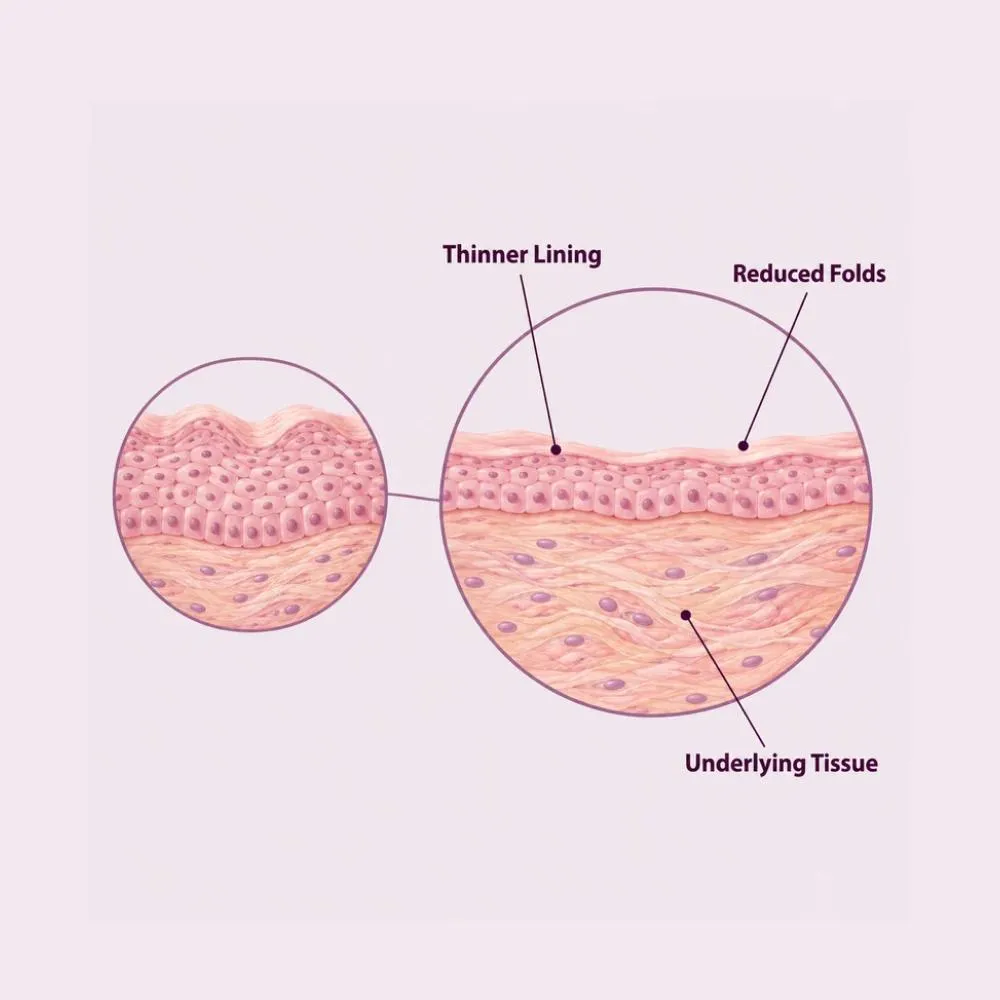
Vaginal atrophy is the thinning, loss of elasticity and reduced lubrication of the vaginal walls that follows a fall in oestrogen. The vaginal lining depends on oestrogen to stay thick, elastic and well supplied with blood, and to maintain the glycogen that feeds the protective lactobacilli. Without it, the tissue becomes thin, pale, fragile and less acidic.
It is now more often called genitourinary syndrome of menopause, because the effects extend well beyond the vagina. The urethra and bladder base share the same embryological origin and the same oestrogen dependence, which is why atrophy so often brings urinary urgency, frequency and recurrent urinary tract infections alongside the vaginal symptoms.
The characteristic that separates it from other menopausal symptoms is its course. Hot flushes and night sweats settle over a few years for most women. Vaginal atrophy does the opposite: it is progressive and does not resolve without treatment. That is precisely why it is worth raising, and why treatment is generally continued long term.
Anything that reduces oestrogen can cause it: menopause is simply the commonest route.
The commonest cause by far. Oestrogen falls sharply and stays low, and around half of postmenopausal women develop atrophic symptoms.
Removal of both ovaries causes an abrupt and complete oestrogen loss, and symptoms are often more severe and faster to appear.
Aromatase inhibitors and tamoxifen suppress oestrogen deliberately. Atrophy is common and particularly difficult, since systemic oestrogen is usually avoided.
Both damage ovarian function and can directly injure the vaginal lining, causing atrophy alongside scarring.
Oestrogen is suppressed during lactation, causing temporary but sometimes marked dryness that resolves when periods return.
Some low-oestrogen or progestogen-only methods cause dryness in a minority of women.
Reduces oestrogen levels, impairs blood flow to the vaginal tissue, and brings menopause forward by one to two years.
Vaginal dryness is not confined to older women. Breastfeeding, hormonal contraception and cancer treatment all cause it, and a woman in her thirties with these symptoms deserves the same assessment as one in her sixties.
Symptoms span the vagina, vulva and urinary tract, and they tend to worsen gradually rather than fluctuate.
Vaginal and vulval symptoms
Urinary symptoms
Recurrent urinary tract infections after menopause are very often driven by atrophy rather than by poor hygiene or bad luck. Treating the atrophy reduces those infections substantially, which repeated antibiotics never will.
The diagnosis is clinical and usually straightforward. The tests exist mainly to exclude other causes.
Pale, thin, dry vaginal walls with loss of the normal folds, sometimes with small areas of bleeding. Often diagnostic on its own.
Atrophy raises pH above 5 as the protective lactobacilli decline. Simple, quick, and it also helps distinguish this from thrush.
Swabs for thrush, bacterial vaginosis and trichomonas, since these cause overlapping symptoms and are treated quite differently.
Checking for lichen sclerosus, which also causes dryness and soreness but requires steroid rather than oestrogen treatment.
Where urinary symptoms dominate, to distinguish genuine infection from the burning and urgency atrophy itself produces.
Postmenopausal bleeding is never attributed to atrophy without investigation, even where atrophy is obviously present.
Atrophy is a very common cause of postmenopausal bleeding, but it is a diagnosis of exclusion. The endometrium must be assessed first: assuming atrophy is how endometrial cancer gets missed.
Atrophy responds very well to treatment. Local oestrogen is the mainstay, with non-hormonal options for those who cannot use it.
Used two or three times weekly regardless of sexual activity. They rehydrate the tissue over time, unlike lubricants which act only in the moment.
Water or silicone-based, used at the time of intercourse. Effective for comfort but they do not treat the underlying tissue change.
Stopping scented soaps, washes and douching, all of which worsen dryness and irritate already fragile tissue.
Maintains blood flow and elasticity. Vaginal dilators serve the same purpose where intercourse is not currently possible.
Improves blood flow to the vaginal tissue and removes one of the factors accelerating atrophy.
Cream, pessary or ring applied vaginally. Highly effective, with minimal absorption into the bloodstream: the treatment of choice for most women.
Prasterone, converted locally to oestrogen and testosterone within the vaginal tissue. A useful alternative to oestrogen preparations.
An oral selective oestrogen receptor modulator acting on vaginal tissue, for women who prefer a tablet to local treatment.
Where hot flushes and other menopausal symptoms coexist. Local oestrogen is sometimes still needed alongside for vaginal symptoms.
Energy-based treatment stimulating collagen and blood flow in the vaginal wall. An option where hormones are contraindicated, though the evidence is less established.
For the secondary muscle tightening that develops after months or years of painful intercourse and persists after tissue improves.
Local vaginal oestrogen delivers a very small dose directly where it is needed, with blood levels remaining in the postmenopausal range. It is a different proposition from systemic HRT, and the fear attached to it is largely misplaced.
Treatment is simple and self-administered. The main requirement is continuing it, since symptoms return if it stops.
Outpatient assessment and ongoing local treatment
A history of symptoms including urinary ones, with examination of the vagina and vulva and pH testing.
Swabs for infection and assessment for lichen sclerosus, since both mimic atrophy and need different treatment.
Where there has been postmenopausal bleeding, the endometrium is assessed before atrophy is accepted as the cause.
Daily application for two weeks as an induction, then reducing to twice weekly for maintenance.
A vaginal moisturiser used regularly alongside, plus lubricant for intercourse and removal of irritants.
Assessing symptom improvement and adjusting. Most women notice meaningful change by six to twelve weeks.
Maintenance treatment is generally continued indefinitely, because symptoms recur within weeks to months of stopping.
Stopping treatment once symptoms improve is the commonest mistake. Atrophy returns because the underlying oestrogen deficiency has not changed: this is maintenance therapy, not a course.
This is common, treatable, and almost never raised. Here is why patients trust us:
Genitourinary symptoms of menopause discussed openly as part of the consultation, rather than left for you to bring up.
Local oestrogen, DHEA, ospemifene and laser therapy, including for women after breast cancer where hormones are usually avoided.
From the first consultation through to post-treatment follow-up, with one team throughout.
Our hospital is in HITEC CITY, near IKEA: easily reachable from across Hyderabad.
Improvement begins within weeks. Full benefit takes about three months, and treatment continues indefinitely.
Induction phase of daily local oestrogen. Some women notice reduced dryness within the first fortnight.
Maintenance dosing begins. Dryness, burning and urinary urgency improve steadily as the tissue thickens.
Intercourse becomes comfortable again for most women. Recurrent urinary infections become less frequent.
Full effect established. Vaginal pH normalises and the protective flora returns.
Maintenance continues indefinitely. Symptoms return within weeks to months if treatment is stopped.
This is maintenance treatment, not a course. Atrophy returns when treatment stops, because the oestrogen deficiency has not changed.
A moisturiser is used two or three times weekly to rehydrate the tissue. A lubricant is used at the time of intercourse. They are not interchangeable.
Soaps, washes, wipes and douching all worsen dryness and irritate fragile tissue. Water alone on the vulva is enough.
Intercourse or a dilator maintains elasticity and blood flow. Prolonged inactivity allows narrowing that is harder to reverse.
Even with known atrophy, new bleeding needs investigating rather than being attributed to it. This is how endometrial cancer is caught early.
Painful intercourse strains relationships considerably, and the avoidance that follows makes the physical problem worse. It is easier addressed together.
Around half of postmenopausal women have this and only a small fraction ever mention it. It is among the most treatable conditions in gynaecology, and the main obstacle is simply that nobody asks about it.
Book a consultation if any of the following apply.
This is one of the least expensive conditions in gynaecology to treat effectively.
| Procedure | Estimated Cost |
|---|---|
| Consultation Includes examination | ₹800 – ₹1,500 |
| Swabs and infection screen To exclude other causes | ₹800 – ₹2,500 |
| Pelvic ultrasound Where there has been bleeding | ₹1,500 – ₹3,500 |
| Local vaginal oestrogen Per month | ₹400 – ₹1,500 |
| Vaginal moisturisers and lubricants Per month | ₹300 – ₹1,200 |
| Vaginal DHEA or ospemifene Per month | ₹1,500 – ₹4,000 |
| Fractional CO2 laser course Three sessions | ₹60,000 – ₹1,20,000 |
| Pelvic floor physiotherapy Per session | ₹800 – ₹2,000 |
Local oestrogen is inexpensive and highly effective. Laser therapy is the costly option, reserved mainly for women who cannot use hormones.
After breast cancer, oestrogen is often avoided, which pushes treatment toward moisturisers, DHEA or laser at higher cost.
Straightforward atrophy needs only a consultation. Bleeding or urinary symptoms require additional testing.
A shared ward, a twin-sharing room or a private suite: the largest single swing in most estimates.
We are empanelled with most major insurers, and our team files the pre-authorisation for you.
Every figure above is an indicative range, not a quote. After your consultation you are given a written, fixed-cost estimate, and that is the number you pay, with no additions once treatment begins.
The gynaecologists who treat vaginal atrophy at our HITEC CITY hospital.

Consultant Gynaecologist & Advanced Laparoscopic Surgeon
MBBS, MS, FMAS
16 years experience

Consultant Obstetrician, Gynecologist & Laparoscopic Surgeon
MBBS, MS (Obstetrics & Gynaecology)
11 years experience
Reviews from women treated for gynaecological conditions at Lux Hospitals, Hyderabad.
Written by Dr. Harshita Kakarla on women’s health and gynaecological care.
Dr. Harshita Kakarla

Dr. Harshita Kakarla

Dr. Harshita Kakarla
Dr. Harshita Kakarla

Dr. Harshita Kakarla
Dr. Harshita Kakarla
Common questions about vaginal dryness, atrophy treatment and costs at Lux Hospitals.
Still have questions? Call us at 079 6908 4422
Still have questions? Message us on WhatsApp at 079 6908 4444
Effective treatment for vaginal dryness and menopausal genitourinary symptoms, discussed openly and privately.
Plot No.116, Lumbini Avenue, HITEC CITY, Near IKEA, Hyderabad – 500032













