



Dr. Samhitha Reddy
Consultant Proctologist & Laparoscopic Surgeon
MBBS, MS, FMAS, FISCP, DMAS
- 8 Yrs
- ASCRS Member
Shoulder replacement is performed far less often than hip or knee replacement, and it is more technically demanding. The shoulder has little inherent bony stability: its function depends almost entirely on the muscles around it, particularly the rotator cuff.
That single fact drives the choice of operation. Our orthopaedic surgeons at Lux Hospitals, HITEC CITY offer both total and reverse shoulder replacement, and which one suits you depends principally on whether your rotator cuff is intact.
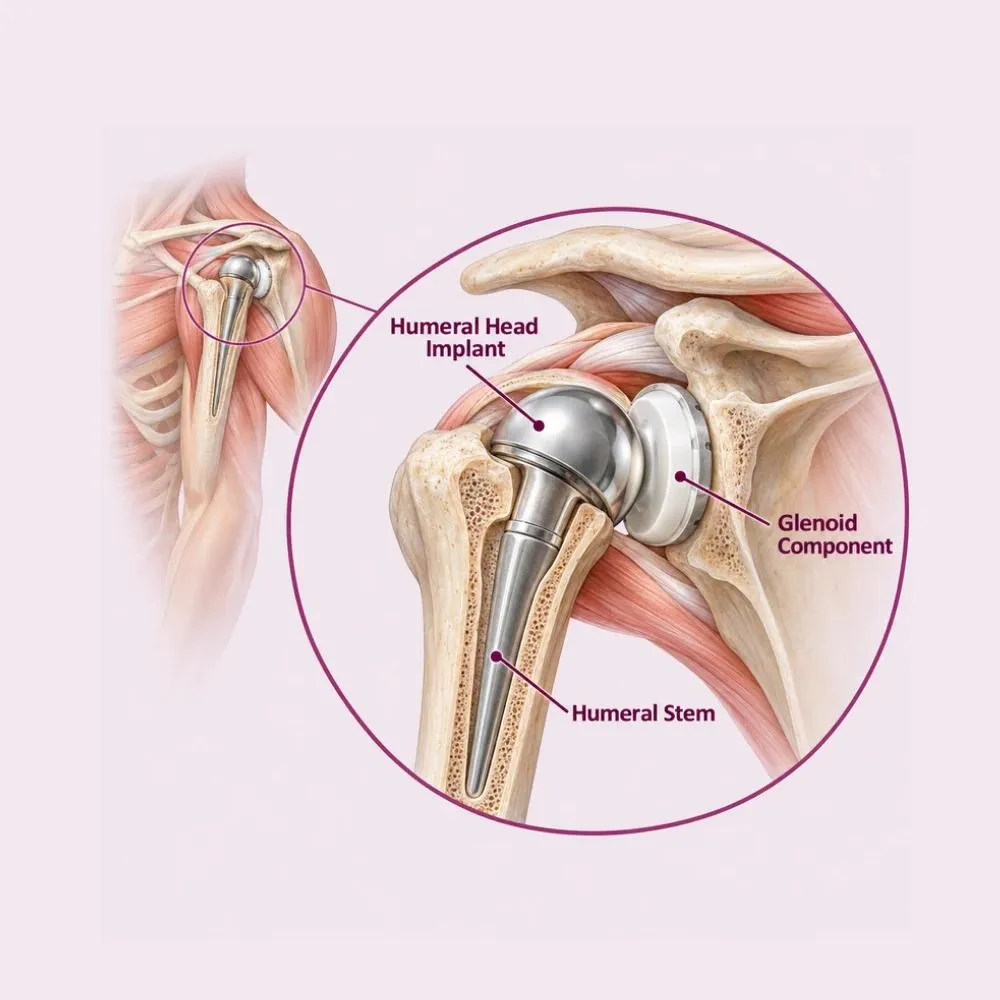
Shoulder replacement resurfaces the ball-and-socket joint of the shoulder with artificial components. In a total shoulder replacement, the humeral head is replaced with a metal ball on a stem and the socket resurfaced with a plastic component, reproducing normal anatomy.
A reverse shoulder replacement does exactly what its name suggests: the ball and socket are swapped over, with a metal ball fixed to the shoulder blade and a socket on the humerus. This sounds counterintuitive, but it is the key to treating patients whose rotator cuff has failed.
The logic is mechanical. A normal shoulder relies on the rotator cuff to hold the ball centred while the deltoid lifts the arm. Where the cuff is torn beyond repair, a conventional replacement will not function and will wear out quickly. Reversing the geometry allows the deltoid alone to lift the arm, restoring function without the cuff. This is why the state of your cuff, more than the arthritis itself, determines which operation you get.
Several conditions destroy the shoulder joint, and they differ in whether they spare the rotator cuff.
Wear of the cartilage covering the ball and socket, typically with an intact cuff: the classic indication for a total shoulder replacement.
Arthritis developing after years of a massive rotator cuff tear, where the ball rides upward against the acromion. The classic indication for reverse replacement.
Inflammatory destruction of both the joint surfaces and the rotator cuff, often at a younger age.
Loss of blood supply to the humeral head causing collapse, associated with steroids, alcohol and sickle cell disease.
A badly comminuted fracture of the upper arm in an older patient, where replacement gives a better result than attempting fixation.
Arthritis developing years after a fracture or dislocation that damaged the joint surface.
Repeated dislocations progressively damage the cartilage and bone of both ball and socket.
Earlier stabilisation or cuff surgery can alter mechanics and accelerate wear over subsequent decades.
The recurring theme is the rotator cuff. Conditions that spare it are treated with an anatomic replacement; those that destroy it need a reverse.
Shoulder arthritis causes deep aching pain and progressive stiffness, and it interferes with reaching, dressing and sleeping.
Symptoms suggesting surgery
Findings that point to reverse replacement
Being unable to actively lift the arm while someone else can move it freely for you is the sign of cuff failure. That finding, more than the X-ray, is what determines the operation.
The assessment establishes the state of the joint and, crucially, the state of the rotator cuff and deltoid.
Active and passive range of movement compared, cuff strength tested, and deltoid function assessed: a reverse replacement depends entirely on a working deltoid.
Show joint space loss, bone spurs, and whether the humeral head has migrated upward: the radiological signature of cuff failure.
Assesses the rotator cuff directly, including tear size, retraction and muscle quality. This is what determines total versus reverse.
Defines glenoid bone stock and any deformity, and is used for three-dimensional planning of component placement.
General health screening, with particular attention to infection, since shoulder implants are vulnerable to low-grade contamination.
Strengthening the deltoid and periscapular muscles before surgery improves the eventual functional result.
The MRI is the decisive investigation. Two patients with identical X-rays can need entirely different operations depending on what their rotator cuff looks like.
Non-surgical treatment manages symptoms and is worth exhausting. Surgery is chosen on the state of the cuff.
Maintaining range of motion and strengthening the surrounding muscles. It cannot reverse arthritis but it genuinely improves function.
Paracetamol and anti-inflammatories for symptom control, used with awareness of long-term risks.
Injected into the joint or subacromial space, giving relief for weeks to months and helping identify the source of pain.
Avoiding overhead loading and adapting how tasks are done can substantially reduce day-to-day pain.
Distending the joint capsule with fluid where stiffness rather than arthritis is the dominant problem.
Replacing both ball and socket in anatomic configuration. The operation for arthritis with an intact rotator cuff, giving excellent pain relief and movement.
Ball and socket positions swapped, allowing the deltoid to lift the arm without a functioning cuff. For cuff tear arthropathy and irreparable tears.
Replacing only the humeral head, used for some fractures and where the glenoid bone stock is inadequate.
Capping the humeral head rather than removing it, conserving bone in younger patients with good bone quality.
Cleaning out the joint and releasing tight capsule. A temporising option in younger patients not yet ready for replacement.
Reverse shoulder replacement has transformed the treatment of cuff tear arthropathy, a condition for which little could previously be offered. It is now among the commonest shoulder replacements performed.
A ninety minute to two hour operation through an incision at the front of the shoulder, with a two to three night stay.
Total or reverse shoulder replacement
General anaesthesia, usually combined with an interscalene nerve block that provides excellent pain relief for the first day.
An incision at the front of the shoulder, working between muscle planes to reach the joint with minimal muscle division.
The worn humeral head is removed and the glenoid socket prepared. The rotator cuff is inspected directly, confirming the pre-operative plan.
The humeral canal is prepared to accept the stem, with the height and version set to reproduce your natural anatomy.
In a total replacement, a metal ball on the humerus and a plastic socket on the glenoid. In a reverse, those positions are swapped.
The joint is reduced and taken through its range, checking stability, tension and that there is no impingement.
Any repairable cuff is reattached, the wound closed, and the arm placed in a sling. Gentle passive movement begins within days.
Rehabilitation differs substantially between the two operations. A total replacement needs the repaired subscapularis protected; a reverse replacement can generally begin active movement sooner.
Shoulder replacement is less common than hip or knee and more dependent on getting the operative choice right. Here is why patients trust us:
Orthopaedic surgeons performing both anatomic and reverse shoulder replacement, with the imaging to decide correctly between them.
Structured physiotherapy from the first week through to six months, tailored to which operation you had.
From the first consultation through to post-treatment follow-up, with one team throughout.
Our hospital is in HITEC CITY, near IKEA: easily reachable from across Hyderabad.
Shoulder rehabilitation is slower than hip or knee, and pain relief arrives well before movement does. Most patients return to normal activities within three to six months.
In hospital with the arm in a sling. The nerve block gives excellent pain relief initially, followed by oral medication and ice.
Sling worn most of the time. Gentle passive movements guided by a physiotherapist, protecting the repaired tissues.
Sling discarded. Active movement begins and range improves steadily. Most patients notice pain relief well established by now.
Strengthening work. Return to most normal activities, driving and desk work. Movement continues to improve throughout.
Continued gains in strength and range. Final functional result is usually reached at around a year.
It protects the repaired subscapularis after a total replacement. Discarding it early risks failure of that repair.
Passive first, then active, then strengthening. Shoulder rehabilitation is longer than for other joints and skipping stages causes stiffness.
Nothing heavier than a cup of tea for the first six weeks, and no pushing up out of a chair with the operated arm.
Regular icing in the first weeks reduces swelling and makes the exercises considerably more comfortable.
Fever, spreading redness or wound discharge, sudden loss of movement, or severe pain that is worsening rather than settling.
Avoid repetitive heavy overhead lifting after a reverse replacement, which loads the implant in the direction it tolerates least.
Pain relief comes considerably sooner than movement. Patients are often comfortable within weeks while range of motion continues improving for a year: knowing that in advance makes the slow months easier.
Book a consultation if any of the following apply.
Reverse replacement implants cost more than anatomic ones. These are the ranges our patients fall into.
| Procedure | Estimated Cost |
|---|---|
| Consultation & assessment Per visit | ₹800 – ₹1,500 |
| X-rays, MRI and CT Full pre-operative imaging | ₹15,000 – ₹30,000 |
| Total shoulder replacement Three nights’ stay | ₹2,20,000 – ₹3,80,000 |
| Reverse shoulder replacement Three nights’ stay, higher implant cost | ₹3,00,000 – ₹5,00,000 |
| Hemiarthroplasty Two to three nights’ stay | ₹1,80,000 – ₹3,00,000 |
| Revision shoulder replacement Four to six nights’ stay | ₹4,00,000 – ₹7,00,000 |
| Post-operative physiotherapy Three to six months of rehabilitation | ₹18,000 – ₹40,000 |
Reverse implants are more complex and more expensive, and the operation is longer. The choice is dictated by your cuff, not by preference.
Significant glenoid bone loss may require bone grafting or augmented components, adding to complexity and cost.
Shoulder rehabilitation runs longer than for hip or knee, often three to six months, and that is a genuine additional cost.
A shared ward, a twin-sharing room or a private suite: the largest single swing in most estimates.
We are empanelled with most major insurers, and our team files the pre-authorisation for you.
Every figure above is an indicative range, not a quote. After your consultation you are given a written, fixed-cost estimate, and that is the number you pay, with no additions once treatment begins.
The orthopaedic and shoulder surgeons who perform shoulder replacement at our HITEC CITY hospital.

Consultant Orthopaedic Surgeon: Joint Replacement & Arthroscopy
MS (Ortho), FIJR, FIASM (UK), FIKS (Italy), FIRJR
8 years experience

Consultant Orthopaedic Surgeon
MBBS, MS, FIJR
6 years experience
Reviews from patients treated for shoulder, knee and orthopaedic conditions at Lux Hospitals, Hyderabad.
Written by Dr. Sai Kishan Sirasala on shoulder surgery and orthopaedic care.
Dr. Sai Kishan Sirasala
Dr. Sai Kishan Sirasala

Dr. Sai Kishan Sirasala

Dr. Sai Kishan Sirasala
Dr. Sai Kishan Sirasala
Dr. Sai Kishan Sirasala
Common questions about shoulder replacement, its recovery, and what surgery costs at Lux Hospitals.
Still have questions? Call us at 079 6908 4422
Still have questions? Message us on WhatsApp at 079 6908 4444
Expert assessment of your shoulder and rotator cuff, with the right replacement for your anatomy and a fixed-cost estimate upfront.
Plot No.116, Lumbini Avenue, HITEC CITY, Near IKEA, Hyderabad – 500032













