



Dr. Samhitha Reddy
Consultant Proctologist & Laparoscopic Surgeon
MBBS, MS, FMAS, FISCP, DMAS
- 8 Yrs
- ASCRS Member
Uterine polyps are soft growths of the endometrium projecting into the cavity of the uterus. They cause bleeding between periods, heavier periods, and difficulty conceiving.
They are almost always benign and they are removed through the cervix without any incision at all: a day-care procedure with a recovery measured in days. Our gynaecologists at Lux Hospitals, HITEC CITY remove them hysteroscopically under direct vision rather than blindly.
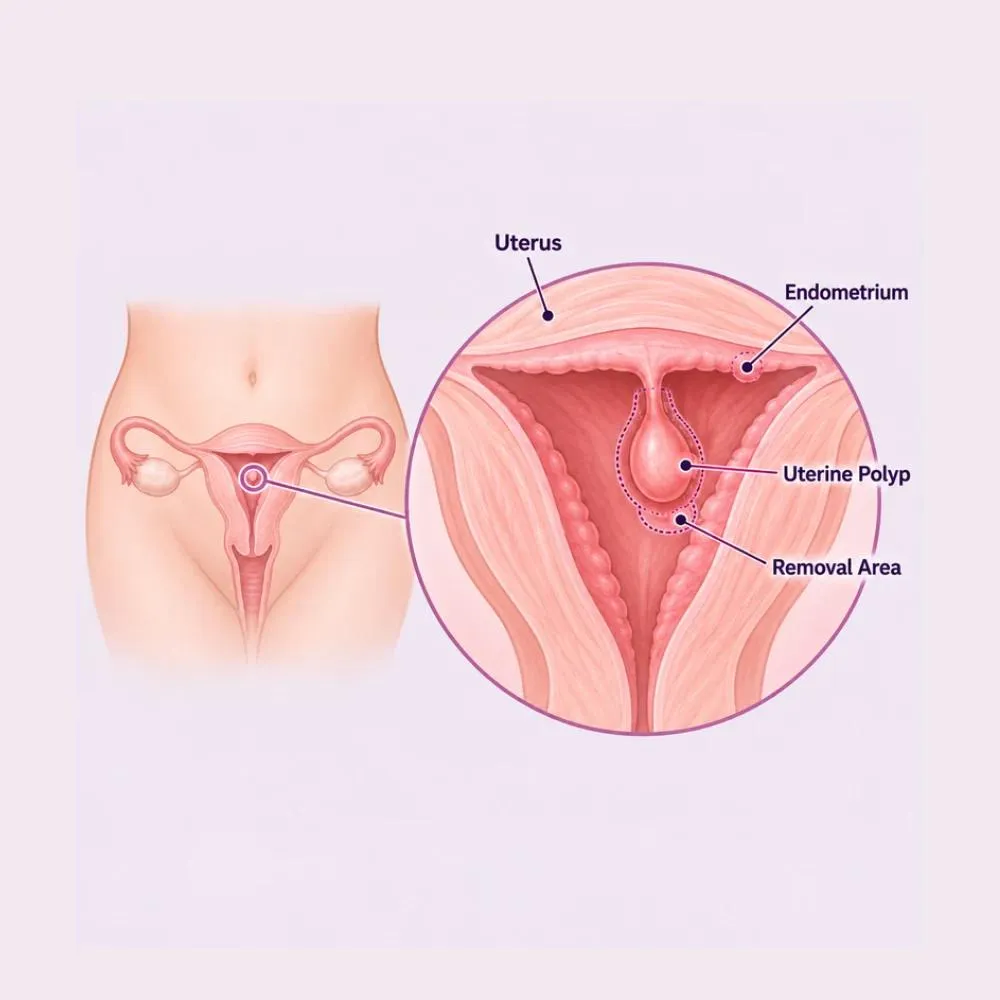
A uterine polyp is an overgrowth of the endometrium, the lining of the uterus, forming a soft, finger-like or rounded projection into the cavity. They may sit on a broad base or hang on a narrow stalk, and range from a few millimetres to several centimetres. Some women have one, others many.
Polyps are oestrogen-sensitive, which explains both who gets them and why they behave as they do. They are commonest between forty and fifty, in the years of fluctuating hormones before menopause, and they are more frequent in women who are overweight, have high blood pressure, or take tamoxifen.
The overwhelming majority are benign. A small proportion, well under one in twenty overall, contain hyperplasia or, rarely, cancer, and that risk rises appreciably after menopause and where there has been bleeding. This is why removed polyps always go for histology rather than simply being discarded, and why a polyp found after menopause is treated more actively than one found before it.
Polyps arise from local overgrowth of the endometrium under the influence of oestrogen.
The endometrium responds to oestrogen by proliferating. Localised areas of excessive response form polyps, which is why they are oestrogen-sensitive.
The erratic hormonal patterns of the forties and early fifties make this the peak age for polyp formation.
Fat tissue converts other hormones into oestrogen, raising overall exposure and with it the likelihood of polyps.
Used in breast cancer treatment, it acts on the endometrium like oestrogen and substantially raises polyp risk. Bleeding on tamoxifen is always investigated.
Particularly oestrogen-only regimens without adequate progestogen to oppose it.
Consistently associated with endometrial polyps, though the mechanism is not fully explained.
Persistent endometrial inflammation appears to promote localised overgrowth and polyp formation.
Cervical polyps are a separate matter. They arise from the cervical canal rather than the uterine lining, are frequently visible on examination, and can often be removed in the clinic without any anaesthetic.
Irregular bleeding is the characteristic symptom, though many polyps are found incidentally on a scan.
Common symptoms
Needing prompt assessment
Any bleeding after menopause needs investigating, every time and without exception. Most turns out to be a benign polyp or atrophy, but this is the presentation in which endometrial cancer is found early.
A standard scan can miss polyps entirely. Outlining the cavity or looking into it directly is what finds them.
The first-line test, showing a thickened or focally irregular endometrium. It misses smaller polyps, so a normal scan does not exclude one.
Fluid instilled into the cavity outlines polyps clearly against it. Far more sensitive than a standard scan and simple to perform.
A fine camera passed through the cervix to inspect the cavity directly. The definitive test, and often done with removal at the same sitting.
A blind sample of the lining, useful for excluding hyperplasia but unreliable for polyps specifically: it frequently misses them.
Haemoglobin and ferritin where bleeding has been heavy or prolonged, since iron deficiency is common and easily overlooked.
Cervical polyps are often visible directly, and can frequently be removed in the clinic at that visit.
A blind D&C for suspected polyps is now considered inadequate practice. It misses polyps regularly, because the curette slides past a soft mobile growth rather than removing it, which is why hysteroscopy under vision is the standard.
Small symptomless polyps in a premenopausal woman may be watched. Anything causing symptoms is removed.
Reasonable for a small symptomless polyp found incidentally before menopause. A proportion regress on their own.
Reassessment after a few cycles, since some small polyps resolve without intervention.
Progestogens or a hormonal IUD can reduce bleeding, though they do not reliably remove the polyp itself.
Correcting anaemia from prolonged bleeding, which often improves how you feel considerably.
The polyp removed under direct vision through the cervix. No incision, day care, and the treatment of choice.
Small polyps removed in the clinic without general anaesthesia using fine instruments, in a single short visit.
A cervical polyp twisted off at the clinic visit, usually painlessly and without any anaesthetic.
A device that cuts and simultaneously removes tissue, useful for large or multiple polyps and quicker than resection.
Considered alongside polypectomy where polyps are recurrent and family is complete.
Reserved for atypical or malignant polyps, or repeatedly recurrent polyps where family is complete.
Removing polyps before fertility treatment is genuinely worthwhile. Polypectomy improves pregnancy rates in women undergoing IUI or IVF, and it is a short day-care procedure to remove an avoidable obstacle.
The procedure takes fifteen to thirty minutes and you go home the same day.
Day-care procedure through the cervix, no incision
Scheduled in the first half of the cycle when the lining is thin and polyps are most visible. Fasting where general anaesthesia is planned.
General or spinal anaesthesia for larger polyps; small ones can be removed in the clinic with local anaesthetic or none at all.
The cervix gently dilated enough to admit the hysteroscope. Office procedures use a fine scope needing little or no dilatation.
The uterus distended with fluid and the whole cavity systematically inspected, including both tubal openings.
The polyp cut at its base with a loop, scissors or morcellator under direct vision: removed at the root rather than merely trimmed.
The base inspected and treated to reduce the chance of regrowth from residual tissue left behind.
The tissue retrieved intact and sent for examination. Every polyp is examined, however benign it appeared.
Removing the polyp at its base rather than trimming the top is what prevents recurrence. A polyp cut off flush regrows from the stalk left behind, which is a common reason women return with the same problem.
Polyps are frequently missed on scans and inadequately removed by blind curettage. Here is why patients trust us:
Hysteroscopic removal at the base rather than blind D&C, which misses polyps and leaves stalks behind to regrow.
Small polyps removed in a single clinic visit without anaesthesia, and larger ones as same-day surgery with no incision.
From the first consultation through to post-treatment follow-up, with one team throughout.
Our hospital is in HITEC CITY, near IKEA: easily reachable from across Hyderabad.
Recovery is quick: most women resume normal activity within a day or two.
Home the same day. Mild cramping like period pain and light bleeding, both settling within hours.
Cramping resolves. Light bleeding or watery discharge continues. Most women return to work within a day or two.
Spotting settles completely. Normal activity and exercise resume. Intercourse after about a week, or once bleeding has stopped.
Histology result reviewed. Your next period may be earlier, later or heavier than usual, which is expected.
Bleeding pattern settles. Where the polyp was affecting fertility, conception can be attempted from the next cycle.
Every removed polyp is examined. Make sure you receive that result rather than assuming no news means good news.
The cycle after polypectomy is often early, late or heavier than usual. This settles by the second or third cycle.
While the cervix and the polyp base heal, to reduce infection risk. Use pads until bleeding has stopped.
Around one in six to one in four women develops another within a few years, particularly where there were several to begin with.
Where the polyp was affecting fertility, there is no need to wait. Pregnancy rates improve after removal.
Bleeding heavier than a period, fever, or foul-smelling discharge suggests infection and needs review rather than waiting.
Polypectomy resolves abnormal bleeding in the large majority of women. Where bleeding continues afterwards, that is a signal to look further rather than to assume the procedure failed.
Book a consultation if any of the following apply.
Polypectomy is a short day-care procedure, so cost is predictable and there is no hospital stay.
| Procedure | Estimated Cost |
|---|---|
| Consultation Includes examination | ₹800 – ₹1,500 |
| Transvaginal ultrasound First-line imaging | ₹1,500 – ₹3,500 |
| Saline infusion sonography Outlines polyps clearly | ₹3,500 – ₹7,000 |
| Office hysteroscopy Clinic procedure, no anaesthesia | ₹12,000 – ₹25,000 |
| Diagnostic hysteroscopy with biopsy Day care | ₹30,000 – ₹60,000 |
| Hysteroscopic polypectomy Day care; no incision | ₹55,000 – ₹1,00,000 |
| Polypectomy with morcellation For large or multiple polyps | ₹70,000 – ₹1,25,000 |
| Cervical polypectomy Often at the clinic visit | ₹3,000 – ₹8,000 |
A single small polyp can be removed in the clinic. Multiple or large polyps need theatre time and a morcellation device.
Office hysteroscopy without anaesthesia costs considerably less than a day-care procedure under general anaesthesia.
Where saline sonography has already defined the polyps, the procedure is planned precisely rather than exploratory.
A shared ward, a twin-sharing room or a private suite: the largest single swing in most estimates.
We are empanelled with most major insurers, and our team files the pre-authorisation for you.
Every figure above is an indicative range, not a quote. After your consultation you are given a written, fixed-cost estimate, and that is the number you pay, with no additions once treatment begins.
The gynaecologists who remove uterine polyps at our HITEC CITY hospital.

Consultant Gynaecologist & Advanced Laparoscopic Surgeon
MBBS, MS, FMAS
16 years experience

Consultant Obstetrician, Gynecologist & Laparoscopic Surgeon
MBBS, MS (Obstetrics & Gynaecology)
11 years experience
Reviews from women treated for gynaecological conditions at Lux Hospitals, Hyderabad.
Written by Dr. Harshita Kakarla on women’s health and gynaecological care.
Dr. Harshita Kakarla

Dr. Harshita Kakarla
Dr. Harshita Kakarla

Dr. Harshita Kakarla

Dr. Harshita Kakarla
Dr. Harshita Kakarla
Common questions about uterine polyps, hysteroscopic removal and costs at Lux Hospitals.
Still have questions? Call us at 079 6908 4422
Still have questions? Message us on WhatsApp at 079 6908 4444
Hysteroscopic polyp removal as day care with no incision, and costs shared upfront.
Plot No.116, Lumbini Avenue, HITEC CITY, Near IKEA, Hyderabad – 500032













