



Dr. Samhitha Reddy
Consultant Proctologist & Laparoscopic Surgeon
MBBS, MS, FMAS, FISCP, DMAS
- 8 Yrs
- ASCRS Member
Sleeve gastrectomy is the most commonly performed weight-loss operation in the world, and for good reason: it is a single, straightforward procedure that produces substantial and durable weight loss without rerouting the intestine.
Around three quarters of the stomach is removed, leaving a narrow tube. Our bariatric team at Lux Hospitals, HITEC CITY performs it laparoscopically, with a two-night stay, and supports you with dietitian-led follow-up for the years afterwards, which is what actually determines the result.
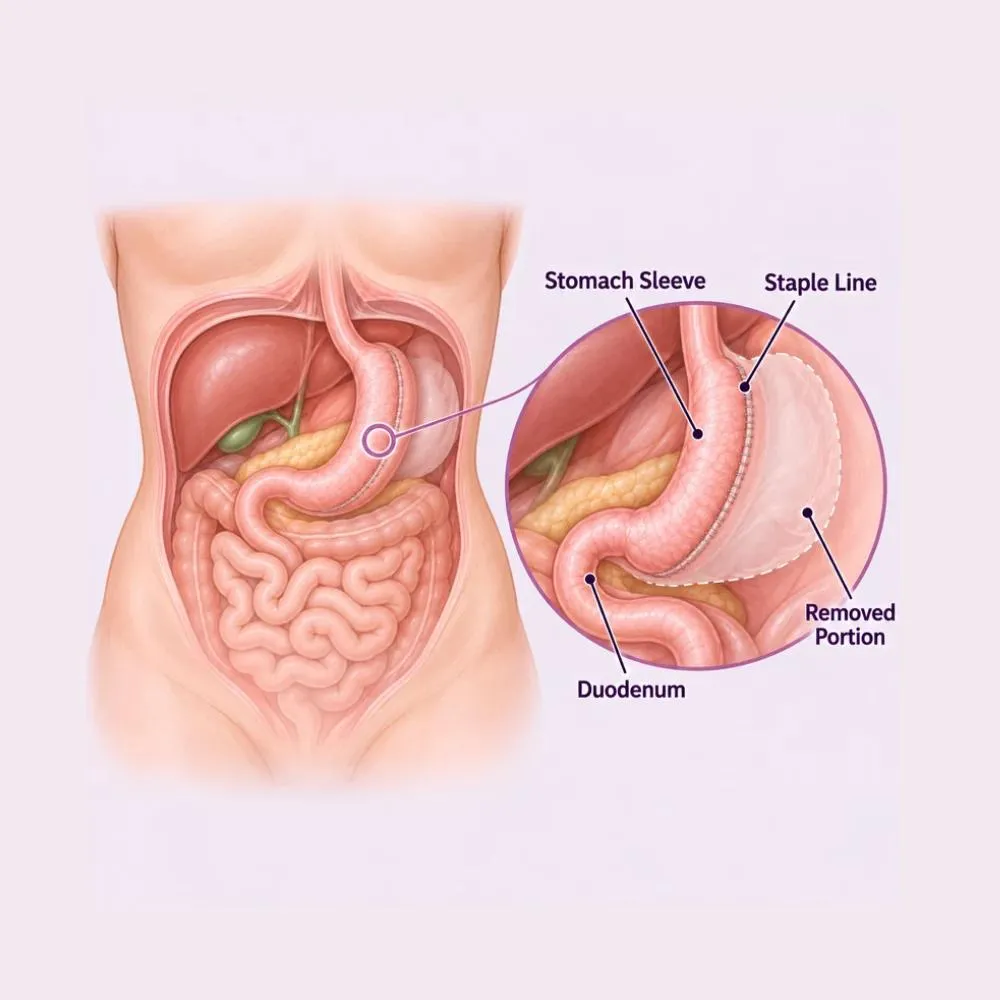
Sleeve gastrectomy is a bariatric procedure in which approximately 75–80% of the stomach is removed, leaving behind a narrow tube-shaped stomach resembling a sleeve or a banana. Because the stomach is much smaller, you feel full after eating far smaller portions.
It works in two ways rather than one. The obvious mechanism is restriction: there is simply less room. The more important one is hormonal: the part of the stomach removed produces most of the body’s ghrelin, the hormone that drives hunger. Patients consistently report that the constant preoccupation with food subsides, and that is what makes the eating changes sustainable.
Unlike gastric bypass, this operation does not reroute the intestines. Food passes through the digestive system by its normal route, absorption is largely unchanged, and there is no risk of the internal hernias that can follow a bypass. It is also technically simpler, which matters in higher-risk patients.
Obesity is not a failure of willpower. It is a regulated condition with powerful biological defences, and understanding those explains why surgery succeeds where repeated dieting has not.
After weight loss, metabolism slows and hunger hormones rise: a coordinated response that actively drives weight regain. This is physiology, not weakness.
Most of the body’s hunger hormone is produced in the part of the stomach removed during this operation, which is why appetite falls markedly afterwards.
Inherited factors account for a substantial proportion of the variation in body weight between people eating similar diets.
Raised insulin promotes fat storage and blocks fat release, creating a cycle that dietary restriction alone struggles to break.
The brain defends a weight it has learned to consider normal. Bariatric surgery appears to reset that set-point downward, which dieting does not.
Insulin, steroids, some antidepressants and antipsychotics all promote weight gain and are often unavoidable.
Poor sleep and chronic stress raise cortisol and disrupt the hormones regulating appetite and satiety.
Energy-dense food is cheap, everywhere, and portioned far beyond what the body needs: a difficult environment for anyone.
The point is not that diet and exercise do not matter: they matter enormously after surgery. It is that for severe obesity they are rarely sufficient alone, and that is a biological fact rather than a moral one.
Bariatric surgery is offered against defined criteria rather than on request. These are the thresholds used in India, which are lower than Western ones because metabolic disease appears at lower body weights in South Asian populations.
You may be a candidate if
Conditions it commonly improves
Surgery is a tool, not a cure. It makes the necessary eating changes achievable in a way that willpower alone has usually not been, but the changes still have to be made, and kept.
Bariatric surgery involves a thorough workup before any date is offered. It confirms you are a suitable candidate, identifies anything that needs treating first, and makes the operation safer.
Height, weight, BMI, waist measurement, weight history and previous attempts at weight loss, alongside a full medical history.
HbA1c, lipids, liver and kidney function, thyroid, vitamin D, B12, iron and folate. Deficiencies are corrected before rather than after surgery.
Examines the stomach and oesophagus for ulcers, H. pylori, hiatal hernia and reflux: all of which influence whether a sleeve is the right choice.
Checks for gallstones and fatty liver. Gallstones are common in this group and may be dealt with at the same operation.
ECG, echocardiogram where indicated, and a sleep study for suspected sleep apnoea, which affects anaesthetic planning directly.
Assessment of eating patterns, readiness for permanent change, and understanding of what the operation does and does not do.
Significant reflux or a large hiatal hernia can make a sleeve the wrong operation, since it tends to worsen reflux. That finding at endoscopy is exactly why the endoscopy comes first.
Surgery is not the first step and is not right for everyone. It is offered where the non-surgical routes have been genuinely tried and the health consequences of obesity are already present.
Dietitian-led calorie and macronutrient planning with regular review. The foundation of every approach, surgical or not.
Graded activity alongside behavioural work addressing eating patterns, emotional eating and habit change.
GLP-1 receptor agonists and other agents produce meaningful weight loss and are a genuine alternative for some patients, though weight is typically regained if stopped.
A temporary, endoscopically placed balloon giving six to twelve months of restriction. Useful as a bridge, or for those not ready for surgery.
Removal of 75–80% of the stomach. Simple, effective, no intestinal rerouting, and the most commonly performed bariatric operation worldwide.
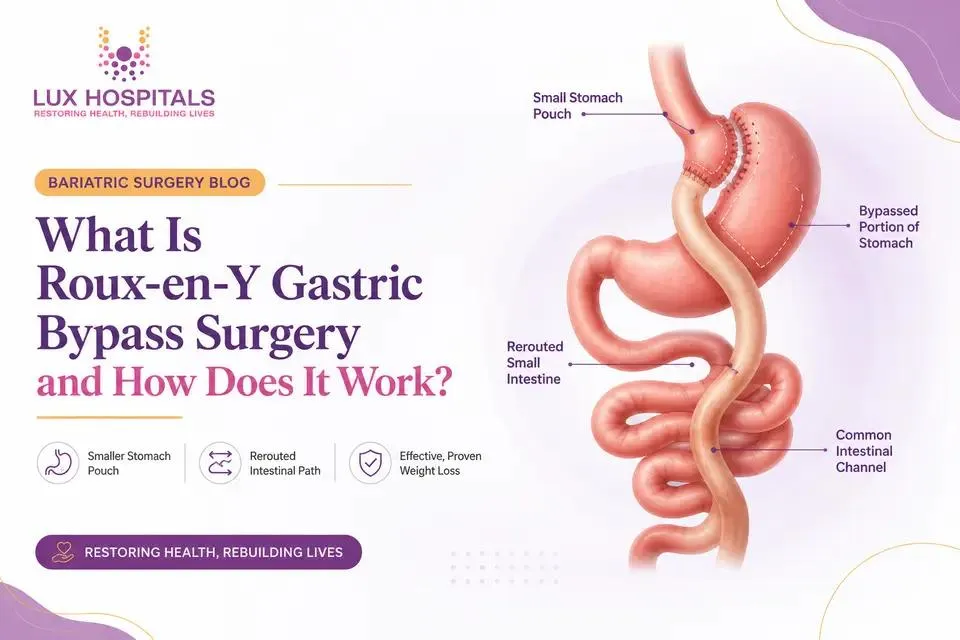
A small pouch is joined directly to the small intestine. Slightly greater weight loss, better for severe reflux and diabetes, but a more complex operation.
A simpler single-anastomosis bypass with a shorter operating time and results comparable to the Roux-en-Y.
An adjustable band around the upper stomach. Reversible, but now performed far less often because of lower long-term weight loss and a high reoperation rate.
Conversion of a sleeve to a bypass, most often for severe reflux developing afterwards or for inadequate weight loss.
Which operation suits you depends on your BMI, your diabetes, whether you have reflux, and your own preference after a proper discussion. A sleeve is the right answer for many patients, but not for someone with significant existing reflux.
A one to two hour keyhole operation through four or five small incisions, followed by a two-night stay. This is what actually happens.
Laparoscopic sleeve gastrectomy
A two-week liver-shrinking diet before surgery. It reduces the size of the fatty liver overlying the stomach and makes the operation considerably safer.
General anaesthetic. The abdomen is inflated with carbon dioxide and four to five ports are placed across the upper abdomen.
The blood vessels along the greater curvature are divided and sealed, freeing the outer edge of the stomach from the omentum and spleen.
A calibration tube is passed into the stomach to define the width of the new sleeve. This measurement determines both the restriction achieved and the leak risk.
A stapler divides the stomach alongside the calibration tube, and the removed 75–80% is drawn out through a port. The staple line is reinforced.
The staple line is tested with dye or air under water to confirm it is completely sealed before closing. A leak is the one serious complication of this operation, and this is when it is ruled out.
Sips of water the same evening, walking within hours, clear fluids the next day, and home after two nights with a detailed diet plan.
The removed portion of stomach is gone permanently: this operation is not reversible. That permanence is precisely why the assessment beforehand is so thorough.
Bariatric outcomes depend as much on the years of follow-up as on the operation itself. Here is why patients trust us:
Led by Dr. Tagore Mohan Grandhi, with fellowships in bariatric surgery (USA) and robotic surgery (Korea) and 28 years of experience.
Dietitian counselling, psychological support and structured long-term follow-up, not just an operation and a discharge letter.
From the first consultation through to post-treatment follow-up, with one team throughout.
Our hospital is in HITEC CITY, near IKEA: easily reachable from across Hyderabad.
Physical recovery takes about four weeks. The dietary progression is deliberately slow, and following it exactly is what protects the staple line while it heals.
In hospital. Sips of water the same evening, walking within hours, clear sugar-free fluids from day one. Home after two nights.
Clear liquids and sugar-free, non-carbonated drinks only. Small, frequent sips. Focus on staying hydrated and on protein supplements.
Pureed and soft foods. Protein first at every meal. Desk work resumes from around week two.
Gradual return to normal solid foods, well chewed, in small portions. Exercise resumes progressively. Weight loss is usually rapid at this stage.
Most of the weight comes off over this period: typically 50–70% of excess body weight by twelve to eighteen months. Regular follow-up and blood monitoring throughout.
60–80g of protein daily, eaten before anything else at each meal. It protects muscle mass while you lose fat rapidly.
A multivitamin, B12, iron, calcium and vitamin D, indefinitely. Deficiency is the commonest long-term problem after this operation, and it is entirely preventable.
Stop fluids thirty minutes before and after eating. Drinking with food washes it through the sleeve and removes the fullness you are relying on.
Walking from day one, building to regular activity including resistance work, which is what preserves muscle during rapid weight loss.
Fever, a racing pulse, severe abdominal pain, persistent vomiting or an inability to keep fluids down. These are the signs of a leak and need assessing immediately.
Reviews and blood tests at six weeks, three months, six months, a year, and annually for life. The people who attend are the people who keep the weight off.
Some weight regain after two to three years is normal and expected, usually ten to fifteen per cent of what was lost. Significant regain is nearly always related to grazing, sugary drinks and stopping follow-up rather than to the operation failing.
Book a consultation with a bariatric specialist if any of the following apply.
Bariatric surgery is covered by most insurers in India where BMI criteria are met, and our team handles the pre-authorisation. These are the self-pay ranges.
| Procedure | Estimated Cost |
|---|---|
| Consultation & bariatric assessment Per visit | ₹1,000 – ₹2,000 |
| Complete pre-operative workup Bloods, endoscopy, ultrasound, cardiac and sleep review | ₹15,000 – ₹30,000 |
| Laparoscopic sleeve gastrectomy Two nights’ stay, staplers included | ₹2,80,000 – ₹4,50,000 |
| Robotic-assisted sleeve gastrectomy Two to three nights’ stay | ₹4,00,000 – ₹6,00,000 |
| Sleeve with hiatal hernia repair Where reflux and a hernia are both present | ₹3,20,000 – ₹5,00,000 |
| Follow-up & dietitian programme First year, included in most packages | ₹12,000 – ₹25,000 |
Stapler cartridges and staple-line reinforcement are the largest single component of the theatre cost, and are used in proportion to stomach size.
A very high BMI, sleep apnoea or significant heart disease means longer theatre time, more monitoring, and sometimes a night in intensive care.
Hiatal hernia repair or gallbladder removal performed at the same sitting adds to the total, but costs far less than a second admission.
A shared ward, a twin-sharing room or a private suite: the largest single swing in most estimates.
We are empanelled with most major insurers, and our team files the pre-authorisation for you.
Every figure above is an indicative range, not a quote. After your consultation you are given a written, fixed-cost estimate, and that is the number you pay, with no additions once treatment begins.
What patients treated here can expect:
50–70% of excess body weight within 12 to 18 months.
Improvement in diabetes, blood pressure, cholesterol and sleep apnoea.
Greater mobility, more energy, and less joint pain.
The bariatric and gastrointestinal surgeon who performs sleeve gastrectomy at our HITEC CITY hospital.

Senior Consultant: Bariatric & Gastrointestinal Surgery
MBBS, MS, FRCS (UK), DLS (France)
28 years experience
Reviews from patients treated for bariatric and gastrointestinal conditions at Lux Hospitals, Hyderabad.
Written by Dr. Tagore Mohan Grandhi on bariatric surgery and metabolic health.

Dr. Tagore Mohan Grandhi
Dr. Tagore Mohan Grandhi
Dr. Tagore Mohan Grandhi
Dr. Tagore Mohan Grandhi
Dr. Tagore Mohan Grandhi
Dr. Tagore Mohan Grandhi
Common questions about sleeve gastrectomy, its results, and what surgery costs at Lux Hospitals.
Still have questions? Call us at 079 6908 4422
Still have questions? Message us on WhatsApp at 079 6908 4444
Laparoscopic sleeve gastrectomy with dietitian-led follow-up, and a fixed-cost estimate and insurance check before treatment begins.
Plot No.116, Lumbini Avenue, HITEC CITY, Near IKEA, Hyderabad – 500032













