Dr. Samhitha Reddy
Consultant Proctologist & Laparoscopic Surgeon
MBBS, MS, FMAS, FISCP, DMAS
- 8 Yrs
- ASCRS Member
Ovarian cysts are fluid-filled sacs on or within the ovary, and most are entirely normal. A functional cyst forms as part of ovulation every month and disappears on its own within a couple of cycles.
The work is in telling those apart from the minority that need treating, and in removing a cyst without sacrificing the ovary around it. Our gynaecologists at Lux Hospitals, HITEC CITY assess cysts properly and operate laparoscopically with ovarian reserve in mind.
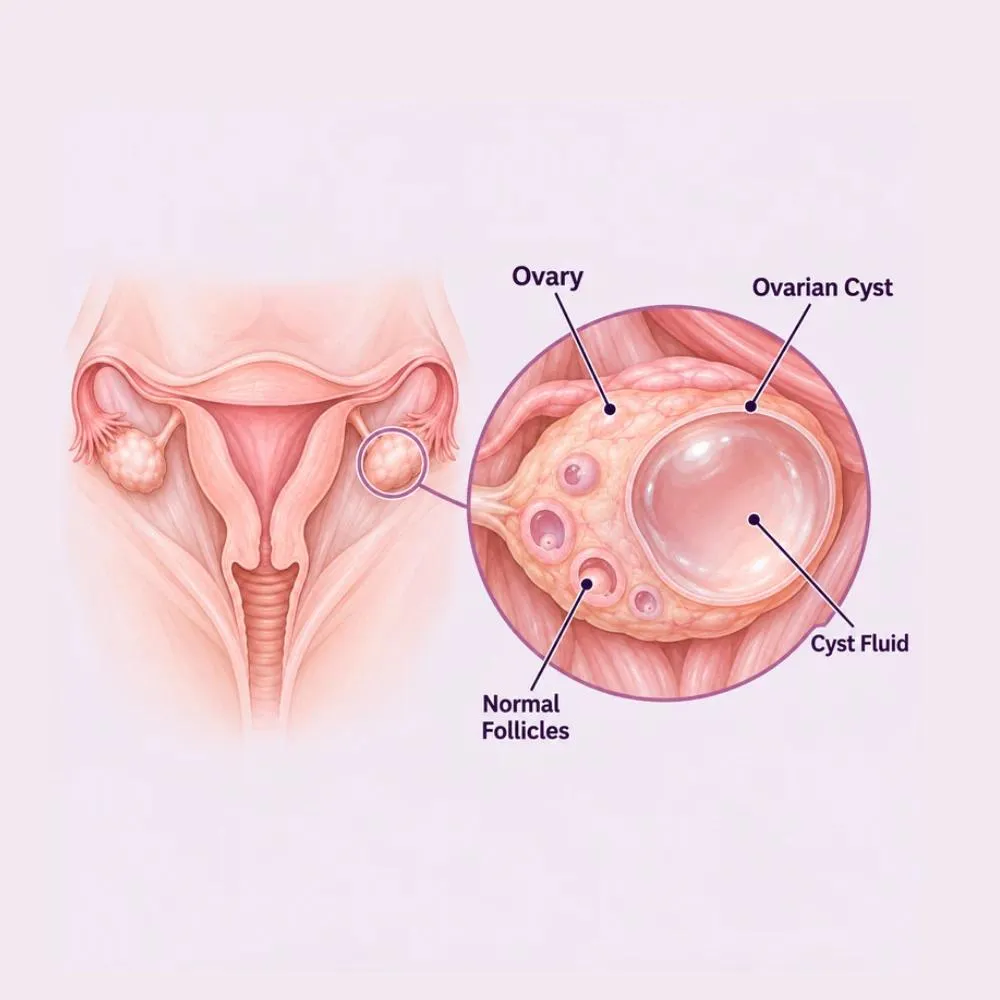
An ovarian cyst is a fluid-filled sac on or within the ovary. The great majority are functional cysts, which form as a normal part of the menstrual cycle. A follicular cyst occurs when the follicle containing the egg fails to rupture and keeps growing; a corpus luteum cyst forms when the structure left behind after ovulation fills with fluid. Both typically resolve within one to three cycles without any treatment.
Beyond those are cysts that do not resolve. A dermoid cyst contains tissue such as hair, skin and occasionally teeth, arising from germ cells. An endometrioma is a collection of old blood from endometriosis, often called a chocolate cyst. A cystadenoma grows from the ovarian surface and can become very large. Polycystic ovaries are a different matter again: many small follicles rather than a single cyst.
The concern that drives most of the assessment is ovarian cancer. It is uncommon, particularly before menopause, but it presents as a cystic mass and there is no reliable screening test. Complex features on ultrasound, a raised CA-125 in a postmenopausal woman, or a cyst that persists and grows all shift the balance toward removal rather than observation.
Most cysts are a by-product of ovulation. The rest have specific and quite different origins.
Follicular and corpus luteum cysts form as part of the ordinary cycle. By far the commonest cause, and they resolve without treatment.
Endometrial tissue on the ovary bleeds each cycle, forming an endometrioma filled with old blood: the chocolate cyst.
Dermoid cysts arise from cells capable of forming any tissue, which is why they can contain hair, skin, fat and teeth. Usually found in younger women.
Cystadenomas grow from the outer covering of the ovary and can reach a very large size while causing few symptoms.
Many small follicles that have stalled rather than a single cyst. A different condition entirely, treated hormonally rather than surgically.
Severe pelvic inflammatory disease can produce a tubo-ovarian abscess, which appears as a complex cystic mass.
A corpus luteum cyst normally persists in early pregnancy to support it, and usually resolves by the second trimester.
Functional cysts are a sign the ovaries are working normally, not a sign anything is wrong. This is worth saying plainly, because the word cyst causes considerable and usually unnecessary alarm.
Most cysts cause nothing and are found incidentally. Where symptoms occur they are usually vague and one-sided.
Common symptoms
Symptoms needing urgent care
Sudden severe one-sided pain with vomiting is ovarian torsion until proven otherwise: the ovary has twisted on its blood supply. It is a surgical emergency, and the ovary can be saved only if it is operated on within hours.
The assessment answers two questions: is this likely to resolve on its own, and is there any suspicion of malignancy?
The key test. Size, whether the cyst is simple or complex, solid areas, septations and blood flow all feed into the risk assessment.
A simple cyst in a premenopausal woman is rescanned rather than removed. Most have gone by then, which avoids an unnecessary operation.
Interpreted with care: CA-125 rises in endometriosis, fibroids, infection and even menstruation, so it is far more useful after menopause than before.
Combines the ultrasound features, CA-125 and menopausal status into a single score that guides whether specialist referral is needed.
Characterises complex cysts more precisely and distinguishes dermoids and endometriomas where ultrasound is unclear.
Done in every woman of reproductive age, since an ectopic pregnancy can present exactly as a painful adnexal mass.
CA-125 is frequently over-interpreted. In a premenopausal woman it is raised by endometriosis, fibroids, infection and menstruation itself, so a mildly high result on its own means very little.
Most cysts need only observation. Surgery is for cysts that persist, cause symptoms, or carry any suspicion of malignancy.
The correct approach for a simple cyst under five centimetres in a premenopausal woman. A repeat scan after two to three cycles usually shows it has gone.
Simple analgesia and heat for discomfort while a functional cyst resolves on its own.
Prevent new functional cysts forming by suppressing ovulation. They do not shrink a cyst that already exists.
Hormonal suppression for endometriomas, or antibiotics for a tubo-ovarian abscess, addressing what is producing the cyst.
The cyst is shelled out through keyhole ports and the ovary repaired and left in place. The standard operation, and the one that protects fertility.
Removal of the whole ovary, where the cyst has destroyed it, where malignancy is suspected, or after menopause when preservation offers little.
Emergency surgery to untwist the ovary and restore blood supply. Done urgently, since the ovary is recoverable only within a narrow window.
Where malignancy is confirmed or strongly suspected, a more extensive operation with a gynaecological oncologist involved.
For very large cysts, or where malignancy is suspected and the cyst must be removed intact without spilling its contents.
Cystectomy versus oophorectomy is the decision that matters most for a younger woman. Removing the whole ovary is quicker and simpler, but it costs half her ovarian reserve permanently, so it should be a deliberate choice, not a default.
The operation takes forty-five minutes to two hours, with a same-day or overnight discharge.
Keyhole ovary-preserving surgery under general anaesthesia
Imaging and tumour markers reviewed, pregnancy excluded, and the plan agreed: specifically whether the ovary is to be preserved.
General anaesthesia, with a camera port at the umbilicus and two or three small ports low on the abdomen.
The whole pelvis and upper abdomen examined, and washings taken where there is any suspicion of malignancy.
A small incision in the ovarian surface, carried down to the plane between the cyst wall and normal ovarian tissue.
The cyst separated from the ovary with gentle traction, ideally intact, particularly for dermoids, whose contents are highly irritant if spilled.
Bleeding controlled with minimal cautery, since heat applied to the ovary destroys follicles and reduces reserve.
The cyst removed in a containment bag through a port, sent for histology, and the ports closed.
Excessive cautery to stop bleeding on the ovary is the quiet way ovarian reserve gets lost. Careful haemostasis with minimal heat is what distinguishes a fertility-conscious cystectomy from a merely successful one.
Ovarian cysts are both over-treated and, occasionally, under-investigated. Here is why patients trust us:
Cystectomy rather than removal of the whole ovary wherever it is safe, with careful technique to protect ovarian reserve.
Ultrasound features, tumour markers and menopausal status combined into a formal risk score, so nothing suspicious is simply watched.
From the first consultation through to post-treatment follow-up, with one team throughout.
Our hospital is in HITEC CITY, near IKEA: easily reachable from across Hyderabad.
Recovery from keyhole cystectomy is quick: most women are back to desk work within two weeks.
Home the same day or after one night. Shoulder-tip pain from the gas is common and settles within a day or two.
Port-site soreness reduces steadily. Walking encouraged. Light bleeding or discharge may occur.
Most women return to desk work. Wound review and histology result discussed.
Light exercise resumes and intercourse after clearance at four weeks. Cycles return to their usual pattern.
A follow-up scan where indicated, confirming the ovary has healed and no new cyst has formed.
Every cyst removed is examined. Make sure you receive that result rather than assuming no news means good news.
Early mobilisation after keyhole surgery reduces the risk of clots and speeds recovery considerably.
Nothing over five kilograms. Port sites need time to heal fully before abdominal strain.
Removing a cyst does not stop new ones forming, particularly functional cysts and endometriomas. Recurrence is not a failed operation.
If you plan to conceive, discuss how much ovarian tissue was preserved and whether AMH testing would be useful.
Sudden severe pain, fever, or increasing rather than settling discomfort needs review rather than waiting for follow-up.
The commonest outcome of an ovarian cyst consultation is a repeat scan showing the cyst has gone. That is the expected result for functional cysts, and it is why immediate surgery is usually the wrong first move.
Book a consultation if any of the following apply.
Many women need only a consultation and two scans. Surgery costs apply to the minority whose cysts persist.
| Procedure | Estimated Cost |
|---|---|
| Consultation Per visit | ₹800 – ₹1,500 |
| Transvaginal ultrasound Usually repeated after two to three cycles | ₹1,500 – ₹3,500 |
| CA-125 and tumour markers Where features are complex | ₹1,200 – ₹4,000 |
| MRI pelvis To characterise a complex cyst | ₹8,000 – ₹18,000 |
| Laparoscopic ovarian cystectomy Day care or one night | ₹1,10,000 – ₹1,95,000 |
| Laparoscopic oophorectomy Where the ovary cannot be preserved | ₹1,20,000 – ₹2,10,000 |
| Emergency surgery for torsion Urgent admission | ₹1,40,000 – ₹2,50,000 |
A simple functional cyst resolves on its own. Two scans and a consultation is the entire cost for a large share of women.
A dermoid or endometrioma takes longer to remove carefully than a simple cyst, and very large cysts may need open surgery.
Ovarian torsion requires emergency admission and out-of-hours theatre, which costs more than planned surgery.
A shared ward, a twin-sharing room or a private suite: the largest single swing in most estimates.
We are empanelled with most major insurers, and our team files the pre-authorisation for you.
Every figure above is an indicative range, not a quote. After your consultation you are given a written, fixed-cost estimate, and that is the number you pay, with no additions once treatment begins.
The gynaecologists who treat ovarian cysts at our HITEC CITY hospital.

Consultant Gynaecologist & Advanced Laparoscopic Surgeon
MBBS, MS, FMAS
16 years experience

Consultant Obstetrician, Gynecologist & Laparoscopic Surgeon
MBBS, MS (Obstetrics & Gynaecology)
11 years experience
Reviews from women treated for gynaecological conditions at Lux Hospitals, Hyderabad.
Written by Dr. Harshita Kakarla on women’s health and gynaecological care.
Dr. Harshita Kakarla

Dr. Harshita Kakarla
Dr. Harshita Kakarla

Dr. Harshita Kakarla

Dr. Harshita Kakarla
Dr. Harshita Kakarla
Common questions about ovarian cysts, surgery, fertility and costs at Lux Hospitals.
Still have questions? Call us at 079 6908 4422
Still have questions? Message us on WhatsApp at 079 6908 4444
Proper assessment of an ovarian cyst and ovary-preserving surgery where it is needed, with costs shared upfront.
Plot No.116, Lumbini Avenue, HITEC CITY, Near IKEA, Hyderabad – 500032