



Dr. Samhitha Reddy
Consultant Proctologist & Laparoscopic Surgeon
MBBS, MS, FMAS, FISCP, DMAS
- 8 Yrs
- ASCRS Member
Stomach cancer is difficult because its early symptoms are indistinguishable from indigestion. Vague upper abdominal discomfort treated with antacids for months is the usual history, and by the time the diagnosis is made the disease has often advanced.
Where it is caught early it is curable, and surgery is what cures it. Our gastrointestinal surgeon at Lux Hospitals, HITEC CITY performs gastrectomy with formal D2 lymph node dissection, alongside oncology for the chemotherapy that surrounds it.
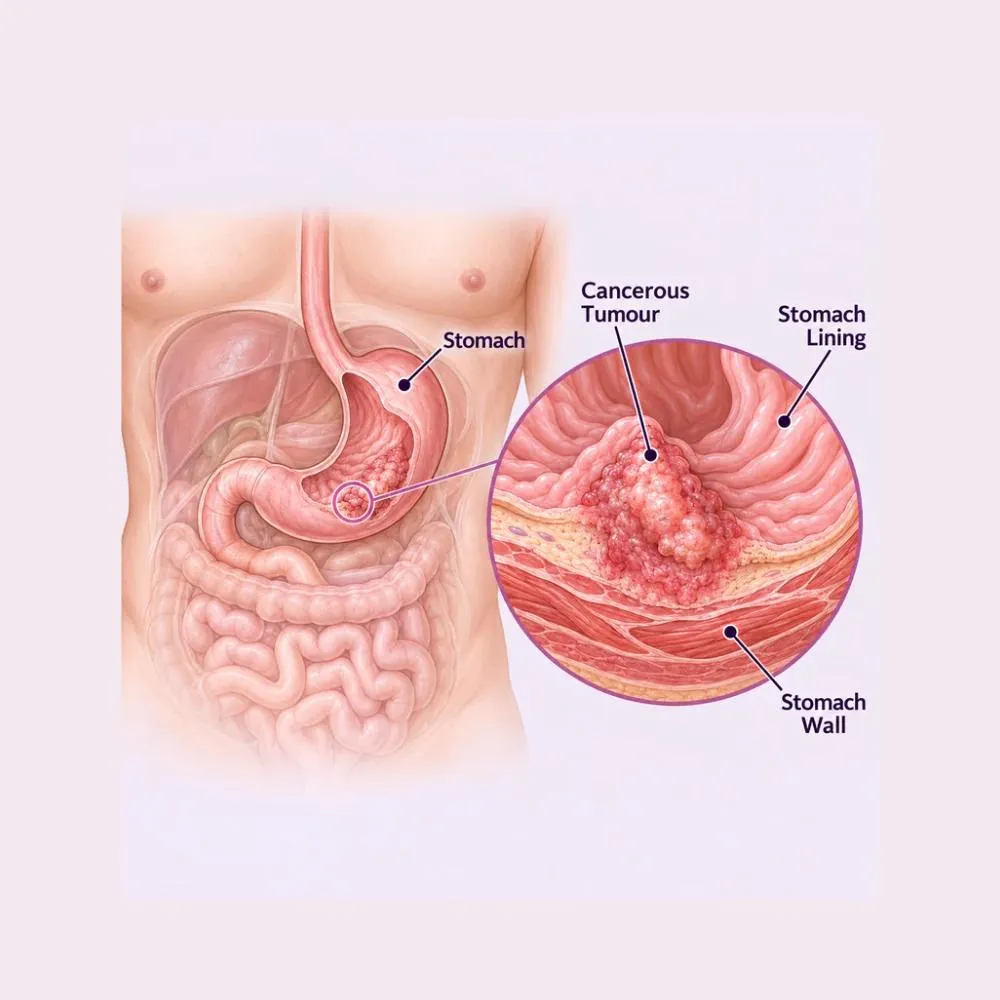
Stomach cancer, or gastric cancer, is a malignant growth arising from the lining of the stomach. The great majority are adenocarcinomas, developing over years from chronic inflammation of the stomach lining: most often driven by long-standing Helicobacter pylori infection.
The sequence is well understood: chronic H. pylori gastritis leads to atrophy of the lining, then to intestinal metaplasia, then to dysplasia, and finally to cancer. That progression takes decades, which is why eradicating H. pylori is genuinely a cancer-prevention measure rather than simply ulcer treatment.
Staging runs from early gastric cancer confined to the mucosa and submucosa, through locally advanced disease invading the muscle wall and lymph nodes, to stage IV with distant spread. Early gastric cancer has excellent outcomes and can sometimes be removed endoscopically, which is why the diagnosis being made early changes everything.
H. pylori infection is the dominant modifiable cause. Diet, smoking and genetics account for much of the rest.
The single largest risk factor. Chronic infection drives the progression from gastritis through metaplasia to cancer over decades, and eradicating it reduces that risk.
Long-standing inflammation with thinning of the stomach lining and intestinal metaplasia are recognised precancerous states.
Diets high in salt, smoked meats and preserved foods, and low in fresh fruit and vegetables, are consistently associated with gastric cancer.
Roughly doubles the risk, with a clear dose relationship, and is one of the most readily modifiable factors.
Heavy regular consumption increases risk, particularly in combination with smoking.
A first-degree relative with gastric cancer raises risk, and hereditary diffuse gastric cancer syndrome carries a very high lifetime risk.
Patients who had partial gastrectomy decades ago have a raised risk in the remaining stomach, developing many years later.
Autoimmune atrophic gastritis causing B12 deficiency also raises the long-term risk of gastric cancer.
Because H. pylori is treatable and its eradication reduces gastric cancer risk, testing and treating it is worthwhile in its own right, particularly in anyone with a family history.
The early symptoms are vague and easily mistaken for indigestion. It is the persistence, and the accompanying weight loss, that should prompt investigation.
Early and common symptoms
Alarm symptoms: investigate promptly
New indigestion in anyone over forty-five, or indigestion with weight loss at any age, warrants an endoscopy rather than another course of acid suppression. That single rule accounts for most of the early diagnoses that are made.
Endoscopy with biopsy makes the diagnosis. Staging then determines whether the cancer can be removed, and in what order treatment should be given.
The definitive test. It visualises the tumour, takes multiple biopsies for diagnosis, and assesses how much of the stomach is involved.
Staging imaging assessing local extent, lymph nodes, and spread to the liver, lungs or peritoneum.
Measures how deeply the tumour has invaded the stomach wall and assesses nearby lymph nodes: the most accurate test for local staging.
A short keyhole look into the abdomen to detect peritoneal deposits too small for CT to show, which would change the plan entirely.
Performed on the biopsy, since HER2-positive tumours respond to targeted therapy alongside standard chemotherapy.
Most patients have lost weight before diagnosis. Nutritional optimisation before surgery measurably improves outcomes.
Diagnostic laparoscopy is worth its place. It finds peritoneal disease in a meaningful proportion of patients whose CT looked operable, and it spares them a major operation that would not have helped.
Surgery offers the only prospect of cure, and for most patients it is combined with chemotherapy before and after. Very early tumours can sometimes be removed endoscopically.
Removal of the lower portion of the stomach with its lymph nodes, for tumours in the distal stomach. The remaining stomach is joined to the small intestine.
Removal of the whole stomach, with the oesophagus joined directly to the small intestine. Needed for proximal or extensive tumours.
Systematic removal of the lymph node stations around the stomach and its arteries. It is the standard of care and materially affects both staging accuracy and survival.
For very early cancers confined to the mucosa, removed through an endoscope with the stomach left entirely intact.
Keyhole gastrectomy with equivalent oncological clearance, less pain and faster recovery in appropriately selected patients.
Bypass or stenting to relieve obstruction where cure is not possible, aimed at allowing normal eating and comfort.
Chemotherapy before and after surgery. It shrinks the tumour, treats micrometastases, and improves survival compared with surgery alone.
Given after surgery in selected patients, particularly where lymph node clearance was incomplete or margins were close.
Trastuzumab for HER2-positive tumours, added to chemotherapy in advanced disease with meaningful benefit.
Checkpoint inhibitors for selected advanced tumours, guided by PD-L1 and microsatellite instability testing.
For advanced disease, to control the cancer, relieve symptoms and extend life.
Perioperative chemotherapy is now standard for locally advanced disease rather than surgery alone. Starting with chemotherapy is not a delay: it is part of the treatment that gives the best chance of cure.
A three to five hour operation removing part or all of the stomach with its lymph node basin, followed by a seven to ten night stay.
Gastrectomy with D2 lymph node dissection
Nutritional support to correct weight loss, chemotherapy where planned, and full anaesthetic and cardiac assessment.
General anaesthetic with an epidural for pain relief. Open or laparoscopic access depending on tumour stage and position.
The peritoneum and liver are inspected for deposits before committing to resection, with washings sometimes taken for cytology.
The stomach is freed from surrounding structures and the feeding vessels divided at their origins, which is what harvests the lymph node stations.
Systematic clearance of the node stations along the stomach and the coeliac vessels. A minimum of sixteen nodes is needed for reliable staging.
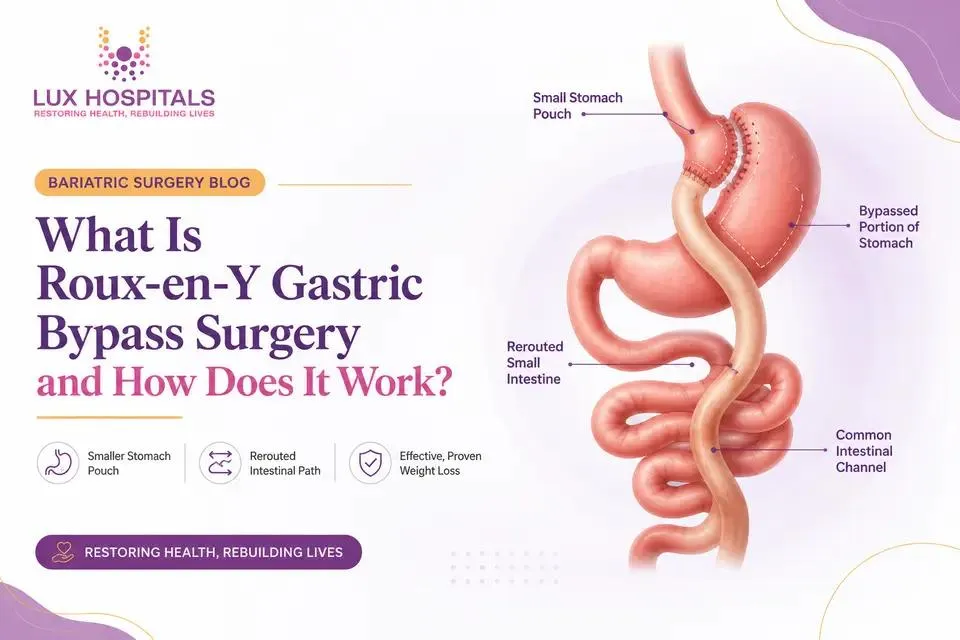
The stomach is divided with clear margins and continuity restored, usually a Roux-en-Y join to the small intestine.
A feeding tube is often placed at surgery. Diet is advanced slowly, and home after seven to ten nights with detailed dietary guidance.
Eating changes permanently after gastrectomy: small frequent meals become necessary, and after total gastrectomy vitamin B12 injections are needed for life. Dietitian support is part of the treatment rather than an add-on.
Gastric cancer surgery is judged on the completeness of the lymph node dissection and on nutritional recovery afterwards. Here is why patients trust us:
Led by Dr. Tagore Mohan Grandhi, with fellowships in robotic surgery (Korea) and 28 years of gastrointestinal surgical experience.
Endoscopic ultrasound, CT and diagnostic laparoscopy, so treatment is planned on an accurate stage rather than an assumed one.
From the first consultation through to post-treatment follow-up, with one team throughout.
Our hospital is in HITEC CITY, near IKEA: easily reachable from across Hyderabad.
Recovery from gastrectomy takes two to three months, and the dietary adaptation is permanent. The full treatment pathway usually spans six to nine months.
In hospital. Nil by mouth initially with tube or intravenous feeding, then clear fluids once a contrast study confirms the joins are intact.
Diet advanced to liquids and then puree. Dietitian teaching on small frequent meals begins. Home once eating adequately.
Soft foods in very small portions, six to eight times daily. Weight loss during this period is expected. Final pathology discussed.
Post-operative chemotherapy where planned. Diet expands gradually, though portion size remains permanently reduced.
Weight stabilises and energy returns. Lifelong B12 injections after total gastrectomy, with surveillance every three to six months for five years.
Six to eight small meals daily rather than three large ones. The stomach’s reservoir function is gone and cannot be recovered.
Lifelong after total gastrectomy, since the stomach factor needed to absorb B12 is no longer produced. Missing these causes neurological damage.
Absorption is reduced after gastrectomy. Supplements and annual blood monitoring are part of long-term care.
Avoid sugary foods and do not drink with meals. Sudden sweating, palpitations and diarrhoea after eating are dumping, and diet controls it.
Fever, worsening abdominal pain, persistent vomiting, difficulty swallowing, or an inability to maintain nutrition.
Clinical review, bloods and imaging every three to six months for five years, with nutritional monitoring throughout.
Living without a stomach is entirely possible and most patients adapt well, but it takes time and dietetic support. Weight loss in the first few months is expected and stabilises: planning for it is better than being surprised by it.
Book a consultation if any of the following apply.
Treatment is a pathway spanning chemotherapy, surgery and further chemotherapy. These are the ranges for its components.
| Procedure | Estimated Cost |
|---|---|
| Consultation & assessment Per visit | ₹1,000 – ₹2,000 |
| Endoscopy with biopsy Including histopathology and HER2 testing | ₹10,000 – ₹22,000 |
| Complete staging workup CT, endoscopic ultrasound and bloods | ₹35,000 – ₹80,000 |
| Diagnostic laparoscopy Day care or one night’s stay | ₹60,000 – ₹1,20,000 |
| Subtotal gastrectomy with D2 Seven to ten nights’ stay | ₹3,50,000 – ₹6,00,000 |
| Total gastrectomy with D2 Eight to twelve nights’ stay | ₹4,50,000 – ₹7,50,000 |
| Perioperative chemotherapy Per cycle; typically 6–8 cycles in total | ₹50,000 – ₹1,50,000 |
A subtotal gastrectomy and a total gastrectomy with oesophageal join differ substantially in complexity, stay and recovery.
Early gastric cancer may need endoscopic resection alone. Locally advanced disease means chemotherapy before and after major surgery.
Trastuzumab for HER2-positive tumours and immunotherapy agents are considerably more expensive than standard chemotherapy.
A shared ward, a twin-sharing room or a private suite: the largest single swing in most estimates.
We are empanelled with most major insurers, and our team files the pre-authorisation for you.
Every figure above is an indicative range, not a quote. After your consultation you are given a written, fixed-cost estimate, and that is the number you pay, with no additions once treatment begins.
The gastrointestinal surgeon who treats stomach cancer at our HITEC CITY hospital.

Senior Consultant: Bariatric & Gastrointestinal Surgery
MBBS, MS, FRCS (UK), DLS (France)
28 years experience
Reviews from patients treated for gastrointestinal conditions at Lux Hospitals, Hyderabad.
Written by Dr. Tagore Mohan Grandhi on digestive health and gastrointestinal surgery.

Dr. Tagore Mohan Grandhi
Dr. Tagore Mohan Grandhi
Dr. Tagore Mohan Grandhi
Dr. Tagore Mohan Grandhi
Dr. Tagore Mohan Grandhi
Dr. Tagore Mohan Grandhi
Common questions about stomach cancer, its treatment, and what care costs at Lux Hospitals.
Still have questions? Call us at 079 6908 4422
Still have questions? Message us on WhatsApp at 079 6908 4444
Complete staging and gastrectomy with formal D2 dissection, planned by a multidisciplinary team with costs confirmed upfront.
Plot No.116, Lumbini Avenue, HITEC CITY, Near IKEA, Hyderabad – 500032













