



Dr. Samhitha Reddy
Consultant Proctologist & Laparoscopic Surgeon
MBBS, MS, FMAS, FISCP, DMAS
- 8 Yrs
- ASCRS Member
A peptic ulcer is a break in the lining of the stomach or duodenum. Most heal completely within weeks once the cause is identified, and in the great majority of cases the cause is either an H. pylori infection or a painkiller.
Untreated, ulcers bleed, perforate or scar the outlet of the stomach. Our gastrointestinal team at Lux Hospitals, HITEC CITY diagnoses by endoscopy, treats the underlying cause properly, and provides round-the-clock surgical cover for the complications.
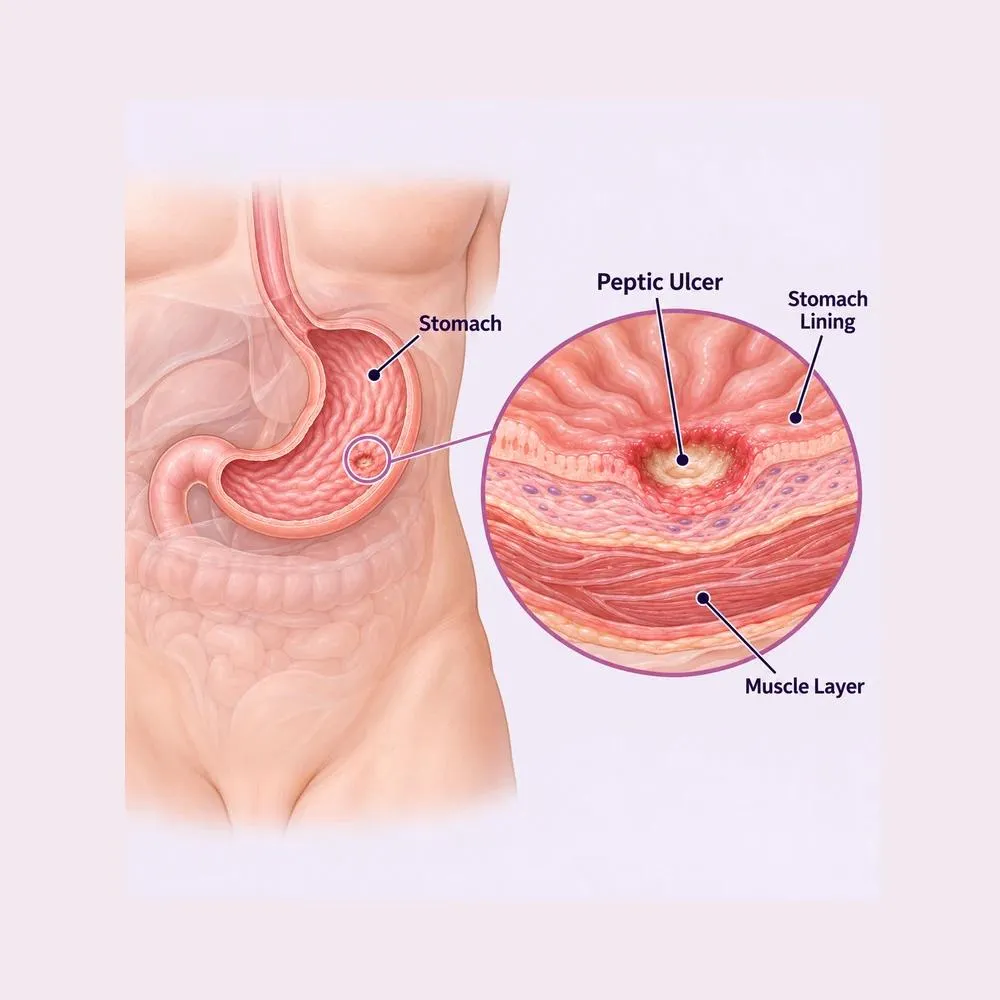
A peptic ulcer is an open sore in the lining of the digestive tract, formed where stomach acid has eroded through the protective mucous layer into the tissue beneath. It is not caused by acid alone: the acid is normally present; what has failed is the lining’s defence against it.
Ulcers are named for where they occur. A gastric ulcer is in the stomach lining and typically causes pain soon after eating. A duodenal ulcer, in the first part of the small intestine, is commoner and characteristically causes pain when the stomach is empty, between meals and at night, which eating temporarily relieves. An oesophageal ulcer occurs lower in the gullet, usually from acid reflux.
The understanding of this condition changed completely once Helicobacter pylori was identified. Ulcers were long attributed to stress and spicy food; in fact the great majority are caused by that bacterial infection or by anti-inflammatory painkillers. That is why they are now curable rather than merely controllable.
Two causes account for the overwhelming majority. The old assumption that stress and spice cause ulcers is largely wrong, though both can aggravate the symptoms.
A bacterium that colonises the stomach lining and undermines its defences. The commonest cause worldwide, and eradicating it cures the ulcer permanently.
Ibuprofen, diclofenac and aspirin block the prostaglandins that maintain the protective mucous layer. The second major cause, and entirely avoidable.
Increases acid production, impairs healing and markedly raises the risk of recurrence after successful treatment.
Directly irritates the stomach lining and increases acid secretion, particularly on an empty stomach.
Corticosteroids, SSRIs and bisphosphonates all raise ulcer risk, especially when combined with an NSAID.
Critical illness, major burns or serious trauma cause stress ulcers through reduced blood flow to the stomach lining.
A rare gastrin-producing tumour causing massive acid output and multiple ulcers. Considered where ulcers are numerous or resistant to treatment.
A family history raises risk, and blood group O is modestly associated with duodenal ulcers.
Because most ulcers have an identifiable and treatable cause, most are genuinely curable. An ulcer that recurs after eradication usually means the H. pylori was not cleared or an NSAID is still being taken.
The classic symptom is burning upper abdominal pain with a recognisable relationship to meals, though a significant minority of ulcers cause no symptoms at all until they bleed.
Typical symptoms
Emergency signs: go to hospital now
Black tarry stools mean digested blood, and sudden severe pain with a rigid abdomen means perforation. Both are emergencies measured in hours, not days.
Endoscopy is the definitive test, and it is essential for gastric ulcers because a small proportion are malignant. Non-invasive testing is reasonable in younger patients without alarm features.
Direct visualisation of the stomach and duodenum. It confirms the ulcer, assesses bleeding risk, and allows treatment at the same sitting.
Taken from every gastric ulcer without exception, to detect H. pylori and (crucially) to exclude gastric cancer, which can look identical.
Urea breath test, stool antigen test or biopsy-based testing. Non-invasive tests are reliable and useful for confirming eradication afterwards.
Full blood count for anaemia from chronic blood loss, plus iron studies. Anaemia in an older patient warrants endoscopy regardless of symptoms.
An alternative where endoscopy is not possible. It outlines larger ulcers but cannot biopsy them, which is its central limitation.
For suspected perforation. Free air under the diaphragm confirms it and mandates immediate surgery.
Every gastric ulcer is biopsied and re-scoped after treatment to confirm it has healed. A gastric ulcer that does not heal on proper therapy is cancer until proved otherwise.
The great majority of ulcers heal with medication in four to eight weeks. Surgery is now reserved almost entirely for complications rather than for the ulcer itself.
The mainstay. They suppress acid production strongly and heal the great majority of ulcers within four to eight weeks.
Two antibiotics plus a PPI for ten to fourteen days. Completing the full course is essential: partial treatment breeds resistance and the ulcer returns.
Where a painkiller is the cause, stopping it is the treatment. Where it cannot be stopped, a PPI is co-prescribed for protection.
For milder symptoms and rapid relief. Antacids neutralise acid immediately but do not heal the ulcer.
Sucralfate and misoprostol coat and protect the ulcer base, used alongside acid suppression in selected cases.
Avoiding spicy, acidic and fatty foods, stopping smoking, and limiting alcohol and caffeine: supportive of healing rather than curative.
For a bleeding ulcer: injection, clipping or thermal coagulation applied through the endoscope. It controls the great majority without surgery.
Emergency laparoscopic or open repair with an omental patch, plus washout of the abdomen. A true emergency requiring surgery within hours.
Where endoscopic control fails, the bleeding vessel is under-run surgically. Uncommon now, but occasionally life-saving.
For gastric outlet obstruction from a scarred, narrowed pylorus after chronic ulceration.
Acid-reducing surgery, now rarely performed since H. pylori eradication made most surgery for uncomplicated ulcers unnecessary.
The transformation here is worth stating: before H. pylori was identified, ulcer surgery was among the commonest abdominal operations. Today it is almost entirely confined to emergencies.
A ten to fourteen day course of tablets that cures the underlying infection. Simple in principle, and it fails mainly when the course is not completed.
Triple or quadruple therapy
Urea breath test, stool antigen test or biopsy at endoscopy. Treatment is not started without confirmation.
Standard triple therapy, a PPI with two antibiotics, or quadruple therapy with bismuth where local resistance is high or triple therapy has failed before.
All medications together for ten to fourteen days without missing doses. Incomplete courses are the main cause of both failure and resistance.
A metallic taste, nausea and loose stools are common and expected. They are not a reason to stop, and are discussed in advance so they do not come as a surprise.
The PPI continues for four to eight weeks beyond the antibiotics, to allow the ulcer itself to heal completely.
A breath or stool test at least four weeks after finishing, and off the PPI for two weeks: otherwise the test can read falsely negative.
Every gastric ulcer is re-scoped and re-biopsied at eight to twelve weeks to confirm healing and definitively exclude cancer.
Eradication succeeds in around eighty to ninety per cent of patients on a properly completed first course. Where it fails, a different antibiotic combination is used rather than repeating the same one.
Most ulcers are simple to treat. The ones that are not arrive as emergencies, and that is where the difference shows. Here is why patients trust us:
Bleeding and perforated ulcers are emergencies. Endoscopic haemostasis and surgical repair are available round the clock.
Endoscopy with biopsy, H. pylori testing and confirmation of eradication, so the cause is treated rather than the symptom.
From the first consultation through to post-treatment follow-up, with one team throughout.
Our hospital is in HITEC CITY, near IKEA: easily reachable from across Hyderabad.
Symptoms usually improve within days of starting treatment, but the ulcer takes four to eight weeks to heal, which is why the course continues after you feel well.
Pain improves markedly within a few days of starting a PPI. The antibiotic course runs alongside, with expected side effects.
Antibiotics complete. The PPI continues. Symptoms usually resolve entirely during this period.
The ulcer heals. The full PPI course is completed even though you feel well: stopping early is a common cause of relapse.
Eradication confirmed by breath or stool test. Gastric ulcers are re-scoped and re-biopsied to confirm healing.
With H. pylori cleared and NSAIDs avoided, recurrence is uncommon. Where an NSAID is unavoidable, long-term PPI protection continues.
Complete the antibiotic course and the full PPI course. Partial treatment is the commonest reason ulcers recur and resistance develops.
No ibuprofen, diclofenac or aspirin unless specifically prescribed with protection. Use paracetamol instead.
Smoking impairs healing and substantially raises the risk of recurrence. It is the single most useful thing you can change.
Limit alcohol, caffeine and spicy or fatty foods while healing. They do not cause ulcers but they aggravate the symptoms.
Get the follow-up test done. Assuming the treatment worked, without checking, is how ulcers quietly come back.
Essential for gastric ulcers. An ulcer that has not healed on proper treatment needs re-biopsy to exclude cancer.
Once H. pylori is eradicated and NSAIDs avoided, peptic ulcer disease is genuinely cured in most patients rather than merely suppressed. That is a real change from how this condition was managed a generation ago.
Book a consultation for persistent symptoms, and seek emergency care for the last four.
Uncomplicated ulcers are treated inexpensively as outpatients. The costs rise sharply only when a complication brings you in as an emergency.
| Procedure | Estimated Cost |
|---|---|
| Consultation & assessment Per visit | ₹800 – ₹1,500 |
| H. pylori breath or stool test Out-patient, non-invasive | ₹2,000 – ₹4,500 |
| Upper GI endoscopy with biopsy Day care, under sedation | ₹8,000 – ₹18,000 |
| Medical treatment course Eradication therapy plus 8 weeks of PPI | ₹2,000 – ₹6,000 |
| Endoscopic treatment of bleeding ulcer Emergency admission, two to three nights | ₹35,000 – ₹75,000 |
| Laparoscopic perforation repair Emergency surgery, five to seven nights | ₹1,50,000 – ₹2,80,000 |
| Surgery for gastric outlet obstruction Five to seven nights’ stay | ₹1,80,000 – ₹3,20,000 |
The difference is enormous. Medical treatment costs a few thousand rupees; emergency surgery for perforation runs into lakhs.
An ulcer treated when it causes pain is cheap to cure. One left until it perforates is a major emergency operation.
Gastric ulcers require a follow-up endoscopy with biopsy to confirm healing, which is an additional cost but a necessary one.
A shared ward, a twin-sharing room or a private suite: the largest single swing in most estimates.
We are empanelled with most major insurers, and our team files the pre-authorisation for you.
Every figure above is an indicative range, not a quote. After your consultation you are given a written, fixed-cost estimate, and that is the number you pay, with no additions once treatment begins.
The gastrointestinal surgeon who treats peptic ulcer disease at our HITEC CITY hospital.

Senior Consultant: Bariatric & Gastrointestinal Surgery
MBBS, MS, FRCS (UK), DLS (France)
28 years experience
Reviews from patients treated for gastrointestinal conditions at Lux Hospitals, Hyderabad.
Written by Dr. Tagore Mohan Grandhi on digestive health and gastrointestinal surgery.

Dr. Tagore Mohan Grandhi
Dr. Tagore Mohan Grandhi
Dr. Tagore Mohan Grandhi
Dr. Tagore Mohan Grandhi
Dr. Tagore Mohan Grandhi
Dr. Tagore Mohan Grandhi
Common questions about peptic ulcers, their treatment, and what care costs at Lux Hospitals.
Still have questions? Call us at 079 6908 4422
Still have questions? Message us on WhatsApp at 079 6908 4444
Endoscopic diagnosis and treatment of the underlying cause, with a fixed-cost estimate before treatment begins.
Plot No.116, Lumbini Avenue, HITEC CITY, Near IKEA, Hyderabad – 500032













