



Dr. Samhitha Reddy
Consultant Proctologist & Laparoscopic Surgeon
MBBS, MS, FMAS, FISCP, DMAS
- 8 Yrs
- ASCRS Member
Inflammatory bowel disease covers two lifelong conditions, Crohn’s disease and ulcerative colitis, in which the immune system inflames the digestive tract. It is not the same as IBS, and the distinction is important: this is genuine inflammation that damages the bowel wall.
IBD is manageable, and managed well most people live entirely normal lives. Our specialists at Lux Hospitals, HITEC CITY provide long-term IBD care: accurate diagnosis, biologic and immunomodulator therapy, nutritional support and minimally invasive surgery where it is needed.
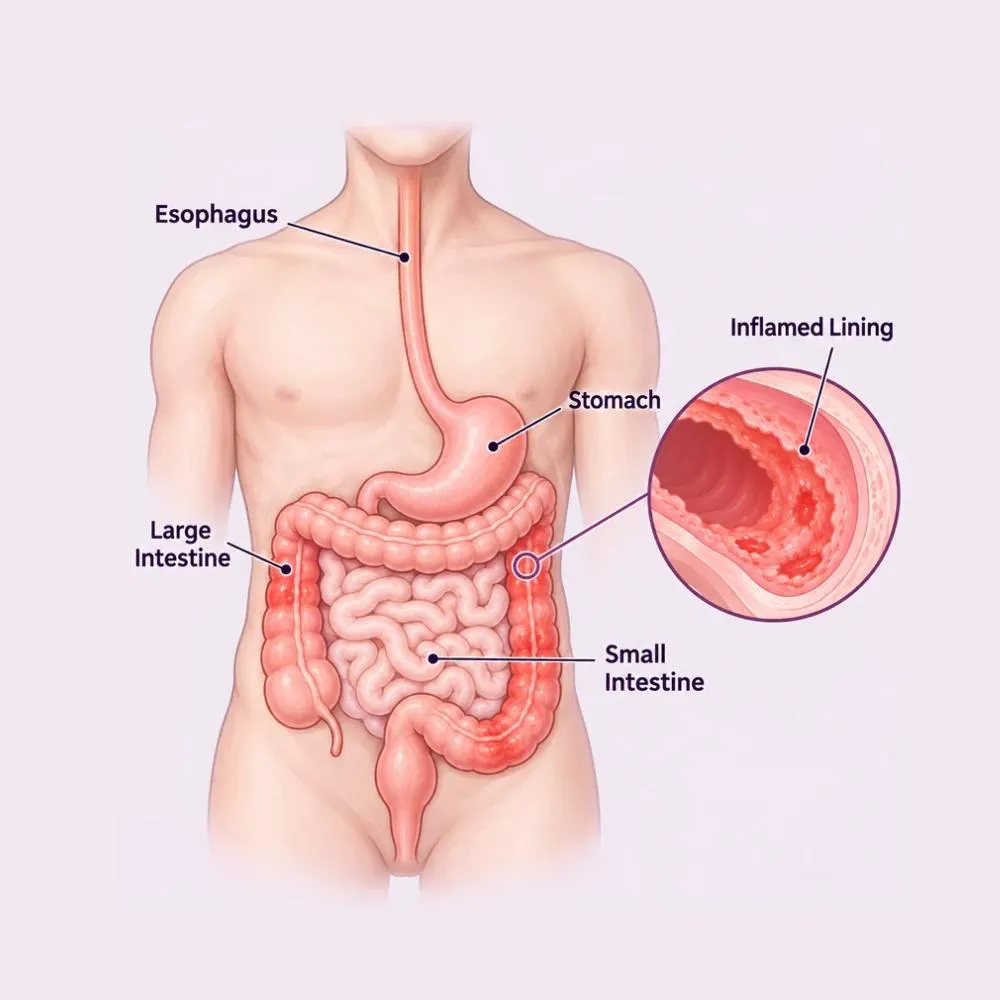
Inflammatory bowel disease is a group of conditions in which the immune system causes chronic inflammation of the digestive tract. The two main forms are Crohn’s disease and ulcerative colitis, and both run a course of flares and remissions over a lifetime.
Crohn’s disease can affect any part of the gut from mouth to anus, occurs in patches with healthy bowel in between, and involves the full thickness of the bowel wall, which is why it causes strictures, fistulas and abscesses. Ulcerative colitis is confined to the colon and rectum, spreads continuously upward from the rectum, and involves only the inner lining.
IBD is fundamentally different from irritable bowel syndrome. IBS is a disorder of gut function with a normal-looking bowel and no lasting damage; IBD is measurable inflammation that ulcerates tissue and, untreated, leads to complications. They are frequently confused, and a faecal calprotectin test separates them reliably.
There is no single cause. IBD develops when a genetically susceptible person meets an environmental trigger and the immune response to the gut’s own bacteria fails to switch off.
The immune system mounts a sustained attack on the gut lining, and inflammation that should resolve instead becomes chronic.
More than two hundred genetic loci are associated with IBD. A family history raises the risk considerably, though most patients have none.
An altered balance of intestinal bacteria appears both to trigger inflammation and to keep it going once established.
An episode of gastroenteritis can precipitate the first attack in someone already predisposed.
Markedly worsens Crohn’s disease and increases the need for surgery. Stopping is one of the most effective interventions available in Crohn’s.
Incidence is rising fastest in urbanising populations, implicating diet and environment, though no single food causes the disease.
Anti-inflammatory painkillers are a recognised trigger for flares and are generally best avoided in IBD.
Stress does not cause IBD, but it reliably triggers and worsens flares in people who already have it.
Nothing you ate or did caused this. What you can influence is the flare rate, and in Crohn’s disease, stopping smoking is the single biggest thing within your control.
Symptoms depend on which part of the gut is inflamed and how severely, but a persistent pattern lasting weeks is the common thread.
Digestive symptoms
Systemic & extra-intestinal
Perianal symptoms (a fistula, an abscess or a deep fissure) alongside diarrhoea and weight loss point strongly to Crohn’s disease, and they change how the whole case is investigated.
Diagnosis rests on endoscopy with biopsy, supported by blood, stool and imaging tests. Distinguishing Crohn’s from ulcerative colitis matters, because the treatment paths diverge.
Full blood count, inflammatory markers, albumin, iron studies, vitamin B12 and liver function: together they gauge activity, severity and nutritional impact.
A stool marker of bowel inflammation that separates IBD from IBS reliably, and remains the most useful non-invasive way to monitor disease afterwards.
To exclude infective colitis, including C. difficile, which mimics a flare and needs entirely different treatment.
The definitive test. It shows the pattern and extent of inflammation, and biopsies confirm the diagnosis and distinguish Crohn’s from colitis.
Used in suspected Crohn’s disease to assess the upper gut and small bowel, which a colonoscopy cannot reach.
Images the small bowel without radiation, showing strictures, fistulas and abscesses. Essential in Crohn’s and repeated over the years.
In perhaps one in ten patients the pattern does not clearly fit either condition at first. That is recognised, it is called IBD-unclassified, and it usually declares itself over time.
Managing chronic IBD requires a long-term approach: a personalised treatment plan, regular monitoring, and adjustment as the disease changes. The aim is remission with a healed bowel lining, not simply the absence of symptoms.
First-line for mild to moderate ulcerative colitis and the backbone of maintenance there. Of limited value in Crohn’s disease.
Prednisolone or budesonide to bring a flare under control quickly. Effective for induction but never for maintenance, because of their long-term effects.
Azathioprine, mercaptopurine or methotrexate to maintain remission and allow steroids to be withdrawn. They take two to three months to take effect.
Anti-TNF agents, vedolizumab and ustekinumab target specific immune pathways and achieve mucosal healing where conventional treatment has not.
Exclusive enteral nutrition can induce remission in Crohn’s disease, particularly in children, without steroids. Correcting iron, B12 and vitamin D deficiency is routine.
Stopping smoking, protecting sleep, managing stress and staying active: supportive measures with genuine effect on flare frequency.
Removal of a diseased segment through keyhole incisions, for Crohn’s strictures or disease that has not responded to medication.
A narrowed segment is widened rather than removed, preserving bowel length: important in Crohn’s, where repeated resections risk short bowel syndrome.
For perianal Crohn’s disease, controlling sepsis and keeping fistula tracts draining while medical therapy takes effect.
For ulcerative colitis, removal of the colon with a pouch fashioned from small bowel: curative for colitis, and avoiding a permanent stoma.
Surgery is needed only where medication and lifestyle changes fail to control the disease, or where complications such as strictures, fistulas or severe bleeding develop. For ulcerative colitis it is curative; for Crohn’s it treats a segment, and medical therapy continues afterwards.
IBD is managed as an ongoing programme rather than a single procedure. This is what continuing care under our team actually looks like.
Structured IBD care programme
Endoscopy, biopsy and imaging to establish which condition you have, how extensive it is, and how severe: the basis of every decision that follows.
Steroids, nutritional therapy or biologics to bring the current flare under control, typically over four to eight weeks.
Moving to a treatment you can stay on long term (5-ASA, an immunomodulator or a biologic) while steroids are tapered off on a planned schedule.
Calprotectin and repeat endoscopy to verify the lining has genuinely healed. Feeling well and being in remission are not always the same thing.
Blood tests before each biologic dose, calprotectin every few months, and nutritional review, so a relapse is caught before symptoms return.
Surveillance colonoscopy from eight years after diagnosis, bone density monitoring, vaccination, and planning around pregnancy or surgery.
The single most useful thing in this programme is continuity: the same team seeing the same patient over years, so a change in pattern is recognised as a change rather than assessed from scratch.
IBD is a long relationship with a team rather than a single episode of care. Here is why patients trust us:
Led by Dr. Samhitha Reddy, one of the top proctologists in Hyderabad, with a multidisciplinary team providing personalised care.
Endoscopy, MRI enterography and calprotectin monitoring, so treatment is guided by measured inflammation rather than symptoms alone.
From the first consultation through to post-treatment follow-up, with one team throughout.
Our hospital is in HITEC CITY, near IKEA: easily reachable from across Hyderabad.
IBD is managed rather than recovered from. The timeline below is how control is typically established and then held.
Diagnosis confirmed and induction treatment started. Symptoms usually begin improving within the first week or two.
The flare comes under control. Steroids taper on a planned schedule and maintenance therapy is established.
Immunomodulators reach full effect. Calprotectin is rechecked to confirm inflammation is genuinely settling.
Endoscopy to confirm mucosal healing: the target that predicts long-term outcome better than symptoms do.
Maintenance continues indefinitely, with regular monitoring, surveillance colonoscopy, and adjustment as life circumstances change.
The commonest avoidable cause of a flare is stopping treatment once things feel settled. It is the treatment keeping you settled.
In Crohn’s disease this is the single most effective thing within your control. It reduces flares, hospital admissions and the need for surgery.
Blood tests and calprotectin detect inflammation returning before you feel it, when it is far easier to treat.
Iron, B12, vitamin D and calcium are commonly low in IBD. They are checked and corrected as part of routine care.
Ibuprofen and diclofenac trigger flares. Use paracetamol instead, and tell any doctor treating you that you have IBD.
Long-standing colonic disease raises bowel cancer risk. Surveillance from eight years after diagnosis is what manages it.
With proper treatment and supervision, people with IBD work, travel, exercise and have families. The disease is serious, and it is also (with modern therapy) genuinely well controlled in most patients.
Any of the following needs same-day medical assessment.
IBD is a long-term condition, so the meaningful figure is an ongoing one. These are the ranges our patients fall into.
| Procedure | Estimated Cost |
|---|---|
| Specialist consultation Per visit | ₹800 – ₹1,500 |
| Colonoscopy with biopsy Day care, including histopathology | ₹15,000 – ₹30,000 |
| MRI enterography For small bowel assessment in Crohn’s | ₹12,000 – ₹22,000 |
| 5-ASA or immunomodulator therapy Per month, including monitoring bloods | ₹1,500 – ₹6,000 |
| Biologic therapy Per dose; frequency varies by agent | ₹25,000 – ₹80,000 |
| Laparoscopic bowel resection Four to seven nights’ stay | ₹2,00,000 – ₹4,00,000 |
Crohn’s needs small bowel imaging repeated over the years; colitis is followed largely by colonoscopy. The monitoring costs differ.
The step from conventional therapy to a biologic is the largest single change in ongoing cost, and is driven by how the disease responds.
Well-controlled disease means routine reviews. Frequent flares mean admissions, imaging and treatment escalation.
A shared ward, a twin-sharing room or a private suite: the largest single swing in most estimates.
We are empanelled with most major insurers, and our team files the pre-authorisation for you.
Every figure above is an indicative range, not a quote. After your consultation you are given a written, fixed-cost estimate, and that is the number you pay, with no additions once treatment begins.
The proctologists and IBD specialists who manage Crohn’s disease and colitis at our HITEC CITY hospital.

Consultant Proctologist & Laparoscopic Surgeon
MBBS, MS, FMAS, FISCP, DMAS
8 years experience

Consultant General & Advanced Laparoscopic Surgeon
MBBS, MS, FMAS
17 years experience
Reviews from patients treated for IBD, colitis and colorectal conditions at Lux Hospitals, Hyderabad.
Written by Dr. Samhitha Reddy on IBD, IBS and digestive health.
Dr. Samhitha Reddy

Dr. Samhitha Reddy

Dr. Samhitha Reddy
Dr. Samhitha Reddy
Dr. Samhitha Reddy
Common questions about inflammatory bowel disease, its treatment, and what long-term care costs at Lux Hospitals.
Still have questions? Call us at 079 6908 4422
Still have questions? Message us on WhatsApp at 079 6908 4444
Accurate diagnosis and long-term IBD care from one team, with costs discussed openly before treatment begins.
Plot No.116, Lumbini Avenue, HITEC CITY, Near IKEA, Hyderabad – 500032













