
Dr. Samhitha Reddy
Consultant Proctologist & Laparoscopic Surgeon
MBBS, MS, FMAS, FISCP, DMAS
- 8 Yrs
- ASCRS Member
Occasional heartburn is normal. Heartburn several times a week, for months, that has you sleeping propped up and reaching for antacids after every meal is reflux disease, and it does gradual damage to the oesophagus while it goes untreated.
Most people manage well on medication. For those who do not, or who would rather not take a tablet indefinitely, our laparoscopic surgeons at Lux Hospitals, HITEC CITY offer keyhole fundoplication: an operation that repairs the valve rather than suppressing the acid.
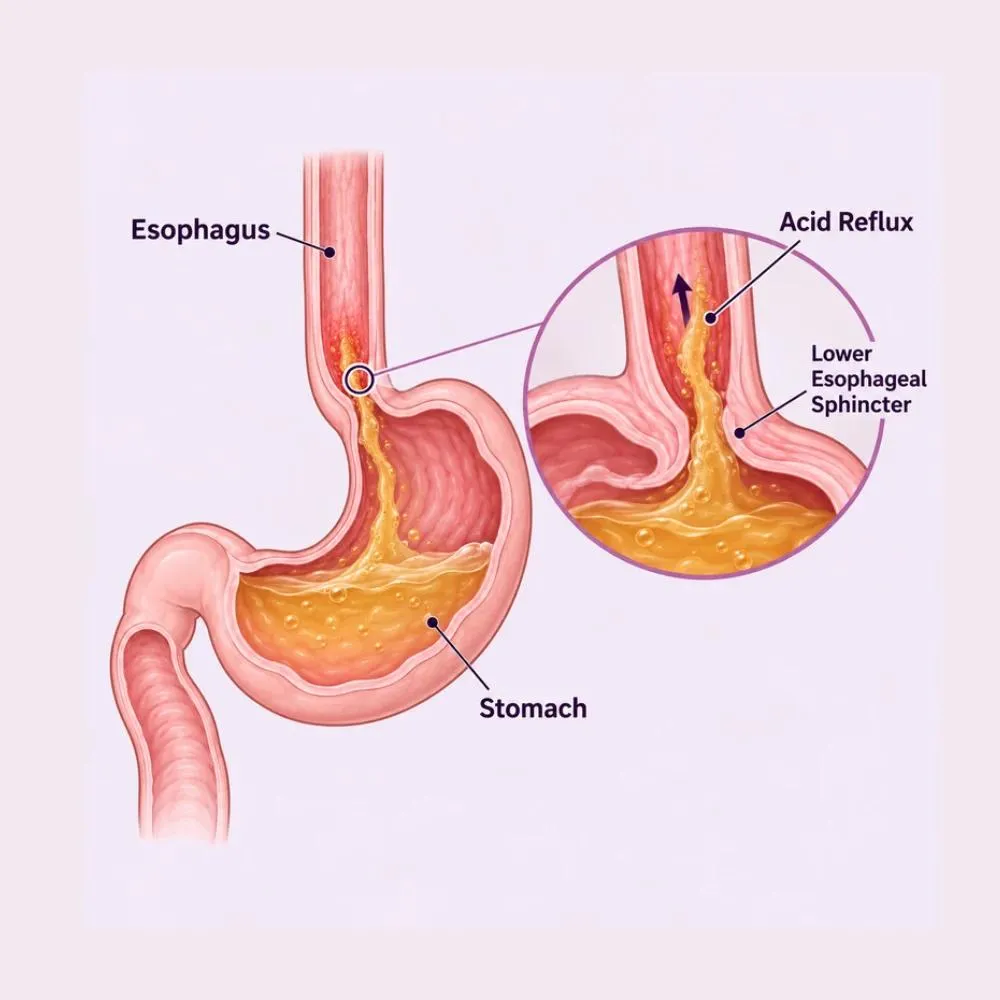
Acid reflux occurs when stomach acid flows backward into the oesophagus, irritating a lining that has no protection against it. When that happens frequently enough to cause symptoms or damage, it is called gastro-oesophageal reflux disease, or GERD.
The mechanism is a valve problem. A ring of muscle at the bottom of the oesophagus (the lower oesophageal sphincter) normally closes after food passes through. When it weakens or relaxes at the wrong moments, acid travels the wrong way. A hiatal hernia, where part of the stomach slides up through the diaphragm, disrupts that valve mechanically and is a very common contributor.
Treating it matters beyond comfort. Years of untreated acid exposure cause oesophagitis, ulceration and scarring that narrows the oesophagus, and in a proportion of patients Barrett’s oesophagus: a change in the lining that carries a small but real risk of progressing to cancer.
Anything that weakens the valve at the bottom of the oesophagus, or raises the pressure pushing against it, causes reflux.
The core mechanism. The valve loses tone or relaxes inappropriately, letting stomach contents travel back up.
Part of the stomach pushes up through the diaphragm, disrupting the valve mechanically. A very common finding in people with significant reflux.
Excess abdominal weight raises pressure on the stomach continuously, and is one of the strongest and most modifiable risk factors.
Spicy, acidic and fatty foods, chocolate, mint, caffeine and carbonated drinks all relax the sphincter or increase acid production.
Both directly reduce sphincter tone and impair the oesophagus’s ability to clear acid once it arrives.
Eating within three hours of lying down means a full stomach and a horizontal oesophagus at the same time.
Hormonal changes relax the sphincter while the growing uterus raises abdominal pressure: reflux in pregnancy is very common and usually temporary.
Gastroparesis, often related to diabetes, leaves the stomach full for longer and gives acid more opportunity to reflux.
Weight, meal timing, smoking and trigger foods account for a great deal of reflux, and addressing them genuinely works. They are the first line of treatment, not preliminary advice before the real one.
Heartburn and regurgitation are the classic pair. A significant number of people, though, present entirely with throat and chest symptoms and never describe heartburn at all.
Typical symptoms
Atypical & alarm symptoms
Difficulty swallowing, weight loss or bleeding are alarm features. They are not typical reflux and warrant an endoscopy promptly rather than a stronger antacid.
Typical symptoms responding to a trial of acid suppression is often diagnosis enough. Investigation is for alarm features, treatment failure, and for anyone being considered for surgery.
The pattern, triggers and timing of symptoms, plus a review of alarm features. Often sufficient to start treatment.
Direct view of the oesophagus and stomach, identifying oesophagitis, ulcers, a stricture, a hiatal hernia or Barrett’s oesophagus, with biopsies as needed.
Measures how much acid actually reaches the oesophagus over a full day. It is the definitive test, and it is mandatory before any anti-reflux surgery.
Measures the strength and coordination of oesophageal contractions. Essential before surgery, since poor motility changes which operation is safe.
X-ray imaging that outlines a hiatal hernia, a stricture or a motility problem, and shows the anatomy before an operation.
A breath or stool test, since this infection contributes to ulcer disease and needs eradicating where present.
No one is offered anti-reflux surgery without pH monitoring and manometry. Operating on symptoms alone is how patients end up with a valve repaired for reflux they did not actually have.
Treatment is layered. Lifestyle change and medication control the great majority of patients, and surgery is for those who do not respond, cannot tolerate long-term medication, or would rather not take it for decades.
Avoiding spicy, acidic and fatty foods, chocolate, mint, caffeine, alcohol and fizzy drinks: identified individually, since triggers vary considerably.
One of the most effective single interventions available. Even a modest reduction in abdominal weight meaningfully reduces reflux.
Smaller meals, nothing within three hours of lying down, and raising the head of the bed by fifteen to twenty centimetres.
The mainstay of medical treatment. They suppress acid production strongly and heal oesophagitis in most patients within eight weeks.
For milder or intermittent symptoms, and for rapid relief. Antacids neutralise acid immediately but do not prevent it.
Where delayed stomach emptying contributes, these speed gastric emptying and reduce the volume available to reflux.
The standard anti-reflux operation. The top of the stomach is wrapped fully around the lower oesophagus to recreate the valve, and any hiatal hernia is repaired at the same time.
A partial rather than complete wrap, chosen where manometry shows weak oesophageal motility. It controls reflux with less risk of difficulty swallowing.
The diaphragmatic opening is narrowed and the stomach returned below it: an essential part of any durable anti-reflux repair.
The same operation with robotic instrumentation, giving greater precision high in the chest where access is confined.
Incisionless procedures performed through an endoscope to tighten the valve, for selected patients who want an alternative to surgery.
Fundoplication is highly effective: around nine in ten patients are off acid-suppressing medication afterwards. It is a real operation with real trade-offs, though, which is why the testing beforehand is thorough.
A keyhole operation taking around ninety minutes to two hours. Five small incisions, a one to two night stay, and a repaired valve rather than a suppressed one.
Laparoscopic Nissen fundoplication
Endoscopy, 24-hour pH monitoring and manometry are all completed first. Manometry decides between a full and a partial wrap.
General anaesthetic. The abdomen is inflated with carbon dioxide and five small ports are placed across the upper abdomen.
The lower oesophagus is freed from the diaphragm so that an adequate length of it sits below the diaphragm without tension.
The widened opening in the diaphragm is narrowed with sutures behind the oesophagus, correcting the hiatal hernia that usually accompanies reflux.
The upper part of the stomach is passed behind the oesophagus and stitched to itself in front, forming a collar that acts as a one-way valve.
A sizing tube is passed to ensure the wrap is loose enough to swallow through and tight enough to stop reflux. This judgement determines the outcome more than any other step.
Overnight observation on fluids, a soft diet the next morning, and home after one to two nights with detailed dietary instructions.
Difficulty swallowing in the early weeks is expected and is why the diet is graded from liquids to soft food to normal over about six weeks. In the great majority it settles completely.
Reflux surgery succeeds or fails on patient selection and on how the wrap is calibrated. Here is why patients trust us:
Endoscopy, 24-hour pH monitoring and manometry in-house, so surgery is offered on evidence rather than on symptoms alone.
Consultants experienced in laparoscopic and robotic anti-reflux surgery, including complex hiatal hernia repair.
From the first consultation through to post-treatment follow-up, with one team throughout.
Our hospital is in HITEC CITY, near IKEA: easily reachable from across Hyderabad.
Recovery from keyhole fundoplication is quick physically, but the diet is deliberately graded over six weeks while the wrap settles and swelling resolves.
Overnight in the ward on clear fluids. Some shoulder-tip discomfort from the gas, which settles within a day or two.
Home on a full liquid diet. Swallowing feels tight and food sticks easily: this is expected as the wrap is swollen.
Soft, pureed diet. Small mouthfuls, chewed thoroughly. Desk work resumes from about week two, driving from around day ten.
Gradual return to normal textures. Swallowing eases noticeably. Avoid fizzy drinks, which are uncomfortable while you cannot belch normally.
Normal diet and full activity including the gym. Most patients are entirely off acid-suppressing medication by this point.
Liquids, then soft, then normal over six weeks. Rushing this is the commonest reason food impacts and a scope is needed.
Eat slowly and sit upright. Bread, tough meat and rice are the usual early offenders: reintroduce them last.
The wrap makes belching difficult at first, so carbonated drinks cause uncomfortable bloating for the first few weeks.
Nothing above five kilos, so the diaphragmatic repair is not put under strain while it heals.
Being completely unable to swallow even liquids, fever, severe chest or abdominal pain, or persistent vomiting.
Reviews at two and six weeks confirm swallowing is settling and that the wrap is working as it should.
Around nine in ten patients are free of reflux symptoms and off medication after fundoplication. The trade-offs (some early difficulty swallowing, and reduced ability to belch or vomit) are real, and are discussed thoroughly before you commit.
Book a consultation if any of the following apply.
Most patients are managed medically, at a modest ongoing cost. Surgery is a one-off expense that removes the need for lifelong medication.
| Procedure | Estimated Cost |
|---|---|
| Specialist consultation Per visit | ₹800 – ₹1,500 |
| Upper GI endoscopy Day care, under sedation | ₹8,000 – ₹18,000 |
| 24-hour pH monitoring Mandatory before surgery | ₹12,000 – ₹22,000 |
| Oesophageal manometry Out-patient | ₹8,000 – ₹15,000 |
| Medical management Per month, depending on the regimen | ₹500 – ₹2,500 |
| Laparoscopic fundoplication Two nights’ stay, hernia repair included | ₹1,50,000 – ₹2,60,000 |
| Robotic-assisted fundoplication Two to three nights’ stay | ₹2,20,000 – ₹3,50,000 |
Most patients are controlled on medication. Surgery is a larger one-off cost that ends the ongoing one.
Straightforward reflux may need only an endoscopy. Anyone considered for surgery needs pH monitoring and manometry as well.
A large or para-oesophageal hernia makes the repair considerably longer, and may require mesh reinforcement.
A shared ward, a twin-sharing room or a private suite: the largest single swing in most estimates.
We are empanelled with most major insurers, and our team files the pre-authorisation for you.
Every figure above is an indicative range, not a quote. After your consultation you are given a written, fixed-cost estimate, and that is the number you pay, with no additions once treatment begins.
The general and laparoscopic surgeons who treat acid reflux and GERD at our HITEC CITY hospital.

Consultant General & Advanced Laparoscopic Surgeon
MBBS, MS, FMAS
17 years experience

Senior Consultant: Bariatric & Gastrointestinal Surgery
MBBS, MS, FRCS (UK), DLS (France)
28 years experience

Consultant Proctologist & Laparoscopic Surgeon
MBBS, MS, FMAS, FISCP, DMAS
8 years experience
Reviews from patients treated for reflux, hernia and general surgery at Lux Hospitals, Hyderabad.
Written by Dr. Abhishek Katha on digestive health and general surgical care.

Dr. Abhishek Katha
Dr. Abhishek Katha

Dr. Abhishek Katha

Dr. Abhishek Katha

Dr. Abhishek Katha

Dr. Abhishek Katha
Common questions about acid reflux, GERD surgery, and what treatment costs at Lux Hospitals.
Still have questions? Call us at 079 6908 4422
Still have questions? Message us on WhatsApp at 079 6908 4444
Proper diagnosis and lasting treatment for GERD, from medication through to keyhole fundoplication, with costs shared upfront.
Plot No.116, Lumbini Avenue, HITEC CITY, Near IKEA, Hyderabad – 500032