



Dr. Samhitha Reddy
Consultant Proctologist & Laparoscopic Surgeon
MBBS, MS, FMAS, FISCP, DMAS
- 8 Yrs
- ASCRS Member
Chronic pancreatitis is permanent inflammation and scarring of the pancreas. Unlike an acute attack it does not resolve: the damage accumulates, and with it comes persistent pain, poor digestion and eventually diabetes.
Treatment aims at three things: controlling the pain, replacing what the pancreas can no longer produce, and relieving any obstruction. Our gastrointestinal team at Lux Hospitals, HITEC CITY combines medical, endoscopic and surgical approaches, because most patients need more than one.
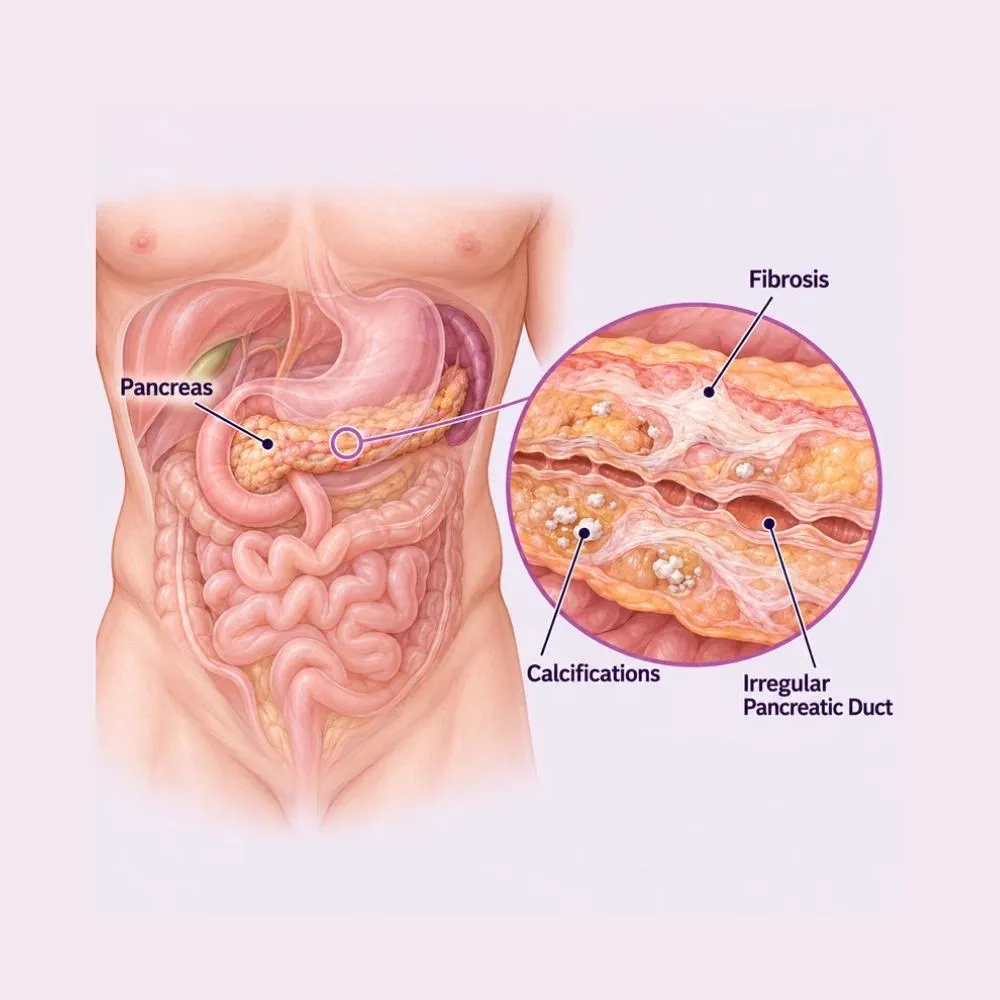
Chronic pancreatitis is long-standing inflammation that progressively destroys pancreatic tissue and replaces it with scar. The changes are irreversible: once functioning tissue is lost, it does not regenerate.
The pancreas has two jobs, and both eventually fail. Its exocrine function produces the enzymes that digest food, as this declines, fat is not absorbed, producing pale, greasy, foul-smelling stools that float, along with weight loss and vitamin deficiency. Its endocrine function produces insulin, and as the insulin-producing cells are destroyed, diabetes develops.
Pain is the dominant symptom and the hardest to treat. It comes from several sources at once: raised pressure in an obstructed duct, inflammation itself, and changes in the nerves supplying the gland that persist even when the inflammation settles. That last mechanism is why pain sometimes continues after successful drainage, and why it needs addressing in its own right.
Alcohol is the commonest cause worldwide, but a substantial proportion of cases in India are idiopathic or genetic, and that distinction matters.
The commonest identifiable cause. Sustained heavy intake over years progressively damages pancreatic tissue.
An independent risk factor that accelerates progression, and one of the most important things to stop regardless of the original cause.
Repeated attacks, particularly from gallstones or raised triglycerides, cause cumulative damage that becomes permanent.
PRSS1, SPINK1 and CFTR mutations cause hereditary pancreatitis, often presenting in childhood or early adulthood.
A distinct form seen in southern India, presenting in young non-alcoholic patients with duct stones, diabetes and malnutrition.
An immune-mediated form that responds dramatically to steroids, which makes identifying it particularly worthwhile.
A stricture, stone or tumour blocking the pancreatic duct causes back-pressure and progressive damage upstream.
Persistently raised lipid levels cause repeated inflammation that progresses to chronic damage.
Autoimmune pancreatitis is worth actively looking for, because it is the one form that responds to medication rather than requiring drainage or surgery.
The combination of persistent upper abdominal pain, greasy stools and unexplained weight loss is characteristic and should point directly to this diagnosis.
Pain and digestive symptoms
Signs of advanced disease
Greasy stools that float and are difficult to flush are the classic sign of enzyme insufficiency. It is easily overlooked, embarrassing to mention, and one of the most treatable parts of this condition.
Diagnosis rests on imaging showing structural change, together with tests of pancreatic function. Enzyme levels are often normal, which misleads.
Shows calcification, duct dilatation and gland atrophy: the structural hallmarks of established chronic pancreatitis.
Maps the pancreatic duct in detail, showing strictures, stones and the beaded appearance characteristic of the disease.
The most sensitive test for early disease, detecting changes before CT can show them, and allowing biopsy where a tumour is suspected.
A stool test measuring exocrine function. A low level confirms enzyme insufficiency and indicates that replacement therapy is needed.
HbA1c for diabetes, fat-soluble vitamin levels, and IgG4 to identify autoimmune pancreatitis, which is entirely treatable with steroids.
Weight, muscle mass and vitamin status. Most patients are malnourished, often more so than they appear.
Distinguishing chronic pancreatitis from pancreatic cancer can be genuinely difficult, since both cause a mass, pain and weight loss. Endoscopic ultrasound with biopsy is usually what settles it.
Treatment is layered and usually combines several approaches. The damage cannot be reversed, but pain, digestion and diabetes can all be managed well.
Enzyme capsules taken with every meal and snack. They correct fat malabsorption, stop the greasy stools and allow weight to be regained.
A structured approach from simple analgesia through to neuropathic agents such as pregabalin, with pain-specialist input where needed.
Non-negotiable. Both accelerate progression, and stopping is the single most effective intervention available.
Pancreatogenic diabetes is unstable and prone to hypoglycaemia, since glucagon production is also lost. It needs careful, specialist handling.
Small frequent meals, adequate protein, and replacement of fat-soluble vitamins A, D, E and K, which are commonly deficient.
Where autoimmune pancreatitis is confirmed, corticosteroids produce a dramatic response and can reverse much of the change.
ERCP with stone removal, stricture dilatation and stenting to relieve raised pressure in an obstructed pancreatic duct.
Shock waves fragment large pancreatic duct stones so they can be cleared endoscopically.
The Puestow procedure: the dilated duct is opened along its length and joined to a loop of bowel, draining it directly. Effective pain relief where the duct is dilated.
Combined drainage with removal of the diseased pancreatic head, for the inflammatory mass that often drives the pain.
Removal of the pancreatic head, for a mass where cancer cannot be excluded or where head-predominant disease has not responded.
Injection to interrupt the nerves carrying pain from the pancreas, offering temporary relief where other measures have failed.
Where the pancreatic duct is dilated, surgical drainage relieves pain in a large majority of patients and does so more durably than repeated endoscopic stenting. Operating earlier rather than after years of escalating painkillers gives better results.
A three to four hour operation that opens the blocked pancreatic duct along its length and drains it into the intestine, with a seven to ten night stay.
Lateral pancreaticojejunostomy (Puestow)
MRCP or CT confirming a dilated duct, nutritional optimisation, diabetes assessment, and confirmation that alcohol has been stopped.
General anaesthetic with an epidural for pain relief. An upper abdominal incision gives access to the pancreas.
The stomach is lifted to expose the front of the pancreas, and intraoperative ultrasound is used to locate the dilated duct precisely.
The duct is opened along its length, usually eight centimetres or more, and any stones within it are cleared completely.
In a Frey procedure the diseased core of the pancreatic head is cored out, since the inflammatory mass there is often what drives the pain.
A loop of jejunum is opened and sewn along the length of the opened duct, so pancreatic juice drains freely into the bowel.
Enhanced recovery with early feeding and mobilisation. Home after seven to ten nights, with enzyme replacement continuing.
Drainage relieves pain in around eighty per cent of appropriately selected patients. It does not restore lost function, though: enzyme replacement and diabetes treatment continue afterwards.
Chronic pancreatitis needs medical, endoscopic and surgical options under one roof, because most patients need more than one. Here is why patients trust us:
Led by Dr. Tagore Mohan Grandhi, with extensive experience in pancreatic drainage and resection procedures.
Pain, enzyme replacement, diabetes and nutrition addressed together, rather than pain alone with escalating painkillers.
From the first consultation through to post-treatment follow-up, with one team throughout.
Our hospital is in HITEC CITY, near IKEA: easily reachable from across Hyderabad.
This is a condition that is managed rather than cured. The aim is good pain control, restored nutrition, and slowing further damage.
Enzyme replacement started and dose adjusted. Greasy stools usually resolve within days, and appetite begins to improve.
Weight starts to be regained. Pain management is optimised, and alcohol and smoking cessation supported properly.
Where pain remains uncontrolled and the duct is dilated, endoscopic or surgical drainage is considered rather than escalating painkillers indefinitely.
Seven to ten nights in hospital, then six to eight weeks of recovery. Pain relief is usually apparent early, and enzyme therapy continues.
Lifelong enzyme replacement, diabetes monitoring, vitamin checks and surveillance: chronic pancreatitis carries a raised risk of pancreatic cancer.
Both accelerate progression regardless of the original cause. This is the single most effective thing within your control.
With every meal and snack, not before or after. Taken incorrectly they do not work, and this is a common and easily corrected mistake.
Five to six small meals daily with adequate protein. Extreme fat restriction is no longer advised: take enough enzymes instead.
Fat-soluble vitamins A, D, E and K are commonly deficient. Check annually and replace, particularly vitamin D for bone health.
Regular HbA1c testing. Pancreatogenic diabetes is prone to hypoglycaemia and needs careful, specialist management.
Chronic pancreatitis carries an increased long-term risk of pancreatic cancer, which makes regular review genuinely important.
Pain that persists after successful drainage usually reflects nerve changes rather than treatment failure. It responds to neuropathic agents and pain-specialist input rather than to more opioids.
Book a consultation if any of the following apply.
This is a long-term condition, so the meaningful figure combines ongoing medication with any procedures needed.
| Procedure | Estimated Cost |
|---|---|
| Consultation & assessment Per visit | ₹1,000 – ₹2,000 |
| Diagnostic workup CT, MRCP, faecal elastase and bloods | ₹25,000 – ₹55,000 |
| Endoscopic ultrasound With biopsy where indicated | ₹18,000 – ₹35,000 |
| Enzyme replacement therapy Per month, taken lifelong | ₹2,500 – ₹7,000 |
| ERCP with stone removal or stenting Often needs repeating | ₹60,000 – ₹1,40,000 |
| Lateral pancreaticojejunostomy Seven to ten nights’ stay | ₹3,00,000 – ₹5,50,000 |
| Frey or Whipple procedure Ten to fourteen nights’ stay | ₹4,50,000 – ₹8,00,000 |
Enzyme replacement and pain control are an ongoing monthly cost. Drainage surgery is a large one-off expense that can end years of escalating treatment.
Stenting frequently needs repeating every few months, and those costs accumulate, often exceeding a single definitive operation.
Insulin, monitoring and vitamin replacement are continuing costs once endocrine function is lost.
A shared ward, a twin-sharing room or a private suite: the largest single swing in most estimates.
We are empanelled with most major insurers, and our team files the pre-authorisation for you.
Every figure above is an indicative range, not a quote. After your consultation you are given a written, fixed-cost estimate, and that is the number you pay, with no additions once treatment begins.
The gastrointestinal and pancreatic surgeon who treats chronic pancreatitis at our HITEC CITY hospital.

Senior Consultant: Bariatric & Gastrointestinal Surgery
MBBS, MS, FRCS (UK), DLS (France)
28 years experience
Reviews from patients treated for pancreatic and gastrointestinal conditions at Lux Hospitals, Hyderabad.
Written by Dr. Tagore Mohan Grandhi on pancreatic and digestive health.

Dr. Tagore Mohan Grandhi
Dr. Tagore Mohan Grandhi
Dr. Tagore Mohan Grandhi
Dr. Tagore Mohan Grandhi
Dr. Tagore Mohan Grandhi
Dr. Tagore Mohan Grandhi
Common questions about chronic pancreatitis, its treatment, and what care costs at Lux Hospitals.
Still have questions? Call us at 079 6908 4422
Still have questions? Message us on WhatsApp at 079 6908 4444
Complete assessment of pain, digestion and pancreatic function, with medical, endoscopic and surgical options under one roof.
Plot No.116, Lumbini Avenue, HITEC CITY, Near IKEA, Hyderabad – 500032













