Dr. Samhitha Reddy
Consultant Proctologist & Laparoscopic Surgeon
MBBS, MS, FMAS, FISCP, DMAS
- 8 Yrs
- ASCRS Member
A fracture is a break in the continuity of a bone, and the treatment is more varied than most people expect: many need nothing but a cast and time, while others need plates, screws or a rod to heal in the right position.
The decision turns on whether the bone is displaced, whether the joint surface is involved and whether the fracture is stable. Our orthopaedic surgeons at Lux Hospitals, HITEC CITY treat fractures around the clock, from simple wrist breaks to complex hip and pelvic injuries.
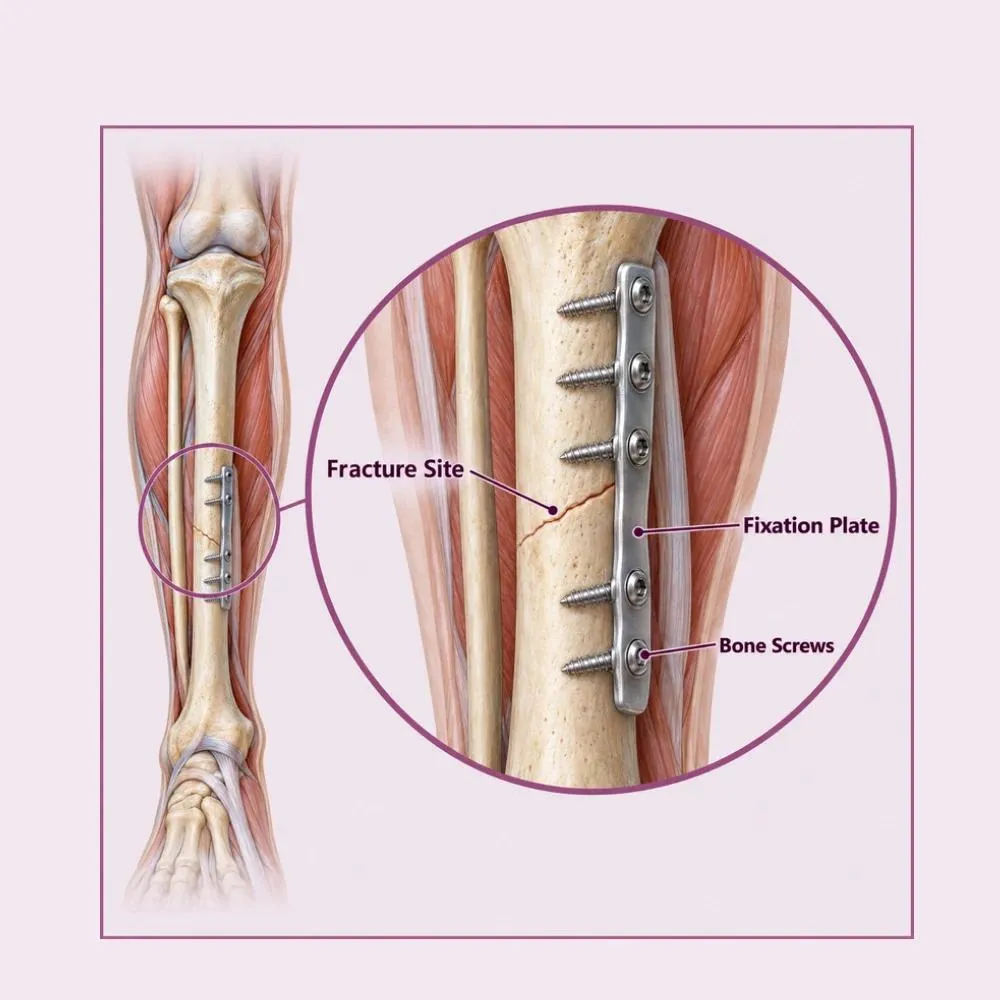
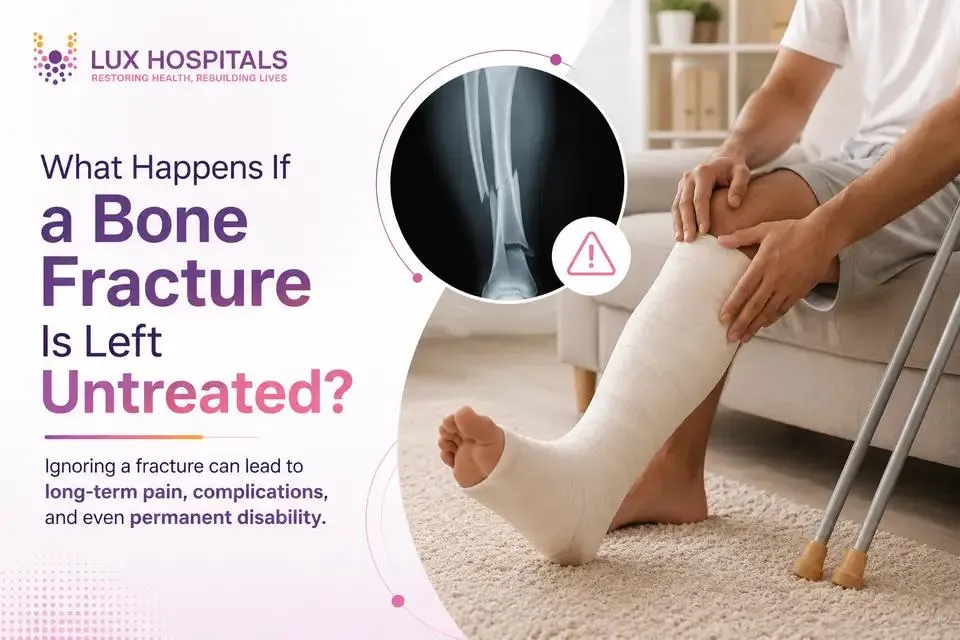
A fracture is a break in a bone, ranging from a hairline crack to a complete break in several pieces. What determines treatment is not how painful it is but three things: whether the fragments are displaced, whether the break enters a joint surface, and whether it is stable enough to hold position while it heals.
Fractures are described by pattern and by whether the skin is broken. A closed fracture leaves the skin intact; an open or compound fracture has a wound communicating with the bone, which makes it an emergency because of infection risk. Comminuted fractures are in multiple pieces, and a stress fracture is a hairline crack from repetitive loading rather than a single injury.
We treat fractures throughout the skeleton: wrist and scaphoid, forearm, elbow, humerus, clavicle, hip and femur, knee, ankle and foot. Each has its own healing time and its own threshold for surgery, which is why an ankle fracture and a wrist fracture of similar severity are managed quite differently.
Fractures result either from force exceeding what normal bone can take, or from normal force acting on weakened bone.
The commonest cause across all ages. A fall on an outstretched hand fractures the wrist; a fall onto the side fractures the hip in older people.
High-energy trauma causing complex, often multiple fractures with significant soft tissue damage.
Direct impact, twisting forces or awkward landings: common causes of ankle, wrist and collarbone fractures.
Thinned bone fractures under force that healthy bone would tolerate. Wrist, spine and hip are the classic fragility fracture sites.
Stress fractures from cumulative loading without adequate recovery, seen in runners, dancers and military recruits.
Widespread in India and a significant contributor to fragility fractures and to poor healing afterwards.
A tumour, cyst or infection weakening the bone so it fractures with minimal or no trauma.
Reduces bone density substantially and raises fracture risk, particularly in the spine and hip.
A fragility fracture, one from a fall from standing height in someone over fifty, is a marker for osteoporosis. Treating the fracture without investigating the bone underneath misses the chance to prevent the next one.
Most fractures are obvious after a clear injury. Some, particularly stress fractures and hip fractures in the elderly, are considerably less so.
Typical signs
Emergency features
Severe, escalating pain with a tense swollen limb and pain on passive stretching can indicate compartment syndrome: a genuine emergency where pressure within the muscle compartment cuts off circulation. It needs surgery within hours.
X-rays confirm most fractures. Some need cross-sectional imaging, and a few do not show on the first film at all.
The first-line investigation, taken in at least two planes. A single view can miss a fracture entirely, which is why two are standard.
Assessing deformity, swelling and point tenderness, along with the circulation and nerve function beyond the injury.
Defines complex fractures and those involving a joint surface in three dimensions, which is essential for planning fixation.
Detects stress fractures and scaphoid fractures that do not show on initial X-rays, and assesses associated ligament damage.
A DEXA scan in anyone over fifty with a fragility fracture, to diagnose osteoporosis and prevent the next fracture.
Vitamin D, calcium, and pre-operative bloods where surgery is planned. Vitamin D deficiency is very common and impairs healing.
A scaphoid fracture in the wrist commonly does not show on the first X-ray. Where the clinical signs are there, the wrist is treated as fractured and re-imaged rather than declared normal.
The aim is to hold the bone in acceptable alignment until it heals. Whether that needs a cast or an operation depends on the fracture, not on preference.
Immobilising an undisplaced or stable fracture in plaster or fibreglass while it heals. Effective for the majority of simple fractures.
Realigning a displaced fracture without opening the skin, under sedation or anaesthesia, then holding it in a cast.
A removable brace allowing controlled movement while supporting the fracture, used for selected humerus and tibial fractures.
Crutches or a walking boot allowing controlled loading, which actually stimulates healing in stable lower limb fractures.
The treatment for most stress fractures, alongside correcting training errors and any nutritional deficiency.
A metal plate contoured to the bone and secured with screws, holding fragments in exact position. Standard for fractures involving joint surfaces.
A rod passed down the centre of a long bone, sharing load with the bone and allowing early weight-bearing. Ideal for femur and tibia shaft fractures.
Screws placed through tiny incisions under X-ray guidance, minimising soft tissue disruption in suitable fractures.
A frame outside the limb holding the bone through pins. Used in open fractures and where swelling makes immediate internal fixation unsafe.
Screws, a dynamic hip screw, or hemiarthroplasty depending on the fracture pattern. Almost always operated on within forty-eight hours.
Adding bone graft where there is a defect or where a fracture has failed to unite.
Hip fractures in older people are operated on urgently, usually within forty-eight hours, because early surgery and mobilisation substantially reduce complications and improve survival. Waiting is not a neutral option there.
The operation varies with the bone and the pattern, but the principles are the same: restore alignment, hold it securely, and allow early movement.
Open reduction and internal fixation
X-rays, assessment of circulation and nerve function, pain relief, and a temporary splint. Open fractures get antibiotics immediately.
Some fractures are fixed immediately; others wait for swelling to settle, since operating through swollen skin risks wound breakdown.
General or regional anaesthesia depending on the site, often with a nerve block for post-operative pain relief.
The fragments are realigned, either through an incision or manipulated under X-ray guidance. Accurate reduction matters most where a joint surface is involved.
Plates, screws, a nail or wires are applied to hold the reduction. The choice depends on the bone, the pattern and the quality of the bone.
X-ray images taken during the operation confirm alignment and implant position before closing.
Wound closed, and movement of the adjacent joints started as soon as the fixation allows, often the same day.
The purpose of fixing a fracture is not simply to hold the bone: it is to hold it securely enough that the neighbouring joints can move early. Stiffness from prolonged immobilisation is often a bigger problem than the fracture itself.
Fractures need prompt assessment, accurate imaging and a decision about surgery made on the fracture rather than by default. Here is why patients trust us:
Fractures assessed and treated around the clock, with urgent surgery for hip fractures and open injuries.
Orthopaedic surgeons treating fractures throughout the skeleton, from simple wrist breaks to complex pelvic injuries.
From the first consultation through to post-treatment follow-up, with one team throughout.
Our hospital is in HITEC CITY, near IKEA: easily reachable from across Hyderabad.
Most fractures unite in six to twelve weeks, though the bone continues remodelling for far longer. Regaining function takes longer than the bone takes to heal.
Pain and swelling settle. Elevation and ice for limb fractures. Movement of adjacent joints begins where the fixation allows.
Early callus forms. Protected weight-bearing or movement progresses according to the fracture. Cast changes if needed.
Most fractures unite over this period. Cast removed, and physiotherapy begins in earnest to restore movement and strength.
Strength and function return progressively. Return to work depends on the job: desk work far earlier than manual.
Full remodelling of the bone. Return to sport, and consideration of removing implants if they cause irritation.
Stiffness from immobilisation is often more disabling than the fracture. Move every joint you are allowed to, from the start.
Keep the limb above heart level in the first weeks. Swelling delays healing and causes cast tightness.
Adequate protein, calcium and vitamin D. Deficiency is common in India and measurably slows fracture healing.
Smoking substantially delays fracture healing and increases the risk of non-union. Stopping while the fracture heals genuinely matters.
Increasing pain, numbness, a cold or pale limb, a tight cast, or fever and wound discharge all need same-day assessment.
A fracture from a simple fall after fifty warrants a bone density scan. Treating osteoporosis prevents the next fracture.
A fragility fracture is a warning, not just an injury. Around half of patients who fracture a hip have already had a wrist or spine fracture: investigating bone health after the first one is what prevents the second.
Come to the emergency department immediately for any of the following.
Simple fractures cost very little. Surgical fixation costs depend on the implant and the complexity of the injury.
| Procedure | Estimated Cost |
|---|---|
| Consultation & X-rays Assessment and imaging | ₹1,500 – ₹4,000 |
| Casting or splinting Including subsequent cast changes | ₹3,000 – ₹10,000 |
| Closed reduction under sedation Day care, with cast application | ₹15,000 – ₹35,000 |
| Wrist or ankle fracture fixation One to two nights; plate and screws | ₹80,000 – ₹1,60,000 |
| Intramedullary nailing: femur or tibia Three to five nights’ stay | ₹1,50,000 – ₹2,80,000 |
| Hip fracture fixation or hemiarthroplasty Four to seven nights’ stay | ₹1,60,000 – ₹3,20,000 |
| Complex or open fracture surgery Often staged, with longer admission | ₹2,50,000 – ₹5,50,000 |
A wrist fracture and a complex pelvic fracture are entirely different operations in time, implants and stay.
Plates, screws, nails and locking implants vary considerably in cost, and complex fractures need more of them.
Open fractures need urgent debridement, often staged surgery, and a longer admission with intravenous antibiotics.
A shared ward, a twin-sharing room or a private suite: the largest single swing in most estimates.
We are empanelled with most major insurers, and our team files the pre-authorisation for you.
Every figure above is an indicative range, not a quote. After your consultation you are given a written, fixed-cost estimate, and that is the number you pay, with no additions once treatment begins.
The orthopaedic and trauma surgeons who treat fractures at our HITEC CITY hospital.

Consultant Orthopaedic Surgeon: Joint Replacement & Arthroscopy
MS (Ortho), FIJR, FIASM (UK), FIKS (Italy), FIRJR
8 years experience

Consultant Orthopaedic Surgeon
MBBS, MS, FIJR
6 years experience
Reviews from patients treated for fractures and orthopaedic injuries at Lux Hospitals, Hyderabad.
Written by Dr. Sai Kishan Sirasala on fractures, bone health and orthopaedic care.

Dr. Sai Kishan Sirasala
Dr. Sai Kishan Sirasala

Dr. Sai Kishan Sirasala
Dr. Sai Kishan Sirasala
Dr. Sai Kishan Sirasala
Dr. Sai Kishan Sirasala
Common questions about bone fractures, their treatment, and what surgery costs at Lux Hospitals.
Still have questions? Call us at 079 6908 4422
Still have questions? Message us on WhatsApp at 079 6908 4444
24/7 emergency assessment with accurate imaging and treatment matched to the fracture, from casting to surgical fixation.
Plot No.116, Lumbini Avenue, HITEC CITY, Near IKEA, Hyderabad – 500032