



Dr. Samhitha Reddy
Consultant Proctologist & Laparoscopic Surgeon
MBBS, MS, FMAS, FISCP, DMAS
- 8 Yrs
- ASCRS Member
Polycystic kidney disease is an inherited condition in which fluid-filled cysts form and multiply within the kidneys, gradually replacing the working tissue and enlarging the organ enormously.
It is the commonest genetic cause of kidney failure, and it runs in families: each child of an affected parent has a one in two chance of inheriting it. Our kidney specialists at Lux Hospitals, HITEC CITY confirm the diagnosis, manage the complications and work to slow the decline.
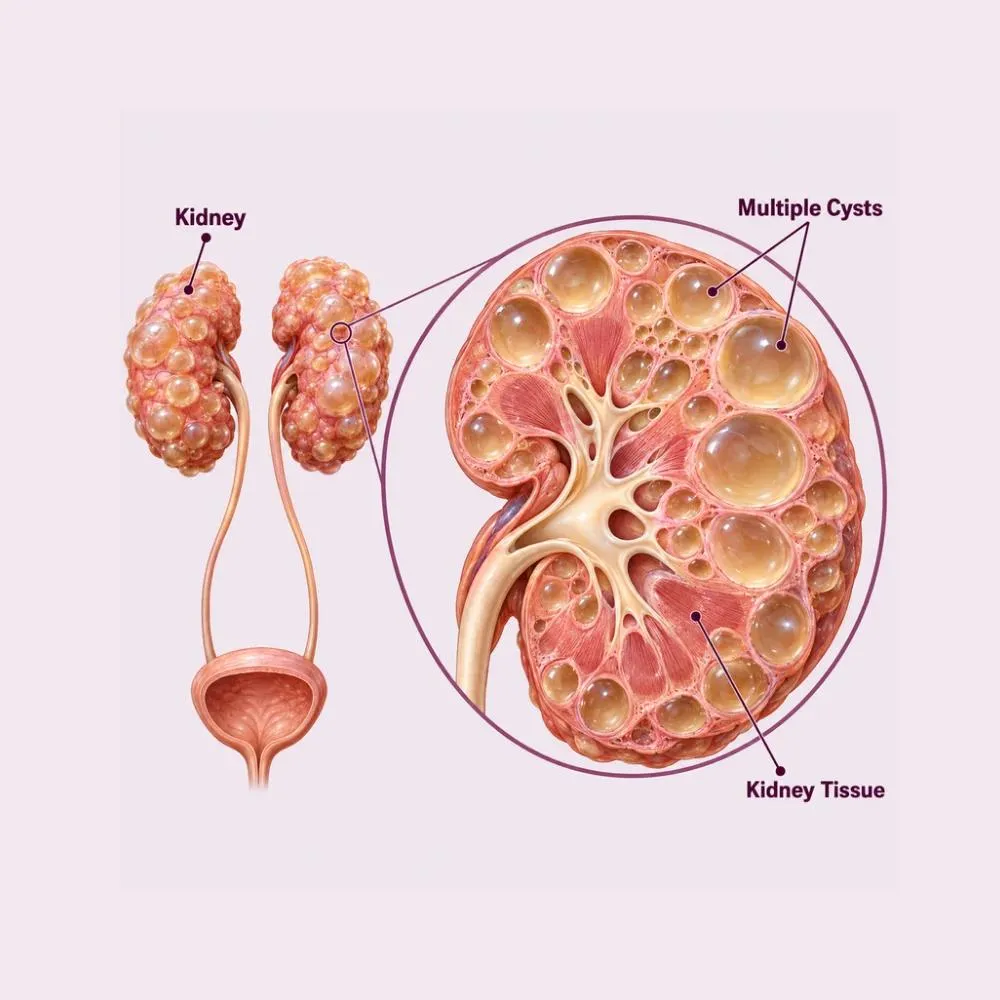
Polycystic kidney disease is a genetic disorder in which numerous fluid-filled cysts develop throughout both kidneys. The cysts arise from the kidney tubules, grow slowly over decades, and progressively compress and replace functioning tissue. A polycystic kidney can reach several times normal size and weigh a few kilograms.
There are two forms. Autosomal dominant PKD, caused by mutations in the PKD1 or PKD2 genes, accounts for the great majority. It is inherited from one affected parent, each child has a fifty per cent chance of inheriting it, and it typically becomes apparent between thirty and fifty. Autosomal recessive PKD is far rarer, requires both parents to carry the gene, and presents in infancy or childhood with a more severe course.
PKD is not only a kidney disease. Cysts commonly form in the liver, and there is a raised risk of intracranial aneurysm, heart valve abnormalities and diverticular disease. Roughly half of people with the dominant form reach kidney failure by around sixty, which makes early diagnosis and blood pressure control genuinely worthwhile.
PKD is genetic. Nothing in your diet, environment or lifestyle causes it, though those factors influence how fast it progresses.
Accounts for roughly eighty-five per cent of dominant PKD. It causes more rapid progression, with kidney failure typically in the mid-fifties.
Around fifteen per cent of cases, with a milder course and kidney failure often deferred to the seventies.
Causes the recessive form. Both parents must carry the gene, and the disease presents in infancy or childhood.
One affected parent gives each child a fifty per cent chance of inheriting the condition, regardless of sex.
Around one in ten cases arises with no family history at all, from a new mutation.
Uncontrolled high blood pressure, high salt intake, smoking and dehydration all speed the decline, and all are modifiable.
The genetics are fixed, but the rate of progression is not entirely. Blood pressure control and adequate water intake measurably slow the loss of function, which is why treatment matters despite the inherited cause.
PKD is often silent for decades. High blood pressure in a young adult is frequently the first sign.
Common symptoms
Symptoms needing urgent care
A sudden, severe headache unlike any you have had before needs immediate assessment. Intracranial aneurysms are commoner in PKD, particularly where a relative has had one, and rupture is a medical emergency.
Ultrasound diagnoses most cases. Genetic testing is reserved for situations where imaging is inconclusive.
The first-line test. The number of cysts required for diagnosis depends on age, which is why the scan is interpreted alongside your family history.
More sensitive for small cysts, and used to measure total kidney volume: the best predictor of how quickly the disease will progress.
Creatinine, eGFR and urine protein, to stage any decline. Function is often preserved for years while the kidneys enlarge.
Mapping the family tree and offering screening to first-degree relatives, who each have a fifty per cent chance of carrying it.
Used where imaging is equivocal, in young people with a negative scan, or in evaluating a potential living kidney donor from the family.
MR angiography of the brain, offered where there is a family history of aneurysm or bleed, or a suggestive symptom.
Screening a family member is a decision with real implications: for insurance, for career, for planning. It is discussed properly rather than arranged automatically, and the choice is theirs.
There is no cure, but progression can be slowed and complications managed effectively.
The most important intervention. ACE inhibitors or ARBs, targeting tight control, measurably slow the loss of kidney function.
Adequate hydration suppresses the hormone that drives cyst fluid secretion. Simple, free, and supported by reasonable evidence.
A vasopressin receptor blocker shown to slow cyst growth and function decline in rapidly progressive disease. It requires liver monitoring and causes considerable thirst.
Simple analgesia and heat, avoiding NSAIDs which damage the kidney further. Cyst drainage is considered for a specific painful cyst.
Cyst infections need antibiotics that penetrate cyst walls and a longer course than an ordinary urinary infection.
Kidney stones are commoner in PKD. Bleeding into a cyst causes visible blood in the urine and usually settles with rest and fluids.
A large symptomatic cyst is drained under imaging guidance and an agent injected to prevent refilling. Relieves pain without major surgery.
Keyhole removal of the tops of multiple large cysts, decompressing the kidney where pain is the dominant problem.
Removal of a massively enlarged kidney, usually to make room for a transplant or where pain and infection are intractable.
Haemodialysis or peritoneal dialysis when kidney failure is reached, with access created several months in advance.
The best long-term option. Family donors need genetic screening first, since they may carry the condition themselves.
A family member offering a kidney must be screened for PKD before anything else. Donating a kidney while unknowingly carrying the gene would leave them with a single polycystic kidney, which is why this step is non-negotiable.
PKD is managed over decades, with the emphasis shifting from monitoring to intervention as it progresses.
Lifelong structured monitoring and management
Ultrasound interpreted against your age and family history, with CT, MRI or genetic testing where the picture is unclear.
Total kidney volume on MRI, alongside age and current function, predicts how quickly the disease will advance and who needs aggressive treatment.
ACE inhibitor or ARB started early with a tight target, since this is the intervention with the clearest benefit.
High water intake, low salt, stopping smoking, avoiding NSAIDs, and avoiding contact sports that risk injuring an enlarged kidney.
Offered where imaging and function suggest rapid progression, with a full explanation of the thirst and the liver monitoring required.
Discussing inheritance, offering screening to relatives who want it, and covering reproductive options where relevant.
At stage four, arranging dialysis access and beginning transplant workup, with family donors genetically screened.
Kidney function in PKD often stays normal for decades while the kidneys enlarge steadily. That is why total kidney volume, not creatinine, is the measure that predicts the future in the early years.
PKD is a lifelong condition affecting a whole family, not a single episode of care. Here is why patients trust us:
Counselling on inheritance and screening for relatives, including the genetic screening a family donor needs before transplant evaluation.
Kidney volume imaging alongside function testing, so treatment intensity matches how fast your disease is actually moving.
From the first consultation through to post-treatment follow-up, with one team throughout.
Our hospital is in HITEC CITY, near IKEA: easily reachable from across Hyderabad.
Most people with PKD live normally for decades. The condition is monitored rather than constantly treated.
Imaging, function tests, blood pressure assessment and a discussion of inheritance and what it means for your family.
Blood pressure brought to target, lifestyle measures established, and the rate of progression assessed.
Six-monthly to annual review with function tests and periodic imaging. Most people are entirely well through this period.
Anaemia, calcium and phosphate managed, alongside more frequent monitoring as chronic kidney disease advances.
Dialysis access created and transplant workup begun, with family donors screened for PKD before evaluation.
The single most effective thing you can do. It slows the loss of kidney function and reduces the risk of aneurysm rupture.
Around three litres daily unless told otherwise. High fluid intake suppresses the hormone driving cyst fluid secretion.
Ibuprofen, diclofenac and similar painkillers accelerate kidney damage. Use paracetamol and ask before taking anything else regularly.
An enlarged polycystic kidney is more vulnerable to injury and bleeding. Non-contact exercise is encouraged.
First-degree relatives each have a fifty per cent chance of carrying it. Screening is their decision, and worth having the conversation about.
A sudden headache unlike any before needs immediate assessment. Brain aneurysms are commoner in PKD and rupture is an emergency.
PKD progresses over decades, not months. Most people diagnosed in their thirties have many years of entirely normal life ahead, and what happens in those years is influenced substantially by how well blood pressure is controlled.
Book a consultation if any of the following apply.
Monitoring and blood pressure control are inexpensive. Tolvaptan and renal replacement therapy are the significant costs.
| Procedure | Estimated Cost |
|---|---|
| Consultation Per visit; usually six-monthly | ₹800 – ₹1,500 |
| Kidney ultrasound Diagnosis and periodic monitoring | ₹1,500 – ₹3,500 |
| MRI for kidney volume Predicts rate of progression | ₹8,000 – ₹18,000 |
| Genetic testing Where imaging is inconclusive | ₹25,000 – ₹60,000 |
| Blood pressure medication Per month | ₹500 – ₹2,500 |
| Cyst aspiration with sclerotherapy For a large painful cyst | ₹35,000 – ₹70,000 |
| Laparoscopic cyst deroofing Two to three days in hospital | ₹1,10,000 – ₹1,90,000 |
Slowly progressive PKD2 disease may need only monitoring and blood pressure tablets for decades. Rapid PKD1 disease needs more intensive treatment.
It is an expensive long-term medication requiring regular liver monitoring, and is reserved for rapidly progressive disease.
Cyst infection, bleeding, stones and pain needing drainage or surgery each add episodic costs.
A shared ward, a twin-sharing room or a private suite: the largest single swing in most estimates.
We are empanelled with most major insurers, and our team files the pre-authorisation for you.
Every figure above is an indicative range, not a quote. After your consultation you are given a written, fixed-cost estimate, and that is the number you pay, with no additions once treatment begins.
The kidney specialists who manage polycystic kidney disease at our HITEC CITY hospital.

Consultant Urologist & Andrologist
MBBS, MS, DrNB (Urology)
10 years experience

Consultant Urologist & Andrologist
MBBS, MS, MCh (Urology)
9 years experience
Reviews from patients treated for kidney and urological conditions at Lux Hospitals, Hyderabad.
Written by Dr. Vipin Reddy B on kidney health and urological care.

Dr. Vipin Reddy B

Dr. Vipin Reddy B

Dr. Vipin Reddy B

Dr. Vipin Reddy B

Dr. Vipin Reddy B

Dr. Vipin Reddy B
Common questions about polycystic kidney disease, inheritance, treatment and costs at Lux Hospitals.
Still have questions? Call us at 079 6908 4422
Still have questions? Message us on WhatsApp at 079 6908 4444
Diagnosis, family screening and a plan to slow polycystic kidney disease, with costs shared upfront.
Plot No.116, Lumbini Avenue, HITEC CITY, Near IKEA, Hyderabad – 500032













