



Dr. Samhitha Reddy
Consultant Proctologist & Laparoscopic Surgeon
MBBS, MS, FMAS, FISCP, DMAS
- 8 Yrs
- ASCRS Member
Adenomyosis is endometrial tissue growing into the muscular wall of the uterus. It causes heavy bleeding with deep, dragging cramps, and a uterus that becomes bulky and tender.
For years it could only be diagnosed after a hysterectomy, so it was routinely missed and women were told nothing was wrong. MRI has changed that entirely. Our gynaecologists at Lux Hospitals, HITEC CITY diagnose it without surgery and treat it while keeping the uterus.
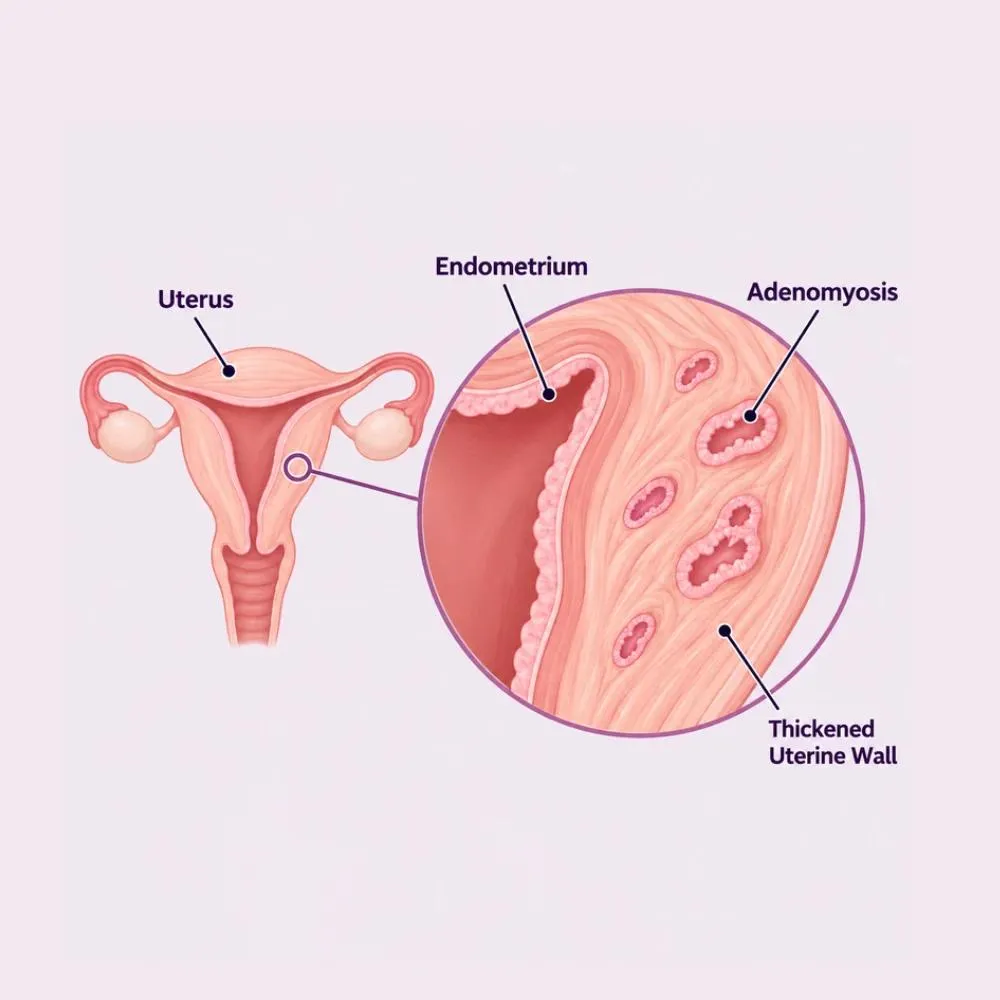
Adenomyosis is the presence of endometrial glands and stroma, the tissue that normally lines the uterine cavity, embedded within the myometrium, the muscular wall itself. That tissue responds to the hormonal cycle and bleeds each month, but it is trapped inside muscle. The result is inflammation, swelling and a uterus that becomes globally enlarged, boggy and tender.
It comes in two patterns. Diffuse adenomyosis involves the wall widely and is the commoner form, producing a uniformly enlarged uterus. Focal adenomyosis forms a discrete mass, sometimes called an adenomyoma, which can look very like a fibroid on ultrasound but behaves quite differently and cannot be shelled out in the same way.
Adenomyosis and endometriosis are related but distinct. Endometriosis is tissue outside the uterus altogether; adenomyosis is tissue within its wall. A woman can have either or both, and roughly a third with one have the other. The distinction matters because the treatments diverge: endometriosis is often excised surgically, while adenomyosis cannot be cut out without taking the uterine wall with it.
The mechanism is not settled, but the risk factors point consistently toward disruption of the boundary between lining and muscle.
Endometrial tissue breaching the normally sharp boundary between the lining and the muscle beneath. The leading explanation.
Caesarean section, dilatation and curettage, or myomectomy can disrupt the boundary and allow tissue to grow inward.
Adenomyosis is commoner in women who have had children, particularly multiple deliveries, though it does occur in women who have not.
Most commonly diagnosed between thirty-five and fifty, after years of cyclical hormonal exposure.
Adenomyotic tissue is oestrogen-driven and produces oestrogen locally, which is why hormonal suppression works and why it resolves after menopause.
Inflammatory changes within the uterine wall both result from and appear to promote further invasion.
Because adenomyosis depends on oestrogen, it resolves completely at menopause. For a woman close to it, that fact genuinely changes the treatment conversation: enduring a few more years may be preferable to a hysterectomy.
The combination of very heavy bleeding with deep cramping pain, worsening over years, is characteristic.
Core symptoms
Associated features
Period pain that has become progressively worse over years, rather than being severe from the start, is the pattern that most suggests adenomyosis rather than primary dysmenorrhoea.
For decades this could only be confirmed after hysterectomy. Imaging has made non-surgical diagnosis reliable.
A uniformly enlarged, soft, tender uterus (described as boggy) is characteristic and quite different from the firm irregular uterus of fibroids.
Shows a thickened asymmetrical wall, small cysts within the muscle and a poorly defined junctional zone. Reliable in experienced hands.
The most accurate non-surgical test. It measures the junctional zone precisely and distinguishes adenomyosis from fibroids, which matters enormously for treatment.
Haemoglobin and ferritin, since heavy prolonged bleeding causes iron deficiency in a majority of women with adenomyosis.
Endometrial biopsy where bleeding is irregular or you are over forty-five, to exclude hyperplasia or malignancy.
The two coexist in around a third of cases, and finding both changes the treatment plan considerably.
Distinguishing adenomyosis from fibroids on imaging is not academic. Fibroids can be removed and the uterus preserved; adenomyosis is spread through the wall and cannot be, so a myomectomy on misdiagnosed adenomyosis simply fails.
Treatment aims at controlling bleeding and pain. The uterus can usually be preserved, though hysterectomy is the only cure.
A levonorgestrel IUD, the single most effective treatment. It thins the lining, reduces bleeding markedly and eases pain, and lasts five years.
Reduce blood loss and pain during the period without hormonal effect. Suitable where conception is being attempted.
Taken continuously to suppress periods altogether, which controls both bleeding and cyclical pain.
Dienogest and similar drugs suppress the adenomyotic tissue directly and are well tolerated long term.
Induce a temporary menopausal state, shrinking the uterus substantially. Used short term with add-back therapy to protect bone.
Correcting the anaemia that most women with adenomyosis have, which often improves wellbeing more than any other single measure.
Blocking the blood supply through a catheter with no incision. It reduces bleeding and pain substantially while preserving the uterus.
Destroying the lining to control bleeding. It works less reliably than in other conditions, since adenomyosis lies deeper than ablation reaches.
Excision of a focal adenomyoma with reconstruction of the uterine wall. Technically demanding, and only feasible for focal disease.
Non-invasive destruction of adenomyotic tissue using focused ultrasound guided by MRI. Available in selected centres.
The only definitive cure, since the disease is within the uterine wall itself. Appropriate where family is complete and other treatments have failed.
The hormonal IUD is the first-line treatment and works well for a large majority. It is a five-minute outpatient procedure, and it deserves a proper trial before anyone discusses removing the uterus.
Treatment escalates only as far as it needs to, and most women are controlled well short of surgery.
Stepped management, medical before surgical
Examination, transvaginal ultrasound and, where the picture is unclear or surgery is being considered, MRI to distinguish adenomyosis from fibroids.
Iron replacement started immediately, since most women presenting with adenomyosis are iron deficient whether or not haemoglobin is low.
Controlling bleeding, controlling pain, or conceiving. Treatment differs substantially depending on which matters most now.
A hormonal IUD fitted as an outpatient in about five minutes, or continuous hormonal treatment where an IUD is unsuitable.
Three to six months before judging effect. Irregular spotting during this settling period is expected and is not failure.
Progestogens, GnRH analogues or uterine artery embolisation where first-line treatment has not controlled symptoms.
Hysterectomy discussed where symptoms remain disabling, family is complete, and the alternatives have genuinely been tried.
Where pregnancy is the goal, the hormonal options are largely unavailable, and treatment shifts to tranexamic acid, NSAIDs and fertility support. Say so early: it reshapes the entire plan.
Adenomyosis is under-diagnosed and frequently treated with a hysterectomy that was avoidable. Here is why patients trust us:
Ultrasound and MRI used to make the diagnosis properly and to distinguish it from fibroids, which the treatment depends on entirely.
Hormonal IUD, medical management and embolisation offered properly before hysterectomy is ever raised.
From the first consultation through to post-treatment follow-up, with one team throughout.
Our hospital is in HITEC CITY, near IKEA: easily reachable from across Hyderabad.
Adenomyosis is managed rather than cured, unless the uterus is removed. Control is realistic and usually achieved.
Diagnosis confirmed, iron started, and first-line treatment begun. Irregular spotting after IUD insertion is common in this period.
Bleeding reduces markedly and pain eases. Anaemia corrects and energy improves, often more noticeably than the bleeding change itself.
Full effect established. Where symptoms remain, escalation to progestogens, GnRH analogues or embolisation is considered.
Ongoing management with the IUD replaced at five years. Symptoms typically remain controlled throughout.
Adenomyosis resolves completely once oestrogen falls. For women close to menopause, this is a genuine endpoint rather than a consolation.
Irregular spotting during the settling period is expected. Most women who persist end up with very light periods or none at all.
Most women with adenomyosis are iron deficient even with normal haemoglobin. Rebuilding ferritin takes three to six months of consistent supplementation.
NSAIDs started a day before bleeding is due work considerably better than the same drug taken once cramping has begun.
Everything else controls symptoms while the disease remains. That is not a reason to rush to surgery, but it is worth understanding clearly.
Adenomyosis can affect implantation and raise miscarriage risk. If you are planning pregnancy, that changes which treatments are available to you.
Bleeding between periods, after intercourse, or after menopause needs separate investigation regardless of a known adenomyosis diagnosis.
Adenomyosis is often dismissed as bad periods for years before it is named. Having the diagnosis is itself worth a great deal, because it converts an unexplained symptom into a treatable condition.
Book a consultation if any of the following apply.
Diagnosis and medical management are modest in cost. Surgery applies only where symptoms remain uncontrolled.
| Procedure | Estimated Cost |
|---|---|
| Consultation Per visit | ₹800 – ₹1,500 |
| Transvaginal ultrasound First-line imaging | ₹1,500 – ₹3,500 |
| MRI pelvis Most accurate non-surgical test | ₹8,000 – ₹18,000 |
| Hormonal IUD insertion Includes device; lasts five years | ₹12,000 – ₹25,000 |
| Monthly medication Progestogen, pill or GnRH analogue | ₹400 – ₹3,500 |
| Endometrial ablation Day care or one night | ₹85,000 – ₹1,60,000 |
| Uterine artery embolisation Includes embolic material | ₹1,80,000 – ₹3,20,000 |
| Laparoscopic hysterectomy Two to three nights | ₹1,60,000 – ₹2,90,000 |
For a large majority, a hormonal IUD at ₹12,000–₹25,000 lasting five years is the whole treatment.
Focal adenomyosis may be excised with the uterus preserved. Diffuse disease spread through the wall cannot be, which limits the options.
Preserving the uterus rules out the definitive option and generally means longer-term medical management.
A shared ward, a twin-sharing room or a private suite: the largest single swing in most estimates.
We are empanelled with most major insurers, and our team files the pre-authorisation for you.
Every figure above is an indicative range, not a quote. After your consultation you are given a written, fixed-cost estimate, and that is the number you pay, with no additions once treatment begins.
The gynaecologists who treat adenomyosis at our HITEC CITY hospital.

Consultant Gynaecologist & Advanced Laparoscopic Surgeon
MBBS, MS, FMAS
16 years experience

Consultant Obstetrician, Gynecologist & Laparoscopic Surgeon
MBBS, MS (Obstetrics & Gynaecology)
11 years experience
Reviews from women treated for gynaecological conditions at Lux Hospitals, Hyderabad.
Written by Dr. Harshita Kakarla on women’s health and gynaecological care.
Dr. Harshita Kakarla

Dr. Harshita Kakarla

Dr. Harshita Kakarla

Dr. Harshita Kakarla

Dr. Harshita Kakarla
Dr. Harshita Kakarla
Common questions about adenomyosis, its treatment and what care costs at Lux Hospitals.
Still have questions? Call us at 079 6908 4422
Still have questions? Message us on WhatsApp at 079 6908 4444
Diagnosis without surgery and uterus-preserving treatment for adenomyosis, with costs shared upfront.
Plot No.116, Lumbini Avenue, HITEC CITY, Near IKEA, Hyderabad – 500032













