



Dr. Samhitha Reddy
Consultant Proctologist & Laparoscopic Surgeon
MBBS, MS, FMAS, FISCP, DMAS
- 8 Yrs
- ASCRS Member
Bladder prolapse, or cystocele, is the descent of the bladder into the front wall of the vagina when the tissue supporting it weakens. It produces a bulge, a dragging sensation, and difficulty emptying the bladder properly.
It is extremely common after childbirth and around the menopause, and it is one of the conditions women most often live with silently for years. Our urologists at Lux Hospitals, HITEC CITY grade the prolapse properly and offer everything from pelvic floor therapy through to surgical repair.
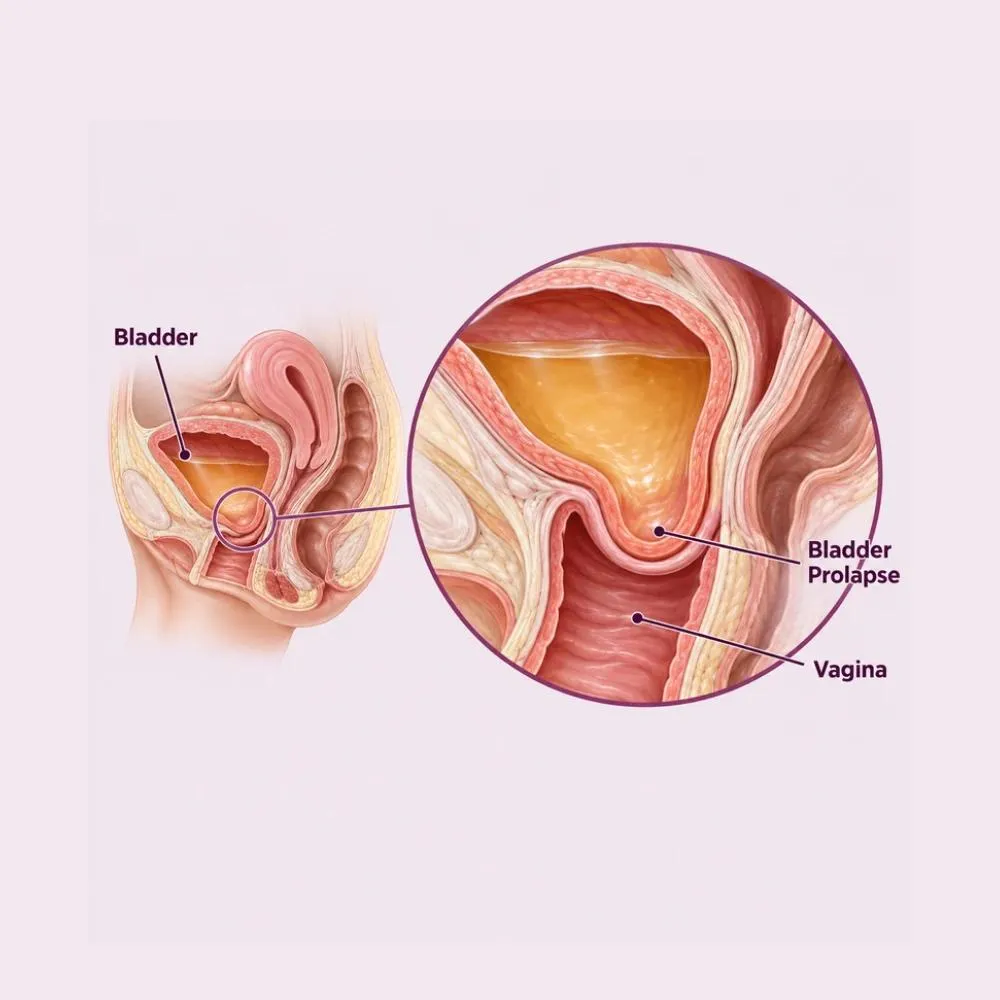
Bladder prolapse occurs when the fascia and muscle supporting the bladder against the front wall of the vagina weaken, allowing the bladder to descend. The result is a bulge felt in the vagina, often described as a sensation of something coming down or of sitting on a ball.
It is graded by how far the descent goes. Grade one is mild, with the bladder dropping only slightly. Grade two brings it to the vaginal opening. Grade three protrudes beyond the opening, and grade four is complete descent. This grading matters because it largely determines whether conservative treatment is realistic or whether surgery is the sensible route.
Prolapse rarely occurs in isolation. The same weakened support frequently allows the uterus, rectum or bowel to descend too, and a woman presenting with a cystocele often has more than one compartment involved. Assessing all of them together is what prevents repairing one and leaving another to become symptomatic afterwards.
Prolapse follows anything that stretches or weakens the pelvic support tissues, and the effects accumulate over a lifetime.
The single largest risk factor. Vaginal delivery stretches the pelvic floor, and prolonged labour, instrumental delivery and large babies increase the effect. Risk rises with each delivery.
Falling oestrogen thins and weakens the connective tissue supporting the pelvic organs. Many women notice prolapse becoming symptomatic in the years around menopause.
Long-standing constipation, chronic cough and repeated heavy lifting all raise abdominal pressure and progressively push the pelvic organs down.
Sustained additional weight increases the load the pelvic floor bears throughout the day.
Hysterectomy in particular removes support structures and increases the risk of subsequent vaginal wall prolapse.
Conditions affecting collagen make prolapse more likely and earlier, and explain why it sometimes occurs in women who have never given birth.
Tissue strength declines with age, and a family history of prolapse raises risk independently of childbirth.
Constipation is the most modifiable of these and the most consistently overlooked. Years of straining on the toilet does measurable damage to pelvic support, and it is entirely treatable.
The characteristic symptoms are a bulge and a dragging sensation that worsen through the day.
Common symptoms
Associated symptoms
Recurrent urinary infections are frequently the presenting complaint. A prolapsed bladder does not empty fully, and residual urine is exactly what infection needs: treating the prolapse often stops the infections.
Diagnosis is clinical, and the assessment establishes the grade, whether other compartments are involved, and how the bladder is functioning.
Examination lying and standing, and while straining, since prolapse is often considerably more apparent upright. This establishes the grade.
A standardised measurement system recording the position of each vaginal compartment, allowing objective comparison over time and after surgery.
Ultrasound measurement of urine left after voiding. A high residual explains recurrent infections and influences the treatment decision.
Analysis and culture, since infection is common with incomplete emptying and should be treated before any surgery.
Assessing bladder pressure and flow, and specifically looking for occult stress incontinence that a large prolapse may be masking.
Checking for uterine and rectal prolapse at the same time, so the repair addresses everything rather than one part.
A large prolapse can kink the urethra and mask stress incontinence entirely. Repairing it sometimes unmasks leaking that was not there before, which is why this is specifically tested for and discussed beforehand.
Mild prolapse is managed conservatively. Surgery is for symptoms that conservative treatment has not controlled.
Supervised, correctly performed exercises. Genuinely effective for grade one and two prolapse, and considerably more so with a physiotherapist than from a leaflet.
A silicone device fitted into the vagina to support the bladder. Effective at any grade, avoids surgery entirely, and is a reasonable long-term option.
Local oestrogen cream or tablets to improve tissue quality after menopause. Used alone and also before surgery to improve healing.
Reducing weight lessens the load on the pelvic floor and measurably improves symptoms.
Fibre, fluids and stool softeners to end straining, and proper treatment of any chronic cough. Both slow progression.
Avoiding heavy lifting and high-impact activity, with guidance on how to lift when it is unavoidable.
The standard repair. The weakened fascia between bladder and vagina is plicated with sutures through a vaginal incision, restoring support using your own tissue.
Reattaching the lateral vaginal support to the pelvic sidewall, where the defect is lateral rather than central.
Abdominal or laparoscopic suspension of the vaginal vault to the sacrum, used for combined or recurrent prolapse with excellent durability.
Addressing uterine or rectal prolapse in the same operation, since repairing one compartment alone frequently leads to another becoming symptomatic.
A sling procedure added where stress incontinence coexists or is unmasked by the repair, avoiding a second operation.
Closure of the vaginal canal, a short and very effective operation for elderly women who no longer wish to be sexually active.
A pessary is genuinely underused. It is fitted in a single outpatient visit, works immediately, and for many women is a permanent solution rather than a stopgap before surgery.
Anterior repair takes around forty-five to ninety minutes, with one to two nights in hospital and no abdominal incision.
Vaginal surgery under spinal or general anaesthesia
Any urinary infection treated first, vaginal oestrogen used for several weeks beforehand where appropriate to improve tissue quality, and routine bloods completed.
Spinal or general anaesthesia, positioned in lithotomy. A catheter is placed to keep the bladder empty during the repair.
An incision in the front wall of the vagina. There is no abdominal incision and no external scar.
The bladder is carefully dissected off the vaginal wall to expose the weakened fascia beneath: the layer that has given way.
The fascia is plicated with strong absorbable sutures, restoring the bladder to its correct position using your own tissue.
Excess vaginal skin is trimmed conservatively (too much causes narrowing) and the wall closed. A vaginal pack is placed for a few hours.
The pack and catheter are removed the following day, and bladder emptying is checked before discharge.
Trimming too much vaginal skin is a real and avoidable complication, producing narrowing and painful intercourse afterwards. Conservative trimming is a deliberate part of the technique.
Prolapse is best treated by starting with the least invasive option that works. Here is why patients trust us:
Pessary fitting and supervised pelvic floor therapy presented as genuine alternatives, not as a formality before recommending surgery.
Uterine and rectal prolapse checked alongside the bladder, and occult incontinence specifically tested for, so nothing surfaces after the repair.
From the first consultation through to post-treatment follow-up, with one team throughout.
Our hospital is in HITEC CITY, near IKEA: easily reachable from across Hyderabad.
Most women go home within two days and return to desk work at two to three weeks. Full healing takes about six weeks.
Pack and catheter removed, bladder emptying checked, and discharge once you are passing urine comfortably.
Some vaginal discharge and light bleeding is expected. Walking encouraged; lifting and straining strictly avoided.
Most women return to desk work. Discharge settles. Driving resumes once you can perform an emergency stop comfortably.
Follow-up examination confirms the repair is holding. Light exercise resumes.
Intercourse resumes after clearance at six weeks. Full activity including exercise, with permanent care over heavy lifting.
Nothing over five kilograms. The repair depends on tissue healing under no load, and early lifting is the commonest cause of early failure.
Fibre, fluids and a stool softener from day one. Straining on the toilet after a prolapse repair directly threatens it.
Restarted once healing allows and continued permanently. They protect the repair and reduce the chance of prolapse elsewhere.
The vaginal wall needs full healing time. Resume only after your follow-up examination confirms it.
If you are managing with a pessary rather than surgery, it needs removing, cleaning and reviewing every three to six months to avoid erosion.
Fever, offensive discharge, heavy bleeding, or an inability to pass urine after discharge all need review rather than waiting.
Prolapse can recur, particularly where the underlying causes continue. Managing constipation, avoiding heavy lifting and keeping up pelvic floor exercises is what makes a repair last.
Book a consultation if any of the following apply.
Conservative treatment costs very little. Surgery is the significant cost, and many women never need it.
| Procedure | Estimated Cost |
|---|---|
| Consultation Includes pelvic examination | ₹800 – ₹1,500 |
| Assessment and urine tests Culture, residual volume, ultrasound | ₹2,000 – ₹5,000 |
| Urodynamic study Where incontinence coexists | ₹8,000 – ₹16,000 |
| Pessary fitting Includes the device and fitting | ₹5,000 – ₹12,000 |
| Pelvic floor physiotherapy Per session; eight to twelve sessions | ₹800 – ₹2,000 |
| Anterior repair (cystocele) One to two nights in hospital | ₹1,10,000 – ₹1,90,000 |
| Combined prolapse repair Multiple compartments in one operation | ₹1,60,000 – ₹2,80,000 |
| Laparoscopic sacrocolpopexy Includes mesh and consumables | ₹2,20,000 – ₹3,60,000 |
A pessary at ₹5,000–₹12,000 resolves symptoms for many women indefinitely. Surgery is reserved for those it does not suit.
Repairing bladder, uterus and rectum together costs more than one alone, but far less than separate operations later.
Adding a sling procedure to address coexisting or unmasked stress incontinence increases the cost but avoids a second admission.
A shared ward, a twin-sharing room or a private suite: the largest single swing in most estimates.
We are empanelled with most major insurers, and our team files the pre-authorisation for you.
Every figure above is an indicative range, not a quote. After your consultation you are given a written, fixed-cost estimate, and that is the number you pay, with no additions once treatment begins.
The specialists who treat bladder prolapse at our HITEC CITY hospital.

Consultant Urologist & Andrologist
MBBS, MS, DrNB (Urology)
10 years experience

Consultant Urologist & Andrologist
MBBS, MS, MCh (Urology)
9 years experience
Reviews from patients treated for bladder and urological conditions at Lux Hospitals, Hyderabad.
Written by Dr. Vipin Reddy B on bladder health and urological care.

Dr. Vipin Reddy B

Dr. Vipin Reddy B

Dr. Vipin Reddy B

Dr. Vipin Reddy B

Dr. Vipin Reddy B

Dr. Vipin Reddy B
Common questions about bladder prolapse, pessaries, surgery and costs at Lux Hospitals.
Still have questions? Call us at 079 6908 4422
Still have questions? Message us on WhatsApp at 079 6908 4444
Assessment of bladder prolapse with non-surgical options and surgical repair, and costs shared upfront.
Plot No.116, Lumbini Avenue, HITEC CITY, Near IKEA, Hyderabad – 500032













