Dr. Samhitha Reddy
Consultant Proctologist & Laparoscopic Surgeon
MBBS, MS, FMAS, FISCP, DMAS
- 8 Yrs
- ASCRS Member
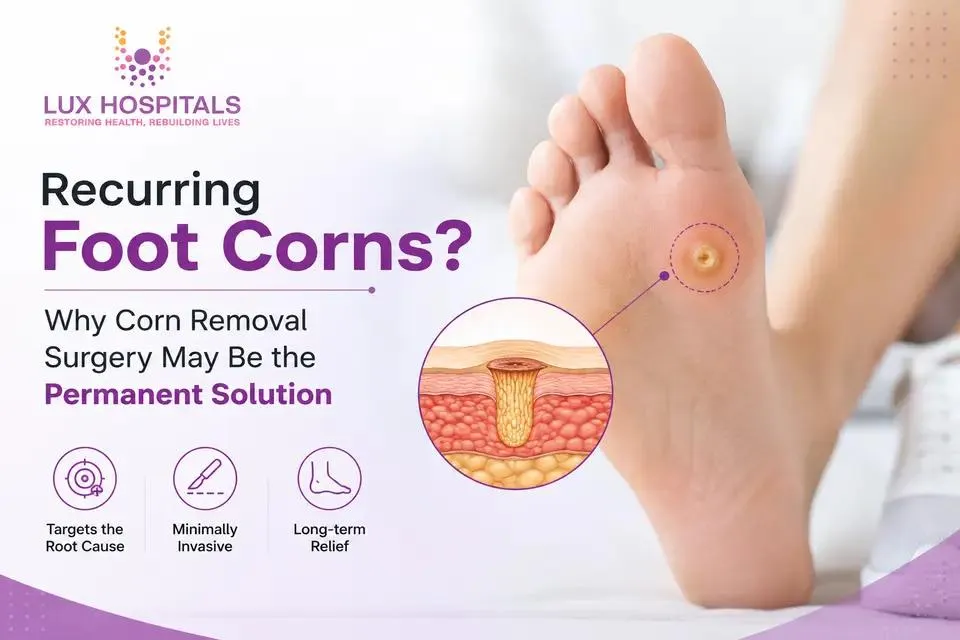
A foot corn is a small area of thickened skin, and it is capable of causing pain out of all proportion to its size. Walking becomes something you plan around, and shoes that once fitted become impossible.
Corns come back if only the hard skin is removed, because the pressure that created them is still there. Our surgeons at Lux Hospitals, HITEC CITY remove the corn and, where a bone deformity underneath is driving it, correct that too, which is what makes the relief permanent.
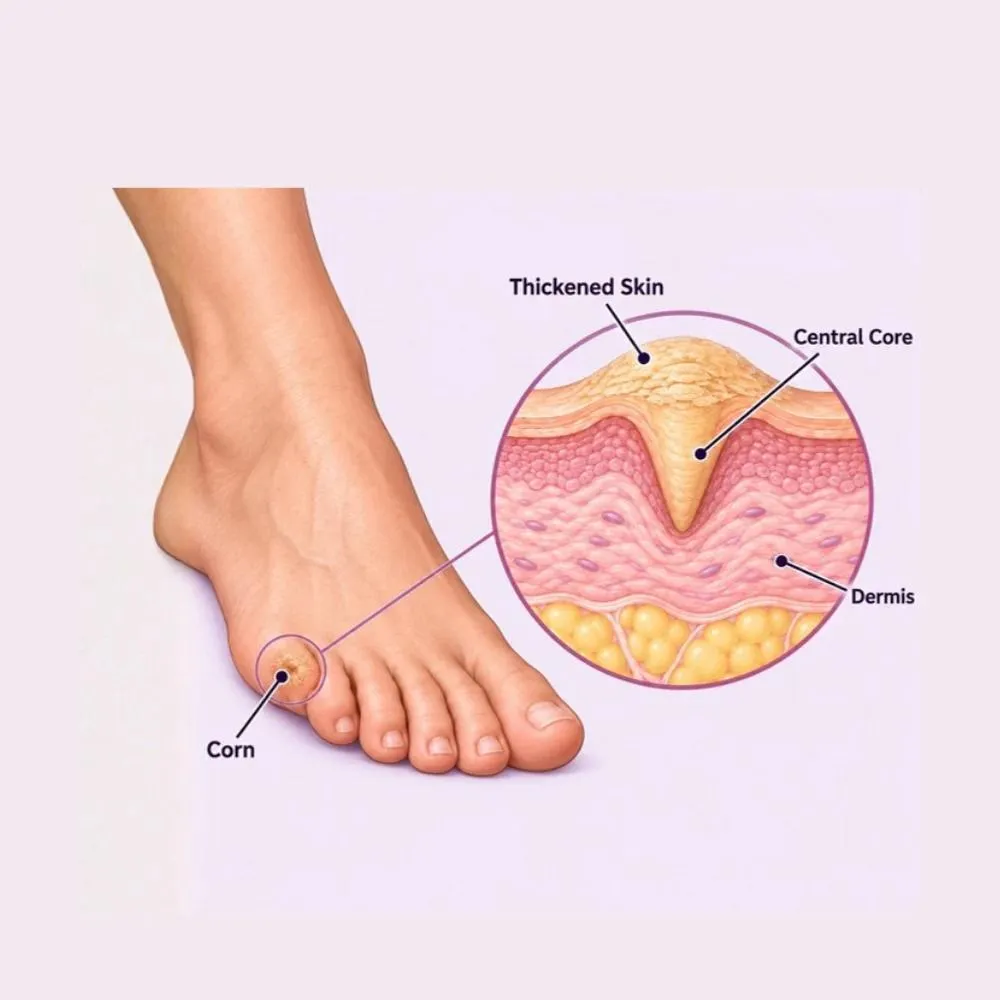
A corn is a small, well-defined area of thickened skin that forms where repeated friction or pressure is applied to one spot. The skin thickens as a protective response, but the thickened area then presses inward on the tissue beneath it, which is what makes it hurt.
Corns differ from calluses in shape and depth. A callus is a broad, diffuse area of thickening across the sole. A corn is smaller and cone-shaped, with a hard central core that points downward into the skin. That core is why a corn is painful when direct pressure is applied to it.
They come in three forms. Hard corns form on the tops and tips of toes and on the sole, over bony prominences. Soft corns form between the toes where moisture keeps them macerated. Seed corns are tiny, often multiple, and appear on the sole.
Every corn comes from repeated pressure or friction at one point. Finding the source of that pressure is what determines whether treatment lasts.
The commonest cause by far. Shoes that are too tight, too loose, too narrow, or have high heels concentrate pressure onto small areas.
Occupations that keep you on your feet all day subject the same points to pressure for hours at a time.
Hammertoes, bunions, claw toes and prominent metatarsal heads create bony points that press directly against the shoe.
An altered walking pattern loads parts of the foot that were never meant to bear that much weight.
More weight through the same surface area means higher pressure at every contact point on the sole.
Socks reduce friction between foot and shoe. Wearing shoes without them, or with poorly fitting ones, increases rubbing considerably.
Persistent moisture between the toes softens the skin and encourages soft corns to form there.
The natural fat padding on the sole thins with age, leaving less cushioning between bone and ground.
This is why footwear is not an afterthought in treatment. Removing a corn while leaving the shoe that caused it means the corn returns, usually within months.
The characteristic feature is sharp, localised pain on direct pressure: quite unlike the general ache of tired feet.
Typical symptoms
Signs needing prompt attention
Corns in people with diabetes are a different matter entirely. Reduced sensation and poor circulation mean a corn can ulcerate without being felt, and these should always be treated professionally rather than at home.
A corn is diagnosed on sight. The more useful part of the assessment is working out what is causing the pressure, and X-rays are often what reveals it.
The corn is examined for its type, depth and central core, and the surrounding skin assessed for infection or ulceration.
Paring the surface settles it: a wart shows pinpoint bleeding and interrupts the skin lines, a corn does not. They need different treatment.
Identifies the bony deformity underneath (a hammertoe, bunion or prominent metatarsal head) that is generating the pressure.
Examining how you walk and where load falls across the foot, which explains why the corn formed where it did.
Looking at the shoes you actually wear. The wear pattern on the sole is often the most informative thing in the consultation.
Sensation testing and a circulation check in anyone with diabetes, since a corn in an insensate foot carries a real risk of ulceration.
An X-ray is worth having if corns keep recurring in the same place. It usually shows a bony prominence that no amount of paring or padding will overcome.
Most corns respond to conservative care and better footwear. Surgery is for those that are deep, painful, recurrent, or sitting over a bone deformity that needs correcting.
The thickened skin and central core are carefully trimmed with a sterile blade. Painless, immediately relieving, and far safer than attempting it at home.
Wide, deep, cushioned shoes with a low heel. The single most effective long-term measure, and the one most often skipped.
Custom insoles redistribute pressure away from the corn, and toe separators or protective pads shield the area.
Softens and dissolves the thickened skin gradually. Effective, but must never be used by anyone with diabetes or poor circulation.
Softening the skin with regular soaking and urea-based creams makes corns less likely to build up.
The hardened tissue and its underlying core are excised with surgical instruments under local anaesthetic. Quick, effective, and done as day care.
The corn is vaporised with a focused laser, with minimal bleeding, a low recurrence rate and less scarring. Recovery is quicker than open excision.
Liquid nitrogen freezes the corn so it shrinks and peels away over the following weeks. Less invasive, and best suited to smaller corns.
Where a hammertoe, bunion or prominent bone is the underlying cause, the bone is realigned or trimmed. This is what actually stops the corn recurring.
Removing the corn without addressing the pressure beneath it treats the symptom. Where an X-ray shows a bony prominence, correcting it is the difference between relief for months and relief for good.
A minor twenty to thirty minute procedure done under local anaesthetic. You walk in, you walk out, and the pain the corn was causing is gone immediately.
Excision under local anaesthetic
The corn is examined and any X-ray reviewed, so that a bone deformity needing correction is identified before rather than after the procedure.
Anaesthetic is injected around the base of the toe or the affected area. The foot is completely numb within a few minutes.
A small incision removes the thickened skin along with the central core. Removing the core completely is what prevents an early recurrence.
Where a hammertoe, bunion or prominent metatarsal head is the cause, the bone is realigned or the prominence trimmed at the same sitting.
The wound is closed with fine sutures, or in some cases left to heal by itself, depending on the site and the amount removed.
A sterile dressing is applied, and a post-operative shoe or sandal provided so pressure is kept off the site while it heals.
Home within the hour with painkillers, antibiotic ointment where needed, dressing instructions and a follow-up date.
The recovery is straightforward, but it does require keeping weight off the area and wearing the right shoe afterwards. Returning to the shoes that caused the corn is the surest way to get another one.
Anyone can pare a corn. Making it stay away means finding and correcting what caused it. Here is why patients trust us:
Experienced general and foot surgeons skilled in corn excision, laser removal and bone correction where it is needed.
A full range of minimally invasive options (excision, laser and cryotherapy) matched to the corn rather than to what is available.
From the first consultation through to post-treatment follow-up, with one team throughout.
Our hospital is in HITEC CITY, near IKEA: easily reachable from across Hyderabad.
Corn removal heals within two to four weeks. Bone correction takes longer, and the footwear changes afterwards are what determine whether the corn stays away.
Home within the hour in a post-operative shoe. Keep the foot elevated. Some soreness as the anaesthetic wears off.
Keep the foot elevated where possible and limit walking. Cold packs reduce swelling. Dressings changed as instructed.
Sutures removed and the wound checked. Walking increases gradually, still in soft, cushioned footwear.
The wound is healed. Normal cushioned shoes resume. Custom orthotics are fitted where they have been advised.
Full activity and normal walking. Where bone correction was performed, recovery extends over this period.
Wide, deep, cushioned shoes with a low heel. This is the aftercare that decides whether the corn comes back: nothing else matters as much.
Change dressings and apply antibiotic ointment as instructed, to prevent infection while the wound heals.
Restrict walking and avoid heavy exercise in the first two weeks. Elevate the foot and use cold packs to reduce swelling.
Custom insoles redistribute pressure away from the site, and are the most effective way to prevent recurrence.
Unusual pain, spreading redness, swelling, discharge or fever. Anyone with diabetes should report any change immediately.
Regular review confirms healing and picks up early signs that pressure is building at the site again.
Corns recur when the pressure returns. If you go back to the same narrow shoes, the corn will come back, which is why footwear and orthotics are treated here as part of the operation rather than as advice afterwards.
Surgery is advised if any of the following apply.
Cost depends on whether the corn alone is being removed or an underlying bone deformity is being corrected at the same time.
| Procedure | Estimated Cost |
|---|---|
| Consultation & assessment Per visit | ₹800 – ₹1,500 |
| Professional paring / debridement Per session, out-patient | ₹1,500 – ₹4,000 |
| Foot X-ray Where a bone deformity is suspected | ₹500 – ₹1,500 |
| Cryotherapy Per session, for smaller corns | ₹3,000 – ₹8,000 |
| Corn excision surgery Day care, under local anaesthetic | ₹15,000 – ₹35,000 |
| Laser corn removal Day care, quicker recovery | ₹20,000 – ₹45,000 |
| Excision with bone correction Day care or one night’s stay | ₹45,000 – ₹95,000 |
Removing the corn alone is a minor procedure. Correcting a hammertoe or bunion underneath it is a considerably larger one.
Several corns, or a single deep-seated one with an extensive core, take longer than a small superficial lesion.
Custom insoles are often advised afterwards to prevent recurrence, and are costed separately from the procedure.
A shared ward, a twin-sharing room or a private suite: the largest single swing in most estimates.
We are empanelled with most major insurers, and our team files the pre-authorisation for you.
Every figure above is an indicative range, not a quote. After your consultation you are given a written, fixed-cost estimate, and that is the number you pay, with no additions once treatment begins.
What patients treated here can expect:
The pressure pain the corn was causing goes as soon as the core is out.
Bone deformity addressed where present, so the corn does not simply return.
Local anaesthetic, home within the hour, healed in two to four weeks.
The general and foot surgeons who perform corn removal at our HITEC CITY hospital.

Consultant General & Advanced Laparoscopic Surgeon
MBBS, MS, FMAS
17 years experience

Senior Consultant: Bariatric & Gastrointestinal Surgery
MBBS, MS, FRCS (UK), DLS (France)
28 years experience

Consultant Proctologist & Laparoscopic Surgeon
MBBS, MS, FMAS, FISCP, DMAS
8 years experience
Reviews from patients treated for foot corns and general surgery at Lux Hospitals, Hyderabad.
Written by Dr. Abhishek Katha on foot corns, lumps and general surgical care.

Dr. Abhishek Katha
Dr. Abhishek Katha

Dr. Abhishek Katha
Dr. Abhishek Katha
Dr. Abhishek Katha
Dr. Abhishek Katha
Common questions about foot corns, their removal, and what surgery costs at Lux Hospitals.
Still have questions? Call us at 079 6908 4422
Still have questions? Message us on WhatsApp at 079 6908 4444
Permanent relief from painful foot corns, with the underlying cause corrected and a fixed-cost estimate before treatment begins.
Plot No.116, Lumbini Avenue, HITEC CITY, Near IKEA, Hyderabad – 500032