Dr. Samhitha Reddy
Consultant Proctologist & Laparoscopic Surgeon
MBBS, MS, FMAS, FISCP, DMAS
- 8 Yrs
- ASCRS Member
A hernia is a gap in the muscle wall that lets tissue behind it push through, usually showing as a bulge that comes and goes. It will not close on its own, and it gets slowly larger.
Surgery is the only definitive repair, and modern surgery does it through keyhole incisions. Our laparoscopic surgeons at Lux Hospitals, HITEC CITY repair hernias with mesh reinforcement, so most patients go home the same day and are back to normal within a week.
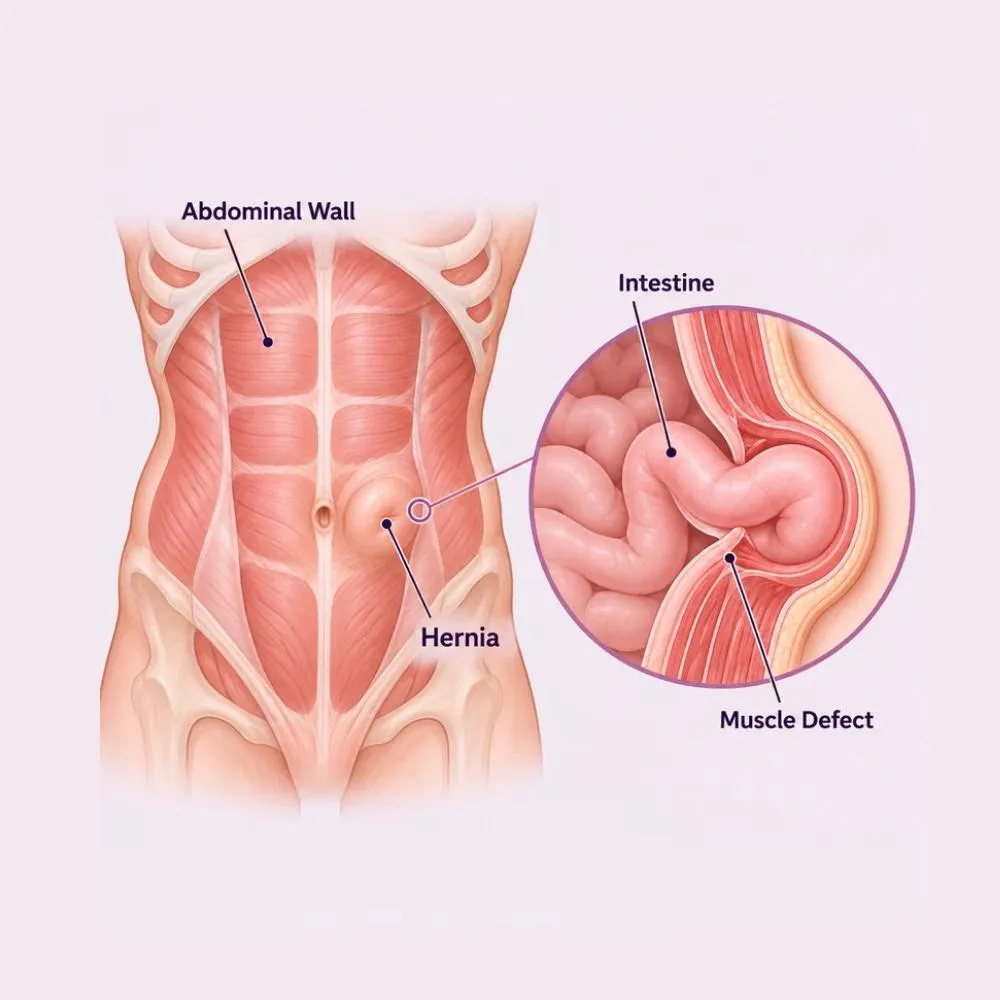
A hernia occurs when an organ or fatty tissue pushes through a weak spot in the muscle or connective tissue that should be containing it. It usually appears as a visible bulge, and typically causes discomfort during physical activity, coughing or lifting.
Hernias are named for where they occur. An inguinal hernia is in the groin and is by far the commonest, particularly in men. A femoral hernia sits slightly lower in the upper thigh and is more common in women. An umbilical hernia is at the navel, an incisional hernia forms at the site of a previous surgical scar, and a hiatal hernia is where part of the stomach pushes up into the chest.
The important point is that a hernia is a mechanical defect. There is a hole, and no amount of exercise, belt or medication closes a hole: those things manage the symptoms while the gap slowly widens. Surgery is the only treatment that actually repairs it.
Every hernia is the result of two things meeting: a weakness in the muscle wall, and pressure pushing against it.
Lifting without proper technique or support raises abdominal pressure sharply against whatever weak point already exists.
Persistent coughing from smoking, asthma or bronchitis applies the same pressure thousands of times over.
Chronic constipation or difficulty passing urine from an enlarged prostate both mean sustained daily straining.
Extra abdominal weight raises baseline pressure inside the abdomen continuously, not just on exertion.
A surgical scar is never as strong as intact muscle, which is why incisional hernias form at old incision sites.
Some people are born with a wider inguinal canal or a weak abdominal wall, which is why hernias can run in families.
Both weaken collagen and impair tissue repair, making the muscle wall less able to withstand pressure.
The abdominal wall stretches considerably and pressure rises, which commonly produces umbilical hernias.
Several of these are within your control, and addressing them matters after surgery as much as before: the same pressures that opened the first gap will test the repair.
Most hernias announce themselves as a lump that appears on standing or straining and disappears on lying down. The symptoms that matter most are the ones that signal a complication.
Typical symptoms
Warning signs: seek help today
That second list describes a strangulated hernia: the blood supply to trapped bowel is cut off. It is a surgical emergency measured in hours, and it is the single reason not to leave a hernia indefinitely.
Most hernias are diagnosed in the consulting room in a couple of minutes. Imaging is added where the lump is not obvious or where the anatomy needs mapping before surgery.
Examining you standing and lying, and asking you to cough. A bulge that appears on coughing and reduces on lying down is diagnostic.
Whether the hernia can be gently pushed back. One that cannot is incarcerated and needs prompt attention rather than a routine waiting list.
Confirms a small or intermittent hernia that cannot be felt reliably, and distinguishes it from a lipoma, a cyst or an enlarged lymph node.
Maps large, complex, recurrent or incisional hernias before surgery, showing the size of the defect and what is inside the sac.
Occasionally used for groin pain where a hernia is suspected but not demonstrable, particularly in athletes.
Routine bloods, an ECG and an anaesthetic review, plus a check for the cough, constipation or prostate problem that may have contributed.
A one-visit diagnosis is the norm. You will usually leave knowing the type of hernia you have, which repair suits it, and roughly what it will cost.
Surgical repair is the only cure. The first list manages symptoms and is appropriate for small, painless hernias in patients unfit for an operation: it is a holding position, not a treatment.
Small, painless hernias that reduce easily may be monitored rather than operated on immediately, with clear instructions on the warning signs.
Avoiding heavy lifting, losing excess weight, stopping smoking and treating constipation: reducing the pressure that widens the defect.
A truss or hernia belt can ease discomfort temporarily. It holds the hernia in but does nothing to repair it, and is not a long-term answer.
Simple analgesia and anti-inflammatories to manage symptoms while surgery is planned.
Keyhole repair through three small incisions, placing mesh behind the defect from the inside. Less pain, faster return to work, and the preferred option for bilateral and recurrent hernias.
A single incision over the hernia, with mesh laid over the repaired defect. Reliable, well proven, and can be done under local or spinal anaesthesia in patients unfit for a general.
Keyhole repair with robotic instrumentation, giving greater precision for complex abdominal wall reconstructions.
For very large or recurrent incisional hernias, the abdominal wall layers are released so the defect can be closed properly rather than merely bridged.
For an incarcerated or strangulated hernia. Trapped bowel is assessed, any non-viable segment resected, and the defect repaired: urgent, and why complications are worth avoiding.
Surgery is recommended for hernias that are larger, symptomatic, or enlarging. Your surgeon will suggest open or laparoscopic repair based on the type, the size, whether it is bilateral, and your own fitness.
The repair most of our hernia patients have. Around forty-five minutes to an hour in theatre, three incisions of five to ten millimetres, and home the same day.
TEP / TAPP laparoscopic repair
Bloods, an ECG where age or history calls for one, an anaesthetic review, and a six-hour fasting window before your slot.
General anaesthetic. Laparoscopic repair needs the abdominal muscles fully relaxed, which spinal or local anaesthesia does not achieve.
Three small ports are placed and the space is opened with carbon dioxide, giving a clear view of the defect from inside, including a second hernia on the other side, which is found surprisingly often.
The contents of the hernia sac are gently drawn back into the abdomen and the sac itself is dissected free from the surrounding tissue.
A sheet of mesh is laid over the defect from behind and secured. Abdominal pressure then holds it flat against the wall, which is why this repair is so durable.
The peritoneum is closed over the mesh so it is not in contact with bowel, the gas is released, and the tiny port sites are closed with dissolvable stitches.
Three to five hours in day care, a light meal, then home the same evening with painkillers and a follow-up date.
Placing the mesh behind the defect rather than over the front is the key difference from open repair. The body’s own pressure holds it in place, and there is no large wound in the muscle you use to sit up.
Hernia repair is a common operation, and that is precisely why the details separate a good result from an average one. Here is why patients trust us:
Led by Dr. Abhishek Katha and Dr. Tagore Mohan Grandhi, with decades of laparoscopic and robotic experience between them.
Minimally invasive laparoscopic repair as the default, meaning faster recovery and minimal scarring.
From the first consultation through to post-treatment follow-up, with one team throughout.
Our hospital is in HITEC CITY, near IKEA: easily reachable from across Hyderabad.
Keyhole repair means you are walking the same evening. The mesh, however, takes about three months to fully integrate, which is what the lifting restrictions are protecting.
Home the same evening. Some soreness at the port sites and shoulder-tip discomfort from the gas, both of which settle within a day or two.
Walking encouraged from the outset. Most patients are off strong painkillers by day two and managing normal household activity.
Desk work resumes for most people. Driving from about day five, once you can perform an emergency stop without hesitating.
Normal daily activity and light exercise return. Bruising and swelling in the groin settle. First follow-up review.
Progressive return to the gym, heavy lifting and manual work. The mesh is fully incorporated by around three months.
Nothing above five kilos for six weeks, then build back gradually. This is the instruction most linked to recurrence when ignored.
Early, regular walking reduces the risk of clots and chest infection and speeds recovery. Rest is not the goal here.
Keep stools soft with fibre and fluid, and take a laxative if needed. Straining on the toilet puts direct pressure on a fresh repair.
Stop smoking, lose excess weight, and get a chronic cough or prostate problem treated: otherwise the same pressure returns.
Fever, spreading redness or discharge from a wound, severe or increasing pain, or a bulge reappearing at the repair site.
Review at two weeks and again at six. The second confirms the repair is sound before you return to heavy activity.
Recurrence after a properly performed mesh repair is uncommon: in the region of one to three per cent. Where it happens, it is usually in patients who returned to heavy lifting early or who kept smoking.
Book a consultation if any of the following apply.
What hernia surgery costs depends on the type of hernia, the repair it calls for, and the room you choose. These are the ranges our patients fall into.
| Procedure | Estimated Cost |
|---|---|
| Open inguinal hernia repair Day care or one night’s stay | ₹45,000 – ₹75,000 |
| Laparoscopic inguinal repair (one side) Day care, mesh included | ₹65,000 – ₹1,10,000 |
| Laparoscopic bilateral repair Both sides in one sitting, one night’s stay | ₹85,000 – ₹1,45,000 |
| Umbilical / epigastric hernia repair Day care, size dependent | ₹40,000 – ₹80,000 |
| Incisional hernia repair Two to four nights’ stay | ₹90,000 – ₹1,80,000 |
| Emergency strangulated hernia surgery Includes bowel resection if required | ₹1,20,000 – ₹2,50,000 |
A small umbilical hernia and a large recurrent incisional hernia are entirely different operations in time and complexity.
Keyhole repair costs more in theatre and less in time away from work, usually a week back rather than three.
Standard polypropylene and composite or biological meshes differ considerably in price, and the choice depends on where the mesh sits.
A shared ward, a twin-sharing room or a private suite: the largest single swing in most estimates.
We are empanelled with most major insurers, and our team files the pre-authorisation for you.
Every figure above is an indicative range, not a quote. After your consultation you are given a written, fixed-cost estimate, and that is the number you pay, with no additions once treatment begins.
What patients treated here can expect:
The defect closed and reinforced, not merely held in.
Day-care keyhole surgery, with desk work realistic within a week.
Mesh repair with long-term results and minimal scarring.
The general and laparoscopic surgeons who repair hernias at our HITEC CITY hospital.

Consultant General & Advanced Laparoscopic Surgeon
MBBS, MS, FMAS
17 years experience

Senior Consultant: Bariatric & Gastrointestinal Surgery
MBBS, MS, FRCS (UK), DLS (France)
28 years experience

Consultant Proctologist & Laparoscopic Surgeon
MBBS, MS, FMAS, FISCP, DMAS
8 years experience

Consultant Breast, Thyroid & General Surgeon
MBBS, MS (General Surgery), Fellowship in Laparoscopic Surgery
7 years experience
Reviews from patients treated for hernia, gallstones and general surgery at Lux Hospitals, Hyderabad.
Written by Dr. Abhishek Katha on hernia, gallbladder and general surgical care.

Dr. Abhishek Katha
Dr. Abhishek Katha

Dr. Abhishek Katha

Dr. Abhishek Katha

Dr. Abhishek Katha

Dr. Abhishek Katha
Common questions about hernias, their repair, and what surgery costs at Lux Hospitals.
Still have questions? Call us at 079 6908 4422
Still have questions? Message us on WhatsApp at 079 6908 4444
Laparoscopic hernia repair with mesh by experienced surgeons, and a fixed-cost estimate shared before treatment begins.
Plot No.116, Lumbini Avenue, HITEC CITY, Near IKEA, Hyderabad – 500032