



Dr. Samhitha Reddy
Consultant Proctologist & Laparoscopic Surgeon
MBBS, MS, FMAS, FISCP, DMAS
- 8 Yrs
- ASCRS Member
Carpal tunnel syndrome is compression of the median nerve at the wrist. Its signature is waking at night with numb, tingling fingers and having to shake the hand to restore feeling.
Caught early it often settles with a splint and an injection. Left long enough it causes permanent nerve damage and muscle wasting that surgery cannot fully reverse. Our orthopaedic surgeons at Lux Hospitals, HITEC CITY treat it at whichever stage you present.
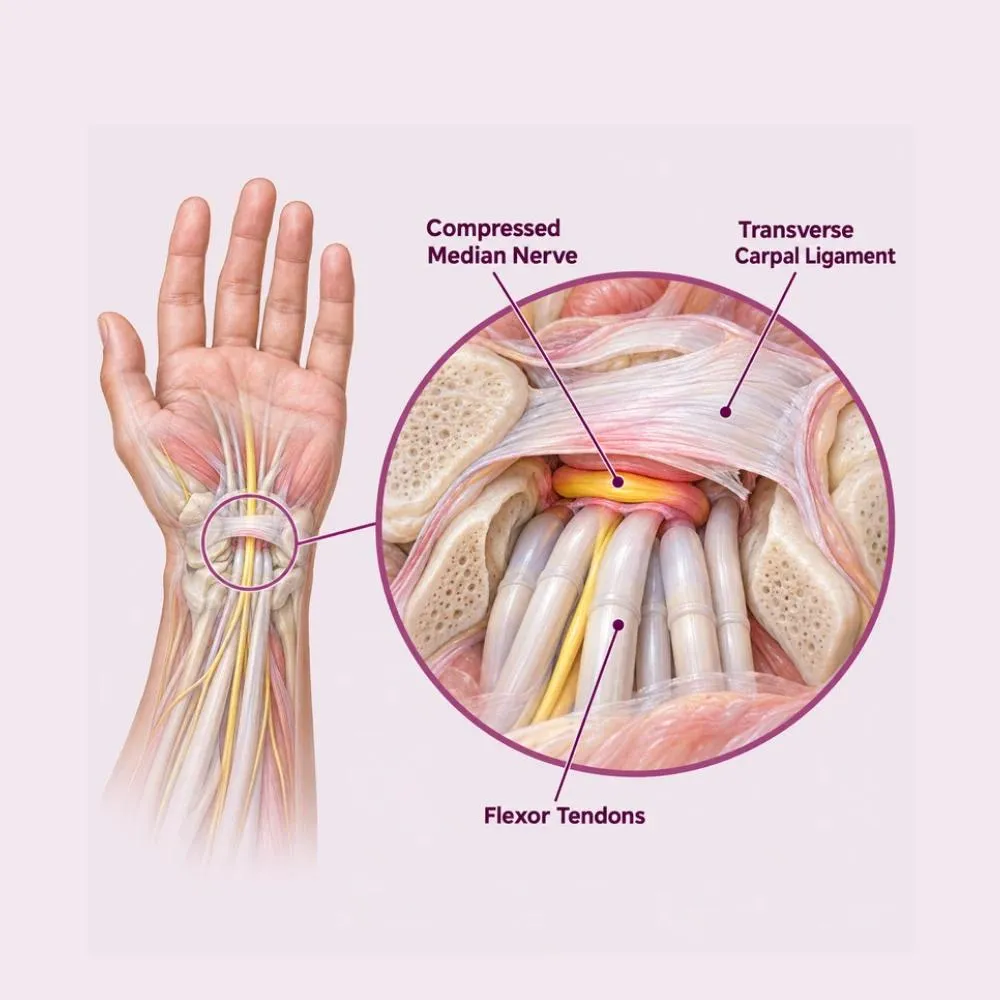
The carpal tunnel is a narrow passage on the palm side of the wrist, bounded by the wrist bones and roofed by a tough band of tissue called the transverse carpal ligament. Nine tendons and the median nerve pass through it. There is no spare room.
Carpal tunnel syndrome occurs when pressure inside that tunnel rises and compresses the median nerve. Because the tunnel cannot expand, anything that swells its contents (inflamed tendon sheaths, fluid retention, arthritis) squeezes the nerve.
The median nerve supplies sensation to the thumb, index, middle and half the ring finger, and powers the muscles at the base of the thumb. That distribution explains the symptoms precisely, and it is why numbness affecting the little finger points away from this diagnosis rather than toward it.
Anything that raises pressure within the fixed space of the carpal tunnel compresses the nerve.
Typing, assembly line work, playing an instrument or prolonged tool use: activities that inflame the tendon sheaths within the tunnel.
Hormonal fluid retention raises pressure in the tunnel. It is common in the third trimester and usually resolves after delivery.
Both raises the risk and makes the nerve more vulnerable to compression, and it is a common association.
Inflamed synovium around the tendons swells within the tunnel and compresses the nerve directly.
Causes tissue swelling that raises pressure in the tunnel, and is worth testing for since treating it can resolve the symptoms.
A fracture or dislocation that healed with altered anatomy can narrow the tunnel permanently.
Some people are simply born with less room, which is why carpal tunnel syndrome runs in families.
Excess weight and conditions causing fluid retention both raise pressure within the tunnel.
Thyroid function and blood sugar are worth checking in anyone presenting with carpal tunnel syndrome. Both are treatable causes, and correcting them sometimes resolves the symptoms entirely.
Night symptoms are the hallmark. Almost everyone with carpal tunnel syndrome describes waking with a numb hand and shaking it to bring the feeling back.
Typical symptoms
Signs of advanced compression
Paradoxically, the night waking stopping is a bad sign rather than a good one when it is replaced by constant numbness: it means the nerve has been compressed long enough to stop signalling intermittently.
The history is often diagnostic on its own. Examination and nerve conduction studies confirm it and grade the severity.
Night waking with numbness in the median nerve distribution, relieved by shaking the hand, is close to diagnostic on its own.
Bending the wrist forward, or tapping over the nerve, reproduces the tingling. Simple bedside tests that support the diagnosis.
Testing sensation in each finger and assessing the thumb muscles for wasting and weakness, which indicates advanced compression.
The objective test. It confirms median nerve compression at the wrist, grades severity, and excludes nerve problems higher up.
Shows swelling of the nerve at the tunnel entrance and can identify a mass or inflamed synovium causing the compression.
Thyroid function, blood sugar and inflammatory markers, since hypothyroidism, diabetes and rheumatoid arthritis are all treatable contributors.
Numbness in the little finger or symptoms extending above the elbow suggest the problem is at the elbow or neck rather than the wrist. Nerve conduction studies distinguish these clearly.
Mild and moderate cases often respond well to non-surgical treatment. Surgery is highly effective and is indicated where the nerve is at risk.
A splint holding the wrist neutral overnight. Simple, inexpensive and genuinely effective: many mild cases resolve on this alone.
Adjusting workstation ergonomics, taking breaks from repetitive tasks and avoiding sustained wrist flexion.
Injected into the carpal tunnel, giving relief for months in most patients. It also confirms the diagnosis when the response is good.
Correcting hypothyroidism, controlling diabetes or treating rheumatoid arthritis can resolve the symptoms without any local treatment.
Specific exercises that mobilise the nerve within the tunnel, useful alongside splinting in milder cases.
The transverse carpal ligament is divided through a small incision in the palm, decompressing the nerve. Highly effective, done under local anaesthetic.
The same ligament divided through one or two small incisions using a camera. Slightly faster return to work, with equivalent long-term results.
Removing inflamed tendon sheath at the same time, in patients with rheumatoid arthritis or marked synovitis.
For persistent or recurrent symptoms, usually because of incomplete division of the ligament at the first operation.
Surgery is recommended where there is constant numbness, thumb muscle wasting, or nerve conduction studies showing severe compression. At that stage, delay risks permanent nerve damage.
A fifteen to twenty minute day-case procedure, usually under local anaesthetic. You walk in, walk out, and go home within the hour.
Carpal tunnel release
Nerve conduction studies reviewed, blood sugar and thyroid checked, and any blood thinners discussed.
Anaesthetic injected into the palm and wrist. A brief sting, after which the area is completely numb. General anaesthesia is rarely needed.
A small incision of two to three centimetres in the palm, placed along the natural crease line where the scar settles best.
The transverse carpal ligament is exposed, with the median nerve and its motor branch identified and protected.
The ligament is divided completely along its length, releasing the pressure. Incomplete division is the main reason symptoms persist.
The nerve is inspected to confirm it is fully decompressed and that there is no other cause of compression within the tunnel.
Skin closed with fine sutures and a light dressing applied. Fingers are moved immediately to prevent stiffness.
The ligament is deliberately not repaired. Leaving it divided is what keeps the tunnel decompressed, and the hand functions perfectly well without it.
This is a common condition where the timing of treatment determines how complete the recovery is. Here is why patients trust us:
Orthopaedic surgeons performing carpal tunnel release regularly, with open and endoscopic techniques available.
Nerve conduction studies and blood tests, so treatable causes such as thyroid disease are found rather than missed.
From the first consultation through to post-treatment follow-up, with one team throughout.
Our hospital is in HITEC CITY, near IKEA: easily reachable from across Hyderabad.
Night symptoms usually resolve almost immediately after surgery. Grip strength takes rather longer to return.
Home within the hour. The night tingling typically stops from the first night. Finger movement encouraged straight away.
Light use of the hand for everyday tasks. Keep the wound dry. Sutures removed at around ten to fourteen days.
Return to desk work from around two weeks, manual work from four to six. Scar tenderness in the palm is normal at this stage.
Grip strength returns progressively. Pillar pain, tenderness either side of the scar, settles over this period.
Full grip strength restored. Where the nerve was severely compressed, sensation may continue improving slowly for up to a year.
Full finger movement from day one prevents stiffness and tendon adhesions. The hand should be used, not rested.
Keep the dressing dry until the sutures come out. Palm wounds are prone to infection if kept damp.
No heavy lifting or forceful gripping for four to six weeks, giving the divided ligament ends time to settle.
Once healed, regular scar massage reduces tenderness and pillar pain, which is the commonest lingering complaint.
Fever, spreading redness, wound discharge, worsening numbness, or severe pain out of proportion to the surgery.
Control diabetes, correct thyroid function and adjust workstation ergonomics, which reduces the chance of trouble in the other hand.
Where the nerve was compressed for a long time before surgery, numbness and thumb weakness may not fully recover. The night symptoms nearly always resolve: permanent damage is what surgery cannot undo, which is the argument for treating earlier.
Book a consultation if any of the following apply.
Non-surgical treatment is inexpensive. Release surgery is a short day-case procedure, and these are the ranges.
| Procedure | Estimated Cost |
|---|---|
| Consultation & assessment Per visit | ₹800 – ₹1,500 |
| Nerve conduction studies Confirms and grades the compression | ₹3,000 – ₹7,000 |
| Wrist splint Night splinting, often effective alone | ₹800 – ₹2,500 |
| Corticosteroid injection Relief typically lasting months | ₹3,000 – ₹7,000 |
| Open carpal tunnel release Day care under local anaesthetic | ₹35,000 – ₹65,000 |
| Endoscopic carpal tunnel release Day care, quicker return to work | ₹50,000 – ₹90,000 |
| Bilateral release Both hands, usually staged | ₹60,000 – ₹1,10,000 |
Endoscopic release costs more because of the instrumentation, and offers a slightly quicker return to work with the same long-term result.
Bilateral disease is common. The two sides are usually staged a few weeks apart so one hand always works.
Nerve conduction studies are standard before surgery. Blood tests for thyroid and diabetes are added routinely.
A shared ward, a twin-sharing room or a private suite: the largest single swing in most estimates.
We are empanelled with most major insurers, and our team files the pre-authorisation for you.
Every figure above is an indicative range, not a quote. After your consultation you are given a written, fixed-cost estimate, and that is the number you pay, with no additions once treatment begins.
The orthopaedic and hand surgeons who treat carpal tunnel syndrome at our HITEC CITY hospital.

Consultant Orthopaedic Surgeon: Joint Replacement & Arthroscopy
MS (Ortho), FIJR, FIASM (UK), FIKS (Italy), FIRJR
8 years experience

Consultant Orthopaedic Surgeon
MBBS, MS, FIJR
6 years experience
Reviews from patients treated for hand, shoulder and orthopaedic conditions at Lux Hospitals, Hyderabad.
Written by Dr. Sai Kishan Sirasala on hand conditions and orthopaedic care.

Dr. Sai Kishan Sirasala

Dr. Sai Kishan Sirasala

Dr. Sai Kishan Sirasala
Dr. Sai Kishan Sirasala

Dr. Sai Kishan Sirasala
Dr. Sai Kishan Sirasala
Common questions about carpal tunnel syndrome, its treatment, and what surgery costs at Lux Hospitals.
Still have questions? Call us at 079 6908 4422
Still have questions? Message us on WhatsApp at 079 6908 4444
Proper diagnosis and treatment of carpal tunnel syndrome before the nerve damage becomes permanent, with costs shared upfront.
Plot No.116, Lumbini Avenue, HITEC CITY, Near IKEA, Hyderabad – 500032













