



Dr. Samhitha Reddy
Consultant Proctologist & Laparoscopic Surgeon
MBBS, MS, FMAS, FISCP, DMAS
- 8 Yrs
- ASCRS Member
A perianal abscess is a collection of pus beside the anus. It is one of the few genuinely urgent problems in proctology: the pain is severe, it worsens by the hour, and antibiotics alone will not fix it.
Drainage relieves it almost immediately. Our proctologists at Lux Hospitals, HITEC CITY drain abscesses the same day you present, and plan the follow-up that stops it becoming a fistula.
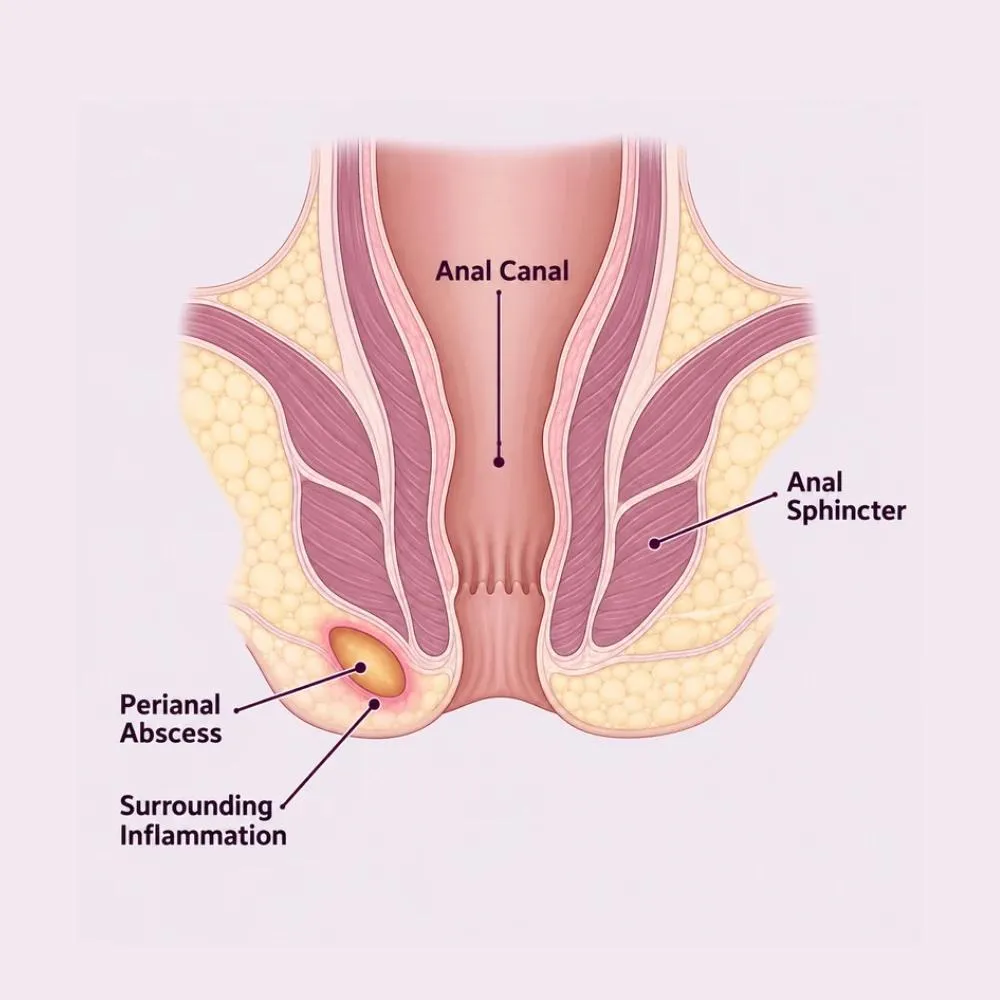
A perianal abscess is a collection of pus that forms in the tissues beside the anus, almost always because one of the small glands inside the anal canal has become infected and the infection has spread outward into the surrounding fat.
Abscesses are named for where they sit. A perianal abscess lies just under the skin beside the anus and is the commonest and most easily treated. Ischiorectal, intersphincteric and supralevator abscesses sit progressively deeper, are harder to detect, and need drainage under anaesthesia.
The important thing to understand is that an abscess and a fistula are two stages of the same disease. The abscess is the acute collection; the fistula is the tunnel that is sometimes left behind after it drains. Around a third to a half of patients who have an abscess drained go on to develop a fistula, which is why the follow-up matters as much as the drainage.
Most abscesses start in a blocked anal gland. Some point to a condition that will keep causing them until it is treated.
The commonest cause. A gland’s outlet blocks, bacteria multiply behind it, and the infection spreads into the surrounding tissue.
A tear in the anal lining gives bacteria a route into deeper tissue, particularly when it has been present for a while.
Full-thickness bowel inflammation causes abscesses that are often recurrent and multiple, and that need the underlying disease treated.
Impaired immunity and poor tissue healing make abscesses both more likely and more severe. Blood sugar control is part of the treatment.
Infections in the anal region can seed an abscess, particularly where there is existing inflammation.
Chemotherapy, long-term steroids or HIV all raise the risk and can blunt the usual warning signs.
Injury to the anal region, or a previous operation that has healed imperfectly, can allow infection to collect.
Both irritate the anal canal and the glands within it, making blockage and infection more likely.
A first abscess is usually just an unlucky gland. A second or third in the same person is a reason to look for Crohn’s disease, diabetes or tuberculosis underneath it.
An abscess builds quickly, typically over two to four days, and the pain is constant rather than tied to bowel movements, which is what separates it from a fissure.
Local symptoms
Systemic symptoms
Anal pain that is getting steadily worse and comes with a fever is an abscess until proved otherwise. It needs assessment the same day, not an appointment next week.
A superficial abscess is diagnosed in seconds by looking and feeling. A deep one may show almost nothing on the outside, which is where imaging matters.
A red, hot, tender, fluctuant swelling beside the anus is diagnostic. Most abscesses need nothing further.
Detects deeper intersphincteric or supralevator collections that are not visible from outside. Often too painful without anaesthesia.
Where pain prevents a proper assessment, examination in theatre is both the diagnosis and the treatment in one sitting.
Transperineal or endoanal ultrasound confirms a collection and shows its depth when the clinical picture is unclear.
Reserved for deep, recurrent or complex abscesses, and for mapping any associated fistula before definitive surgery.
Inflammatory markers, and a blood sugar check in every patient: undiagnosed diabetes turns up surprisingly often here.
Delay is the real risk. An abscess that is watched for a week can spread into deeper spaces, and that is a far bigger operation than draining it early.
There is really only one treatment for an abscess, and that is drainage. Everything else is either support for it or management of what it leaves behind.
Used alongside drainage where infection is spreading, or in patients with diabetes or reduced immunity. They cannot penetrate a walled-off collection, so they are never a substitute for drainage.
Warm sitz baths and oral analgesia give real relief before and after the procedure, and keep the wound clean afterwards.
Blood sugar control, or medical therapy for Crohn’s disease, where one of those is driving repeated abscesses.
The definitive treatment. A small incision over the abscess releases the pus, and the relief is immediate: most patients notice the difference before they leave theatre.
For deeper ischiorectal or supralevator abscesses, drainage is done under spinal or general anaesthesia so the cavity can be fully explored and all its loculations broken down.
A small soft drain is left in a large cavity for a few days, so it drains continuously and does not seal over and re-collect.
Where a fistula tract is found at the time of drainage, a soft thread is placed through it to keep it draining and prevent the abscess re-forming while the tissue settles.
Performed later, as a planned second stage, if a fistula declares itself in the weeks after drainage. It is not usually attempted in the acute setting.
Antibiotics alone will not cure an abscess. They may quieten the surface while the collection continues to build underneath, which is how a simple abscess becomes a complicated one.
A short procedure with the most immediate payoff in proctology. Most patients describe the pain as transformed within minutes of waking.
Incision & drainage
Examination, a blood sugar check and basic bloods. An abscess is not kept waiting for an elective slot.
Local anaesthesia for a small superficial abscess; spinal or general for anything deeper, so the cavity can be explored properly.
A cut is made over the point of maximum fluctuance, as close to the anus as is safe: a drainage scar close in leaves a shorter tract if a fistula does form.
The pus is released and the cavity is gently explored with a finger to break down the internal partitions. A cavity drained but not opened up will simply re-collect.
The cavity is irrigated, and the surgeon looks for an internal opening. Where an obvious tract is found, a draining seton may be placed.
The wound is left open to heal from the base upward, with a light dressing or a soft drain rather than tight packing.
Home the same day for most patients, with antibiotics where indicated, painkillers, sitz bath instructions and a follow-up date.
The wound is deliberately left open. Closing it over would trap infection and guarantee a re-collection: it needs to heal from the inside out.
An abscess needs treating today, not next week. Here is why patients trust us:
Abscesses are treated as urgent. You are assessed and drained the day you present, not booked for later.
Surgeons who drain these routinely and who know where deep collections hide, so nothing is missed.
From the first consultation through to post-treatment follow-up, with one team throughout.
Our hospital is in HITEC CITY, near IKEA: easily reachable from across Hyderabad.
Pain relief is immediate; wound healing takes a few weeks because the cavity is left open on purpose. Most people are back to normal routine within a couple of days.
The severe throbbing pain is gone. Some soreness at the wound, easily controlled with oral painkillers. Home the same day.
Sitz baths begin, two or three times a day. Most patients resume normal activities and light work within one to two days.
Discharge from the open wound is expected and reduces steadily. First follow-up review and a wound check.
The cavity fills in from the base and the wound closes. Complete healing typically takes three to eight weeks.
Review for fistula formation. This is the appointment that matters most: around a third to a half of abscesses leave a tract behind.
Ten minutes in warm water, two or three times daily. It cleans the open wound and relieves soreness better than anything else.
Do not let the skin edges seal over before the cavity has filled. Your dressing routine is designed to prevent exactly that.
Complete the full course if one was prescribed, even after the pain has gone.
Soft, regular stools make bowel movements comfortable while the wound heals, and reduce irritation of the anal glands.
Returning fever, pain that builds again after settling, or a new swelling: all suggest a re-collection or a second abscess.
Even if everything has healed. This is the review that catches a fistula while it is still simple to treat.
Persistent discharge from the drainage site weeks after everything else has settled is the classic sign of a fistula. It is not a failure of the drainage: it is the second half of the same disease, and it is treatable.
Any of the following needs medical attention the same day.
Cost depends on the depth of the abscess and the anaesthesia it needs. These are the ranges our patients fall into.
| Procedure | Estimated Cost |
|---|---|
| Drainage under local anaesthesia Superficial abscess, day care | ₹10,000 – ₹20,000 |
| Drainage under anaesthesia Deeper abscess, day care or one night’s stay | ₹25,000 – ₹45,000 |
| Drainage with seton placement Where a fistula tract is found at the time | ₹35,000 – ₹60,000 |
| Complex or recurrent abscess One to two nights’ stay, imaging included | ₹50,000 – ₹85,000 |
A superficial perianal collection and a deep ischiorectal one are very different procedures with different anaesthetic requirements.
An abscess is usually treated the same day, which means emergency admission rather than a planned elective slot.
Finding a tract at drainage adds a seton and commits you to a planned second procedure later.
A shared ward, a twin-sharing room or a private suite: the largest single swing in most estimates.
We are empanelled with most major insurers, and our team files the pre-authorisation for you.
Every figure above is an indicative range, not a quote. After your consultation you are given a written, fixed-cost estimate, and that is the number you pay, with no additions once treatment begins.
What patients treated here can expect:
The pain resolves as soon as the collection is drained.
Most patients are back to normal routine within one to two days.
Structured follow-up that catches a tract early, while it is still simple.
The proctologists and colorectal surgeons who drain perianal abscesses at our HITEC CITY hospital.

Consultant Proctologist & Laparoscopic Surgeon
MBBS, MS, FMAS, FISCP, DMAS
8 years experience

Consultant General & Advanced Laparoscopic Surgeon
MBBS, MS, FMAS
17 years experience
Reviews from patients treated for abscesses, fistulas and piles at Lux Hospitals, Hyderabad.
Written by Dr. Samhitha Reddy on abscesses, fistulas, piles and colorectal health.

Dr. Samhitha Reddy


Dr. Samhitha Reddy

Dr. Samhitha Reddy

Dr. Samhitha Reddy

Dr. Samhitha Reddy
Common questions about perianal abscesses, their drainage, and what treatment costs at Lux Hospitals.
Still have questions? Call us at 079 6908 4422
Still have questions? Message us on WhatsApp at 079 6908 4444
Same-day drainage for immediate relief, with a fixed-cost estimate shared before treatment begins.
Plot No.116, Lumbini Avenue, HITEC CITY, Near IKEA, Hyderabad – 500032













