



Dr. Samhitha Reddy
Consultant Proctologist & Laparoscopic Surgeon
MBBS, MS, FMAS, FISCP, DMAS
- 8 Yrs
- ASCRS Member
Physiotherapy is not what people do when there is nothing else to offer. For a great many musculoskeletal conditions it is the most effective treatment available: more effective than surgery, and with none of the risk.
It is also what determines the result of most orthopaedic operations. Our physiotherapy department at Lux Hospitals, HITEC CITY works alongside the surgical team, so rehabilitation is planned with the operation rather than arranged afterwards.
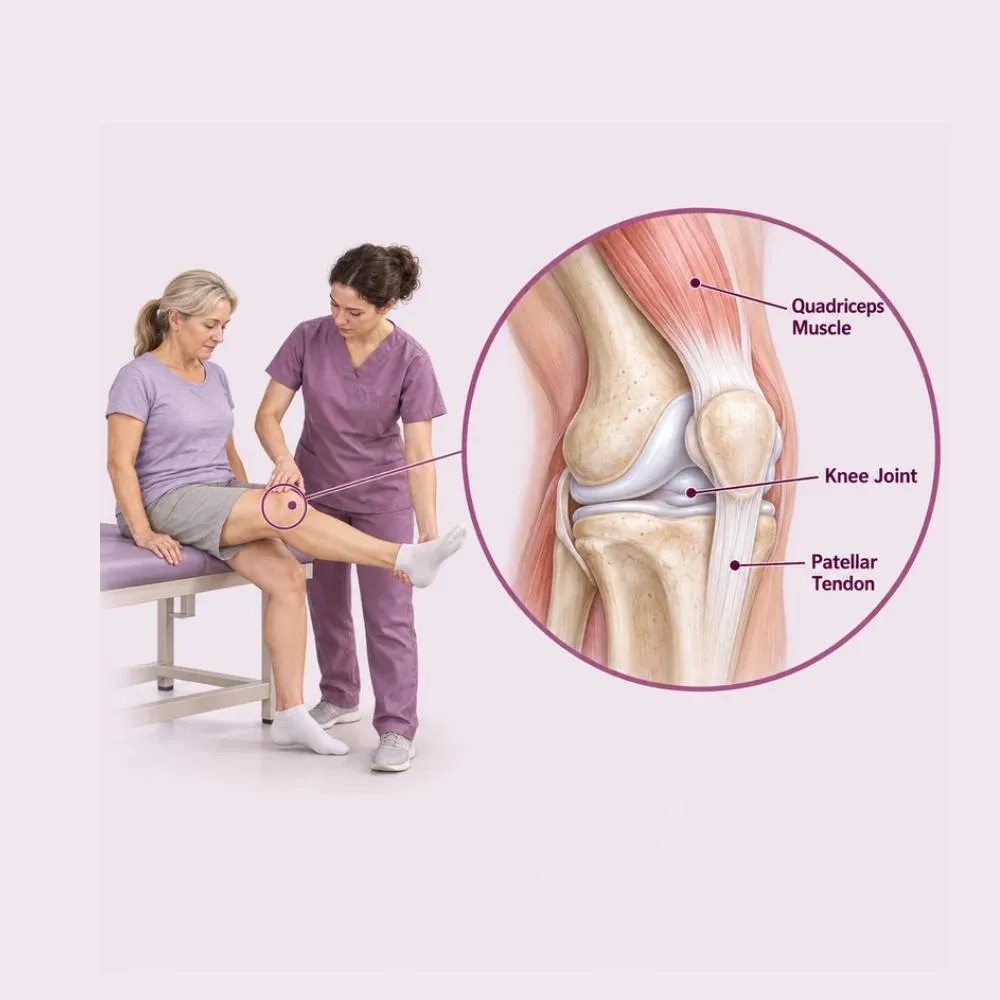
Physiotherapy is the treatment of pain, injury and restricted movement through exercise, manual therapy and education. It aims at restoring function rather than simply relieving symptoms, which is why its effects tend to last.
It serves three distinct purposes. As a primary treatment, it is the first-line and often definitive management for back pain, tendinopathy, arthritis and many sports injuries. As post-operative rehabilitation, it is what turns a technically successful operation into a functional result. As prevention, it corrects the movement patterns and weaknesses that caused the problem in the first place.
The evidence for it is strong and frequently underappreciated. For knee osteoarthritis, degenerate meniscal tears, subacromial shoulder pain and non-specific back pain, structured physiotherapy performs as well as surgery in high-quality trials, without the anaesthetic, the incision or the recovery.
The mechanisms are specific rather than vague. Understanding them explains why exercise outperforms rest for most musculoskeletal problems.
Stronger muscles offload the joint and absorb force that would otherwise pass through damaged cartilage or a healing structure.
Pain causes compensation, and compensation causes new problems. Retraining the pattern addresses the cause rather than the symptom.
Stiff joints and tight soft tissues restrict movement and increase load elsewhere. Restoring range redistributes that load.
Correcting technique, posture and ergonomics reduces the repeated stress that caused a tendinopathy or overuse injury.
Controlled loading stimulates tendon and cartilage repair. Complete rest actually weakens these tissues rather than protecting them.
In chronic pain the nervous system becomes over-sensitised. Graded exposure and education measurably reduce that sensitivity.
Restoring the body’s positional awareness after injury, which is what prevents re-injury in sport.
Fear of movement perpetuates disability. Supervised progression rebuilds confidence, which is itself therapeutic.
The old advice to rest a painful back is now known to be actively harmful. Staying active within tolerance produces better outcomes, and physiotherapy is how that is done safely.
Physiotherapy is used across the musculoskeletal system, both as primary treatment and as rehabilitation after surgery.
Common conditions treated
Also treated here
Delaying physiotherapy has real costs. A frozen shoulder left untreated stiffens further, a weak knee after injury wastes rapidly, and back pain becomes chronic, and chronic pain is considerably harder to treat than acute.
A physiotherapy assessment is a proper diagnostic process, not a preamble to a set of generic exercises.
The problem, how it started, what makes it better or worse, and (most importantly) what you actually want to get back to.
How you move, stand and load the affected area, which often reveals the cause rather than just the site of pain.
Range of motion, strength testing, joint stability and special tests localising the structure responsible.
Any X-rays, MRI or surgical notes, interpreted alongside the examination rather than in isolation.
Watching you perform the specific tasks that hurt: climbing stairs, lifting, reaching overhead, or a sport-specific movement.
Identifying the small number of presentations needing medical rather than physiotherapy assessment, and referring them promptly.
Working in a hospital means red flags can be escalated to an orthopaedic surgeon the same day rather than being sent back to a GP, which is one of the genuine advantages of hospital-based physiotherapy.
A programme combines several of these, weighted to the condition and reviewed as you progress.
Progressive strengthening tailored to the affected structure. The core of almost every programme, and the component with the strongest evidence.
Restoring joint mobility and soft tissue length, particularly important in frozen shoulder and after immobilisation.
Strengthening the deep stabilising muscles of the trunk, which is central to managing back pain long term.
Restoring positional awareness after injury: what prevents recurrent ankle sprains and re-injury after ligament reconstruction.
Correcting walking patterns after injury or surgery, which prevents secondary problems developing elsewhere.
Graded return-to-play programmes with objective testing before clearance rather than clearance by calendar.
Hands-on joint mobilisation and soft tissue techniques, used to reduce pain and stiffness so active exercise can progress.
Targeting tight bands and tender points in muscle that restrict movement and refer pain.
TENS, ultrasound and interferential therapy for pain modulation. Useful adjuncts, not treatments in their own right.
Fine needles into trigger points to release muscle tension, often combined with exercise.
Supporting a joint or offloading a tendon during the rehabilitation phase.
Workstation setup, lifting technique and pacing. Frequently the most valuable part of the whole programme.
The passive treatments (ultrasound, TENS, heat) feel pleasant and have a limited role in reducing pain so exercise can proceed. A programme consisting only of those is not physiotherapy, and it is worth knowing the difference.
A course of sessions over weeks to months, with a home programme between them. The home exercises are where most of the benefit comes from.
Structured rehabilitation programme
A full assessment lasting forty-five minutes to an hour, establishing the diagnosis, your goals and a baseline to measure against.
Specific, measurable targets agreed with you: climbing stairs without pain, returning to badminton, lifting your child.
Manual therapy and pain-relieving techniques to make movement tolerable, alongside the first exercises.
Exercises to do between sessions, taught precisely and reviewed each visit. This is where most of the progress actually happens.
Exercises made harder as you improve. A programme that does not progress stops producing benefit.
Formal review against the original baseline every few weeks, with the programme adjusted according to the response.
A long-term maintenance programme once goals are met, so the gains are kept rather than lost over the following months.
The single strongest predictor of a good outcome is doing the home exercises. Attending sessions without doing them between visits produces very little: the sessions guide the work, they are not the work itself.
Hospital-based physiotherapy sits alongside the surgical team, which changes what it can do. Here is why patients trust us:
Rehabilitation planned with the surgeon who operated, following the protocol for your specific procedure rather than a generic one.
Where something is not progressing as it should, an orthopaedic opinion and imaging are available the same day.
From the first consultation through to post-treatment follow-up, with one team throughout.
Our hospital is in HITEC CITY, near IKEA: easily reachable from across Hyderabad.
Improvement is gradual and rarely linear. Understanding the shape of it makes the process considerably less frustrating.
Assessment, initial pain relief and learning the home programme. Some soreness after new exercises is normal and expected.
Pain typically begins improving. Range of motion and confidence in movement return before strength does.
Strength gains become apparent. Exercises progress in load. Most acute conditions have largely resolved by this point.
Return to full activity, sport or manual work. Programme shifts from rehabilitation toward maintenance.
Maintenance exercises continue. Strength gained is lost within months if training stops entirely.
This is the treatment. Attending sessions without doing the work between them produces very little benefit.
Tendons and muscles adapt over weeks to months, not days. Progress is real but gradual, and rarely a straight line.
Exercises must get harder as you improve. Repeating the same programme indefinitely stops producing benefit.
Mild discomfort during and after exercise is expected and safe. Sharp or escalating pain is not, and should be reported.
Ergonomics, technique and training load. Treating the symptom without changing what caused it invites recurrence.
Once discharged, keep a maintenance programme. Strength is lost within a few months of stopping entirely.
Physiotherapy asks more of you than most treatments: it requires consistent effort over weeks. That is precisely why its results tend to last longer than treatments you receive passively.
Book an assessment if any of the following apply.
Physiotherapy is charged per session, with packages available for longer rehabilitation programmes.
| Procedure | Estimated Cost |
|---|---|
| Initial assessment Full assessment, typically 45–60 minutes | ₹800 – ₹1,500 |
| Follow-up session Per session, 30–45 minutes | ₹500 – ₹1,000 |
| Short programme Six to ten sessions for acute conditions | ₹5,000 – ₹12,000 |
| Post-operative rehabilitation package Six to twelve weeks after joint surgery | ₹12,000 – ₹35,000 |
| ACL or cuff repair rehabilitation Six to nine months of structured programme | ₹25,000 – ₹50,000 |
| Chronic pain programme Twelve weeks, including education and pacing | ₹15,000 – ₹30,000 |
An acute ankle sprain may need six sessions. Rehabilitation after ACL reconstruction runs for six to nine months.
Post-operative rehabilitation follows a defined protocol over a longer period than treatment for a simple acute injury.
Twice weekly initially, reducing as you become independent with the home programme. Fewer sessions with good adherence beats more with poor.
A shared ward, a twin-sharing room or a private suite: the largest single swing in most estimates.
We are empanelled with most major insurers, and our team files the pre-authorisation for you.
Every figure above is an indicative range, not a quote. After your consultation you are given a written, fixed-cost estimate, and that is the number you pay, with no additions once treatment begins.
What patients treated here can expect:
Often as effective as an operation for common joint and back conditions.
Movement, strength and confidence rebuilt rather than symptoms masked.
The underlying cause corrected, not just the current episode treated.
The orthopaedic team our physiotherapy department works alongside at our HITEC CITY hospital.

Consultant Orthopaedic Surgeon: Joint Replacement & Arthroscopy
MS (Ortho), FIJR, FIASM (UK), FIKS (Italy), FIRJR
8 years experience

Consultant Orthopaedic Surgeon
MBBS, MS, FIJR
6 years experience
Reviews from patients treated for joint, spine and sports injuries at Lux Hospitals, Hyderabad.
Written by Dr. Sai Kishan Sirasala on rehabilitation, sports injuries and orthopaedic care.
Dr. Sai Kishan Sirasala
Dr. Sai Kishan Sirasala
Dr. Sai Kishan Sirasala

Dr. Sai Kishan Sirasala

Dr. Sai Kishan Sirasala
Dr. Sai Kishan Sirasala
Common questions about physiotherapy, rehabilitation programmes, and what treatment costs at Lux Hospitals.
Still have questions? Call us at 079 6908 4422
Still have questions? Message us on WhatsApp at 079 6908 4444
Evidence-based rehabilitation linked directly to our orthopaedic team, with clear goals and costs shared upfront.
Plot No.116, Lumbini Avenue, HITEC CITY, Near IKEA, Hyderabad – 500032













