



Dr. Samhitha Reddy
Consultant Proctologist & Laparoscopic Surgeon
MBBS, MS, FMAS, FISCP, DMAS
- 8 Yrs
- ASCRS Member
Acute urinary retention, being completely unable to pass urine, is one of the most acutely distressing conditions in medicine. The bladder distends, the pain becomes severe, and relief arrives the moment a catheter is passed.
Chronic retention is the opposite: painless, gradual, and quietly damaging the kidneys. Our urologists at Lux Hospitals, HITEC CITY relieve retention urgently and then find the cause, because a catheter treats the symptom and not the problem.
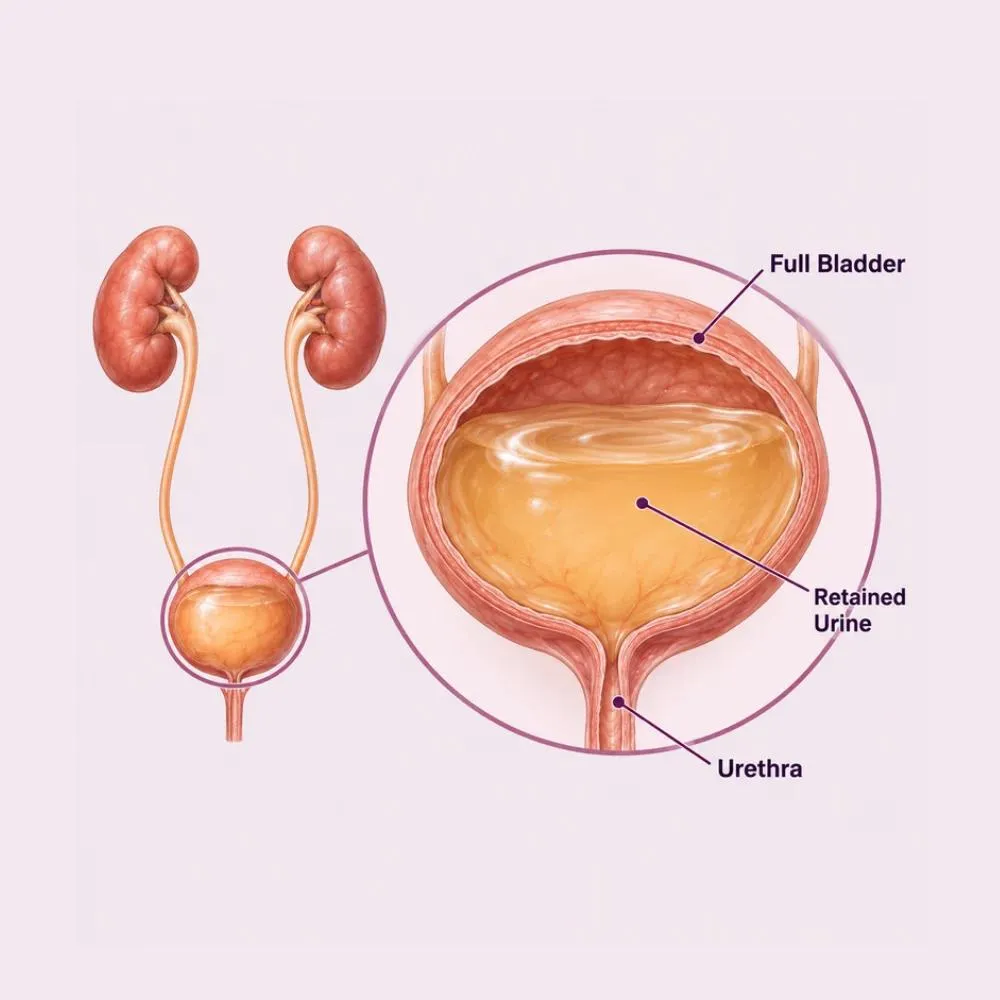
Urinary retention is the inability to empty the bladder completely. It comes in two forms that could hardly be more different in how they present, though both need the same underlying question answered: why is the bladder not emptying?
Acute retention is sudden and complete. The bladder fills, becomes painfully distended, and no urine can be passed at all. It is intensely painful and needs a catheter urgently: the relief when one is passed is immediate and dramatic.
Chronic retention is gradual and, crucially, often painless. The bladder slowly stretches and adapts, holding large volumes without discomfort. Patients describe only a poor stream and frequent small voids, and the bladder may hold a litre or more. This is the dangerous form, because the back-pressure it generates can silently damage the kidneys before anything hurts.
Retention results from either an obstruction the bladder cannot overcome, or a bladder that cannot contract properly.
By far the commonest cause in men. Progressive obstruction eventually exceeds what the bladder can push against.
Scar narrowing the urethra, which can tighten to the point of complete blockage.
Antihistamines, decongestants, tricyclic antidepressants, some antipsychotics and anticholinergics all impair bladder contraction. A frequent and easily reversed cause.
Diabetes, multiple sclerosis, spinal cord injury, Parkinson’s disease and previous pelvic surgery all disrupt the nerves controlling bladder emptying.
A loaded rectum compresses the bladder neck. Surprisingly common as a precipitant, and simply treated.
Inflammation and swelling can tip a partially obstructed bladder into complete retention.
Anaesthesia, opioid painkillers and immobility after surgery frequently cause temporary retention.
A stone or blood clot obstructing the bladder outlet, causing sudden complete blockage.
Medication is worth checking in every case. Over-the-counter cold and allergy remedies are a common precipitant, and stopping them alone sometimes resolves the problem entirely.
The acute and chronic forms present so differently that they are worth considering separately.
Acute retention: emergency
Chronic retention
Painless chronic retention is the one that causes lasting harm, precisely because nothing hurts. It is often discovered when kidney function is found to be impaired on a routine blood test.
The retention itself is confirmed in minutes. The important work is establishing why, and whether the kidneys have been affected.
A palpable, tender distended bladder in acute retention. Rectal examination assesses the prostate and checks for constipation.
Measures the retained volume immediately and non-invasively, confirming retention and quantifying it.
Creatinine and electrolytes. Chronic retention can cause significant kidney impairment, and this is what detects it.
Culture to exclude infection as a precipitant, and dipstick for blood suggesting a stone or tumour.
Looking for swelling of the kidneys from back-pressure, which indicates the obstruction has been longstanding.
A careful review of every drug, including over-the-counter remedies. This alone identifies the cause in a meaningful proportion.
Draining a chronically retained bladder can cause a large diuresis and a drop in blood pressure. Where the retained volume is very high, patients are monitored rather than sent straight home.
The first step is always to drain the bladder. Everything after that is about treating the cause so the catheter can come out.
A catheter passed into the bladder, giving immediate and complete relief. The first step in every case of acute retention.
A catheter placed through the abdominal wall where the urethral route cannot be passed, such as in a tight stricture.
Started immediately, then the catheter removed after a few days to see whether normal voiding returns. Successful in a good proportion.
Stopping a causative medication, treating infection or clearing constipation: sometimes all that is needed.
Passing a catheter periodically rather than leaving one in. Preferred for long-term management, with far lower infection rates.
TURP or laser enucleation for prostatic obstruction. The definitive treatment in most men with retention, and it removes the need for a catheter.
Reconstructing or opening a urethral stricture causing the obstruction.
Endoscopic clearance of a stone or clot obstructing the bladder outlet.
An implanted device for retention caused by a bladder that will not contract, where no obstruction is present.
Where the bladder cannot be made to empty and surgery is not appropriate, a planned long-term catheter regime with regular changes.
The aim is always to get the catheter out. Long-term catheters cause infections, stones and discomfort, and they are a last resort rather than a solution.
A five to ten minute procedure that relieves the pain of acute retention almost instantly. It is uncomfortable briefly and then transformative.
Urethral catheterisation
The distended bladder is confirmed by examination and ultrasound. Retained volume is measured before anything is passed.
The area is cleaned and local anaesthetic gel instilled into the urethra, which is left for a few minutes to take effect.
A soft catheter is passed gently along the urethra into the bladder. Urine begins draining immediately and the pain resolves as it does.
Where the volume is very large, drainage is monitored. Rapid decompression can cause bleeding from the bladder lining and a drop in blood pressure.
The drained volume is measured, since it indicates how longstanding the retention is and guides what follows.
An alpha blocker is usually started at once, improving the chance the catheter can be removed successfully in a few days.
The catheter is removed after three to seven days to see whether normal voiding returns, with a plan for definitive treatment if it does not.
Where a suprapubic catheter is needed, usually because a stricture prevents the urethral route, it is placed under local anaesthetic with ultrasound guidance, and it is often more comfortable long term.
Relieving retention is straightforward. Ensuring the catheter comes out and stays out is the part that needs a urologist. Here is why patients trust us:
Acute retention is treated as an emergency, with catheterisation available around the clock.
Full assessment of prostate, urethra, medications and kidney function, so definitive treatment follows rather than an indefinite catheter.
From the first consultation through to post-treatment follow-up, with one team throughout.
Our hospital is in HITEC CITY, near IKEA: easily reachable from across Hyderabad.
Relief is immediate once the bladder is drained. What follows depends on whether the bladder recovers its ability to empty.
Catheter passed and pain relieved within minutes. Alpha blocker started. Where the retained volume was very large, monitoring continues.
Catheter in place while the bladder recovers from being overstretched. Any infection treated and precipitating medication stopped.
Trial without catheter: it is removed and voiding assessed. A good proportion of men pass urine normally at this point.
Where the trial failed, definitive treatment is planned. Where it succeeded, flow and residual volume are rechecked.
After a chronically overstretched bladder, contractility can take months to recover, and sometimes does not fully return.
Avoid antihistamines and decongestants, which commonly precipitate retention. Check any new prescription against this.
A loaded rectum compresses the bladder neck and is a frequent and easily corrected precipitant.
A catheter is a holding measure. Prolonged catheterisation causes infections and stones, and the underlying obstruction remains.
Keep the bag below bladder level, maintain good hygiene, and drink adequately to keep urine flowing freely.
A catheter that stops draining, fever, heavy bleeding, or being unable to pass urine again after the catheter has come out.
Where retention had been chronic, kidney function is rechecked to confirm it recovers after decompression.
A bladder that has been chronically overstretched may never fully regain its ability to contract, even after the obstruction is relieved. This is precisely why chronic retention should not be left once identified.
Go to the emergency department immediately for the first two.
Emergency relief is inexpensive. The cost lies in treating whatever caused the retention.
| Procedure | Estimated Cost |
|---|---|
| Emergency consultation & catheterisation Including bladder ultrasound | ₹4,000 – ₹12,000 |
| Blood and urine tests Kidney function and culture | ₹1,500 – ₹4,000 |
| Ultrasound KUB Assessing kidneys for back-pressure | ₹1,500 – ₹3,500 |
| Trial without catheter & review Including alpha blocker therapy | ₹3,000 – ₹8,000 |
| Suprapubic catheter insertion Day care, under local anaesthetic | ₹18,000 – ₹40,000 |
| TURP or laser prostate surgery The definitive treatment in most men | ₹75,000 – ₹2,20,000 |
| Admission with impaired kidney function Three to seven nights with monitoring | ₹50,000 – ₹1,50,000 |
Retention from a medication needs only that stopped. Retention from prostatic obstruction needs surgery, and that is the main cost.
Chronic retention with impaired kidney function needs admission and monitored decompression rather than discharge with a catheter.
A successful trial without catheter ends the episode. Failure means definitive treatment, which is a separate procedure.
A shared ward, a twin-sharing room or a private suite: the largest single swing in most estimates.
We are empanelled with most major insurers, and our team files the pre-authorisation for you.
Every figure above is an indicative range, not a quote. After your consultation you are given a written, fixed-cost estimate, and that is the number you pay, with no additions once treatment begins.
The urologists who treat urinary retention at our HITEC CITY hospital.

Consultant Urologist & Andrologist
MBBS, MS, DrNB (Urology)
10 years experience

Consultant Urologist & Andrologist
MBBS, MS, MCh (Urology)
9 years experience
Reviews from patients treated for bladder and urological conditions at Lux Hospitals, Hyderabad.
Written by Dr. Vipin Reddy B on bladder health, urinary flow and urological care.

Dr. Vipin Reddy B

Dr. Vipin Reddy B

Dr. Vipin Reddy B

Dr. Vipin Reddy B

Dr. Vipin Reddy B

Dr. Vipin Reddy B
Common questions about urinary retention, its treatment, and what care costs at Lux Hospitals.
Still have questions? Call us at 079 6908 4422
Still have questions? Message us on WhatsApp at 079 6908 4444
Immediate relief of urinary retention around the clock, followed by finding and treating the cause so the catheter comes out.
Plot No.116, Lumbini Avenue, HITEC CITY, Near IKEA, Hyderabad – 500032













