



Dr. Samhitha Reddy
Consultant Proctologist & Laparoscopic Surgeon
MBBS, MS, FMAS, FISCP, DMAS
- 8 Yrs
- ASCRS Member
Urinary incontinence is extremely common and enormously under-reported. Most people wait years before mentioning it, managing quietly with pads and by mapping every toilet on every journey.
It is also highly treatable, and the treatment depends entirely on which type you have. Our urologists at Lux Hospitals, HITEC CITY establish that properly and treat accordingly, from pelvic floor therapy through to sling surgery.
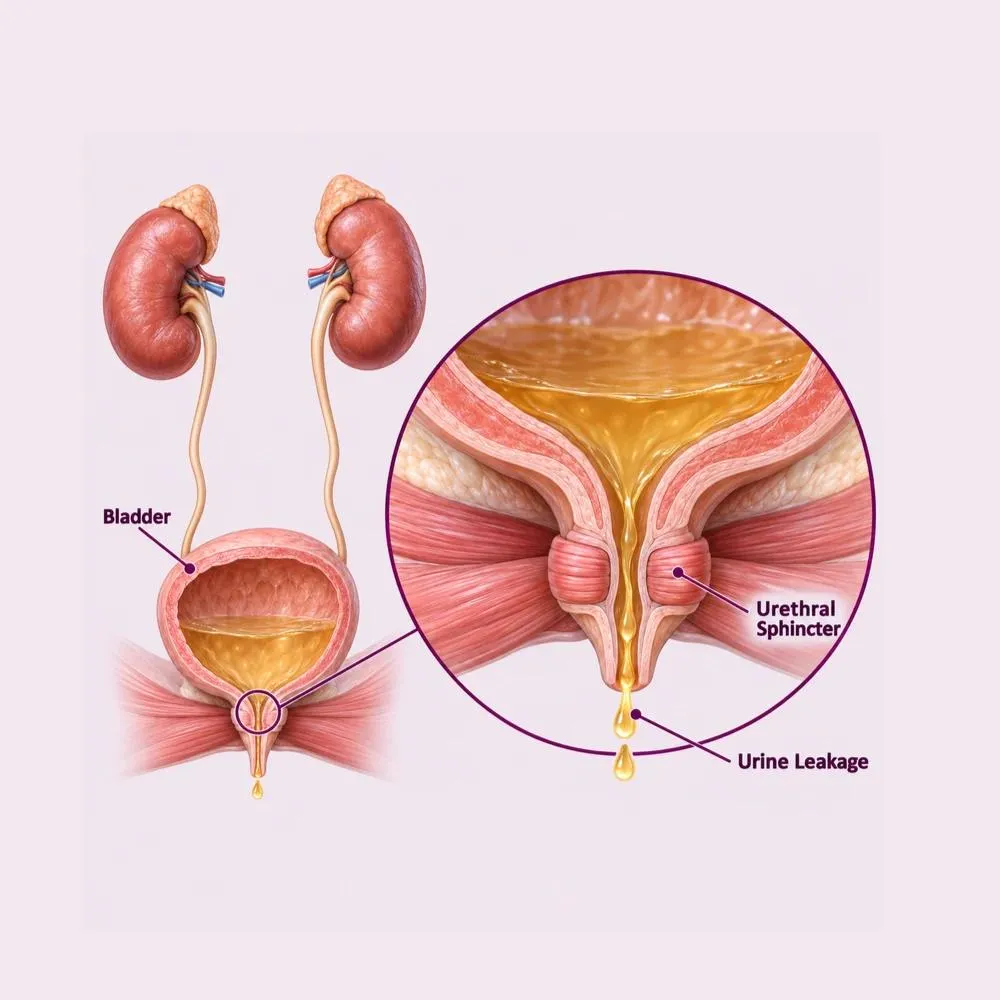
Urinary incontinence is any involuntary leakage of urine. It ranges from a few drops on coughing to complete loss of bladder control, and it affects a large proportion of women and a significant number of men: far more than ever seek help for it.
There are five types, and distinguishing them is the whole of the diagnostic task. Stress incontinence is leakage on coughing, sneezing, laughing or exercising, caused by a weak pelvic floor or urethral sphincter. Urge incontinence is leakage preceded by a sudden overwhelming need to go, caused by an overactive bladder muscle. Overflow incontinence is constant dribbling from a bladder that never empties. Functional incontinence is when you simply cannot reach the toilet in time. Mixed incontinence combines stress and urge.
The reason this matters is that the treatments are almost opposite. Stress incontinence responds to strengthening the pelvic floor and to surgery that supports the urethra. Urge incontinence responds to calming the bladder with medication or Botox, and a sling operation would not help it at all.
The causes differ by type, and several often coexist in the same person.
Vaginal delivery stretches and can damage the pelvic floor and its nerves. The leading cause of stress incontinence in women.
Falling oestrogen thins the urethral and vaginal tissues, weakening the seal that maintains continence.
The commonest cause in men. Surgery near the sphincter, particularly radical prostatectomy for cancer, can leave stress incontinence.
The bladder muscle contracts involuntarily before it is full, producing the sudden urgency of urge incontinence.
Parkinson’s disease, multiple sclerosis, stroke and spinal injury all disrupt the nerve signals coordinating bladder control.
Prostate enlargement or a stricture prevents complete emptying, and urine eventually overflows from a chronically full bladder.
Raises abdominal pressure continuously, worsening stress incontinence. Weight loss produces measurable improvement.
Diuretics, sedatives and some blood pressure drugs contribute, as do caffeine, alcohol and fizzy drinks.
Reviewing medications and cutting caffeine are among the simplest interventions, and they help a surprising proportion of patients before anything else is tried.
The pattern of when you leak is what identifies the type. It is worth paying attention to before the consultation.
Stress incontinence
Urge & other types
Leaking without any warning at all, or continuous dribbling, points toward overflow from a bladder that is not emptying, which needs prompt assessment, since it can affect the kidneys.
The aim is to establish which type you have, because that determines everything about the treatment.
Three days recording fluid intake, voids, volumes and leakage episodes. The single most informative part of the whole assessment.
Assessing pelvic floor strength, checking for prolapse in women and prostate size in men, and observing leakage on coughing.
Excluding infection and diabetes, both of which cause or worsen incontinence and are simply treated.
Measuring urine left after voiding. A high residual indicates overflow incontinence, which needs entirely different treatment.
Pressure measurements during bladder filling and voiding. Reserved for unclear cases and before any surgery is considered.
Direct bladder inspection where there is blood in the urine, pain, or a suspicion of a stone or fistula.
Fill in the bladder diary honestly. Nothing in it will surprise us, and an accurate picture of when and how much you leak is what identifies the type correctly.
Most patients improve substantially without surgery. What works depends entirely on the type, which is why the diagnosis comes first.
Supervised strengthening, ideally with biofeedback. The first-line treatment for stress incontinence, and effective in the majority who do it properly.
Gradually extending the interval between voids to increase bladder capacity and reduce urgency. The core treatment for urge incontinence.
Weight reduction, cutting caffeine, alcohol and fizzy drinks, treating constipation and reviewing medications.
Medication calming an overactive bladder, reducing urgency and leakage episodes in urge incontinence.
For post-menopausal women, restoring the thickness and seal of the urethral tissues. Simple and often effective.
A vaginal pessary supporting the urethra, useful where prolapse contributes or surgery is not wanted.
Botulinum toxin injected into the bladder wall through a cystoscope, relaxing an overactive bladder for six to nine months. Highly effective for urge incontinence.
A tape placed to support the urethra, the standard operation for stress incontinence in women. Day case, with rapid recovery and high success rates.
Lifting and supporting the bladder neck with sutures. An alternative to a sling, particularly where mesh is not wanted.
Supporting the urethra in men with mild to moderate stress incontinence after prostate surgery.
An implanted cuff giving reliable continence in men with severe stress incontinence after prostate surgery. The gold standard for that group.
An implanted device modulating the nerves controlling the bladder, trialled with a temporary wire before anything is implanted permanently.
Bladder Botox has transformed urge incontinence treatment for patients who cannot tolerate or do not respond to tablets. It is done through a cystoscope, takes minutes, and lasts six to nine months.
A twenty to thirty minute day-case procedure for stress incontinence in women, with most patients home the same day.
Mid-urethral sling
Type confirmed on urodynamics, infection excluded, and residual volume checked. A sling on urge incontinence would not help.
Spinal, general or occasionally local anaesthesia with sedation, depending on your preference and medical history.
A small incision in the front vaginal wall beneath the mid-urethra, giving access to place the tape.
A narrow polypropylene tape is passed beneath the mid-urethra and out through two tiny exit points, either above the pubic bone or in the groin.
The tape is set to support the urethra without compressing it: loose enough to void freely, firm enough to prevent leakage. This judgement determines the result.
The bladder is inspected to confirm the tape has not passed through it, which is a recognised and immediately correctable complication.
The small incisions are closed, voiding is confirmed before discharge, and you go home the same day.
Tape tension is the whole art of this operation. Too loose and leakage persists; too tight and you cannot empty properly. It is set with the bladder full and tested during the procedure.
Getting the type right is the whole battle, because the treatments for stress and urge incontinence are almost opposite. Here is why patients trust us:
Bladder diary, residual volume and urodynamics where needed, so treatment matches the type rather than the symptom.
Consultations in private with staff for whom this is an everyday conversation rather than an awkward one.
From the first consultation through to post-treatment follow-up, with one team throughout.
Our hospital is in HITEC CITY, near IKEA: easily reachable from across Hyderabad.
Non-surgical treatment improves gradually over weeks. Sling surgery gives immediate improvement with a short recovery.
Pelvic floor training and bladder retraining begin. Lifestyle changes and any medication started. Improvement is gradual.
Most of the benefit from conservative treatment appears in this window. Formal reassessment at twelve weeks.
Home the same day. Some discomfort and a slower stream initially. Avoid lifting, straining and intercourse.
Return to desk work at two weeks, normal activity at six. Continence is usually apparent immediately.
Pelvic floor exercises continue indefinitely. Botox is repeated every six to nine months where it is being used.
Indefinitely, even after successful surgery. Pelvic floor strength behaves like any other muscle and fades when training stops.
Both raise abdominal pressure continuously. Addressing them improves symptoms and protects any surgical repair.
Caffeine, alcohol and fizzy drinks all worsen urgency. Cutting them is simple and frequently effective.
Nothing heavy for six weeks after a sling, so the tape settles into position without being pulled.
Inability to pass urine after surgery, fever, vaginal discharge or bleeding, or pain during intercourse.
Most people wait years before seeking help. It is common, it is treatable, and it is a routine conversation here.
The great majority of patients improve substantially, and many achieve complete continence. The main obstacle to that is how long people wait before asking.
Book a consultation if any of the following apply.
Most patients are treated without surgery at modest cost. These are the ranges our patients fall into.
| Procedure | Estimated Cost |
|---|---|
| Consultation & assessment Per visit | ₹800 – ₹1,500 |
| Urine tests & ultrasound Including residual volume | ₹1,500 – ₹4,000 |
| Urodynamic studies Before surgery or in unclear cases | ₹8,000 – ₹18,000 |
| Pelvic floor therapy programme Six to twelve supervised sessions | ₹10,000 – ₹25,000 |
| Bladder Botox injection Day care; lasts six to nine months | ₹45,000 – ₹90,000 |
| Mid-urethral sling Day care or one night | ₹90,000 – ₹1,80,000 |
| Artificial urinary sphincter Includes the implanted device | ₹4,50,000 – ₹7,50,000 |
Urge incontinence is usually managed medically. Stress incontinence needing surgery is a larger cost.
An artificial sphincter is dominated by the price of the implant, which is why it is reserved for severe cases.
Bladder Botox lasts six to nine months and needs repeating, which should be factored into the comparison with surgery.
A shared ward, a twin-sharing room or a private suite: the largest single swing in most estimates.
We are empanelled with most major insurers, and our team files the pre-authorisation for you.
Every figure above is an indicative range, not a quote. After your consultation you are given a written, fixed-cost estimate, and that is the number you pay, with no additions once treatment begins.
The urologists who treat urinary incontinence at our HITEC CITY hospital.

Consultant Urologist & Andrologist
MBBS, MS, DrNB (Urology)
10 years experience

Consultant Urologist & Andrologist
MBBS, MS, MCh (Urology)
9 years experience
Reviews from patients treated for bladder and urological conditions at Lux Hospitals, Hyderabad.
Written by Dr. Vipin Reddy B on bladder health, continence and urological care.

Dr. Vipin Reddy B

Dr. Vipin Reddy B

Dr. Vipin Reddy B

Dr. Vipin Reddy B

Dr. Vipin Reddy B

Dr. Vipin Reddy B
Common questions about urinary incontinence, its treatment, and what care costs at Lux Hospitals.
Still have questions? Call us at 079 6908 4422
Still have questions? Message us on WhatsApp at 079 6908 4444
Discreet assessment of bladder leakage with treatment matched to your type, and costs shared before treatment begins.
Plot No.116, Lumbini Avenue, HITEC CITY, Near IKEA, Hyderabad – 500032













